Thursday, October 15, 2026
Home Blog Page 1556

The college degree racket

4

By ART CHANCE
SENIOR CONTRIBUTOR

In the 1960s and ’70s, bookstores had shelves of books about how to study for and pass various qualification exams for government jobs and even some private sector jobs.

Last year’s homecoming queen couldn’t (usually) just use her looks and name to get a job; she had to prove she could type 50 words per minute. Most jobs had some sort of qualifying criteria and testing to make sure the candidate could meet that criteria. That all ended in the early 1970s.

In 1971 the U.S. Supreme Court handed down Griggs v. Duke Power Company. It was a South Carolina case, and racial discrimination in employment was simply a fact in the South. It was all but impossible for a black person, especially a black man, to get any but the most menial job.

Art Chance

As late as the early 1980s, when I last spent any time there, if you hired a white carpenter he’d tell you his rate was, say, $20 an hour. That $20 included his black laborer who did all the lifting, handing, and holding; nobody asked what the laborer was getting paid.

Willie Griggs sued Duke Power Company, a major electric utility, alleging that its job qualification requirements did not have “business utility” in terms of evaluating the applicant’s skills and that they had a disparate impact on black applicants.

The Supreme Court found for Mr. Griggs, setting a standard of business utility for qualifications for hiring or promotion, in itself a reasonable standard and an appropriate reaction to discriminatory hiring and promotion.

If the high school diploma or the college degree isn’t directly related to the applicant’s ability to perform the work, it is an artificial and potentially discriminatory barrier to employment or promotion. In the abstract, Griggs is a pretty good decision though the Supreme Court has pulled away from the disparate impact line, usually requiring a demonstration of an actual intent to discriminate.

But, court decisions often have unintended consequences. Griggs vs. Duke launched a tsunami of discrimination suits against skills tests and minimum job qualifications in the 1970s, many of them successful and accompanied with large judgments. American business and government rapidly abandoned skills testing because it was simply too expensive to defend the business utility of the test.

Business and government responded by setting as long a probationary period as they dared on new hires and promotions and by setting a minimum qualification of “a degree” for many jobs. Especially in government, a degree is often pretty much useless for anything other than maybe making you a good conversationalist. Even the degrees required for professional certifications are as likely to be an artificial barrier as a legitimate requirement to do the job.

Fast forward 40 years:  A degree is worth about 10 years in most government job classifications. If you go to work in government right out of high school or with a GED, you start at the very bottom and if you’re successful it takes you about 10 years to get to the top of the technical level or bottom of the supervisory classes in your classification. If you have a degree in 14th Century French Lesbian Poetry, you start at the top of the technical or bottom of the supervisory classes in your classification.

The colleges figured out this game very quickly and figured out a way to provide “a degree” to people who shouldn’t even be on the grounds crew at a college, and they charged them a lot for the privilege. Today the nation has about $1.5 trillion in student loan debt, most of it from people with a useless degree and who can’t get a job above waiting tables. If you were wondering why so many young people think they’re Socialists, it’s because they’re so poor. today’s GI Bill is “good in-laws.”

To bring this to Alaska and contemporary issues here, the State of Alaska caught the “need a degree” disease too. Were I a lawyer, I’d go recruit some young men with high school diplomas who were denied a job or promotion with the State and sue the State for the “a degree” minimum qualifications it has on so many jobs for which “a degree” has no relevance. A degree from the most prestigious university would not teach you a thing about using the State of Alaska’s proprietary financial management, budgeting, and personnel administration systems; you only learn that by doing it.

Gov. Michael Dunleavy should lead other Republican governors in having his director of Personnel review the class specifications of every job in State government. The last time I looked there were about 1,000 of them. He should eliminate the “a degree” minimum qualification for every job for which the degree wasn’t required for a professional certification.

While on the topic, if the University of Alaska eliminated those “Studies” and “Communications” degrees, the university system would become a heck of a lot smaller, and quickly.

Art Chance is a retired Director of Labor Relations for the State of Alaska, formerly of Juneau and now living in Anchorage. He is the author of the book, “Red on Blue, Establishing a Republican Governance,” available at Amazon.

Politics of destruction: Trevor Shaw withdraws name from judicial commission

10

HANK BARTOS OF FAIRBANKS APPOINTED TO REPLACE

An appointee from Ketchikan has withdrawn his name from a volunteer position on the Alaska Commission on Judicial Conduct .

Trevor Shaw had been appointed to serve on the volunteer commission by Gov. Michael Dunleavy. However, Democrats savaged his reputation and created enough damage that he chose to resign rather than go through the rest of the confirmation process. He and his wife are expecting a child within a few weeks.

“A myriad of inaccuracies, misconceptions, and outright falsehoods regarding my public service have cast a shadow over my confirmation that is damaging to the mission of the Commission on Judicial Conduct,” Shaw wrote. “I will continue to endeavor for the truth of the situation to be revealed, as opposed to the alternative facts that are being predominately portrayed in a concerted effort to deceive the public about my nomination,” he wrote in a letter to the governor.

Shaw was the president of the Ketchikan School Board when a high school teacher in Ketchikan was accused, and later arrested, for sexual misconduct.

At the time, Shaw was the youngest school board president in Alaska history, and some in Ketchikan criticized his leadership during the investigative process of the teacher. In a small town, everyone knows everyone, and the teacher was a family friend who had officiated at his wedding.

Shaw eventually resigned from the school board in 2018, rather than face a recall that was under way.

The scandal came at the same time Shaw was trying to negotiate union contracts in public session, rather than behind closed doors. The teacher’s union and local Democrats used the scandal to gin up opposition to Shaw, who was also the district chair for the Alaska Republican Party.

Today Gov. Dunleavy accepted Shaw’s withdrawal and appointed Fairbanks resident Hank Bartos to serve on the commission. Bartos is a retired Air Force pilot. A Realtor since 1987, he has a bachelor’s degree from the University of South Carolina and master’s degree from Boston University.

Bartos, the current nominee, served on the Fairbanks North Star Borough Assembly, the Economic Development Commission Board of directors, as an Alaska board member to National Association of Counties, Alaska Municipal League Board of Directors, United Way Board of Directors, Big Brothers Big Sisters board member, and numerous other committees around Fairbanks.

Zulkosky to Public Safety commissioner: ‘Manage your tone.’

TRIBAL AFFAIRS COMMITTEE DRESSES DOWN COMMISSIONER PRICE

At the invitation of the newly created House Special Committee on Tribal Affairs, Public Safety Commissioner Amanda Price was giving data to the committee about rural public safety in Western Alaska. Lots of data.

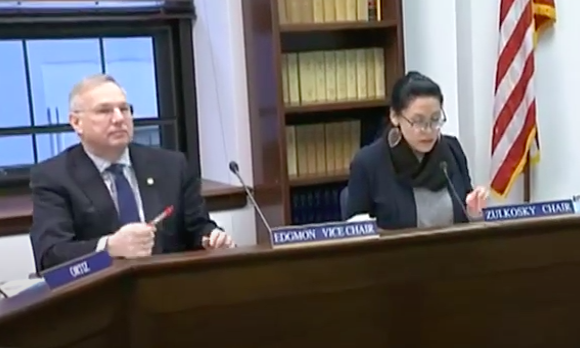
But from the outset, the hostile reception she received from committee Chairwoman Rep. Tiffany Zulkosky and House Speaker Bryce Edgmon came through loud and clear.

Price is somewhat of a data machine. She delivers numbers like an high-powered rifle — fact after fact after fact. And although passionate about public safety, she is a linear presenter who is tasked with giving appropriators the information they need to make decisions.

Right now those decisions involve whether to cut back the funding for the Village Public Safety Officer program, as Gov. Dunleavy has proposed doing. Most observers feel the program is challenged, if not broken.

DPS Commissioner Amanda Price

Price didn’t know she was walking into a trap, one apparently set by Zulkosky and Edgmon, the latter of whom has let it be known throughout the Capitol that he doesn’t like this particular Public Safety commissioner. The two were loaded for bear.

Price began her presentation on the rural Alaska public safety components. Recruitment, hiring, retention — it’s all an historic challenge for the Village Public Safety Officer program in rural Alaska. The program works through grantees, which are tribal associations that provide the public safety services with state grants. They are not contractors, she noted, but grant recipients, a difference she felt was an important distinction.

But in spite of her skills as a presenter and her command of the facts, she was interrupted repeatedly by Zulkosky and Edgmon, who is vice chair of the committee.

Zulkosky had asked members to hold their questions until the end of the presentation. But the House Speaker couldn’t wait and she gave him a pass. Edgmon started asking Price questions that were posed in the form of accusations — why is the State of Alaska getting in the way of the VPSO program? Why does the department feel it needs to exert such control? Why can’t the tribal associations — the grantees who manage the VPSO program — have their hands untied by the bureaucracy?

Between Zulkosky and Edgmon, there were a dozen of these pointy-edged questions that seemed to come from a pent-up anger.

Why were some VPSO grant applications denied in 2017 and 2018? The two wanted her to give detailed history of what had happened before she became commissioner.

Finally, with his voice shaking, Edgmon said he had viewed the video of her in another committee, and he accused her of saying that the VPSO program is more expensive than the State Trooper program, because Price included indirect costs for the VPSO program but did not for the Trooper program.

He then accused Price of having “an indifference” to the VPSO program and wanted her to explain why she said it was more costly.

[Watch the entire proceedings at this link]

“Rep. Edgmon … Mr. Chairman … Thank you for the question. No, sir, I don’t believe I said that a VPSO is more expensive than an Alaska State Trooper. I believe that I said that they’re a bit comparable in cost…”

Edgmon interrupted again: “Well madam, if I may just jump in, you also sort of insinuated that the indirect rate was as high as 48 percent. When I watched that, you know, that sort of caught my attention because there are some entities like Northwest Arctic Borough that has an indirect of 9 percent and Bristol Bay Native Association, which has an indirect rate of 15 percent and maybe one of the grantees that actually at that 48 percent range,” he said.

“Rep. Edgmon, through the chair, thank you so much,” Price started. “Thank you for putting forward your frank statement. I find myself in an interesting position where providing data is often taken as insinuation. And just for this body and the purpose of everybody who is in the room and who is listening, I am not a person who insinuates. I make statements so never feel like you have to try read behind the lines. I’m trying to make data statements. The VPSO program is one of the arenas I am responsible for. All of the prongs of public safety are of critical importance.

“Indifference? I think certainly not,” she continued. “I think trying to infer what my attitude or perception is based on data presented is just one of the many challenges that comes with sitting at a microphone and trying to provide data. When I was…”

Edgmon interrupted again to scold her: “If I could jump in please, I would recommend that you choose your words a little bit more artfully, because that was the message that was directly left with me. And I’m somebody who’s been around this building for quite a few years. I’ve seen a number of commissioners in your department come and go. I’m not questioning your dedication and integrity, any of that. But I’m just saying, the message I was left with — me and others — was very different from what I’m hearing you’re trying to portray.”

Edgmon indeed has been around the building for many years, beginning his legislative career as an aide to Sen. George Jacko, who served from 1989-1994.

A few minutes later in the hearing, Edgmon was again dressing Price down, telling her that in her half hour presentation she had not offered one bit of a plan to correct the program. He ignored the fact that she had been interrupted a dozen times at this point. Now visibly angry, he called her presentation “rhetoric.”

“Rep. Edgmon, did you not hear me make the statement earlier that on April 25, we are working with the grantees to deliver what our plan is for the Village Public Safety Officer Program, and how to strengthen it?” Price asked.

Rep. Zulkosky had her moment to also exert her authority: “I would ask the commissioner nominee to manage tone in response to the committee.”

Zulkosky, who had not managed the meeting up until that point, but had allowed it to become a verbal shooting gallery, had finally decided someone had better watch her tone.

Protest 101: Tax dollars at work

A small detachment of students and other supporters protested cuts to the University of Alaska budget on Monday in front of the Capitol in Juneau. The University system is facing $134 million in cuts, or 17 percent of its total budget.

On hand was a University of Alaska Southeast van that had been used to transport the students from the Auke Bay campus for the protest, shown above. About 20 people participated. One of the protesters held a sign that read “Fund Our Future.”

UAS has about 2,500 students,  with a student-faculty ratio of 9-1, and a graduation rate of 26 percent.

Walk out: House Education budget prompts GOP protest

21

THREE REPUBLICANS VOTE WITH THEIR FEET ON INCREASING BUDGET

On Monday morning, the House Finance subcommittee on Education started to erase, line by line, the Gov. Dunleavy education budget from discussion, and put in its place the FY 2019 budget for education, which would form the basis for the discussion and amendments for the FY 2020 budget.

But the meeting didn’t get very far before the three Republican members of the subcommittee objected to the process and eventually all three of them walked out of committee to bring attention to what they said was a committee that was changing its rules, with no transparency.

Essentially, Reps. DeLena Johnson, Josh Revak and Ben Carpenter were sending a message to Alaskans and the rest of the Legislature that it was likely that all of the Finance subcommittees were using the upside-down budgeting method that would force minority members to actually vote against the governor’s budget.

The method uses the 2019 as the base, and subcommittee members then vote on each line of Dunleavy’s budget. If the Dunleavy line fails, then the base budget moves ahead.

The three minority members were told by committee Chairman Daniel Ortiz of Ketchikan that they could raise their issues as amendments on Wednesday. Monday’s votes were to be on “action items.”

That didn’t set well with Rep. DeLena Johnson, who asked Ortiz to clarify what was actually going on and why all of these “action items” were being done outside of the amendment process, when it was clear that they were amendments.

Rep. DeLena Johnson

“The committee brought forward 34 budget amendments this morning – all of which increased government spending – and wouldn’t allow for debate on any of them,” said Johnson later. She was the one who led the objections that characterized the entire meeting, most of which was done in an undeclared at-ease, with the microphones turned off.

Johnson protested the “action item” method of amending the budget and asked Committee Chair Daniel Ortiz to clarify the process because it was clear that the budget in front of them was not the governor’s budget.

Ortiz said that he too had been confused.

Rep. Daniel Ortiz

“To be perfectly honest with you — this is all off the record — to tell you the truth, I wasn’t sure how we were going to work through this process. We were trying to get some instruction through the co-chairs of Finance as to exactly how we were going to deal with this because there was a question of — we’re starting with the FY adjusted base budget, but we still were required to address the governor’s suggested numbers in the budget,” he explained.

Ortiz had just admitted that the committee was dealing with two budgets — last year’s as a base, and the governor’s budget.

“This isn’t how the committee process is supposed to work and it is not the process that was agreed to beforehand. I’m not going to be a rubber stamp for an agenda that clearly aims to take more money out of the pockets of hardworking Alaskans without telling them,” Johnson said in a statement later.

Rep. Josh Revak was the first to vote with his feet, even as Rep. Ben Carpenter continued to argue against the predetermined outcome of the education budget.

“It has become clear after the first few weeks of the budget process that the Democrat-led House Majority intends to suppress debate with those who disagree and create a platform for those who agree with their agendas,” Revak said.  “Regardless of whether you’re represented by a member of the minority or the majority, every Alaskan deserves to have a voice in this process.”

That’s true, but the House is now being run by Democrats, and they’ll produce a Democrat budget.

“As evidenced by this morning’s meeting, the House leadership is not prepared to have an honest conversation about the size, scope, or role of government,” Carpenter said in a press release. “We’re more than happy to identify compromises to find the best solutions for Alaskans, but we can’t have productive conversations if we’re deliberately hiding the fact that we have no way to pay for these 34 proposed budget increases, other than to tax the people or raid the PFD.”

Carpenter was referring to the fact that the Democrat majority is increasing the budget without saying where the money will come from.

Johnson stayed a few more minutes after Carpenter had finally given up and walked out. The exchange among the committee had mainly taken place with the microphone off, but Johnson asked that the committee be back on the record so she could state why she was leaving.

“Given the change to the way we’re doing business here today, I feel like this is a heavy-handed action by the majority, I think the minority voice is not being heard. I think my constituents and the people who elected me deserve better. And as such I will not be participating today.”

With that, she picked up her notebook and left, leaving five Democrats on the subcommittee to vote on the Education budget “action items.”

Dueling roadshows: Dunleavy, House Finance hit the road

24

PUBLIC HEARINGS AND COMMUNITY MEETINGS TO HASH OUT BUDGET OUTSIDE OF JUNEAU

Gov. Michael Dunleavy announced his long-awaited “Statewide Discussion for a Permanent Fiscal Plan,” a series of community discussions and meetings to outline a permanent fiscal plan for Alaska. The discussions will center on his FY 2020 budget proposal and constitutional amendments intended to rein in government spending, prevent new taxes without a vote of the people, and protect the Permanent Fund dividend.

At the same time, the House Finance Committee released its own series of hearings that will take place across the state this weekend, essentially putting the governor’s budget on trial in communities across the state. The House Finance hearings will precede the governor’s community discussions.

“We are at a pivotal point in Alaska’s history, a once in a generation moment where we must begin making the tough decisions to put our state on a path towards a permanent fiscal plan,” Dunleavy said in a press release. “One thing is clear, in order to be successful, we must have the engagement and support of the Alaskan people. Alaskans overwhelmingly spoke during the last election cycle, and chose a government that would protect the PFD, fix our unsustainable spending, and put an end to the ‘nothing is too important to reform’ type attitude.

“Regardless of where this path takes us, Alaskans must buy into the decisions being made in Juneau. To that end, we’re excited to announce a series of meetings, events and gatherings to further engage the Alaskan people. These presentations will outline our vision for Alaska, take an in-depth look into the direction we’re headed, and further lay our proposals out in the open,” Dunleavy said.

Joining Dunleavy will be Alaska Attorney General Kevin Clarkson, Commissioner of Revenue Bruce Tangeman, OMB Director Donna Arduin, and Deputy Chief of Staff Jeremy Price.

Dunleavy Discussion Events and Locations (others to be announced):

  • Kenai, AK – Monday, March 25, 2019

o   6pm – Public Event at The Cannery Lodge

  • Anchorage, AK – Tuesday, March 26, 2019

o   10am – Talk of Alaska

o   6pm – Public Event at 49th State Brewery

  • Nome, AK – Wednesday, March 27, 2019

o   4pm – Public Event at Old St.  Joseph’s Hall

  • Fairbanks, AK – Thursday, March 28, 2019

o   8am – Fairbanks Chamber of Commerce

o   6pm – Public Event at Westmark Hotel

  • Mat-Su, AK – Friday, March 29, 2019

o   6pm – Public Event at Everett’s

HOUSE FINANCE COMMITTEE MAJORITY MEMBERS WILL FAN OUT ACROSS STATE

They’re hearings. But they’re not really formal hearings. They are more like town halls.

The House Finance Committee majority members, has unveiled its own hearing schedule for this weekend, preemptively getting ahead of the governor. They’d caught wind of the governor’s meeting schedule and set theirs in front of his.

But there will no recording of the meetings, nor will bey be entered into the legislative record called Basis. In fact, there will not even be quorums of the Finance Committee, just individual members of the Finance Committee majority members.

“While the committee typically holds public input hearings in the Alaska State Capitol in Juneau, the proposals contained in the governor’s budget this year would fundamentally change life for many Alaskans: everything from the university and K-12 schools to the Alaska Marine Highway System and Pioneer Homes are slated for deep cuts under Governor Mike Dunleavy’s proposal,” the House Majority wrote.

“Given the historic nature of the decisions before policymakers and the fact that our savings accounts have been spent down, the committee is going above and beyond to listen directly to Alaskans. The hearings are the first of their kind in Alaska’s history,” the Majority’s press release continued.

“Cuts and efficiencies are possible and necessary, but these proposed reductions would have significant impacts on elders and youth, rural and urban residents, and every facet of our economy,” said House Speaker Bryce Edgmon, a Democrat from Dillingham who relinquished his party affiliation so he could become speaker in a Democrat-led caucus. “Because of this stark reality, all budget decisions must be informed by input from people across our state.”

Here’s the final House Finance schedule:

JUNEAU

Friday, March 22 from 5-8 p.m. in Room 519 of the Alaska State Capitol, 120 4th Street, Juneau

KETCHIKAN

Saturday, March 23 from 12-3 p.m. in Ted Ferry Civic Center, 888 Venentia Avenue, Ketchikan

MAT-SU

Saturday, March 23 from 12-4 p.m. at the Mat-Su LIO, 600 E. Railroad Avenue, Wasilla

BETHEL

Saturday, March 23 from 2-5 p.m. at the Yupiit Piciryarait Cultural Center, 401 Chief Eddie Hoffman Highway, Bethel

KENAI

Saturday, March 23 from 5:30-8:30 p.m. at Soldotna Sports Center, 538 Arena Avenue, Soldotna

ANCHORAGE

Sunday, March 24 from 2-5 p.m. at the Anchorage LIO, 1500 W. Benson Boulevard, Anchorage

SITKA

Sunday, March 24 from 2-5 p.m. at Centennial Hall Assembly Chambers, 330 Harbor Drive, Sitka

FAIRBANKS

Sunday, March 24 from 2-5 p.m. at the Fairbanks LIO, 1292 Sadler Way, Suite 308, Fairbanks

Bass Pro, Cabela’s get into anti-Pebble Mine fray

BIG STORES THROW ANTI-MINING SUPPORT TO  ‘STAND FOR SALMON’ GROUP

It’s not just the REI Co-op that has gotten political. Now, two major outdoor companies that are frequented by hunters, fishers, and rugged outdoors enthusiasts are getting in on the anti-Pebble mine action.

Bass Pro and Cabela’s, now under the same ownership, sent a letter to customers this month, asking them to donate to a nonprofit organization that the companies would donate to, dollar for dollar.

The nonprofit? The Wild Salmon Center, which is a major funder of Stand for Salmon, a group well-known in Alaska politics.

“There’s no place in the world quite like Bristol Bay, Alaska,” the letter from Bass/Cabela’s reads. “Its rivers are filled with big rainbow and Dolly Varden trout, and it’s home to the largest wild salmon runs in the world — more than 60 million sockeye last year. For sportsmen and women, Bristol Bay rivers are what dreams are made of.

“Unfortunately, this beautiful place is at risk of being damaged forever by large-scale mining projects. The recent earthquake on November 30, 2018 further illustrated the risk of mining and development in this area.”

The letter then asks for a contribution to the Wild Salmon Center during 2019. Because…earthquakes?

The Wild Salmon Center, based in Portland, Ore., features decades-long efforts to preserve salmon habitat in the Northwest and Kamchatka, as well as Alaska. Its website has a pseudo-scientific “technical report” about Pebble, with outdated material referring to past mining plans.

The Alaska senior campaign manager for the Wild Salmon Center is Sam Snyder.

Snyder was the Alaska force behind Ballot Measure 1, which would have halted all manner of development across Alaska. On the Wild Salmon Center’s website, Snyder also takes credit for stopping the Susitna-Watana Dam.

Wild Salmon Center’s IRS-990 forms for 2016 and 2017, indicate the group “Worked with partner organizations to update Alaska’s fish habitat permitting law to strengthen protections for salmon habitat across the state.”

WSC in 2017 took full credit for the ballot initiative, saying it drafted the actual initiative and presented it to then-Lt. Gov. Byron Mallott for review and approval.

The group also took credit for stopping the Susitna-Watana Dam: “Capping a three-year, Wild Salmon Center-led campaign that rallied more than 14,000 Alaskans, Gov. Bill Walker halted the $6 billion project.”

WSC wrote that it developed school curriculum in Alaska: “Advanced the development and implementation of WSC’s comprehensive salmon education curriculum for grades 4-6.” This was a project it developed out of a pilot project it launched in Cordova in 2016.

In other words, the group is now in the public schools, teaching Alaska’s children.

The Wild Salmon Center made grants of at least $600,000 for Stand for Salmon activities in both 2016 and 2017. The year Ballot Measure 1 was on the ballot — 2018 — has not yet been reported by the group to the IRS.

The Stand for Salmon initiative was opposed by resource industries, Alaska Native corporations, labor unions, and others who feared that even a permit to build a driveway to a home would come under undue permitting burdens.

Millions of dollars were spent battling for the votes of Alaskans before the Nov. 6 decision, which went decisively against Stand for Salmon. Now, it appears Stand for Salmon will be the beneficiary of the Bass Pro Shops and Cabela’s good intentions as the environmental group organizes for the next phase of battling the the Pebble Project: Getting more people to appear at public hearings opposed to the project.

To learn more about the current Pebble Project, visit the U.S. Army Corps of Engineers site where comments are being collected in response to the draft environmental impact statement.*

The draft environmental impact statement comment period is March 1 through May 31, 2019. Public hearings are also scheduled throughout Alaska. Stand for Salmon will be organizing the opposition.

How do Alaska outdoor enthusiasts feel about Bass and Cabela’s supporting Stand for Salmon through the Wild Salmon Center matching grant? At least one Alaskan was unhappy about it, and forwarded the fundraising letter to Must Read Alaska for review, saying that the message “probably played well in the board room” but was not in tune with Alaskans.

*Must Read Alaska is neutral on the Pebble Project, but favors a fair regulatory and public process.

When salary schedules become ‘salacious’ testimony

26

REP. KREISS-TOMPKINS SEARCHES FOR A WORD, FINDS A SEXY ONE

Last Thursday, Department of Public Safety Commissioner Amanda Price made a presentation to a House Finance subcommittee on the Village Public Safety Officer program, in which she included facts that the highest paid VPSO in the system, with fringe benefits, costs the state $178,000, and that two positions in one area of the state were costing $350,000.

She continued to explain that the 43-member VPSO program costs the state $13 million in the proposed Walker budget, and $11 million in the Dunleavy budget. Because there are so many unfilled positions, the Dunleavy budget is lower.

She described challenges of recruiting and retention, and the relationship between the state, which provides the funding, and the tribal organizations that manage the VPSO programs. She said the department loves the VPSO program, in spite of its challenges.

There were a lot of numbers in her presentation, but those high salaries certainly stood out to the House Finance subcommittee on Public Safety. They brought questions.

Rep. Matt Claman asked Price several times if $350,000 is too much for two positions, and she artfully responded that she was merely providing the appropriators like him with the data, that she wasn’t saying the pay is too much or not enough.

Rep. Kreiss-Tompkins

Then came Rep. Jonathan Kreiss-Tompkins, who in spite of his Yale education, struggled to find the right word.

The word he ended up using was “salaciousness.”

“There’s a certain salaciousness about splashing around larger numbers,” Kreiss-Tompkins said, in reference to Price’s presentation about the specific pay of VPSOs.

The only word that Kreiss-Tompkins could find to describe that salary analysis was “salaciousness?”

Commissioner Price is, readers know, the first female commissioner of the Alaska Department of Public Safety, and she’s undeniably attractive. (OK, she’s hot, guys, but was her fiscal analysis actually salacious?)

(Salacious: having or conveying undue or inappropriate interest in sexual matters.)

Price returned to the mic after a bit and gave her perspective:

“I’d like to comment on Rep. Kreiss-Tompkins, and just reflect that it was not my intention to make insinuations. I’m providing data, and some of the language selections that you made, sir, I think created an opportunity. You used the word ‘salacious’ … I would like to put forward that all of your salaries is public, my salary is public, Alaska state troopers salary is public. The public has a right to know how the public dollars that are being appropriated and allocated are being utilized and it’s my responsibility to address how those funds are being utilized. I put that information forward to provide information to provide some perspective and clarity for a body that may  or may not have had that not have had that knowledge.

“It was not in fact sir was meant to be salacious or insinuate anything,” she concluded.

(Salacious synonyms: pornographic, obscene, indecent, improper, crude, lewd, erotic, titillating, arousing, suggestive, sexy, risqué, coarse, vulgar, gross, dirty, ribald, smutty, filthy, bawdy…)

There, she said it. She didn’t mean to be salacious, Rep. Kreiss-Tompkins.

Foraker Group was shadow group behind Walker’s Census Commission

NO MORE — NONPROFIT GIANT IS NOT THE CONTROLLING ENTITY

Gov. Michael Dunleavy made more board and commission appointments last week, including an entirely new 2020 Census Alaska Complete Count Commission. Only one person was held over on that commission from the Walker era.

In doing so, Dunleavy removed all members who were part of a self-appointed parallel group convened by the Foraker group.

Here’s how it went down:

On Feb. 12, Dunleavy changed the composition of the Census Commission by revoking Gov. Bill Walker’s Administrative Order 301, which was signed one week before the Nov. 6 General Election.

Dunleavy replaced it with Administrative Order 303.

Dunleavy then removed nearly all of Walker’s picks for the commission, several of whom were associated with a parallel group called the Alaska Census Working Group, a creation of the nonprofit Foraker Group in Anchorage.

The Foraker Group specializes in helping other nonprofit groups with their management systems, financial systems, strategic planning and leadership development. Some see them as left-leaning.

A review of the Walker Census commissioners shows that the Foraker Group’s Alaska Census Working Group was actually in charge, including owning the chairmanship of the commission and four of the nine seats.

Walker’s nine-member Census Commission included:

  • One person from Department of Labor and Workforce Development (Eddie Hunsinger)
  • One person from Department of Commerce  (Katherine Eldemar)
  • One person from Department of Health and Social Services  (Heidi Lengdorfer)
  • One person from regional healthcare organization ( Ellen Provost, Alaska Native Tribal Health Consortium)
  • One person from the Alaska Municipal League (Patricia Branson, Kodiak mayor, who serves on the Foraker Group Governance Board)
  • One person from a tribal organization who is recommended by Walker’s Tribal Advisory Council (Carol Gore, also on the Foraker Group’s Alaska Census Working Group)
  • Two public members (Laurie Wolf, CEO of the Foraker Group, and Becky Hultberg, on the Foraker Group Operations Board).
  • One person from the Foraker Group’s Alaska Census Working Group, who would serve as chair of the commission (Gabe Layman, a lawyer employed by Cook Inlet Housing Authority.)

The Alaska Census Working Group is not one with which Alaskans may be familiar. It was a project ramped up last year by the mother nonprofit (Foraker) for the purpose of having a say — and sway — in the census.

Bruce Botelho, who masterminded the Walker-Mallott ticket in 2014 and also in 2018, is on Foraker’s Alaska Census Working Group and also serves on the governance board of the Foraker Group. This put one of the most partisan heavyweights of the Alaska Democratic Party right in the middle of Alaska’s census commission, without his name ever being actually attached to the work of the commission.

Gov. Walker had budgeted $250,000 for the commission in his December budget, funding that would have been de facto controlled by the Foraker Group. That funding has been zeroed out by the Dunleavy Administration.

The Foraker Group has since taken down the Alaska Census Working Group page from its website. But CEO Laurie Wolf made a presentation to the Senate Community and Regional Affairs Committee on Feb. 26.

Dunleavy’s commission makeup is now different. And the Foraker Group is not part of it. In taking this step, the Governor has effectively taken back control of the Census Commission rather than allow a shadow group to control it.

The commission now has one representative from the Office of the Governor, the Department of Labor and Workforce Development, the Department of Commerce, the Department of Health and Social Services, a mayor of a municipality in the state, a member of the Alaska Native community, and three public at-large members.

The 2020 Census Commission members are:

  • Darren Deacon of Kalskag, chair of commission
  • Heather Carpenter of Juneau
  • Jedediah Cox of Anchorage
  • Jordan Shilling of Anchorage
  • Justin Larkin of Anchorage
  • Michele Hartline of Nikiski
  • Stephen Colligan of Wasilla
  • Eddie Hunsinger of Anchorage
  • Bryce Ward of North Pole

WHAT DOES THE COMMISSION DO?

The state’s Census Commission is responsible for setting parameters and methodologies to help with the complete census count. Given how population is changing in Alaska, with the Mat-Su as the fastest growing area in the state and population in Southeast decreasing, the Census will play a role in the legislative political boundaries.  Those will be set through a process known as redistricting, which occurs every ten years subsequent to the actual census count.

Alaska is a notoriously difficult place to accurately count population because of its wide geography, the seasonal nature of work and subsistence activities, and a naturally reticent populous that doesn’t like answering government questions. But the count is an important factor in federal funding of over 100 programs, so the State of Alaska has a lot at stake in making sure every eligible Alaskan is accounted for.

[Read: U.S. Census starts a year from now in Toksook Bay.]