Sarah Monkton, the acting executive director of the Alaska Human Rights Commission has resigned, Must Read Alaska has learned.
Earlier this month, two volunteer members of the commission resigned after the agency became embroiled in a national controversy stemming from abuses by its previous executive director, who has also resigned.
Monkton was serving as the acting chief of the beleaguered agency.
It all began when Marti Buscaglia, the former executive director, violated the civil rights of a plumber who had parked his truck in the agency’s lot.
The truck’s decal, “Black Rifles Matter,” offended Buscaglia, and she left him a note on the back of her business card, ordering him to remove his truck from the lot. She then used the agency’s Facebook page to deride the worker.
Buscaglia later told the media she thought “Black Rifles Matter” was hate speech.
Commission chairman Brandon Nakasato and vice chairman Freddie Olin IV then quit around the same time Buscaglia quit. She had been investigated and placed on 15-day leave, but she chose to depart and try to save the agency further embarrassment.
The governor then appointed the agency’s lead enforcement officer, Monkton, to replace Buscaglia. Monkton lasted a week.
Monkton is married to the former State Prosecutor, Quinlan Steiner, who has also resigned his position and since been replaced.
The Human Rights Commission is run by a volunteer commission board and is in charge of hiring the executive director. The two board members who resigned were replaced by Gov. Dunleavy immediately after it became known they were trying to control the hiring of the next executive director of the agency before Dunleavy could put new members in place. Dunleavy does not hire or fire the executive director.
The commission is scheduled to meet on Thursday. At this point, the agency has no executive director or chief enforcement officer, and no board chair or vice chair, although it has a full membership of seven on the board.
The retired Alaska Superior Court judge was no doubt ready for the barrage of heavy fire he took in the combined House Fisheries/Natural Resources Committee meeting on Monday night.
Karl Johnstone knew coming into his interview that the commercial fishing interests were loaded for bear in opposition of his nomination to the Fisheries Board, a volunteer position. And the committee was stacked with opponents of Gov. Michael Dunleavy who had had targeted him.
And yet Johnstone was courteous, open, and answered the committee’s accusatory questions fully, without rancor.
If they were hoping to wear him down by “Kavanaughing” him, it didn’t work.
Karl Johnstone
Rep. Louise Stutes chaired the meeting. She had already, in written communications to her commercial fishing friends, declared all-out war on Johnstone’s nomination, saying she would do everything in her power to prevent him from being confirmed.
Stutes went so far as to read an anonymous letter into the record, opposing Johnstone. No one on the joint committee objected to her doing so, and she ruled the committee with an iron hand. She made exaggerated expressions during the meeting that Johnstone could not see, but which expressed disapproval or disbelief.
As a committee aide provided material to the attack team on the committee, they asked Johnstone questions they were given to ask. Some of the questions ended up embarrassing the committee members who asked them.
Rep. Sara Hannan wanted to know if Johnstone is a snowbird and how many days he spends in the state. Enough to qualify for a Permanent Fund dividend, Johnstone said. Hannan was trying to imply that having a second home out of state or traveling widely as a retiree should be a disqualifier.
Hannan asked if he took cost of living allowances in his retirement, and she expressed surprise to learn that COLA doesn’t apply to the retirement pensions of retired judges. Stutes’ staff had set her up to look unprepared.
Hannan wanted to know why in 2009 he stayed at the Captain Cook Hotel during the Fish Board meetings. He answered he stayed there because he was advised to stay there by Fish and Game. He was told it would be best if he was on site early and stayed late into the evening to interact with attendees.
Hannan wanted to know how much he had donated to the Dunleavy campaign. Johnstone had been an early supporter of the campaign of Charlie Huggins before Huggins dropped from the race, and then Johnstone supported Dunleavy. But he said none of that. To the committee he only said yes, he supported Dunleavy and donated to the political action committee that supported the candidacy of the governor who has since appointed him, and it was $1,000.
Hannan expressed to the committee that she felt that was a problem.
Rep. Geran Tarr implied, delicately, that Johnstone is too old to serve on the Board, and should spend more time “transitioning” and visiting his family. Tarr pondered aloud that he may have too much experience, since he has, in the past, served three terms on the Board of Fisheries. She said maybe it’s time for someone else to serve.
Tarr, who is often heard championing food security with Alaskans, then took up the cause of out-of-state commercial permit holders, rather than those rod-and-reel and dip netters from her own lower-income East Anchorage neighborhoods, who are trying to supplement their food budgets with fish from the rivers.
She said she was troubled that he seemed more concerned with personal use fishing than commercial fishing and that he was not acknowledging climate change as a factor in the changing fishing conditions in Alaska.
Rep. Ivy Spohnholz wanted to know why, when Gov. Bill Walker nominated Roland Maw to the Fish Board in 2015, the board refused to interview him. She said she felt it was not very transparent.
Spohnolz didn’t seem to know that Maw had subsequently been indicted on felony charges related to Alaska Permanent Fund dividend fraud and theft, including six felony counts of first-degree unsworn falsification and six felony counts of second-degree theft.
Johnstone politely didn’t bring that up, but said the entire board of seven had decided not to interview Maw, and they didn’t feel that giving a reason was productive.
Rep. Chris Tuck wanted to know Johnstone broke hiring rules when hiring a coroner 25 years ago. Johnstone said he was wrong to have done so, and he had been rightfully admonished for not following established procedures.
Rep. Stutes then wanted to know how many times Johnstone had attended the Kenai River Classics, a fundraiser started by Sen. Ted Stevens to support fisheries conservation. Johnstone said hadn’t been for six or seven years.
“Did you in the past?” she continued.
Yes, Johnstone said, but he only attended the dinner, which he paid for himself. He didn’t attend the fishing portion of the event.
Stutes wouldn’t let up: “Did you pay for all your expenses?”
Yes, Johnstone said, he drove to Kenai and back at his own expense.
The accusations kept coming like a firing squad. Stutes and her sisterhood on the committee were going to take him down.
Johnstone is, for United Fishermen of Alaska, their number one target. Both Israel Peyton and Marit Carlson Van Dort breezed through their confirmation interviews with barely a concern from the committee earlier in the evening.
The governor’s nominee for the Fisheries Board then was the subject of hours of testimony from the public. The sports fishing community praised him, while the commercial fishing community damned him. Chairwoman Stutes quickly cut off the testimony of his supporters, while allowing those who oppose him to go on for another 15 seconds past the 90-second limit she had set at the beginning.
At the end of the list of commenters came Roland Maw, but he told the committee that perhaps he’d just not have anything to say at this time.
Chairwoman Stutes then read a four-minute scripted statement about why she opposes Johnstone, reiterating many of the points provided by the United Fishermen of Alaska. She represents commercial fishing interests in Kodiak and Cordova.
The inquisition ended after four hours. Supporters of Johnstone complained that while they got their letters submitted in time, they were not added to the committee packet. But then again, it was never intended to be a fair meeting.
Johnstone’s nomination to the Fish Board will be considered by a joint session of the House and Senate on Wednesday. It’s considered to be close.
Have an opinion on the matter? The Kenai River Sports Fishing Association has a handy tool for sending your thoughts on Johnstone or the other nominees to all Alaska legislators. Try it here.
Gov. Michael Dunleavy accepted the resignation of Public Defender Quinlan Steiner on Friday, and named Beth Goldstein as acting Public Defender. She started in that role on Monday morning.
Steiner had resigned on April 2, but made his resignation effective to the date when a new public defender was named, as in, “effective upon the appointment of a new Public Defender nominated by the Alaska Judicial Council under AS 18.85.030.”
The Judicial Council announced its intention to take action to fill the vacancy created by the resignation, and the governor understood that as an acknowledgment the seat was vacant, giving him the authority to appoint an interim.
AS 18.85.050 states “If the position of public defender becomes vacant for any reason, the governor may appoint an acting public defender to serve until the regular appointment procedures under AS 18.85.030 are complied with. The governor and the judicial council shall act under AS 18.85.030 as soon as possible after the vacancy occurs. A person appointed under that section to fill a vacancy begins a new four-year term.”
“For any reason” in this case is the governor accepting the resignation of the public defender, but moving up the date, based on the Judicial Council’s decision to nominate a replacement.
Steiner was challenging the governor’s authority as of Friday and told the mainstream media he was not sure whether he would come into work on Monday.
Evidently, he stayed home. Goldstein is now the official interim Public Defender; it says so on her LinkedIn page.
Goldstein has her JD from the University of New Hampshire’s Franklin Pierce School of Law, and an undergraduate degree in genetic engineering from Cedar Crest College.
She has served as an assistant public advocate in the Appeals and Statewide Criminal Defense Unit.She also clerked with the Court of Appeals for the Federal Circuit, served as a patent attorney with Proctor and Gamble Company, and served as an Assistant Federal Public Defender in the Southern District of Ohio.
In 2007, Goldstein authored a paper for the Duke Law Review entitled: Sexual Relationship, Did We Have One? The paper reviewed the definition of “sexual relationship” within the context of Alaska’s domestic violence laws.
The Alaska Department of Transportation & Public Facilities has an updated design concept for the Knik-Goose Bay Road reconstruction for the Centaur Avenue to Vine Road section of the project.
The KGB Road improvement is one of the highest infrastructure priorities of the Dunleavy Administration. It was put on hold by the former Walker Administration because, according to Rep. Mark Neuman, the people of the Valley were not supportive of the Walker plan to cut the Permanent Fund dividend in half and tax working class Alaskans. Neuman said that’s what he was told by the governor’s legislative liaison.
The project was immediately restarted once Michael Dunleavy took office.
The design changes are based on input from the public and stakeholders to address issues, challenges, safety, and future needs, the department said. The public is encouraged to review the plans, ask questions and submit comments to the design team.
The corridor is heavily used and the site of numerous accidents, especially during peak hours. DOT says the project will
add capacity and correct problems created by what is described as unconstrained access, meaning drivers can enter and exit the road at any point, rather than at structured locations. This new design should improve safety and reduce congestion. The project will be designed to accommodate both current needs and projected future volumes.
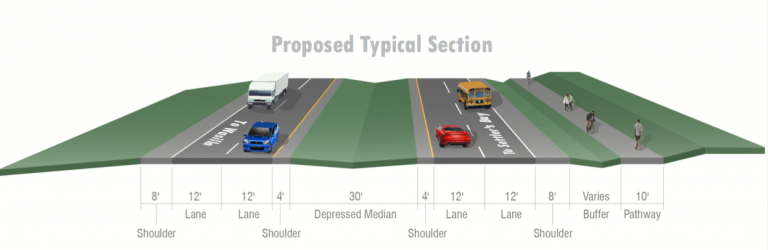
This project will expand the corridor to a four-lane divided roadway with a separated multi-use pathway on the west side, turn lanes, access control, traffic signals, drainage, and other related improvements. In order to improve safety and reduce congestion, breaks in the median are proposed for every half mile to mile.
The project design is approximately 75 percent complete. The team will continue to gather public input and coordinate with the adjacent Vine Road to Settler’s Bay Drive part of the KGB Road project. The next steps are to refine the engineering plans and move ahead on the appraisal and acquisition of additional right-of-way needed for the project.
The Centaur Avenue to Vine Road project is the larger of the two Knik-Goose Bay Road reconstruction projects that DOT is moving toward construction. It’s 6.5 miles long and has numerous utility relocations and around 200 property acquisitions. Total project cost is $125-150 million, 90 percent of which is paid for by federal funds. DOT is considering options to move the project into construction expeditiously, including advanced utility relocations and breaking the project into several phases.
DOT is hosting a public open house on May 16 to provide information to the public and discuss the new design features, highway layout, and the potential property impacts with residents.
KGB Road was designated by the State of Alaska as a Safety Corridor in 2009 due to a higher -than-average rate of fatalities and major injury crashes. This designation allowed a multi-agency approach to reduce crashes, bringing together law enforcement, engineering, emergency services and education to improve the safety of the highway.
In the 10 years since KGB Road was designated as a Safety Corridor, the department has invested about $9 million in safety features, including signing, striping and signals. These features have achieved reductions in crashes, however, significant upgrades are still needed and many deaths have occurred along this road.
The Centaur Avenue to Vine Road upgrades are scheduled for construction in 2021.
A couple of retired judges sat in the back of the Senate Judiciary meeting and cackled loudly on Friday as Sen. Mike Shower and his aide Scott Ogan presented SJR 3, which proposes an adjustment to the way Alaska appoints members to the Alaska Judicial Council.
Retired Chief Justice Walter “Bud” Carpeneti was one of the cacklers, and not once, but twice he and his colleague were loud enough to disrupt the proceedings. Sen. Shower turned around to see who was making the disruption. Clearly, the retired judges did not like SJR 3 and were making their feelings known to the committee.
Shower had a small audience in front of him. Finance Committee was meeting at the same time, so for most of the meeting, it was just Sen. Shelley Hughes and Sen. Jesse Kiehl listening to Shower and Ogan.
Shower said that Article 1 Section 2 of Alaska’s Constitution provides that all power is inherent in the people. But when it comes to appointing people to the Judicial Council, Alaska’s Constitution has left it up to the professional members of the Bar Association. It’s unwise, Shower argued, to leave something so important to this special interest group.
The Judicial Council is the body that recommends who will become a judge in Alaska. It screens and nominates judicial applicants; evaluates the performance of judges, and makes evaluation information and recommendations available to the voters; and conduct studies.
How does one become a member of the Judicial Council?
Alaska Constitution Article IV, Section 8 sets the Judicial Council at seven members. Three are attorneys appointed by the Alaska Bar Association. Three cannot be attorneys and these are appointed by the governor, subject to confirmation by the legislature. The appointments are for staggered six-year terms, must be spread over different areas of the state, and must be made without regard to political affiliation.
The chief justice of the Alaska Supreme Court is the Council’s seventh member and serves as chairperson.
Sen. Shower believes that the three that are appointed by the Alaska Bar should also stand for confirmation by the Legislature because of Article 1, Section 2 of the Constitution — the “power inherent in the people” clause. And he’s suggesting this change in the Alaska Constitution be placed before the voters in the next General Election.
This would lessen the unilateral influence that the Alaska Bar has over the selection of judges, he said.
Shower explained that the judicial branch is one-third of government, and has immense power over people’s lives. Most Alaskans are not aware that judges are picked by the Judicial Council. The judges are then appointed by the governor based on those council choices. Judges stand for reelection, but it is difficult to remove them.
“The only part of our state government where people get no direct vote over who sits in control of one-third of our government is the judicial branch. More concerning is this system was designed so lawyers get the final and ultimate say in who becomes a judge. Even with three non-attorneys on the Judicial Council, the Chief Justice can and does weigh in to choose the appointee as the tie-breaking vote, siding with the three attorneys on the council,” Shower said.
“This is quite far from the constitutional precept of the founding fathers of our Republic, in which the people should be represented in all branches of government. Alaska’s system removes the voice of the people directly from the equation. In fact the consultants brought in during Alaska’s constitutional convention believed this system went far beyond what they considered safe and far removed the citizens from the process,” he said.
The Alaska Supreme Court has come out squarely against the proposal.
SJR 3 will be taken up again by the Senate Judiciary Committee today.
House Speaker Nancy Pelosi is in a snit because President Donald Trump says he plans to dump illegal aliens in sanctuary cities, like her San Francisco, as we suggested days ago in an editorial.
“The extent of this administration’s cynicism and cruelty cannot be overstated,” a Pelosi spokeswoman said. “Using human beings — including little children — as pawns in their warped game to perpetuate fear and demonize immigrants is despicable.”
Cynicism? Cruelty? It is cynical and cruel not to fix this nation’s broken immigration system. It is cynical and cruel to allow the system’s asylum provisions to entice illegals on a dangerous path north.
Ms. Pelosi who has done little to stanch the flow of illegals now seems to want them everywhere – but in her district. She should take down the walls she lives behind and enjoy the fruits of her handiwork.
As for us, we are glad the president is reading our editorials. Or is it just a case of great minds thinking alike?
April 14, 12:21 am: The tripod fell on the Tanana River on Sunday morning, ending this year’s Nenana Ice Classic in record time. Prior to today, the record was set at 3:27 p.m. on April 20, 1940.
April 14,1865: Actor John Wilkes Booth entered the presidential box at Ford’s Theatre in Washington, D.C., and fatally shot President Abraham Lincoln. His accomplices also tried to assassinate Secretary of State William Seward.
April 15, 1929: Anscel Eckmann, who was born in 1895, made the first nonstop flight between Seattle and Juneau in a Lockheed Vega on floats, owned by flight school and charter owner Joseph L. Carman. The flight took 9 hours, 35 minutes. Jack Halloran was the mechanic onboard and “Bob” Ellis (Ellis Airlines, which eventually became Alaska Air) was navigator. Upon their arrival on April 15, Alaska-Washington Airways was founded. The company quickly increased its fleet six Vegas but was beset by financial setbacks and accidents, and ceased operations in March, 1932. Eckmann was also a pilot in World War II. Today is the 90th anniversary of his historic first flight nonstop flight to Juneau. The photo is from the Alaska State Library, George A. Parks collection, with more details here.
April 15: Your tax filing is due today. From its inception, the United States raised revenue, but generally from whiskey and tobacco. It was not enough to pay for wars like the Civil War or the Spanish-American War. Along came the 16th Amendment to the Constitution, which was ratified in 1913, and Congress was empowered to “collect taxes on incomes, from whatever source derived, without apportionment among the several states, and without regard to any census of enumeration.” Homer S. Cummings, chairman of the Democratic National Committee during the Woodrow Wilson administration, called the income tax among the most notable achievements of the Democratic Party.
April 16, 1959: The first Alaska State Legislature adjourned after being in session since Jan. 26.
April 16, 2019: Tuesday is the 92nd day of the first session of the 31st Legislature.
April 16: Tuesday isTax Freedom Day, the day that represents how long Americans as a whole have to work in order to pay the nation’s tax burden. Americans will collectively spend more on taxes in 2019 than they will on food, clothing, and housing combined.
April 17-18: Alaska Trucking Association’s annual meeting, O’Malley’s on the Green.
April 19:Skagway International Folk Festival and Art Show.
April 19: Regular meeting of Alaska Public Offices Commission. Agenda here.
April 22: Celebration of Congressman Don Young, longest serving Republican in the History of Congress, 5:30 pm, Chugach Alaska Atrium, 3800 Centerpoint Drive, $250 suggested campaign contribution.
April 30: Alaska Aviation Film Festival, Beartooth Theater Pub.
Gov. Michael Dunleavy on Saturday said the Democrat-led House Majority is playing fast and loose with Alaskans concerning the shortfall in funds for the Senior Benefits program.
They underfunded the program last year, he said, even though they were warned about it running out of money.
Last week, the Department of Health and Social Services announced that for May and April, those seniors in the highest income bracket of the program — with an income of $26,355 — would not receive their expected $76 per month senior benefit check from the State. Senior Benefits is a program that was created in 2007 to help low- to moderate-income seniors make ends meet.
“Members of the House Majority are quite frankly, being disingenuous with Alaskans when they express shock and disappointment that the Senior Benefits program will not have enough revenue for its highest income seniors for two months, said Dunleavy. “Why? Because they knowingly underfunded it.”
The $152 they will not be receiving for the two months equals about one half percent of their total yearly income.
Those same seniors, however, have lost more than $1,000 a year for the past three years in income from the diminished Permanent Fund dividend, which was reduced by half under the era of Gov. Walker.
Additionally, the House budget this year takes another $1,659 from Alaskans’ Permanent Fund dividends for 2019, which totals 6.29 percent of that senior citizen’s income of $26,355.
Dunleavy said that the Walker Administration warned lawmakers that the program was probably going to run out of funds before the end of 2019, but the Legislature passed the appropriation anyway.
Some 4,731 Alaskans over the age of 65 receive the $76 per month. Last year, the Democrat-led House Majority legislation, HB 236, reauthorized the Senior Benefits program but required DHSS to reduce or stop payments to the highest income tier if funding came up short. The Department could, according to the bill, rob another program for the funds, at its discretion.
Dunleavy said the DHSS is looking for what other funds might be available to come up with the $800,000 required to pay those Alaskans.
A letter signed by Speaker Bryce Edgmon, House Majority Leader Steve Thompson, and 17 other members of the Democrat-led Majority, was sent to Commissioner Adam Crum on Friday urged the commissioner to come up with the money. Republicans Thompson, Gary Knopp, and Gabrielle LeDoux signed the letter.
Rep. Ben Carpenter, a Republican, said it was ironic that Democrats were upset about the $76 being taken from lower-income seniors, when they show little concern for the past three years when $3,678 has been taken from those same seniors — and every other Alaskan — by shortchanging them on their Permanent Fund dividends.
The Senior Benefits program is managed by the Alaska Department of Health and Human Services and distributes a check each month to lower-income seniors.
There are about 4,731 individuals receiving $76 per month who will not receive a benefit the final two months of the fiscal year ending June 2019. The lowest income individuals eligible for higher payments of $175 and $250 a month will continue to receive monthly benefits.
A similar situation occurred in March 2016 when Senior Benefits payments went from $125 to $47 a month for the highest income tier.
“The House Majority needs to be honest with regard to the actions they took last year. They are fully aware that they chose to underfund Senior Benefits in their own budget last year under the previous Administration,” Dunleavy said.
Dunleavy’s proposed budget for 2020 would cut the program altogether. The House of Representatives’ version of the 2020 budget retains funding for it. That budget is now under review by the Senate.
By the close of 1918, the “Spanish Flu” pandemic had run its course across most of the globe, with more than 50 million deaths reported since it had started in late 1917. If you’re reading this, someone in your lineage probably died from the Spanish Flu.
It first hit Juneau, Alaska by the fall of 1918. Eventually one out of every 20 people living in the territory died from the flu, the sinking of the Princess Sophia, and World War I, which equated to over half of all deaths reported in the two-year timeframe. Victims often froze to death because they were too weak to chop firewood.
Many of these deaths were among Alaska Natives. Nome and surrounding villages were particularly hard hit.
“When passengers from the S.S. Victoria, the last ship of the season from Seattle, docked in Nome, all hell broke loose on the Seward Peninsula,” wrote Laurel Downing Bill, in a story published in the Senior Voice.
According to historian Alfred Crosby “the Spanish flu did to Nome and the Seward Peninsula what the Black Death did to 14-century Europe.” The author of “The Forgotten Pandemic” estimated that 8 percent of the Alaska Native population died from the flu.
The second wave hit remote Bristol Bay in the spring of 1919, with spring breakup. It is somewhat of an untold part of Alaska territorial history.
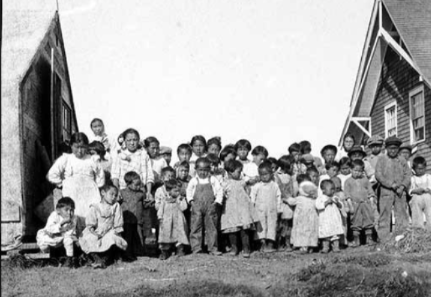
At the time, Bristol Bay was even more remote, its villages populated by about 1,000 Alaska Natives who had little immunity to Western disease. The only medical staff around came and went with the annual cannery operations that started each spring.
Alaska was still a far-flung possession of the United States, only having become organized as a territory seven years prior. The U.S. government involvement in the state was still in its infancy, although timber, mining, trapping, and fishing interests were active along the coastline. Congress was reluctant, if not resentful, to spend much money on a place considered wild and remote. The canneries served the coastline, bringing in supplies, workers, and medical staff.
Most non-Native fishermen in Bristol Bay were immigrants, with many coming from the Mediterranean countries of Italy, Croatia, Greece, and even Algeria. Scandinavians came from Norway, Sweden, and Finland, and other European countries of Germany, Russia, and Denmark. and Norway. They fished from a fleet of diminutive sailing boats.
Natives were living subsistence lives and would have in the spring of 2019 been preparing to travel to fish camps for the harvesting season, which stretched from late May to September. They had been isolated for the previous eight or nine months of winter, with little contact with westerners, such as federal representatives or even missionaries.
While the influenza had been raging in ports like San Francisco and Seattle, the weather in the Gulf of Alaska prevented travel and trade until the spring of 1919. Then, the devastation unfolded.
Some 82 percent of influenza deaths were in Alaska Natives. Ultimately, the flu killed more people per capita in Alaska than anywhere else, except Samoa.
Because of the isolation and a lack of public health, it’s impossible to know how many deaths occurred, and the age of victims are also considered to be estimates, since most Alaska Natives didn’t have birth records. Accounts are pieced together from government publications, missionary accounts, and information provided by traders and newspapers. The count is likely underreported.
Dillingham, then known as Kanakanak, Ugashik, Nushagak, and Naknek were hit hard, while the village of Egegik reported no cases.
The Coast Guard sailed into the bay in mid-June that year, only to find hundreds of sick and dying Natives and about 100 orphans. A large number of the adults died in Kanakanak, and dogs were feasting on the bodies of the dead.
The Coast Guard sent a crew ashore to kill the dogs, and the Coast Guard report avoided elaborating further, saying “conditions were too harrowing to narrate in this report in detail…”