(2-minute read) LONGTIME CAMPAIGN MANAGER RETIRES, NEW TEAM FORMING
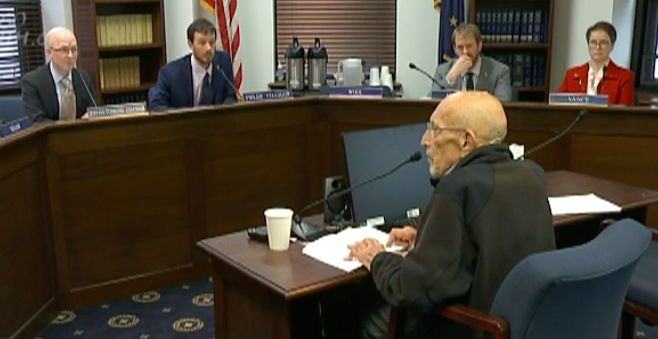
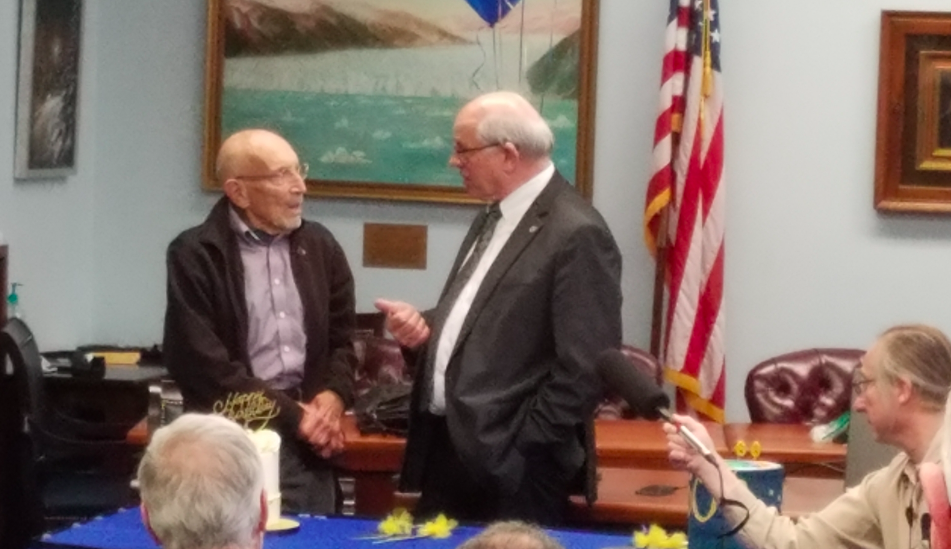
Congressman Don Young will be a candidate for U.S. House again in 2020.
His State Director Chad Padgett said this morning that Young’s long-time campaign manager has retired and a new campaign team is in the early stages of organizing. Jerry Hood had run Young’s campaign since 2012.
On March 8, 2019, Young will become the longest serving Republican in the history of the House and Senate. He is serving his 24th term in the House as Alaska’s congressman since 1973. He is the last remaining member of Congress who has been in office since the Nixon Administration. He became the Dean of the House of Representatives on Dec. 5, 2017, after the resignation of John Conyers from Michigan.
Rep. Joseph Gurney Cannon of Illinois served in the House for 46 years to the day, but his service was not continuous. Don Young has served for 45 years, 325 days, as of Jan. 26, 2019.
In the Senate, Sen. Strom Thurmond of South Carolina served 47 years, 5 months and 8 days, but he started his Senate tenure as a Democrat, for his first 10 years in office.
Young moved to Alaska in 1959 and settled in Fort Yukon, above the Arctic Circle. He worked in gold mining, trapping, and construction. He also captained a tugboat, running a barge operation on the Yukon River. In the winters, he taught at the local Bureau of Indian Affairs elementary school.
Jerry Hood
Hood came to Alaska in 1970 and worked in the broadcast industry before joining the Teamsters Union in 1973, where he was a shop steward, editor of the union’s newsletter, business representative, and executive director of the Teamster’s political action committee, among other roles.
No replacement for Hood has been named, Padgett said.
(2-minute read) CHANGES 5 OF 7 ON BOARD OF NURSING
Gov. Michael Dunleavy announced 44 appointments to State boards and commissions. He replaced five of seven members of the Board of Nursing, and replaced all three members of the Clemency Board.
The Nursing Board regulates and approves applications for licenses and permits, and discipline of nurses.
The Clemency Board makes recommendations to the Governor to grant a pardon, commutation, reprieve or remission of fines and forfeitures concerning state crimes. Dunleavy removed Bruce Botelho, Jim Cantor and Nancy Shaw. He named Ralph Samuels, Carol Fraser and Scotty Barr to the board.
The state has over 140 boards and commissions. Many citizens get their start in politics by serving on one.
Alaska Commission on Aging
Nona Safra of Anchor Point
Mike Coons of Palmer
Alaska Commission on Judicial Conduct
Trevor Shaw of Ketchikan
Alaska Judicial Council
David Parker of Wasilla (reappointment)
Alaska Police Standards Council
Jennifer Winkelman of Juneau (Correctional Administrative Officer)
Rebecca Hamon of King Salmon (reappointment)
Chief Stephen Dutra of North Pole (reappointment)
Chief Burke Waldron of Bethel (reappointment)
Alaska Workers’ Compensation Board
Bob Doyle of Wasilla
Bradley Austin of Juneau (reappointment)
Sarah LeFebvre of Fairbanks (reappointment)
Dr. Christopher Twiford of Kodiak
Albert Haynes of Wasilla
Sara Faulkner of Homer
Randy Beltz of Anchorage
Julie Duquette of Fairbanks
Big Game Commercial Services Board
Tom Harris of Anchorage
Jason Bunch of Kodiak (reappointment)
Cash Joyce of Wasilla (reappointment)
Board of Direct-Entry Midwives
Cathy Mosher of Willow
Board of Governors of Alaska Bar Association
Jedediah Cox of Anchorage
Board of Marine Pilots
Edward Sinclair of Juneau
Board of Massage Therapy
Julie Endle of Palmer
Board of Nursing
Julie Tisdale of Anchorage
Danette Schloeder of Anchorage
Marisha Dieters of Eagle River
Wendy Monrad of Anchorage
Shannon Connelly of Palmer
Board of Social Work Examiners
Geoffry McCormick of North Pole (reappointment)
Colleen Vague of Wasilla
Board of Psychologists and Psychological Associate Examiners
There was a great deal of speculation about how City and Borough of Juneau officials would react to Federal Judge H. Russell Holland’s recent ruling on the cruise industry (CLIA) lawsuit. CLIA lodged the lawsuit in 2016 in an attempt to clarify the legal and permissible uses of Juneau’s marine passenger fees and port development fees.
The suspense is over.
Win Gruening
In two public presentations last week, Juneau City Manager Rorie Watt laid out the city’s case.
Watt described issues surrounding the lawsuit as “a ball of spaghetti”. While the city has chosen “not to litigate these issues publicly in the past,” Watt explained that now it’s time to take their case to the public.
The timing seems odd since Judge Holland ruled that many of the proposed projects and services to be funded by passenger fees would be considered unconstitutional under the U. S. Constitution’s Tonnage Clause because they do not provide a service to cruise ship vessels.
Has the city chosen to abandon legal arguments in favor of a public relations campaign thereby hoping to gain negotiating advantage?
Perhaps. But is that the best way to encourage a mutually agreeable settlement or does it foment further acrimony between the community and the industry?
Watt claims that not much will change as a result of the ruling because the city “won” the lawsuit on two major points:
The ruling reaffirmed the collection of marine passenger fees and port development fees is constitutional.
The ruling didn’t say the use of past fees was illegal.
Both points, while technically true, ignore that they were not issues CLIA contested.
CLIA has acknowledged the collection of these fees is not necessarily unconstitutional but contend many of Juneau’s uses of revenue generated by the fees are unconstitutional.
Moreover, Judge Holland’s decision concerned prospective uses of the fees and therefore did not address the issue of past fees.
Here’s what relevant portions of Judge Holland’s 35-page order did say:
“Expenditure of marine passenger fees and port development fees for services to passengers only, such as crossing guards, repair and maintenance of sidewalks” are unconstitutional “because they do not constitute a service to a vessel.”
Furthermore, the order states, “…the question… is not whether Juneau’s use of marine passenger fees and port development funds benefits passengers. Passenger benefits are not relevant. The proper question as to each category of expenditure by defendants is: Does the expenditure provide a service to a vessel? If the answer is yes, the expenditure is constitutional. If the answer is no, the expenditure is unconstitutional….”
And finally, “Expenditures or fees imposed upon vessels which enhance the tourist experience of passengers brought to Juneau by plaintiffs’ members’ vessels do not qualify as a service to a vessel, even though the enhancement of passengers’ experience at Juneau may benefit plaintiffs’ members financially.”
Despite the decision’s clear wording, City Manager Watt maintains that expenditures solely serving cruise passengers also benefit the vessel.
Questioned on this point, Watt posits the proposed Archipelago project on the Juneau wharf and debt service funding for the new Juneau cruise ship docks as expenditures that could be jeopardized under CLIA’s interpretation. Yet, the docks clearly benefit the vessel and would be certainly constitutional. The Archipelago project is one that could be a subject of negotiation due to its proximity and connection to the cruise dock.
I have no personal knowledge of the legal strategy of Juneau or the cruise industry. Nor is it my intention to defend the cruise industry. They have plenty of people capable of doing that. My concern is getting the fairest deal for all concerned.
Everyone needs to consider, what are the risks of prolonging this litigation?
With city legal costs approaching $1 million, the longer this lawsuit drags on, the costlier it will be.
Further judicial pronouncements could be more specific and may enforce compliance. How would this affect potential negotiations with CLIA?
With this latest ruling already setting a precedent, further rulings may further cement precedent limiting the uses of similar fees imposed by other ports in Alaska.
How can legitimate concerns about the funding of infrastructure to support the growing numbers of cruise ship visitors be addressed while embroiled in a legal battle with the industry?
Public assertions by city officials that don’t square with the facts of the case or Judge Holland’s order complicate opportunities for negotiation.
Mischaracterizing the possible consequences of the judge’s decision do not help encourage elected assembly members to work cooperatively with the cruise industry or to resolve any ambiguities.
It can be a fine line between “spin” and misleading the public.
No one is well served by the latter.
Win Gruening retired as the senior vice president in charge of business banking for Key Bank in 2012. He was born and raised in Juneau and graduated from the U.S. Air Force Academy in 1970. He is active in community affairs as a 30-plus year member of Juneau Downtown Rotary Club and has been involved in various local and statewide organizations.
A former candidate for House District 21 is now the deputy director for community relations for Gov. Michael Dunleavy. She will be based in the Anchorage office and be engaged in outreach work to various communities across Alaska.
Stewart is originally from Alabama. She came to Alaska with the U.S. Army and was stationed at Fort Richardson.
In 2012, she was awarded the Freedom’s Sister Award by Ford Motor Company for her community outreach. Previous recipients included Myrlie Evers-Williams, Barbara Jordan, and Rosa Parks.
She is the former director of the Office of Equal Opportunity under Anchorage Mayor Dan Sullivan, small business development program manager at the Alaska Department of Commerce, deputy director of community relations for Gov. Frank Murkowski, and constituent relations aide to Gov. Tony Knowles.
Stewart was the first executive director of Bridge Builders of Anchorage, and president/CEO of the Alaska Black Chamber of Commerce.
She was a volunteer on the re-election campaign of Gov. Sean Parnell, and ran for State House in 2016 and 2018 against Rep. Matt Claman, losing both times to the incumbent Democrat.
Two appointees of the new Dunleavy Administration have withdrawn from their appointments.
John Quick, the Department of Administration commissioner, offered his resignation today. It was accepted after too many irregularities in his resume were revealed in the media.
Art Chance, who was offered a position in the Department of Administration, decided to not accept an offer of employment. Chance, a rough-hewn labor negotiator, had a social media presence that would have been a distraction to the Administration. He has been a columnist at Must Read Alaska, but it’s his sometimes raw language on Facebook that was becoming an issue, in light of the dismissal of former Assistant Attorney General Libby Bakalar, who kept a savage and coarse blog going during the Walker Administration.
Chance had shut down his Facebook page upon deciding to work for the Dunleavy Administration, but the trail of social media is long and unforgiving.
When asked for comment, Gov. Michael J. Dunleavy stated the following: “This decision is for the best.”
Gov. Michael Dunleavy named Paula Vrana as Acting Commissioner of Administration.
“Earlier this evening, Commissioner Designee Jonathan Quick resigned. I appreciate his willingness to serve the people of Alaska and wish him the best in his future endeavors,” Governor Dunleavy said in a press release.
“I appointed Paula Vrana as Acting Commissioner of Administration.
“Acting Commissioner Vrana is an attorney who joined the Department of Administration on Jan. 2, 2019. She immediately immersed herself in your department’s important role to the State of Alaska, and I am confident you are in good hands,” Dunleavy wrote in a letter to Department of Administration employees.
Quick, in his letter of resignation, strongly refuted some of the claims made against him, but said he didn’t want to become a distraction.
For Commissioner Designee Quick’s letter of resignation, click here.
The 9th Army “Arctic Warrior” Band based at Joint Base Elmendorf-Richardson has been secured by the Alaska Inaugural Ball Committee as the entertainment for the gala set for Feb 2 at the Dena’ina Center in Anchorage. The event has sold out with 882 seats sold and a waiting list.
It’s a black-tie event to honor the election of Governor Mike Dunleavy and Lt. Governor Kevin Meyer.
The 9th Army Band deploys around the state to provide official band support to military ceremonies, as well as providing public outreach at holiday and other community events. It was repositioned in 2016 from Fort Wainwright in Fairbanks to the Anchorage base and has 42 musicians .
In addition to the jazz band, Dave Stieren and Sarah Erkmann Ward will co-emcee the event and other entertainment, including a dance band, is being finalized.
It was all a lie, a lie that leftist celebrities, talking heads and the news media eagerly bought into hook, line and sinker – and without bothering to ask even the first question. Why? It mirrored their hatred of anybody not like them.
It started with an anonymous Twitter account hiding behind a fake name. It fired off a tweet of outrage that a bunch of Kentucky high school kids – Catholic high school kids wearing Make America Great Again hats, no less – had taunted and mocked a 63-year-old Native American “Vietnam veteran” after the March for Life in Washington, D.C.
The tweet included a video appearing to show just that. It went viral. The twitter sphere went bonkers largely, we suspect, because the students were white, Catholic and wearing MAGA caps – and the Left could not wait to pile on. The outrage was over the top.
Actor Jim Carrey likened the students to “baby snakes.” Kathy Griffen accused them of showing “Nazi signs.” The kids profanely were called bigots, bullies, white nationalists, racists. One “Saturday Night Live writer even offered to perform oral sex on anybody who punched them in their faces. One writer wanted them dead. Film producer Jack Morrissey joked about “MAGA kids” going “screaming, hats first into the woodchipper.” There were death threats and endless venom.
Read the rest of this story at Anchorage Daily Planet:
BUT THERE’S PLENTY OF DOCUMENTATION TO BACK UP HIS CLAIM
(Note: This story is updated with a letter that Commissioner John Quick has sent to the Senate joint committee that interviewed him on Tuesday. See link at the bottom.)
(Note ii: This story is updated to reflect that Commissioner Quick has resigned.)
After a day of political drama, the commissioner of the Department of Administration has resigned. His resume simply did not hold up under scrutiny.
The “owners” of a coffee, tea and frozen yogurt company in Washington state have challenged the claim by Commissioner of Administration nominee John Quick that he was an owner of the company. They said he was an employee whom they fired.
The Janie Reynolds letter to the Senate committee that interviewed Quick prior to his confirmation is linked here:
But while Janie Reynolds says Quick was an employee they let go, Quick says the ownership was a handshake deal when he started the business with their son, his longtime childhood friend when they were in their mid-20s. Both of them are Christians, and this arrangement is not unusual among young entrepreneurs.
In Tacoma area news stories about the successful business, Bryan Reynolds is always mentioned as an owner in recent years, but a search of news stories from several years ago finds that Quick was an owner-partner with Reynolds. At least that part of his story seems to hold up.
Quick’s claim is also backed up by an old blog entry in his family’s blog from 2011, quartetofquicks.blogspot.com
It appears from news stories, that the two young men went into business together, but eventually the entire Reynolds family eventually got involved and Quick exited the business.
Janie Reynolds, who said she is 50 percent owner of Anthem Coffee & Tea/Elements Frozen Yogurt, wrote a letter to the Senate Joint Finance and State Affairs Committee.
The letter became part of his confirmation process on Tuesday, with Sen. Bill Wielechowski and Sen. Scott Kawasaki asking him pointed questions about his financial ties to that company and his answers were in conflict with the letter they had in their hand from Reynolds, which was then leaked to the media and selected bloggers. It was clearly a coordinated set up.
Quick told the committee that he sold the company to a private party, and he didn’t want to reveal their names on the record, but was a friend from high school. That friend, from MustReadAlaska research, was Bryan Reynolds.
Quick was most recently the chief of staff to the mayor of Kenai Borough, Charlie Pierce.
UPDATE: John Quick sent a letter to the committee this afternoon, clarifying that he had an equity stake position in the company and that he parted ways with the company, rather than selling it, as he stated to the committee.
Other parts of his resume, including some online postings, did not hold water. For example, it appears he does not have a master’s degree, although in some places online he indicated that he earned one.
In the end, the inconsistencies were too many to explain away, and his appointment appeared destined to fail the confirmation process.
(1-minute read) MURKOWSKI, SULLIVAN VOTE YES, BUT THE TALLY CAME UP SHORT
The U.S. Senate voted down President Donald Trump’s $5.7 billion border wall today. The compromise would have given additional leniency to DACA — young, illegal immigrants also known as “dreamers.” Importantly, it would have reopened the portions of the government that are currently in shutdown mode.
HR 268 was expected to fail, as it needed 60 votes to pass and went down 50-47, but with yes votes from Sens. Lisa Murkowski and Dan Sullivan. (The vote was incorrectly announced on the Senate floor as 51-47).
One Democrat voted for the funding: Sen. Joe Manchin of West Virginia. Two Republicans voted no: Tom Cotton of Arkansas, and Mike Lee of Utah.
The Senate also voted down a Democrat-backed bill to keep the government open through Feb. 8. That bill excluded money for the border wall. That measure failed 52-44. Sullivan voted no and Murkowski voted yes.
Today is the 34th day of the partial government shutdown. The Democrats are blocking the president on his promise to secure the southern border with Mexico, and are blocking legislation that includes funding for his proposed wall. They also want permanent status for the “dreamer” immigrants, and a pathway to citizenship.
This bill would have provided $12.1 billion in FY2019 supplemental appropriations to several federal departments and agencies for expenses related to the consequences of recent wildfires, hurricanes, volcanos, earthquakes, typhoons, and other natural disasters. It was designated as emergency spending, which is exempt from discretionary spending limits and other budget enforcement rules.