Sunday, May 3, 2026
Home Blog Page 1503

Happy Seward’s Day, Alaska state government workers!

8

Monday, March 25 is Seward’s Day, the uniquely Alaska day that allows State of Alaska workers a day off on the last Monday of every March to enjoy time with their families and friends. It’s one of the unique benefits afforded to State workers, along with a 37.5 hour work week.

So who is William Seward? Depends on who you ask. For some Alaska Natives, he is the epitome of colonial expansion policy of Manifest Destiny, 19th-century doctrine that the expansion of the United States throughout the American continents was inevitable and proper.

Few remember that Seward, a Republican, was seriously injured and was, indeed, an actual target of the 1865 assassination plot that killed Lincoln.

Seward remained Secretary of State through the presidency of Andrew Johnson, during which he negotiated the Alaska Purchase in 1867, and he was loyal to Johnson during his impeachment.

Here’s the official State Department biography of him:

In 1861, Abraham Lincoln chose his former rival for the Republican presidential nomination Senator William Henry Seward of New York to be his Secretary of State. He served under Lincoln and his successor, Andrew Johnson, until 1869.   Although Seward was at times impetuous – shortly after taking office in 1861 he proposed to Lincoln that the Union be preserved by starting a war with France or Spain – Lincoln blocked his imprudent projects and channeled his brilliance and effervescence into more useful activities.

An outspoken abolitionist, Seward negotiated the Lyons-Seward Treaty of 1862, which put in place new measures to end the Atlantic slave trade.

During the Civil War, he carefully managed diplomatic relations with Great Britain and France. He persuaded the British government to stop British shipyards from building war ships for the Confederacy. And he continually pressed the French and British not to recognize the Confederate states as an independent nation.  His success on behalf of the Union cause was rewarded by an attempted assassination on the same night that the conspirators killed Lincoln.  Fortunately, Seward survived the attack.

Seward was a firm proponent of the Monroe Doctrine and a firm believer in its philosophical underpinning, Manifest Destiny—the inevitability of the United States expanding west to the Pacific Ocean.  As early as 1846, Seward had stated that “our population is destined to roll its resistless waves to the icy barriers of the north, and to encounter oriental civilization on the shores of the Pacific.”

The end of the Civil War in 1865 enabled him to put his beliefs into practice.  Two of his major achievements occurred in 1867.  With the use of restraint, tact, and wisdom, Seward’s efforts over several years to persuade Emperor Napoleon III to withdraw French troops from Mexico came to fruition.

That same year, Seward negotiated the purchase of Alaska from Russia for $7.2 million. He had wisely invited Senator Charles Sumner, the chairman of the Senate Foreign Relations Committee, to join him in the negotiation with the Russian minister.  Sumner persuaded the Senate to give its consent to the treaty, 37 to 2.

When the appropriation for the purchase languished in the House of Representatives, reflecting the views of Eastern newspapers which ridiculed the agreement as “Seward’s Folly,” the mostly favorable Western newspapers helped to persuade public opinion and the House to support the purchase.

The sale ended Russian influence in North America, gave the United States access to the northern Pacific Ocean, and added territory nearly twice the size of Texas for about 2 cents an acre. Asked to name his greatest achievement, Seward said “The purchase of Alaska, but it will take the people a generation to find it out.”

Seward also attempted to purchase the Danish West Indies (Virgin Islands) and to annex the Dominican Republic in the Caribbean.  Not content with having reached the Pacific Coast, Seward wanted to move into the Pacific itself, to support both trade with the East and the defense of the United States.  While he successfully appropriated Midway Island, he was not successful in gaining control of the Hawaiian Islands.

How many have voted in Anchorage so far?

As of Monday, March 25, approximately 15,665 Anchorage residents have cast their ballots in the Anchorage Municipal Election. The state’s largest city is in its second mail-in election, after launching the program in 2018.

Last year, 79,275 ballots were cast, of the 218,388 registered voters in the Anchorage bowl. This year, about 216,000 ballots were mailed out by the Muni’s Election Office.

Those ballots were printed in Washington state and mailed the week of March 10; they are due back by April 2. With nine days left, another 63,610 voters will need to get busy in order to match last year’s record.

Going door to door in the Fairview neighborhood are canvassers from the progressive Alaska Center (for the Environment), to boost the liberal turnout. Another group is canvassing conservative voters to make sure they vote down the 5 percent alcohol tax proposed by the city to raise money for homeless services.

Mailing your ballot is not the only option. There are secure drop boxes in locations around the city, and they are being emptied by election workers regularly. You can also vote on April 2 in person at limited locations – check the list here.

[Check this list for a drop box near you]

Need to know more? Check out Must Read Alaska’s previous reports on the municipal election, then go find that ballot in the stack of junk mail — your vote could make the difference.

[Read: List of candidates]

[Read: Five things you should know about the ballot propositions]

[Read: Anchorage voters to decide on alcohol tax]

That time leading Democrats promised evidence would point to ‘collusion’

THEY WILL FACE NO CONSEQUENCE FOR THEIR DISINFORMATION CAMPAIGN

Over the past two years of special counsel Robert Mueller’s investigation into collusion with Russia by President Donald Trump’s campaign, leading Democrats have bet the farm on certain outcomes and hyped the “collusion” theory to all of America, with the help of the mainstream media. They said it was a slam dunk: Collusion and impeachment.

Today, Attorney General William Barr released a summary of the report. The verdict? No collusion. Pure and simple. If Barr’s summary is inaccurate, surely Mueller would have stated that by now.

Here’s a brief sample of what key Democrats have been saying to warp the public dialogue for the past two years. These are but a fraction of the “on message” unfounded allegations from sitting members of Congress in a coordinated effort to destroy public confidence in the president. In other words, actual collusion by Democrats:

COLLUSION HYPE

  • Sen. Richard Blumenthal: “The evidence is pretty clear that there was collusion between the Trump campaign and the Russians.” (MSNBC’S “All In,” 10/17/18)
  • Rep. Adam Schiff: “Well, look, there’s clear evidence of an attempt to collude.” (CNN’s “The Situation Room” 12/14/17)
  • Sen. Ron Wyden: “I think there was clearly an intent to collude.” (CNN’s “Wolf,” 12/15/17)
  • Rep. Adam Schiff: “I think there’s plenty of evidence of collusion.” (“CBS This Morning” 08/05/18)
  • DNC Chair Tom Perez: “Over the course of the last year, we have seen, I think a mountain of evidence of collusion between the campaign and the Russians.” (Fox’s “The Five,” 04/23/18)
  • Rep. Eric Swalwell: “We saw strong evidence of collusion … I think that’s clear collusion.” (CNN’s “Wolf,” 03/16/18)
  • Rep. Jerry Nadler, chair of House Judiciary: “…we know there was collusion with people in the campaign with Russians.” (MSNBC’s “All In,” 10/27/17)
  • Rep. Maxine Waters: “And I am so depending on our special counsel Robert Mueller to connect the dots so that he can prove the collusion.” (MSNBC’s “All In,” 08/04/18)
  • Sen. Richard Blumenthal: “There are indictments in this president’s future,” (MSNBC’s “Morning Joe” March 21, 2019)
  • Sen. Richard Blumental: “Even more so now than ever before, according to the intelligence we’re receiving, we need to understand what Vladimir Putin and the Trump campaign may have done together, but also the obstruction of justice that was done by the president of the United States in real time.” (MSNBC’S “Morning Joe” March 21, 2019)

IMPEACHMENT/WATERGATE HYPE

  • Rep. Adam Schiff: “I think, of a size and scope probably beyond Watergate.” (ABC’s “This Week,” 05/27/18)
  • Sen. Richard Blumenthal: “It may well produce impeachment proceedings.” (CNN’s “Anderson Cooper 360,” 05/10/17)
  • Rep. Jerry Nadler: “I think it shows that Mueller is in the old Watergate sense, following the money.” (CNN’s “Erin Burnett Outfront,” 04/04/18)
  • DNC Chair Tom Perez: “On a certain level, this is worse than Watergate.” (Fox’s “Trish Regan Primetime,” 11/08/18)
  • Sen. Richard Blumenthal: “It’s a Watergate Moment.” (CBS’ “This Morning,” 08/23/18)
  • Sen. Bernie Sanders: “Obviously, the suggestion is it goes back to Watergate.” (CNN’s “The Situation Room,” 05/10/17)
  • Sen. Ron Wyden: “That is almost a Watergate-level effort to interfere with an ongoing investigation.”  (CNN’s “New Day,” 06/08/17)

Unfortunate nature of government: Spending more than we have

30

FEEL-GOOD POLITICS DOESN’T PAY THE BILLS

By REP. JOSH REVAK

Planning and readiness.

They are the most critical elements needed for success in any endeavor. Through six years in the U.S. military and two deployments to the Middle East, I had no choice but to accept that planning and readiness are, in fact, the greatest defenses one has when staring any adversity, or even death, in the face.

When it counts, it is planning and logical thinking – not emotional reaction – that keeps you alive and afloat.

Today, as I sit in Juneau as a member of the citizen Legislature, I am increasingly concerned that far too many Capitol players and influencers have adopted the practice of emotional sensationalism to avoid hard conversations about fiscal planning and readiness.

Over the past month, I’ve watched as special interests launched protests and organized biased public testimony. I’ve overheard community organizers imploring their followers to act like children who are threatened with the loss of a toy rather than rational adults focused on solving fiscal problems.

The fact that special interest groups can get away with using vulnerable people to manufacture crises as a way of avoiding unpopular conversations about real problems is, in my opinion, abhorrent. Nonetheless, this outrage has led to the House Majority’s conclusion that the government must continue to grow.

At what expense, though?

The Majority claims to have a plan to pay for more government spending, so why haven’t they talked about the specifics of it publicly? Is the plan for an income tax? Is the plan for an 80 percent cut to the Permanent Fund dividend, as the rumors have circulated? Alaskans deserve to know what will be asked of their pocketbooks before legislators rush a budget through before the deadline.

House members are right to scrutinize specific elements of the governor’s budget, but to throw it out the window completely in favor of a management plan created by a previous governor of Alaska is a slap to the face of Alaskans. We are sent to Juneau to implement their will – not to tell them that we know better than they do.

Until we address our spending problem and enforce a working spending cap, it doesn’t matter how much revenue we bring in as a state – we will always spend more than we have. That is the unfortunate nature of government. We’re taking a lot of buns out of the oven, but we aren’t putting any dough back in.

The state has a spending and accountability problem. If they are going to take your money to continue feeding the beast, they should at least let you know what their plan is.

While it’s true we need to look out for the needs of Alaskans, emotional sensationalism will not drive good policy decisions – logic and data will. Let’s have the tough conversations, right-size government, and implement a plan to prepare Alaska for decades to come.

Feel-good politics doesn’t pay the bills.

Rep. Josh Revak is a six-year combat veteran and recipient of the Purple Heart. Elected in 2018, he serves Anchorage District 25 as a member of the Alaska House of Representatives.

Mat-Su testifies: Cut the budget

WHILE KETCHIKAN AND BETHEL VOICE GRAVE CONCERN OVER CUTS

The statewide discussion about the state budget is under way this weekend. On Friday, it was Juneau, and Saturday members of the House Finance Committee fanned out to Ketchikan, Bethel, Mat-Su, and Kenai to hear what Alaskans have to say.

Today, the Finance Committee leadership, which is under the control of Democrats, appear in Anchorage, Sitka, and Fairbanks to hear from Alaskans about the size of government and how to pay for it.

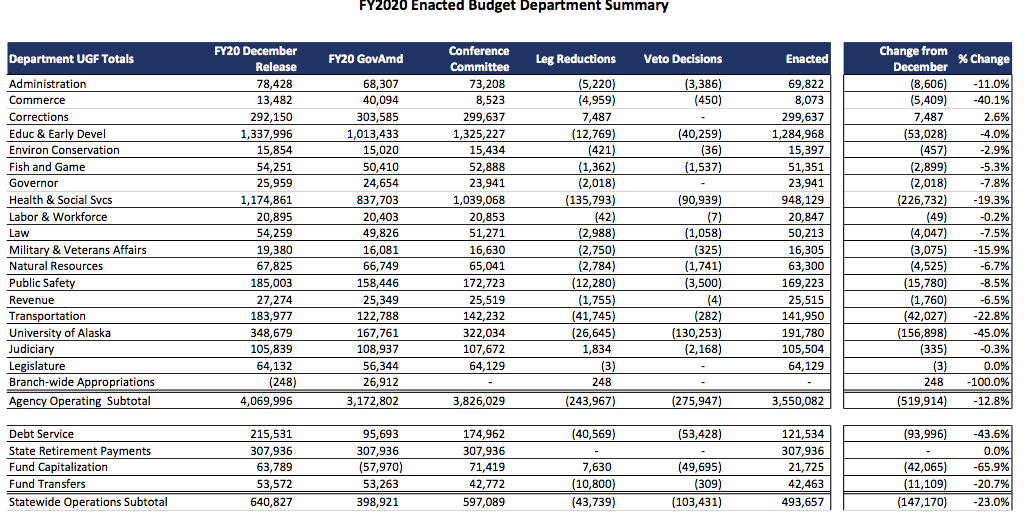
It’s a discussion prompted by the proposed budget of Gov. Michael Dunleavy, who downsized the government footprint to be about 78 percent of what it is today– a $1.6 billion cut starting July 1.

MAT-SU IS ‘DUNLEAVY COUNTRY’

Nearly 200 people attended the hearing in Wasilla, and the testimony went about two-to-one in favor of Gov. Michael Dunleavy’s austere budget and constitutional amendments to limit taxes, pay a full Permanent Fund dividend, and put a spending cap in place.

Rep. Tammie Wilson, a North Pole Republican member of the Democrat-led majority, moderated the meeting under the watchful eye of Speaker Bryce Edgmon, a Democrat who changed his party registration to undeclared so that he could form a caucus controlled by Democrats, but with Republican members.

Edgmon was noticeably uncomfortable in the conservative Mat-Su Valley and left about a third of the way through the hearing. He was heading to Kenai to monitor that hearing, which was occurring later in the day.

Some in the Mat-Su who testified expressed concern that education and health service cuts would devastate the state. A few attendees landed in the middle, favoring both moderate cuts and taxes. One person mentioned saving the ferries. But, as one woman put it, “this is Dunleavy country and karma is a b*tch!” She, like many others, said government had grown too large and she didn’t want to pay taxes for more of it.

With 11 pages of people signed up to testify, and about 17 names per page, some people gave up and left before they could be called to give their opinion at the Mat-Su Legislative Information Office.  Not all could fit in the room, so they spilled into the outer office and small meeting room to wait their turn.

The beginning of the meeting trended 90-10 in favor of budget cuts, but as the hours went on, more teachers and health care workers arrived and testified about the need for either a static budget or more funding for programs. Several from the “red for ed” movement came and spoke for saving education from the chopping block.

But teacher Dee McKee, winner of the BP Teacher of Excellence Award (2017) told the panel that education is an area that does have waste.

She pointed to the Nome School District, which receives funding for more than 1,500 students, but that the school only has 674 students. She was referring to the multiplier effect that incentivizes school districts to label students for special education, so the district can get more money.

“We have ghost students. This is insane. If you’re looking at education, and if this is typical, it’s got to get fixed,” she said.

Lisa Shelby, a principal at Susitna Valley Jr/Sr High spoke about how well her students do in graduation rates and test scores, compared to others around the state, and how much the school does for students, including providing a lot of lunches for students from lower-income families.

John Nelson, a financial adviser who ran for Congress in 2018, testified, “We do have a spending problem. We do have to get it under control.”

In Bethel, the testifiers were most, if not all, opposed to spending cuts.

Beverly Hoffman said that she was born in Bethel and was worried, saying even the mention of cuts had created chaos.

“This administration has just wanted to shock the crap out of us,” she said, “It’s deplorable, that’s the word. We know how to live here. We’re grateful for PCE [power cost equalization payments]. It’s ludicrous. I wish he [Dunleavy] came here today. Boy he’d get an earful. We deserve the best in education. The best in public safety, the best in health [care].” Hoffman is a local activist for the failed Stand for Salmon initiative that was on the November General Election ballot and opposes the Donlin Mine.

Meanwhile, back in Wasilla, Tammy Miller was telling legislators that she has learned how to cut her expenses when she’s faced losing a portion of her income “and I also look at how my money is used and I don’t throw good money after bad.” She expects government to do the same.

Berkley Tilton, married to Rep. Cathy Tilton, encouraged lawmakers to use the existing historic formula for calculating the Permanent Fund dividend and to initiate a spending cap, as proposed by the governor, and Lyle Downing (no relation to this writer) testified that the dividend should not be considered a revenue stream for services.

Carol Carman spoke about education funding, but then turned to Speaker Edgmon and addressed him on another matter that has been on her mind:

“Rep. [Matt] Claman has an ethics problem. He is chair of Judiciary, and he is a practicing lawyer. What are you going to do about it?” Under the ethics rules of the Legislature, Claman is not allowed to serve in a position where he has a conflict of interest, and as a trial lawyer, he is handling criminal justice reform legislation as a committee chair.
Rep. Wilson said she would take that comment back to Juneau for consideration.

After nearly three hours in Wasilla, 187 had signed up, 85 had testified, and it was running about two-to-one in favor of budget cuts.

Other legislators who attended the meeting in the Mat-Su included Reps. DeLena Johnson, David Eastman, and Cathy Tilton and Sens. Shelley Hughes and Mike Shower, all from the Valley. They are part of the 15-member Republican minority that was created after fellow Republicans Tammie Wilson, Chuck Kopp, Jennifer Johnston, Bart LeBon, Gary Knopp, and Steve Thompson left the Republican Majority and joined Democrats in a coalition, which already had two putative Republicans in it.

Farther to the south, 150 people in Ketchikan attended their hearing on Saturday and many said they want the ferry system, education, and social services saved. Ketchikan is the headquarters of the Alaska Marine Highway System, yet also was a stronghold for support for Gov. Dunleavy in the recent election. About 50 people spoke during that Saturday hearing, moderated by Rep. Daniel Ortiz.

Hearings continue today:

Anchorage: Sunday, March 24 from 2-5 p.m. at the Anchorage LIO, 1500 W. Benson Boulevard, Anchorage

Sitka: Sunday, March 24 from 2-5 p.m. at Centennial Hall Assembly Chambers, 330 Harbor Drive, Sitka

Fairbanks: Sunday, March 24 from 2-5 p.m. at the Fairbanks LIO, 1292 Sadler Way, Suite 308, Fairbanks

(With apologies to Kenai, this writer was not able to monitor that hearing on Saturday.)

Franklin Graham calls on the Church to respond to Alaskans’ needs

12

FRANKLIN GRAHAM HAS BUDGET MESSAGE FOR THE FAITHFUL

As the keynote speaker for the 2019 Alaska Governors Prayer Breakfast in Anchorage, Rev. Franklin Graham had a message that included a faith-centered way of addressing the State of Alaska’s budget crisis.

His core themes included the importance of reconciling with God and not settling for “normal faith or one that keeps Christ only on the edges of our lives.”

Graham,  the CEO of the relief organization Samaritan’s Purse, then called on the faithful to fill in the gap to help the poor and suffering across the state. It’s something Christians are called to do by the Gospel, he reminded the gathering at the Dena’ina Convention Center.

“Some would say that it’s the governor and the State’s responsibility to care for everyone. But actually, God’s Word makes it quite clear that it’s our job as Christians to take care of the widows, the orphans and those who are hurting,” Graham said in his sermon.

“With tight budgets, we have a unique opportunity as a church to help fill some of the social gaps that may be in our community,” Graham said.

Graham described how the church has historically had that role, but in the last 100 years, people have come to expect government to take on more and more of social services.

He acknowledged the brokenness of the world, with poverty, addiction, constant strife, and despair that is found in Alaska and across the globe.

“There is one thing government can do — build the roads, defend our state, and those kinds of things. But when it comes to caring for the widows and the orphans and those who are hurting, the church can do it better than the government any day, I promise you that,” he said.

Graham went on to encourage the faithful to speak to the Office of the Governor to see what more can be done in communities by faith-based organizations and churches.

[Watch the entire prayer breakfast on Facebook at this link]

The 66-year-old evangelist and missionary, who is known for not shying away from political commentary, first came to Alaska in 1971, and returns every year to his home on Lake Clark. Samaritan’s Purse has an office in Soldotna, where it has several airplanes, pilots, mechanics, and other staff stationed.

Every summer the organization, based in Boone, N.C., leads constructions projects around Alaska — sometimes in response to disasters, such as the 2009 Yukon and Kuskokwim River floods, and sometimes for the purpose of building up the faith culture in villages.

The group is currently building a church in Ruby and another in Dillingham, he said. It has a global presence and works side-by-side with governments and church organizations to rebuild after natural or manmade disasters.

Graham spoke at the Dena’ina Convention Center, to a crowd of 1,100 people. Gov. Michael Dunleavy also spoke to the crowd, which received him warmly.

“I am blessed. I’ve got  a wonderful wife of 31 years, and three beautiful daughters who are doing well, and we’re so proud of them. When you are in politics or any endeavor that you find yourself in the public light … there are some people who may not agree with you. I said that to somebody the other day, and they said ‘Do you read the paper at all?’ and I said, ‘Not really.'” The audience laughed with him.

Gov. Michael Dunleavy poses for a photo with a group attending the Governors Prayer Breakfast on March 23.

“[Prayer] is going to be one of the most crucial elements that I’m going to I need over the next several weeks,” he said, acknowledging the intense debate that is occurring in Juneau and across the state over the state government’s budget, which has been exceeding its revenue for several years.

Our children must read by age 9

8

By JODI TAYLOR
GUEST CONTRIBUTOR

Right now, Alaska’s public-school children are ranked dead last in the nation in fourth-grade reading proficiency, a key indicator used to measure academic success. In terms of school years, they are up to a full year behind their counterparts in other states.

This means many of our fourth graders cannot read Charlotte’s Web or The Lion, The Witch, and The Wardrobe.

While it may seem like such a simple, basic issue, the ability to read is actually the foundation of a child’s educational success; the value of reading cannot be stressed enough.

By not guaranteeing that grade-school students become proficient readers, we are failing our children. We must do everything in our power to ensure that every child is able to read well enough so that when they enter middle school and begin learning harder material, they can read to learn. Through the third grade, students learn to read. As they enter the fourth grade, they read to learn. If a child does not develop this skill, he or she will also fall behind in social studies and science. Word problems in math will be unsolvable, navigating the rich world of literature impossible, and communicating complex ideas in written and spoken word unthinkable.

Students who cannot read well almost never catch up and their future is in peril. Statistics compiled by groups like ExcelinEd are sobering. Students who cannot read by the end of the third grade are four times more likely to drop out of high school. High school dropouts make up 75 percent of food stamp recipients and 90 percent of those on welfare. Nearly 85 percent of teenagers in the juvenile justice system cannot read to learn and seven out of 10 adult prisoners cannot read above a fourth-grade level.

Evidence-based research shows that a strong reading initiative can make a big difference. The Alaska Policy Forum supports a “Read by 9” policy, which provides a common sense and proven solution. It starts by making sure kindergartners know the A-B-Cs and the sounds they make. Strategies, guided by science, focus on developing critical skills through the third grade so students can read with ease, understand the material, and are starting to think critically.

We need to implement a system of instruction that places a heavier emphasis on making sure our children leave third grade with the ability to read. We want each child entering the fourth grade to do so with confidence and with the skills he or she needs to learn.

As a final safeguard, students unable to read proficiently at their grade level may be retained and given an extra year of enhanced instruction so that before promotion to the next grade, they can learn to read well. Because learning to read is so important and catching up so difficult to do, students must be proficient readers before they move on to more difficult materials.

Regardless of where they go to school, every child deserves the opportunity to reach his or her full potential and to fully embrace the American dream. Let’s work together: parents, teachers, administrators, and policy makers to ensure that Alaska implements the Read by 9 reading initiative so that all our children can read to learn and love to learn.

Jodi Taylor is an Alaska Policy Forum Board Member, a life-long Alaskan who attended public school, an entrepreneur at heart, and mother of five children.


UAS forum focuses on ‘modern journalism’ and ‘fake news’

7

The Juneau World Affairs Council presents its annual World Affairs Forum at the University of Alaska Southeast next week, on the theme of “Modern Journalism: The Role of News Media in a Changing World.”

A Gallup poll last June revealed that Americans estimate 62 percent of the news they see in newspapers, on TV and hear on the radio is biased, 44 percent of it is inaccurate and 39 percent is misinformation.

The Juneau World Affairs Council says that if people don’t agree with a story, they tend to label it “fake news,” and that people who turn to news from social media sources are getting their news from “echo chambers of social media, perpetuating their pre-existing biases.

“Key politicians call journalists the ‘enemy of the people” and many of their constituents embrace the sentiment — with very real consequences for our nation and the world. We hope to consider a number of issues, including media ownership, the thinning line between news and opinion, and tools to help consumers become more media literate,” JWAC wrote.

The schedule of lectures focuses on themes that may demonstrate the very bias that has turned many conservatives away from mainstream media.

One of the keynote presenters, UAS Professor David Noon, specializes in research that includes the “social construction of race and gender. More recently, Dr. Noon has written about the use of World War analogies in contemporary political rhetoric, cold war historical memory in the fiction of Don DeLillo, and the work of neoconservatives and Christian prophecy writers in the war on terrorism,” according to his bio.

Does the line-up of speakers and topics inherently favor mainstream media and public broadcasting? Read on and leave your comments below.

Here’s the schedule and descriptions of the lectures:

Friday, March 29

Session I

2–3 p.m. | UAS Egan Lecture Hall

Whipped into a Frenzy: Anti-Media Violence in American History and the Perilous Course Ahead — with David Noon

Donald Trump — whose image owed much to tabloid and credulous media attention in the 1980s — has cultivated a uniquely hostile relationship with the mainstream press in the four years since launching his campaign for the presidency. His rhetorical denunciations of “fake media” and journalists as “enemies of the people” have been accompanied by quite real dangers endured by reporters and staff who have been targeted for violence at rallies, through the mail, and in their offices. Anti-press violence has an extensive history in the United States, one that long predates the 2017 inauguration of Donald Trump. What should we know about that past, and how does the relationship between presidents, violence, and popular culture help us to make sense of our troubling contemporary media environment?

Session II

3:15–4:15 p.m. | UAS Egan Lecture Hall

Disinformation, Misinformation, and “Fake News”: Understanding and Responding to the Challenge of False Information in the Digital Age — with Geysha Gonzalez

Recent events have revealed that both state and non-state actors are capable of carrying out malign information operations against democratic countries. Targeted disinformation campaigns can interfere not only in elections but our entire political discourse, often seeking to damage the foundations of democratic societies. This session will focus on defining and unpacking the problem and offering democratic solutions for civil society, governments, and platforms to address this challenge.

Session III

4:30–5:30 p.m. | UAS Egan Lecture Hall

NO GOING BACK — News Media’s Painful Pursuit of Digital Native consumers — with Brian O’Donoghue

Traditional news media filled a well-understood role, holding officials accountable and, by and large, functioning as gatekeepers against misinformation. The breakdown of revenue models supporting newsgathering leaves a generation self-defined by social media exposed to manipulation by increasingly partisan channels and other special interests. A discussion weighing opportunities opened by the low cost of entry in today’s digital media circus against disturbing lessons from the classroom.

Session IV

7–8:15 p.m. | UAS Egan Lecture Hall

Gloom and Doom: The Media’s Role in Public Disengagement on Climate Change — with Elizabeth Arnold

It’s really bad. It’s really really, bad. — Repetition of a narrow narrative that focuses exclusively on the impacts of climate change leaves the public with an overall sense of powerlessness. Arnold addresses this problem after studying five years of national media coverage of climate change in the Arctic, and argues for journalism that provides a more representative view of the challenges posed by a warming climate — reporting that includes responses and innovation, adaptation and resilience.

Saturday, March 30

Session V

10–11 a.m. | UAS Egan Lecture Hall

Deflecting Digital Disinformation: The Inoculating Influence of Procedural News Knowledge — with Erik Bucy

This talk reviews the importance of mainstream media knowledge and its use as a bulwark against, and inoculating influence on, the digital disinformation that is polluting the world’s media systems. Most media literacy efforts promise too much and deliver too little. Focusing on this teachable resource can give educators and policy makers a useful tool in combating the rising tide of fake news and propaganda that is choking and confusing democratic discourse.

Session VI

11:15 a.m. – 12:15 p.m. | UAS Egan Lecture Hall

Trolls, Sockpuppets, and Bots, Oh My! How Political Campaigns Have Dealt with Fake News and Propaganda Efforts — with Jessica Baldwin-Philippi

In the aftermath of the 2016 election, pundits’ and journalists’ debriefings of why Trump won and why Clinton lost have taken on a variety of topics, from claims about Clinton’s campaign being too data driven and not message-focused, to post hoc revisions of Trump’s digital prowess. The most enduring and continually returned-to retrospective has been the story of Russia-sponsored propaganda efforts led by sock puppets and bot armies. While propaganda efforts and cyber security remain necessary areas of focus, they are, in many ways, an extension of practices that digital campaigns have been dealing with for years. This talk will discuss the longer histories of trolling, sock puppets, and bots in campaign communication and internet culture, that can contextualize 2016, as well as our current political moment looking ahead to 2020.

Session VII

1–2 p.m. | UAS Egan Lecture Hall

Balance in a Bonkers World. The Imperative for a Solutions-Based Approach to Environmental Reporting — with Tafline Laylin

The media is desperately in need of a reboot, especially where environmental reporting is concerned. Every day the science becomes more clear: our planet — and all of its inhabitants — face extreme peril. Humanity’s continued existence is no longer guaranteed, and yet our global attention is consistently hijacked by shallow, inflammatory discourse. With 10 years of covering environmental news behind her, Tafline Laylin argues that journalists have a duty to present solutions to the myriad challenges we have created. Beyond bombastic headlines about the latest natural disaster, which often paralyze the reader’s ability to act, we need to outline the path to constructive, regenerative change — and get back to balance in this bonkers world.

Session VIII

2:15-3:15 p.m. | UAS Egan Lecture Hall

Ownership, Markets and Journalism Quality — with Stephen Lacy

More than a dozen studies during the past three decades have found that circulation, audience, and profit are positively related to the quality of an outlet’s journalism, as defined by professional standards and consumer demand. Many factors go into shaping journalism quality, but key in this process are the resources invested in a newsroom. These resources depend on the strategies pursued by the journalism organization and the market factors (competition and demand) that interact with those strategies. This presentation will examine how ownership, market forces and quality helped to shape current conditions in journalism and how they might influence the future of journalism.

Session IX

3:30–4:30 p.m. | UAS Egan Lecture Hall

Panel Discussion led by Stephen Lacy

With all eight of our guest speakers again taking questions from the audience.

The JWAC/UAS World Affairs Forum is sponsored by UAS, AEL&P, Coeur Alaska Kensington Mine, Haight & Associates, Sealaska, and Wostmann & Associates, with support from KTOO, the Ramada by Wyndham hotel, and MRV Architects.

A full schedule and more information about each speaker are available at on the Juneau World Affairs Council website.

Juneau spoke: ‘We want taxes, less dividend’

FIRST HOUSE FINANCE HEARING BRINGS DOZENS TO MIC

If Juneau has any say in it, there will be a progressive state income tax, smaller or no Permanent Fund dividends, and government that is about the same or bigger.

Sixty-eight people testified Friday night in the first of the House Finance Committee’s series of traveling public hearings that will pop up across the state this weekend.

Some said that the Dunleavy budget was amoral, that it would force them to leave the state, and that they support funding for education, health care, and ferries.

Friday’s hearing occurred on a beautiful Spring evening in Juneau, and some speakers noted that they thought twice about coming to testify on such a rare evening, when many would choose to enjoy the lengthening days. But they came to the Capitol anyway, out of love for the way of life they have and concern for their family’s future.

Helen Alten of Haines said that if the budget cuts go through, her family will have to move from Haines because her job as the director of the Haines Shelson museum would be cut, and she’s the sole supporter of her family, which includes her disabled husband who cannot work. Lesley Lyman, a retired teacher, likened the budget cuts to hacking up a human body, and Marc Wheeler, a business owner, said he could already see the effect of threatened cuts on his coffee shop, as uncertainty clouds the horizon. Heather Parker was concerned that people won’t have access to health care and will actually die.

“This is a self-created crisis, and there’s a solution. Invest in Alaska,” she said.

Many of those who testified expressed appreciation for the opportunity to voice their opinions on the budget proposed by Gov. Dunleavy, which matches the actual revenues the state has, and is $1.6 billion smaller than the budget paying for state services in the current fiscal year.

The hearings continue around the state this weekend according to this schedule:

Ketchikan: Saturday, March 23 from 12-3 p.m. in Ted Ferry Civic Center, 888 Venentia Avenue, Ketchikan

Mat-Su: Saturday, March 23 from 12-4 p.m. at the Mat-Su LIO, 600 E. Railroad Avenue, Wasilla

Bethel: Saturday, March 23 from 2-5 p.m. at the Yupiit Piciryarait Cultural Center, 401 Chief Eddie Hoffman Highway, Bethel

Kenai: Saturday, March 23 from 5:30-8:30 p.m. at Soldotna Sports Center, 538 Arena Avenue, Soldotna

Anchorage: Sunday, March 24 from 2-5 p.m. at the Anchorage LIO, 1500 W. Benson Boulevard, Anchorage

Sitka: Sunday, March 24 from 2-5 p.m. at Centennial Hall Assembly Chambers, 330 Harbor Drive, Sitka

Fairbanks: Sunday, March 24 from 2-5 p.m. at the Fairbanks LIO, 1292 Sadler Way, Suite 308, Fairbanks