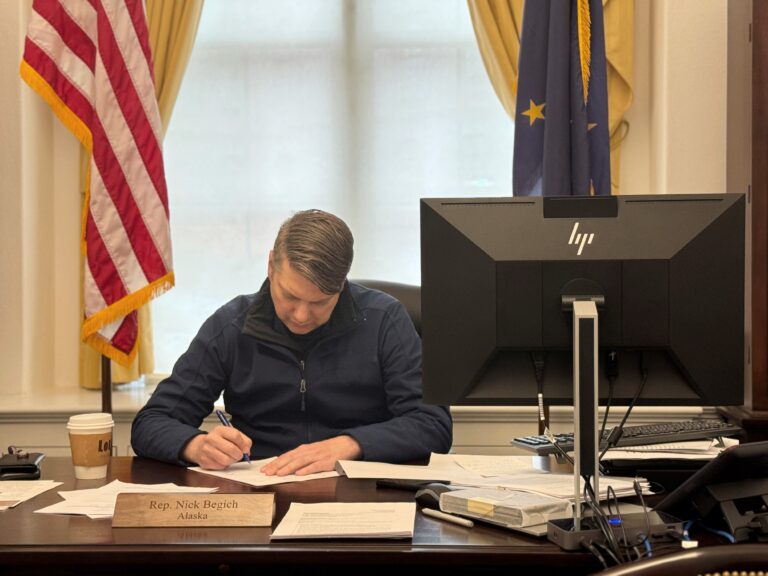
It’s “Crypto Week” in the US House of Representatives, and Alaska’s Congressman Nick Begich is emerging as one of the nation’s most influential voices on cryptocurrency policy. From July 14-18, lawmakers are debating and voting on sweeping digital asset legislation, with Begich playing a central role as both a legislator and an expert in the rapidly evolving crypto landscape.
Begich, already known for his pro-oil, gas, mining, and aerospace stances, has made a name in Washington for his in-depth knowledge of Bitcoin and blockchain technology. His involvement in shaping cryptocurrency legislation comes as the US House focuses on three major bills that could redefine the nation’s approach to digital assets: the GENIUS Act, the CLARITY Act, and the Anti-CBDC Surveillance State Act.
Congressman Nick Begich speaks at a national Bitcoin Policy Institute conference with Congressman Tom Emmers.
The Guiding and Establishing National Innovation for US Stablecoins Act (GENIUS Act) seeks to regulate stablecoins, which are cryptocurrencies pegged to traditional assets like the US dollar. Already passed in the Senate with bipartisan support (68-30), the bill would require stablecoin issuers to maintain full cash reserves, register with federal regulators, and follow anti-money laundering protocols. With President Trump signaling enthusiastic support, the bill is expected to pass the House this week.
The Digital Asset Market Clarity Act (CLARITY Act) aims to end the longstanding regulatory turf war between the Securities and Exchange Commission (SEC) and the Commodity Futures Trading Commission by clearly defining which agencies oversee different types of digital assets. The legislation promises to unlock innovation while drawing criticism from Democrats concerned about consumer protections.
The Anti-CBDC Surveillance State Act, introduced by House Majority Whip Tom Emmer, would ban the Federal Reserve from issuing a central bank digital currency (CBDC). Proponents argue it protects financial privacy, while critics call it premature since the Fed has yet to formally pursue a digital dollar.
Begich is not just a participant in Crypto Week; he is helping lead the conversation. Earlier this year, Begich introduced the BITCOIN Act of 2025, co-sponsored with Sen. Cynthia Lummis of Wyoming, proposing the creation of a US Strategic Bitcoin Reserve. The ambitious legislation would allow the federal government to acquire up to 1 million Bitcoin over five years using budget-neutral mechanisms like Federal Reserve remittances and gold revaluations. Crucially, the bill includes strong protections for Bitcoin self-custody rights.
Begich’s personal experience bolsters his credibility. He has publicly disclosed holding Bitcoin since 2013, giving him over a decade of firsthand knowledge in the digital asset space. He has been a sought-after speaker at major crypto events like the Bitcoin for America Summit and the Bitcoin Policy Summit, where he has shared the stage with leading policymakers such as Tom Emmer.
Congressman Begich is one of the few lawmakers who deeply understands the technical and economic implications of Bitcoin. With bipartisan support behind the GENIUS Act, passage seems likely within weeks. The CLARITY Act faces tougher odds in the Senate, while the Anti-CBDC Act may struggle to advance. Nevertheless, Crypto Week marks a pivotal moment for America’s digital asset strategy, and Alaska’s Nick Begich is at the heart of it — a national leader helping chart the future of U.S. financial innovation.
Alaska’s current education system stands in sharp contrast to the unified, accountable governance envisioned by the Framers of the 1955 Constitutional Convention. Article X was designed to eliminate redundant special-purpose districts, especially school districts, by integrating them into borough governments. The goal was clear: reduce administrative duplication, empower local control, and ensure equitable public services. Today, that vision has been lost.
The state now supports dozens of independent school districts, each duplicating costly administrative functions without delivering improved outcomes. Rural and remote communities suffer most, facing high per-student costs, limited access to specialized instruction, and chronic teacher turnover. The Alaska Department of Education and Early Development (DEED) worsens the problem by enforcing a one-size-fits-all model that ignores the state’s vast geographic and cultural diversity.
Boroughs are left funding school districts they cannot oversee, undermining accountability and strategic planning. The Framers never intended school districts to be permanent or autonomous; they expected boroughs to take on educational responsibilities to promote efficiency, equity, and transparency.
Reform is further blocked by public education unions and entrenched special interests that resist change to protect political influence. These groups oppose consolidation and accountability, prioritize bureaucracy over outcomes, and dominate school boards and legislative policy, preserving a broken status quo.
Adding to the system’s inflexibility is Alaska’s “Mini-Blaine Amendment,” which prohibits public funds from supporting religious or private schools. While Article IX, Section 6 permits spending for any legitimate public purpose, the Mini-Blaine restriction hinders modern innovations like Education Savings Accounts (ESAs). Originally rooted in 19th-century anti-Catholic bias, it now obstructs parental choice and customized education options.
However, recent U.S. Supreme Court rulings (Espinoza and Carson) affirm that once states fund education, they cannot exclude religious providers. These decisions create a clear path for Alaska to adopt ESAs, empowering families to direct education funding toward services that best meet their children’s needs, especially vital in underserved rural areas.
Until Alaska reforms its education system to reflect its constitutional foundations, it will continue to sacrifice fiscal responsibility, democratic governance, and student success to preserve a system designed to serve institutions, not children.
I. A Unified System of Local Government
At the heart of Article X lies a mandate: “maximum local self-government with a minimum of local government units.” The Framers designed boroughs to serve as broad-based, general-purpose governments, capable of assuming key responsibilities like education, roads, and planning. Their goal was to eliminate the duplicative jurisdictions and unaccountable authorities that plagued other states.
School districts, road boards, and similar entities were to be temporary mechanisms, used only until borough governments matured. In time, these special-purpose bodies were expected to be absorbed into the broader borough framework, streamlining services and ensuring public accountability through elected assemblies.
During the 1955-1956 Alaska Constitutional Convention, the delegates clearly intended to eliminate duplicative and overlapping local government structures and favored general-purpose boroughs over special-purpose districts, particularly school districts.
Key Supporting Evidence from the 1955 Convention:
Delegates’ Intent to Avoid Duplication: The delegates sought to avoid the “crazy quilt” of overlapping jurisdictions seen elsewhere by creating the borough system—designed to simplify governance and prevent a maze of redundant taxing authorities.
Integration of School Districts into Boroughs: The delegates saw the absorption of school districts by boroughs as essential to a unified system, reducing duplication while allowing flexible, locally accountable governance suited to Alaska’s unique geography. Boroughs would assume functions like education, previously handled by separate districts.
Challenges of Implementation Without Timetable: While the constitution did not specify a timetable for borough creation, the delegates were aware this would create a transitional period during which school districts, public utility districts and other special service districts would continue to operate. However, they anticipated that these would eventually be replaced or absorbed as the borough system matured.
The delegates’ intent was not only to favor general-purpose over special-purpose governance but also to reduce administrative duplication, particularly in the realm of education. The records of the 1955–1956 Alaska Constitutional Convention accurately reflect this vision. While some delegates favored maintaining independent school districts, the prevailing and adopted constitutional model supported integration into boroughs, a foundational component of Alaska’s unique local government structure.
II. Education: A State Duty, Locally Delivered
Article VII, Section 1 of the Alaska Constitution assigns the responsibility for public education to the State. However, this did not imply permanent separation from local government. Rather, the Framers envisioned a transitional period during which school districts would serve as administrative tools until boroughs were able to assume educational governance.
The Convention records make clear: school districts were not meant to be autonomous, permanent structures. Once capable, boroughs were expected to administer education directly by aligning with the overall goal of unified, locally accountable government.
III. A System in Constitutional Tension
Despite this intent, Alaska’s current system maintains structurally independent school districts, even within organized boroughs. These districts possess:
Independent elections and governance;
Budgetary and policy autonomy;
Tax-levying or tax-requesting authority;
Little or no integration with borough operations.
As a result, residents in organized boroughs must navigate two separate local governments: one for education, and another for all other services. This fragmentation directly contradicts Article X’s call for unified governance and minimal tax-levying jurisdictions.
Furthermore, it raises a constitutional question: does this dual structure, particularly within organized boroughs, violate the Framers’ intent and the Constitution’s structural mandates?
IV. The Constitutional Conflict
This question is not theoretical. It is foundational. It hinges on whether the Legislature has exceeded its discretion under Article VII by embedding education within a permanent parallel structure outside the borough system.
Legal precedent supports the Framers’ original design:
In Mobil Oil Corp. v. Local Boundary Commission, the Alaska Supreme Court upheld the principle of consolidated local governance through the borough system. The Court explicitly affirmed the Framers’ intent behind Article X of the Alaska Constitution, recognizing that boroughs were designed to unify and streamline local government functions. The decision stands as a clear judicial endorsement of the borough model as the constitutional foundation for local governance in Alaska.
In State v. A.L.I.V.E. Voluntary, the Court held that all exercises of public power must conform to constitutional structure, even if functionally sound. The A.L.I.V.E. decision is a powerful affirmation that constitutional form is not optional, even when the substance or function of a governmental action seems justified. The legislature cannot circumvent Article II’s procedures, and no branch of government may lawfully claim power except through the constitutional structure.
Today’s structure undermines both constitutional design and democratic accountability. The existence of independent school districts in organized boroughs fragments power, duplicates governance, and weakens public oversight.
V. A Constitutional Remedy Is Due
Alaska’s Framers sought to create a system where education and other local services were delivered by unified, locally accountable borough governments, not scattered among autonomous special-purpose districts. While temporary flexibility was allowed, permanent fragmentation was explicitly rejected.
The current system, particularly within organized boroughs, fails to realize this vision. It may comply functionally with the State’s duty to provide public education under Article VII, but it fails structurally under Article X’s mandate for unified local governance.
To restore constitutional integrity, Alaska must:
Transition education governance into borough structures;
Eliminate overlapping authorities where feasible;
Ensure that the delivery of education remains accountable to locally elected governments.
A constitutional challenge is not only possible, it is necessary to fulfill the promise of Alaska’s founding vision.
Those were the words retired Alaska Public Safety Commissioner Dick Burton chose to begin his email to three former colleagues on Jan. 2, 2023.
Burton’s colleagues agreed. One responded, “the whole thing is bizarre.” Another responded that he had checked with a retired district attorney who said it sounded funny to him as well.
The “really stinky” something that Burton was referring to was the Class C felony assault indictment against Ketchikan Police Chief Jeffrey Walls obtained by the Office of Special Prosecution under Attorney General Treg Taylor.
Matt Clark, an OSP prosecutor, had appeared before a Ketchikan grand jury four days earlier on Dec. 29, 2022. Count I of the proposed indictment was for a Class B felony assault requiring Walls’ intent to cause physical injury. Count II was for a Class C felony not requiring intent, but recklessness. The grand jury returned a “no true bill” on Count I but returned a true bill on Count II.
The indictment stemmed from an incident at Salmon Falls Resort, a restaurant outside of Ketchikan city limits, on September 10, 2022. Walls was off duty and went out to dinner there with his wife Sharon. During their meal, Walls was twice assaulted by a drunk customer from Washington State who would later admit his first assault against Walls was intentional.
The second assault occurred about a half hour later after the first. The assailant was served alcohol by the resort in between. In the second assault, he slammed into not only the Chief but also Sharon, hitting her with such force that her shoulder and chest were bruised.
Immediately after recovering from the second assault, Walls chased down the assailant in the restaurant and used force to try to detain him until Alaska State Troopers arrived. Two staff members of the resort who hadn’t seen the assaults interfered with Walls’ detainment resulting in another off-duty Ketchikan police officer, Kevin Manabat, trying to help Walls subdue the assailant.
After AST arrived, the drunk man was arrested and originally charged with four misdemeanors including assault, harassment, and being drunk on a licensed premise. Taylor later dismissed those charges and went after Walls instead, claiming Walls used excessive force in taking down the assailant. The Office of Special Prosecutions also threatened Officer Manabat with charges.
In evaluating Taylor’s decision, Walls’ background is highly relevant.
Walls had arrived in Ketchikan a year earlier from New Orleans, where he had been a highly decorated police officer, detective and commander. The recipient of 20 awards, medals, and letters of commendation since 2001, Walls had spent the previous 10 years as the Police Commander of the Eight District which includes the French Quarter.
Walls promotion to Police Commander occurred while the US Department of Justice’s Office of Civil Rights was investigating an alleged pattern of civil rights violations and criminal misconduct by the New Orleans Police Department. The NOPD and Justice Department soon entered into a consent decree, an extensive blueprint for positive change, encompassing sweeping, department-wide reforms that were expected to take many years to implement.
A federal district court maintained jurisdiction over the Consent Decree with annual reporting by a Monitoring Team. Bullet points in its 2019 Executive Summary include “NOPD continues to make significant progress in every area of the Consent Decree” and “NOPD leadership deserves significant credit for bringing the Department this far.” Walls was part of that leadership team.
Walls had grown up in a small Alabama town and missed the feel of a tight-knit community. He’d always loved the idea of moving to Alaska, so when the police chief position in Ketchikan became vacant, he applied.
He was hired in early 2022 and quickly focused his attention on reducing illegal narcotics activity. He promoted drug prevention programs in the schools and increased his department’s community outreach. He began working with judges to implement diversion programs for low level offenders.
Walls also focused on drug seizures and immediate gains were realized. In his first year, KPD seized 17,000 deadly fentanyl pills, an increase of over 500% from the previous year. Undoubtedly, the lives of many Alaskans were saved through his initiatives.
But Walls wasn’t satisfied with this achievement. His department knew some drugs had slipped by them and Walls wanted them to be even more effective. He initiated the City’s acquisition of a K-9 dog with unique training that increased the dog’s reliability and credibility in court proceedings.
In November of 2022, the FBI Special Agent in Charge for Alaska made a visit to the Ketchikan Police Department to commend them for these seizures. That year Ketchikan seized more illegal narcotics than any other department in Alaska.
Did Taylor have a problem with that? The Attorney General obtained the indictment against Walls the following month.
Walls’ first annual performance evaluation in January of 2023 concluded, “Chief Walls consistently exceeded expectations in his role as Police Chief. He has demonstrated a deep commitment to public safety, community engagement, and officer development. Under his leadership, KPD has achieved significant drug seizures, improved relationships with the community, and prioritized training for his staff.”
In June of 2023, Ketchikan Superior Court Judge Kathryn Lybrand dismissed the indictment against Walls, finding that prosecutor Clark had advised the grand jury in error. Clark had wrongly led the grand jury to believe that because Walls was off duty, he had no authority to use force to detain his and his wife’s assailant pending AST’s arrival.
Really stinky indeed: OSP had obtained its indictment obtained against a good police officer by misleading the grand jury on the law. Go figure. But things were about to get even stinkier.
Taylor decided to go after Walls again. This time our Attorney General took the highly unusual step of presenting the Class C charge to a grand jury in Juneau where none of the witnesses were present. Taylor assigned a different prosecutor to advise the grand jury, OSP’s Bailey Woolfstead.
In September of 2023, the Juneau grand jury indicted Walls not only on the Class C felony, but determined that Walls’ use of force was intentional adding back in the Class B felony count that the Ketchikan grand jury had rejected.
In December of 2023, Lybrand once again threw out the illegally gained indictment against Walls. The judge found that the prosecutor presented the case to the grand jury in a way that removed material evidence from its consideration. The judge also found that the testimony of Alaska State Trooper Larry Dur’an was “incomplete, inaccurate, and misleading” in a material way.
Unbelievably, Taylor went after Walls a third time, once again using the highly irregular measure of utilizing grand jurors in Juneau. Taylor assigned yet another OSP prosecutor, Krystyn Tendy, to advise the grand jury. Tendy succeeded in obtaining a Class C felony indictment against Walls in January of 2024.
For the third time, Judge Lybrand threw out the indictment but this time she took the highly unusual step of dismissing the indictment with prejudice. Lybrand wrote in her May 3, 2024 order, “the State’s three consecutive failures to present this case correctly leave the court with no confidence that the State will do it correctly a fourth time.”
Lybrand barred the State from going after any more felony indictments against Walls. However, the judge did not dismiss the State’s misdemeanor charges against Wall, allowing a jury trial on those charges to stay on calendar for September 10, 2024.
By now Walls and his wife Sharon were done with their Alaska dream that had turned into a two-year nightmare. Before the scheduled trial, Walls reached an agreement with Taylor where in exchange for a dismissal of the misdemeanor charges, he would retire as the Police Chief and leave the state.
Sam Curtis a spokesperson for the Department of Law said ensuring Walls “will no longer be part of Alaska’s law enforcement community was a primary goal” of their agreement to dismiss the remaining misdemeanor charges.
Deputy Attorney General John Skidmore stated, “Neither Ketchikan, nor any other community in Alaska, nor any community in the rest of the country will be at risk that Mr. Walls’ poor judgement will impact them while wearing the uniform of a law enforcement officer.”
Undoubtedly, fentanyl traffickers throughout SE Alaska joined the Department of Law in celebration.
However, the City of Ketchikan was not pleased. In a memo to the mayor and City Council, the assistant city manager wrote:
“It is with great sadness that the City Manager’s office accepts the retirement notice of Police Chief Jeffrey Walls…. During his tenure, Chief Walls has served our community with distinction and dedication and has done so throughout his career. He has instituted lasting changes for the department, including increased community engagement and dialogue, robust training and promotional opportunities for staff, implementing advanced technologies in the field of police work, leadership restructuring, a K-9 program, and the beginnings of a reserve program. The City Manager’s office has always been impressed with his leadership, integrity, and commitment to public service and community, and we consider it a privilege to have been able to work with him these last several years.”
Police Chief Walls gave a lot to Alaska. What did our Attorney General give to him in return? The shaft.
Sharon Walls, an assault victim without recourse, thanks to Taylor, doesn’t want to ever return to Alaska. She told me that if someone told her there was a pot of gold in Alaska and all she had to do to claim it was to fly back to Alaska, she would pass.
Sharon still can’t understand why Taylor would drop charges against her assailant and go after her husband so aggressively, misleading the grand jury on multiple occasions. Sharon holds a political science degree from Louisiana State University, where she took a course in public corruption. In her mind now, Alaska is the #1 state in the country for public corruption.
There are a number of aspects to the Walls’ story that are deeply disturbing, yet tie into a long pattern of abuse of power by State officials responsible for Alaska’s criminal justice system. More details will be forthcoming.
Before he passed away in June 2024, former Commissioner Burton expressed deep concern about some of these other aspects in the Walls’ case. They involve AST.
In Burton’s remembrance, a Facebook post by the AST stated, “his devotion to law enforcement in Alaska was unrivaled.” In honor of Burton, maybe it’s time AST leadership started being honest with themselves. Top officials there know what I’m referring to.
As for the Department of Law, it’s one thing for its prosecutors over the years to manipulate grand juries in indictments and attempted investigations into cases involving “ordinary” citizens like Thomas Jack Jr., David Haeg, or numerous families who have had their children wrongfully kidnapped by OCS. But when the Department of Law manipulates and misleads three different grand juries to indict a decorated police chief whose department has just been commended by the FBI for its effort in taking deadly drugs off the street, they’ve elevated the problem to a whole new level.
Fellow Alaskans, we’re in deep, deep trouble.
All three branches of the State government have known about these problems for a long time but have chosen to ignore them. Like New Orleans, perhaps the State of Alaska’s criminal justice system needs federal oversight under a consent decree.
If that happens, maybe, just maybe, we can convince Chief Walls and Sharon to return to Alaska and use their extensive experience to help oversee our transition from a state known for its corruption to a state known for its justice.
In the process, perhaps many more Alaskan lives will be saved.
David Ignell was born and raised in Juneau where he currently resides. He formerly practiced law in California state and federal courts and was a volunteer analyst for the California Innocence Project. He is currently a forensic journalist and recently wrote a book on the Alaska Grand Jury.
James Baisden, a conservative member of the Kenai Peninsula Borough Assembly, announced his resignation, effective Oct. 19—just after the next borough election. His timing ensures that his seat representing the Kalifornsky district will appear on the Oct. 7 ballot, giving voters the opportunity to choose his replacement rather than leaving it to an appointment by the Assembly.
Baisden, who previously served as chief of staff to former Borough Mayor Charlie Pierce and before that was chief of emergency services, was elected to the Assembly last year. He said increased personal commitments are prompting his early departure.
“I’ve enjoyed hanging out with everybody here,” Baisden told fellow Assembly members at their regular Tuesday meeting, where they accepted his resignation letter. “Yeah, I’ve got some things that I’ve got to do. I didn’t think it would happen as soon.” He said his family life has change “a little bit” but did not go into detail.
The Kalifornsky district seat covers the area between Kenai and Soldotna.
Baiden’s departure adds to an already packed municipal election, in which voters will now select candidates for five Assembly seats instead of the usual three. The seat representing Sterling and Funny River, currently vacant, will also be on the ballot.
The filing period for candidates for this seat opens Aug. 1, giving interested residents a chance to get on the ballot before the Oct. 7 election.
The FBI is asking for the public’s assistance in identifying a suspect involved in a bank robbery at the Wells Fargo branch located inside the 5th Avenue Mall on Friday afternoon.
According to investigators, the robbery occurred at approximately 1:40 pm on July 11. The suspect, described as a man possibly in his 40s or 50s, approximately 5 feet 5 inches tall, entered the bank and passed a note to a teller demanding money. The note indicated that the man was armed, though no weapon was visibly displayed.
Prior to the robbery, the suspect was observed sitting in a massage chair outside the bank entrance. After receiving an undisclosed amount of cash, he exited the mall on foot. Law enforcement officers responded quickly to the scene, but the suspect was not immediately located.
Authorities have not released surveillance images at this time but are encouraging anyone who may have seen the individual or has any relevant information to come forward.
The last bank robbery in Anchorage occurred one year ago on July 13, 2024, when James Surrells, 54, robbed a local credit union and took $450. He was caught later that day and was sentenced in March, 2025 to over 13 years in prison for the crime, which he committed while on supervised release for a previous bank robbery conviction in a 2014 incident.
The FBI Anchorage Field Office is leading the investigation and urges anyone with tips to call 907-276-4441. Anonymous tips may also be submitted online at tips.fbi.gov.
Missouri on just became the latest state to prohibit foreign entities from financing ballot measure campaigns, as Gov. Mike Kehoe signed Senate Bill 152 into law on Tuesday. Missouri is the 19th state to adopt such an explicit ban, and the ninth state to do so in 2025.
The legislation bars foreign nationals, governments, and entities from directly or indirectly contributing to ballot initiative campaigns, a response to growing concerns over foreign influence in US elections. Kehoe’s signing follows similar legislative action in Louisiana, where Gov. Jeff Landry approved House Bill 693 on June 20.
The first such ban was enacted nearly three decades ago in California, under the administration of then-Gov. Pete Wilson in 1997. Since then, momentum has grown as lawmakers nationwide seek to reinforce the integrity of ballot initiative processes—often seen as particularly vulnerable to large infusions of outside cash.
Of the 19 states with bans now in place, 11 had Republican trifectas (control of both legislative chambers and the governorship) at the time of enactment. Six had divided governments, and only two were under Democratic trifectas. This year’s surge has been overwhelmingly driven by Republican-led states — seven of the nine states enacting bans in 2025 fall into that category.
Lawmakers in several other states, including Idaho and North Carolina, are reportedly considering similar bans.
While Alaska’s laws require transparency for candidate elections, contributions to ballot measure campaigns can come from any source, including out-of-state entities, except foreign nationals, with no contribution limits.
Alaska has yet to join the growing list of states that have outlawed foreign money in initiative campaigns. The Last Frontier has is a target for Outside entities to push “citizen-led” ballot measures.
By TRENT ENGLAND AND JASON SNEAD | DAILY CALLER NEWS FOUNDATION
Remember the sales pitch for ranked choice voting? Sure, it’s more complicated, excludes voters, and delays results. But it’ll be worth it because ranked choice voting is supposed to help moderate, consensus candidates. So much for that.
Marxist extremist Zohran Mamdani is now the Democrat nominee for New York City mayor, with 43.5 percent of the vote. Well, sort of. Mamdani was ranked first by about 432,305 voters from among 1,026,783 who cast a ballot in the Democrat’s primary. Following ranked-choice voting retabulations, Mamdani’s share of the vote went up to 56% out of only 973,864 voters, producing the mirage of a Mamdani majority.
This is ranked choice voting’s new math. A normal election is simple addition: one vote, plus one vote, and so on until it’s done. With ranked choice voting, there are multiple rounds of addition—and subtraction.
Ranked choice voting tabulation starts by eliminating the least popular candidate, which really means eliminating the votes (first-place rankings) for that candidate. If affected voters ranked other candidates, their votes are shifted to their second-place rankings, and this repeats until a winner clinches a “majority.” But here is the kicker: along the way, if voters run out of rankings before the final round of tabulation, their ballots are eliminated from the final results. It’s as if those people never voted—all to make it appear that the winner has majority support. Their votes simply disappear from the final results.
With ranked choice voting, your right to vote does not include the right to have your vote count for an unpopular candidate. Nor does it include the right to timely and reliable election results.
It’s clear that Mamdani is going to be the Democrat’s nominee. Voters used longer, more complex ballots, and none of it matters. The initial result is almost certain to stay the same when ranked choice tabulations are completed. This was true four years ago, when Eric Adams had an even greater lead in first-place votes and, eventually, won in the ranked choice process as well.
At least when ranked choice voting is superfluous, results can be quick and decisive. If the election was closer, the multi-round tabulation could lead to weeks of uncertainty. Delays and complexity are a recipe for distrust. After Maine adopted ranked choice voting, a researcher at the MIT Election Lab found it produced “significantly lower levels of voter confidence, voter satisfaction, and ease of use.”
In Oakland, Calif., voters can be forgiven for losing confidence. Ranked choice voting there led to the wrong winner taking office. It started with a few hundred voters who didn’t rank a candidate first but did rank one second. Election officials made their own mistake, incorrectly programming their ranked choice voting tabulation software. These errors, only possible with ranked choice voting, threw off all the final counts and changed the result in one school board race.
The failure almost went undetected, because ranked choice voting tabulation happens inside the “black box” of a computer. Outside experts stumbled on it and notified the county nearly two months after the election. In all, it took four months, a voluntary resignation by the wrong winner, a court order, and dumb luck to fix this ranked choice voting mess.
New York City’s first experience with ranked choice voting flirted with a similar disaster. Before it was reversed, a tabulation glitch threatened to knock current Mayor Eric Adams out of contention. And even after the City spent $15 million to teach people how to use ranked choice voting, many simply don’t do it.
Ranked choice voting makes voting harder, affecting some citizens more than others. The data is clear: minority, low-income, and less-educated voters are more likely to have their ballots eliminated. Their voices are diluted, their influence diminished, according to another analysis. All this is supposed to be worth it because ranked choice voting will somehow produce moderate, consensus winners.
Mamdani appears to be the first choice of about 14% of New York City’s 3 million registered Democrats. In other words, he’s not even the consensus choice of his own party. His positions are so extreme that Gov. Kathy Hochul has thus far declined to endorse him. Mamdani wants government to run grocery stores, confiscate guns, shut down prisons, and allow prostitution. After the vicious Oct. 7 Hamas terrorist attack, Mamdani blamed Israel’s government for “ongoing violence” in the region.
Ranked choice voting has failed New York City. It burdens voters without providing any real benefit, threatens to delay results by weeks, and increases the risk that some hidden mistake will cause a true election disaster. No wonder voters in six states refused to adopt it last year, and 17 states have banned it. Many cities have tried ranked choice voting and then repealed it. New York City should join them.
Jason Snead and Trent England are Co-Chairs of the Stop RCV Coalition.
On the one-year anniversary of one of the most brazen attempts on the life of Donald Trump, the US Senate Homeland Security and Governmental Affairs Committee on Sunday released its final report on the attempted assassination during campaign rally in Butler, Penn. The report sharply criticized the United States Secret Service for what it described as “a complete breakdown of security at every level.”
The report, issued by Committee Chairman Sen. Rand Paul of Kentucky, outlines a series of intelligence and procedural failures that nearly cost Trump his life on July 13, 2024, when a gunman opened fire from a rooftop overlooking the rally, injuring four people, including Trump, and killing firefighter Corey Comperatore.
According to the report, Secret Service agents received a report of a suspicious individual with a rangefinder on the rooftop of the American Glass Research building 25 minutes before shots were fired. Despite this, no action was taken to clear or secure the location. The report found that key intelligence was not shared with agents protecting Trump, coordination with local law enforcement was deficient, and critical assets, including counter-sniper teams, were missing from the scene.
Following the attack, the Committee, along with the Senate Permanent Subcommittee on Investigations, launched a yearlong bipartisan investigation. Over 17 transcribed interviews were conducted, and more than 75,000 pages of documents were reviewed. A preliminary report was released in September 2024; the final report incorporates new evidence and details systemic failures.
Among the Committee’s findings:
Secret Service denied multiple requests for additional personnel and resources to protect Trump during the campaign.
No personnel have been terminated as a result of the failures in Butler. Six were formally disciplined, some as late as July 2025. In at least two cases, the disciplinary decisions were reduced from the original recommendations.
Then-Director Kimberly Cheatle falsely testified to Congress that all asset requests had been approved for the rally.
Despite prior intelligence, counter-sniper teams were absent at a July 9, 2024, rally in Doral, Florida, contrary to authorized protocol.
Advance agents operated under vague directives, leading to poor site control and miscommunication.
A failure to transmit crucial intelligence regarding the rooftop threat to Trump’s protective detail meant no action was taken to delay his appearance.
Coordination with local law enforcement was described as insufficient from planning through execution of the event.
Sen. Paul criticized the lack of accountability, noting that only through subpoenas did the Committee gain visibility into internal disciplinary actions. The report warns that the structural issues uncovered, ranging from poor communication to lapses in leadership, must be corrected to prevent future threats against high-profile public figures.
As part of the report’s release, the Committee published subpoenaed documents, disciplinary records, and transcribed interviews in an effort to promote transparency. The addendum also includes a summary of procedural changes implemented by the Secret Service in the wake of the Butler attack. Here are the documents released today:
INTERVIEW TRANSCRIPTS: These transcribed interviews were conducted during the 118th Congress. References to offices reflect the leadership structure of the Committee in the 118th Congress, and not the current leadership structure of the Committee. In these documents, references to “HSGAC Minority” refer to now Chairman Paul’s staff. References to HSGAC majority refer to now Ranking Member Peters’ staff. References to PSI Minority refer to now Chairman Johnson’s staff. References to PSI Majority refer to now Ranking Member Blumenthal’s staff.
The Bear Paw Parade celebrated its 40th anniversary on Saturday with all the charm and energy locals have come to love. From pageant princesses and football teams to candy-tossing floats and grinning kids lining the route, the annual event felt as youthful and joyful as ever.
But this year’s celebration came with an unexpected twist. A group of “no circumcision” protesters disrupted the family-friendly atmosphere with graphic signage and costumes featuring blood-red stains over their pants. Their presence rattled many parade-goers, prompting calls to local law enforcement.
Police responded quickly but, after assessing the situation, determined the protest fell under constitutionally protected free speech. No arrests or citations were made.
The festival managers posted about the incident on Facebook:
A Note to Our Bear Paw Festival Attendees
Well folks… we knew Bear Paw would bring surprises — but today brought something none of us anticipated.
During what should’ve been a joyful, family-friendly afternoon full of music, parades, and festival fun, a group of demonstrators chose to share a very specific message about circumcision. While we absolutely respect the right to free speech, this was not the time or place for such content.
Our team quickly contacted the Anchorage Police Department’s non-emergency line. Officers responded promptly and professionally. Because of the public nature of our event, removal was not possible, but the situation remained peaceful and was monitored closely. No injuries occurred, and the festivities continued as planned.
To our families, vendors, performers, and incredible volunteers — thank you for your patience, understanding, and keeping cool under very strange circum….stances. We recognize this disruption was unwelcome and out of line with the spirit of Bear Paw.
We are actively reviewing our safety protocols and public space policies to better protect the joyful, inclusive atmosphere we all value.
Thank you for sticking with us — and for helping keep Bear Paw all about community, celebration, and just the right amount of weird.
—The Bear Paw Festival Team
Despite the jarring display, the spirit of Bear Paw endured, and Must Read Alaska captured photos of the festivities that carried on, undeterred by the brief disruption: