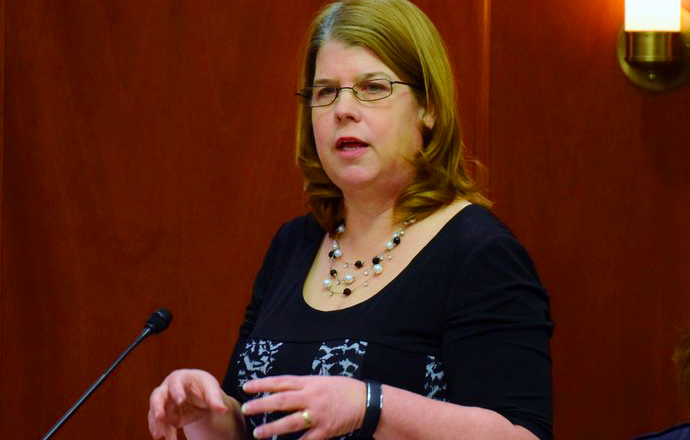
Rep. Tammie Wilson, who joined the Democrat-led Majority in February to become the powerful co-chair of House Finance, is out of the Majority.
News of her departure from the 25-member caucus spread quickly through the Capitol as she began packing her spacious Finance Chair suite to move into one of the tiny offices that minority members are assigned to.
The original majority caucus had eight Republicans and is now down to six of them, after Rep. Gabrielle LeDoux announced her departure from the group in May. LeDoux voted against the operating budget because she agrees with those who believe the $3,000 Permanent Fund dividend is statutorily correct.
Reps. Gabrielle LeDoux, center, and Tammie Wilson, right, are no longer part of the Democrat-led Majority.
Wilson on Wednesday was the lone vote against an override of Gov. Michael Dunleavy’s $444 million vetoes of the budget. For this, and for having attended the alternate legislative meeting in Wasilla, she paid the price.
The way she left the caucus is also subject to different versions. She said she was kicked out; the Majority caucus framed it as thanking her for her service and wishing her well in her future endeavors.
Wilson told reporters she would be heading home to Fairbanks. The Republican Minority, which Wilson left in February to join the Democrat-led Majority, has reached out to her, but it’s unclear where she stands. After LeDoux left the Majority, she is alone without a caucus, and the same may hold true for Wilson.
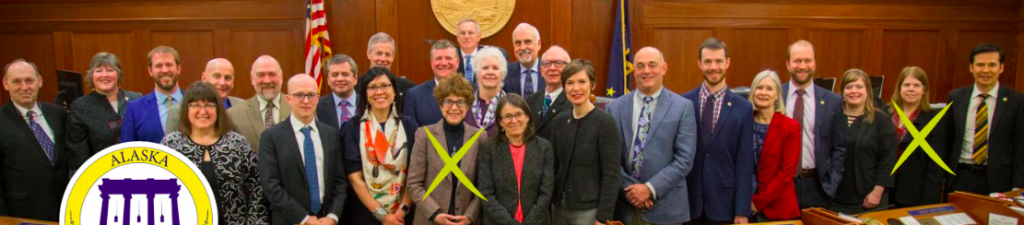
The House Majority is down to 23. In actuality, there are 23 Republicans elected to the House, but Reps. Louise Stutes, Bart LeBon, Steve Thompson, Gary Knopp, Jennifer Johnston, and Chuck Kopp caucus with the Democrats, leaving the Republicans with just 16 in their caucus.
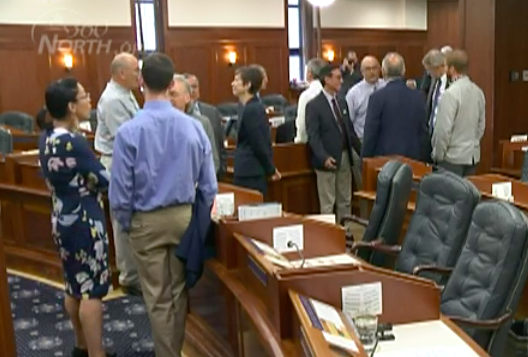
With just 24 hours to go to override the governor’s vetoes, the two-thirds of the legislature that is in Juneau is trying to figure out a last-ditch effort to restore $440 million in government spending through veto overrides.
They didn’t have enough people in the room to succeed, however, even if everyone voted to override.
During their floor speeches about the operating budget in Thursday’s joint session, their speaking tones were not quite as defiant as on Wednesday. They pleaded. They begged their colleagues in Wasilla to join them.
Only Sen. David Wilson of Wasilla had heeded the call to come to Juneau, and they all knew he was a no vote on an override.
They were in the process of suffering from a humiliating defeat by the more conservative legislators — the “Thrifty One-Third” who have sided with Gov. Michael Dunleavy’s call for the second Special Session to be held in Wasilla.
Sen. John Coghill speaks about the cuts to the University of Alaska.
Sen. John Coghill expressed sadness. His community of Fairbanks will take a major hit when the University of Alaska restructures to adapt to a $135 million cut. The university of one of the three pillars of the Fairbanks economy, he said, along with mining and military. He cautioned that many small businesses that exist because of the university employment base will go belly up.
Sen. Tom Begich’s voice broke as he talked about losing the state he loves. He reminisced about working as a legislative aide during the days when the oil money flowed and spending was reckless.
Rep. Andy Josephson said he would fight on until his last breath:
“This ship will be righted or I will die trying. We will do everything we can through every mechanism before us,” Josephson said. He said he thought all the people who want a full PFD will probably get in their Winnebagos and leave the state if they don’t get them.
Rep. Chuck Kopp called on all to compromise, but seemed to especially want the governor to compromise, likening the Legislature to a lighthouse — immovable — and the governor to a battleship that had better change course. At least that was how the analogy was delivered, although Kopp may have meant something different.
Rep. Bryce Edgmon withdrew his motion to rescind the vote from Wednesday that failed to override the operating budget vetoes. To vote again was futile. He spoke in conciliatory terms at the end of today’s joint floor session, saying that all sides need to work together.
Session adjourned at 12:25 pm on Thursday as rumors flew through political circles about how Friday would play out, with a noon deadline for veto overrides looming: Would legislators in Juneau get on a plane and come north?
Or will legislators in Wasilla fly south so that at least the capital budget veto override motion, offered today by Sen. Lyman Hoffman, can be voted on.
READ SEN. GIESSEL LETTER ON VETOESDESTROYING ECONOMY
Legislators in Juneau have been actively explaining themselves to the public and their voters about where they stand on the governor’s budget vetoes and why they oppose them.
On the floor of the joint House and Senate, Rep. Steve Thompson described his feelings this way: “We’re mad as hell and we’re not going to take it anymore!”
He may have been paraphrasing a movie script from the 1996 movie “Network.”
The “mad as hell” scene from the movie “Network.”
But Thompson was also channeling the anger of the anarchist-led mob who took over a legal meeting of legislators that was being held in Wasilla at the same time.
A protester continues yelling while Rep. Lance Pruitt takes a selfie in Wasilla on Wednesday during the anarchists’ takeover of the legislative meeting.
No legislator in Juneau has yet condemned the takeover of the Wasilla meeting by the radical, screaming mob that came from other communities to occupy a legally assembled Wasilla legislative meeting.
The Democrat-led House Majority seemed to want more disruption:
“We will keep fighting until this assault on our economy and state ends … but our efforts will only succeed if everyone disturbed by these reckless cuts continues to raise their voice,” the House Democrat-led Majority wrote.
The Senate President today issued a long explanation of why she supports a veto override, and she, too, made no mention of the “Occupy” group that illegally invaded the Wasilla meeting — a meeting she does not recognize as legitimate.
Her words are newsworthy and deserve wider readership. Here’s Giessel’s letter in full:
Sen. Cathy Giessel, Senate President
SEN. CATHYGIESSEL LETTER TO CONSITUENTS
On Wednesday, July 10th, the House and Senate met together in order to consider overrides to the Governor’s vetoes of the Operating Budget. That override was not successful.
Alaska has, in its Constitution, the highest requirement for a veto override vote of items struck from a budget- ¾ of the Legislature need to vote in order to undo the actions of a governor. All other states require 2/3, 3/5 or simple majority.
We did not have 45 legislators present for the vote. The missing members equate to a NO vote on the override. That means the override was not attainable.
We have recessed the joint session until today. We are hopeful that the missing legislators will decide to come to Juneau to participate in this critical vote.
The Finance committees have been meeting. One of the missing Senators called in to participate in the Senate Finance meeting on Tuesday morning. Clearly, Senators understand that the work being done in Juneau is legitimate and urgent for the state.
The Constitution of our country and of the State of Alaska clearly defines a representative form of government. In fact, the Alaska Statehood Act, the compact the people of Alaska voted into existence, states that “the State of Alaska shall always be republican in form.” This means that the people elect representatives who bring their ideas to bear when government decisions are made.
There are 3 branches of government – Executive, Judicial and Legislative. James Madison, in the Federalist Papers, noted that the most powerful branch is the Legislative. His reason? The Legislative branch is elected by small groups of people, and so it is therefore closest to the people. The Legislator brings the voices of each smaller area into the larger discussion of what should become law.
Legislators represent the diverse opinions of people across our state. The 40 Representatives and 20 Senators are different. With all the different life experiences, professions, families and cultural backgrounds, hailing from communities in the Arctic, in the temperate rainforest, in the tundra, and in the Pacific swept island chains, how could we not be different?
When you see big divides in the Legislature, understand that this represents a multitude of opinions across our state. An example of this is seen in the contrasting views on the budget and the Permanent Fund Dividend.
Operating Budget – The Legislature held lengthy meetings, full of debate and disagreement. At the end, we constructed a budget that reduced spending back to 2004 levels of unrestricted general funds, resulting in the largest real education in state history. At the same time, legislators worked cooperatively with organizations affected to negotiate reductions. The reductions were about $250 million. The Senate voted unanimously on that budget.
Operating Budget Now – The Governor made reductions of $444 million more, above and beyond what the Legislature has done collaboratively as 60 lawmakers. We now face destruction of key parts of the state’s economy.
Mental Health Budget – This budget is never controversial…until this year. The Governor has vetoed some of the funds in this budget as well.
Vetoed Items:
University – The University of Alaska is a key research facility. It is known, world-wide, for Arctic research. The U.S. is an Arctic nation because of Alaska.
Yet, the U.S. government has little expertise on Arctic topics outside of the work pioneered by UA. The University prepares our professional workforces. In fact, the presence of the University was one of the reasons that the military decided to deploy fighter jets here.
Head Start, Adult Dental, Senior Benefits, WWAMI (medical education scholarships to bring doctors back to Alaska), University of Alaska Performance Scholarships for high school seniors, behavioral health and homeless grants and more have been targeted by the Governor’s red pen – over 180 items vetoed that impact Alaskans of every age, geographic area, demographic.
I am asked if I am a fiscal conservative who wants to reduce the size of government. The answer is yes; just ask the many folks who criticized me for most of my time in the Legislature for being a “rabid right winger” on fiscal issues. I voted for a fiscally conservative budget in the Operating Budget this year. The Legislature performed careful surgery. The vetoes are reckless amputations.
Veto Override Session:
As I presided over the Joint Session, I could see each legislator’s face as they spoke about the impact of the various vetoes. Many strong men and women had to fight back tears as they spoke about the damage caused by cuts that undermine their communities. These lawmakers were seeing the faces of the men, women, and families in their districts. They were envisioning their neighborhood streets with ‘For Sale’ signs in front of homes and ‘Closed’ signs on businesses. It was heart-felt grief for our Alaskans and our economy that drove those remarks on the floor yesterday.
Some people think Legislators are aloof, wealthy, detached elites. Fake news!!! We are Alaskans, citizens just like all of you. We worked hard to meet the need to reduce spending without creating mortal injury to our families, businesses and jobs. We came together, as Alaskans of different backgrounds, in this Special Session, to repair Alaska from the impacts of these vetoes. Sadly, 22 of our colleagues didn’t share the same level of concern.
Thursday, July 11 – Rescind Action and vote again to override
We have made allowance for our absent colleagues. There is a motion to pull back the failed vote to override and return to the Joint Session on Thursday to vote again.
The time for that last vote will be at 10:30 AM. This allows our absent colleagues to arrive in Juneau and get to the Capitol. There was a flight last night available, or they could come down on this morning’s early flight. We are offering them every opportunity possible to do the right thing for Alaskans.
The Alaska Gasline Development Corporation is reducing its staff by two third and refocusing its mission.
By August, the agency that had 26 staff members in the 2019 fiscal cycle under Gov. Bill Walker will be down to eight, plus some contractors who will provide technical work. 12 current employees of the agency are being laid off; others are already gone.
AGDC will pursue the permitting for an Alaska liquified natural gas project, but will once again look to the private sector to shoulder the development and risk of the project, which is estimated to cost between $43 and $60 billion and involves two major processing plants and an 800-mile gasline from the North Slope to Nikiski.
Under Walker, AGDC was the lead on the project and the owners of Alaska gas — BP, Exxon, and ConocoPhillips — were chased off because they were not moving fast enough for Walker. Walker had signed agreements with China, as well as Japan, and Korean entities to buy the gas, and had all but put China in the driver’s seat as the project developer and financier.
The CEO of the agency, Joe Dubler, released this statement on Wednesday:
“AGDC is restructuring to reflect our primary focus on completing the FERC permitting process to advance the Alaska LNG project. AGDC will continue to pursue (Federal Energy Regulatory Commission) authorization, expected in June 2020, with an eight-person technical staff plus contract support as needed, and reduce employee headcount by twelve. Completing the permitting process will substantially de-risk Alaska LNG and open the door to a wider range of potential project parties with the broad expertise required to unlock the value and manage the risks associated with a project of this magnitude.”
Fairbanks is a town divided. Some residents support state budget cuts — which are coming in at 12.5 percent of the entire state budget.
Others, including the daily newspaper of the Golden Heart City, do not support the $400 million in cuts, and want a legislative override.
Former Rep. Al Vezey of the greater Fairbanks Borough may or may not be in either camp, but one thing he is clear on is that the legislative meetings in Juneau do not qualify as the second Special Session. They are simply meetings. Vezey filed a lawsuit Wednesday to ask the court for an injunction against those proceedings.
The Vezey complaint, which names House Speaker Bryce Edgmon and Sen. President Cathy Giessel, says that the two presiding officers acted in contempt of the constitutionally ordained mandate to comply with Gov. Michael Dunleavy’s executive proclamation, which set the venue for the second Special Session in Wasilla.
“The assembling of legislators in Juneau, Alaska is nothing more than a gathering of members of the legislature,” his complaint reads. “This gathering is and was instigated through the President of the Alaska State Senate and the Speaker of the Alaska State House of Representatives by virtue of their ex officio authority.”
The complaint asks the court for a declaratory judgment that the currently convened meetings in Juneau do not constitute an actual meeting of the Special Session, and that anything coming out of those meetings does not have the force of law. And it asks for an injunction, compelling Giessel and Edgmon to convene the Special Session in Wasilla, where the governor called it.
It’s an argument that judges will be loathe to involve themselves because both sides are politically motivated and have much at stake.
NEWSPAPER REVEALS ITS CARDS
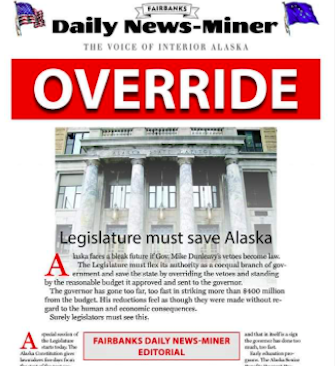
Two days earlier, the Fairbanks NewsMiner published a full-page, front-page editorial titled “override.”
Conservatives in Fairbanks say that the newspaper, circulation about 9,000, has all but destroyed its credibility over this decision to turn completely political and will likely lose hundreds of subscribers with its breathless declaration: “Legislature must save Alaska.”
In fact, it is extremely rare for a newspaper to use its front page real estate to express the owner’s opinion. It would have been done only with a robust discussion of the editorial board.
But the newspaper is now owned by the nonprofit Snedden Foundation, which bought the newspaper in 2015. The Snedden Foundation’s top employees are all NewsMiner staffers, and the newspaper is the foundation’s sole business line. The Snedden Foundation will have some explaining to do to the IRS this year for its clear attempt to influence legislation by becoming a propaganda organ.
The Snedden Foundation’s IRS filing in 2017 showed it does not carry on propaganda or try to influence public policy or elections.
Front page editorials are an oddity, but not without precedent. In the rare occasions they are used, they stir controversy in their communities about the appropriateness of dedicating what is considered to be “neutral space” to the newspaper’s opinion. Some examples of other newspapers that have dabbled in the practice include:
1951: President Harry Truman fired Gen. Douglas MacArthur for insubordination. The New York Journal American condemned the action on the front page.
1953: With fighting ending in Korea, William Randolph Hearst Jr. wrote “The Korean Truce” editorial on the front page of the Albany, N.Y. Times Union.
But rarely do frontage editorials take up the entire page, as the NewsMiner chose to do. It’s a huge risk for the newspaper, and harms the credibility of reporters covering the issues.
REPUBLICANS SPLIT
At a meeting of Fairbanks Republicans a week and a half ago, Rep. Steve Thompson, a Republican who now caucuses with the Democrats, took a barrage of polite but pointed criticism from his fellow Republicans for not standing with Republicans in support of the governor. His appearance at the Friday Republican luncheon was nothing short of disastrous for him and few in Fairbanks political circles think he will have the stomach to run for re-election.
Steve Lundgren, president and CEO of Denali State Bank and another Republican, testified to the House Finance Committee this week that his bank wanted veto overrides because, well, the bank is a holder of several University of Alaska bonds, and he’s worried about the value of those bonds. Unfortunately, Lundgren demonstrated that his invited expert testimony about the state budget was motivated.
Fairbanks is, in many ways a university town, and the $135 million haircut to the university budget will hit many families hard. There will be consolidation, job losses, and degree programs scrapped. Hundreds of jobs could be eliminated, and that’s of no small concern to a town that takes pride in the Fairbanks campus and has fought for it year after year, battling for supremacy over the growing Anchorage campus.
As elsewhere in the state, Fairbanks residents are taking sides, and it’s not only Democrats nicking Republicans over the budget, but someRepublicans also attempting to convince legislators to override the vetoes.
They have until Friday; after that, the budget that is signed is the budget that sticks for Fiscal Year 2020, and the university — in Fairbanks and at all the other 16 campus locations in Alaska — will need to adapt to a new reality.
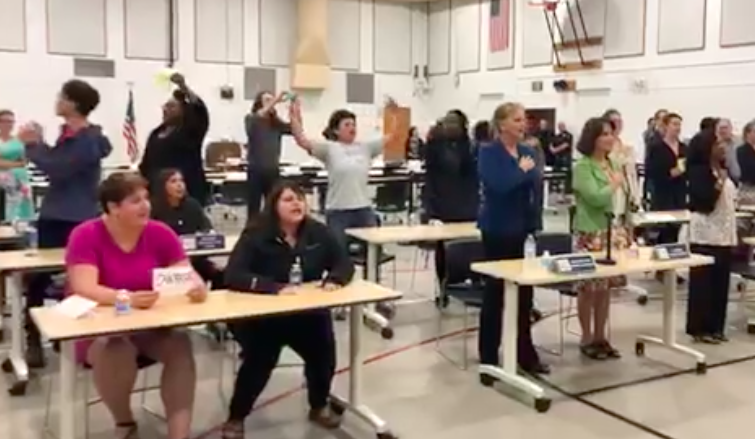
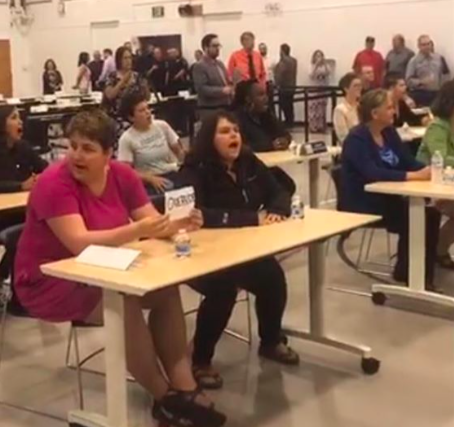
A videographer and citizen reporter who films under the name Politadick captured the action at Wasilla Middle School, as several police officers stood by while protesters occupied, disrupted, and essentially took over the Wednesday meeting of several legislators who were in Wasilla, where the governor called the second Special Session:
Questions remain about why Wasilla police allowed the front doors of the school to be barricaded by protesters who chained themselves to the doors, endangering the people inside, who arrived through a side entrance.
The Legislature is split in two, with two thirds of the elected officials meeting in Juneau, and one third meeting in Wasilla. Both sides claim to have the State Constitution on their side as it pertains to the location of the second Special Session.
Save Our State, a loose coalition of groups that has not been transparent about its funding or core organizers, is the apparent parent organization that this group of anarchists is working under. It’s believed that Save Our State is led by Vince Beltrami of the AFL-CIO, the National Education Association, the ACLU, the Alaska Center for the Environment, and other groups who are proxies for the Alaska Democratic Party. But there are others whose financial support might surprise Alaskans.
The interesting thing about the video is that the legislators were polite, unfazed, and handled themselves with decorum, as did the conservatives present in the audience.
These protesters were not Wasilla residents. These were from Anchorage and possibly from out of state.
More coverage on the meeting disruption can be found here:
Alaska Republican Party Chairman Glenn Clary issued a statement on Wednesday afternoon, calling on law enforcement to ensure the safety of legislators:
“This afternoon in Wasilla, threatening, shrieking Democrat protesters and their ancillary leftist accomplices disrupted a peaceful session of Republican legislators who were considering budgetary matters pursuant to Governor Dunleavy’s instructions. We have seen these tactics used by similar mobs who injure conservatives around the country. And now the Democrats have brought this type of indecent behavior to our great State,” Clary said.
“The Alaska Republican Party expects law enforcement to protect all of our duly elected legislators and media representatives, wherever they are in the State of Alaska, from all harm so they can go about their lawful activities,” he concluded.
Clary’s remarks were in response to unlawful occupation by leftist protesters of a lawful assembly of legislators at the Wasilla Middle School earlier on Wednesday.
The 22 legislators who are convening in Wasilla were given the royal “Antifa treatment,” with numerous antics and disruptions from protesters.
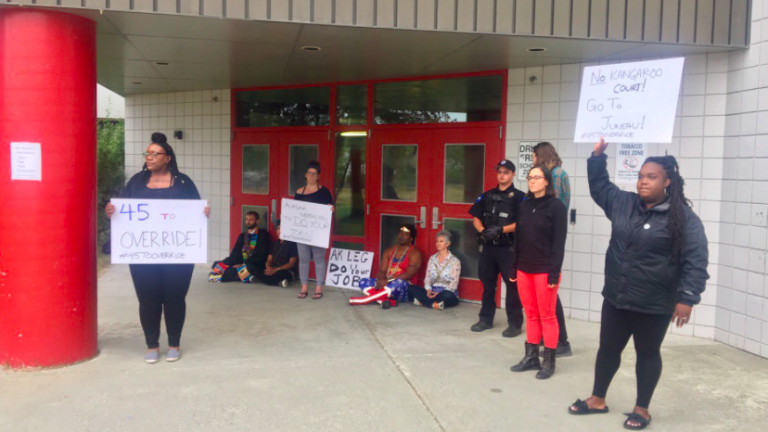
The moment the legislators walked into the gymnasium at Wasilla Middle School, where their makeshift proceedings are taking place, the protesters rushed to occupy the lawmakers’ assigned seats. Legislators simply moved to other seats. Protesters screamed and chanted and held signs.
Photo by Shannon Connelly
As Rep. Sharon Jackson began to sing “Amazing Grace,” there was a noticeable pause in the yelling, as if it caught the protesters off guard. Then, a protester yelled “Indigenous prayers on indigenous land!” And the collective howling continued.
As the prayer was said, protesters yelled more against prayers and for “45 to override!”
They screamed over the voices of legislators reciting the Pledge of Allegiance.
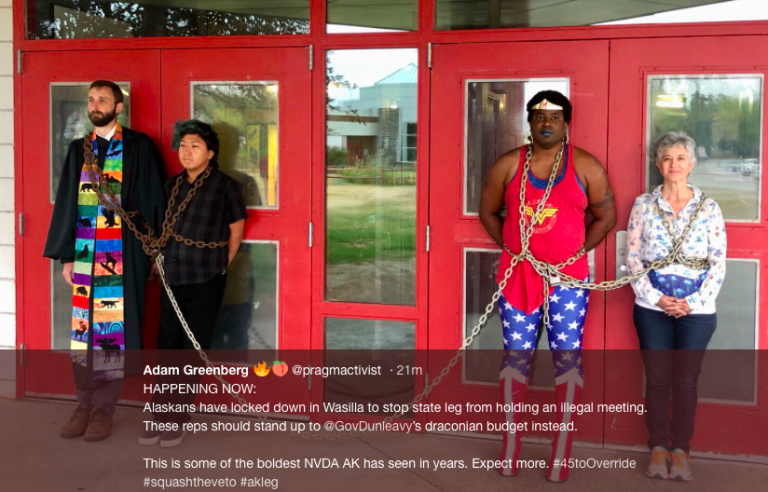
And then some of them chained themselves to the outer door, causing a public safety hazard. They screamed while Sen. Mia Costello made a few remarks.
Wasilla Police and State Troopers talked to the protesters but didn’t intervene. They later ushered lawmakers into a “hospitality room” for their safety, and eventually the lawmakers were able to exit the building through an undisclosed door.
Rep. Lance Pruitt takes a selfie with one of the screaming protesters, while another one screams behind him.
Protesters stayed for another two hours, while media cameras took in the entire spectacle.
In contrast, there were conservatives from across the Mat-Su Valley at the meeting, and they conducted themselves with decorum, although they were shocked at the spectacle and, in whispers, wondered why the protesters were not arrested. There was no shouting back, although there were some attempts to have meaningful dialogue — attempts that were met with more shouting.
One lawmaker noted that the presiding officers of the Legislature, Sen. Cathy Giessel and Rep. Bryce Edgmon, said Wasilla was not a safe place to do the people’s business, ostensibly because Wasillans are known for their passionate conservative politics.
But it was the “other side” that created a safety issue, behaving much as protesters do in third-world countries when they occupy government buildings, the lawmaker noted.
Among the protesters who stormed the floor and took legislators’ seats were Olivia Garrett, who was recently a staffer to Sen. Scott Kawasaki; and Judy Jessen, who recently staffed Rep. Ivy Spohnholz. They are the women photographed above.
Back in Juneau, there were not enough legislators present to override the governor’s vetoes. Gov. Michael Dunleavy has vetoed 12.5 percent of the overall operating budget, but many of the cuts are to the University of Alaska, whose leadership has mounted a concerted protest. The entire university system is now alive with protest of the $135 million vetoes to the nearly $1 billion university budget, which is 17 percent of the overall university system operating budget.
Protesters stormed the Capitol in Juneau this year, led by AFL-CIO President Vince Beltrami, but the media didn’t report it widely. MRAK did report on the near takeover of the Third Floor of the Capitol:
While the theatrics took place in Wasilla, a vote took place in a joint session in Juneau, and the votes to override the governor’s vetoes failed with just 37 to override. Rep. Tammie Wilson, who flew to Juneau on Monday, was the lone “no” vote. There were not even enough lawmakers in Juneau to actually override the vetoes, but the vote allowed them to get on the record their displeasure.
This is a developing story. Check back for further details.
A group of protesters has chained itself to the doors of Wasilla Middle School to prevent legislators from entering. Evidently they are unaware that there are other entrances to the school.
Some 22 legislators are meeting in Wasilla, where the governor has called for a special session. Others are meeting in Juneau to try to override the governor’s budget vetoes.
In the Twitter post above, the protesters are calling the Wasilla gathering an illegal meeting.