Sunday, October 11, 2026
Home Blog Page 1471

Alaska Life Hack: Smoke gets in your eye with Kenai fire

8

WORST AIR IN WESTERN HEMISPHERE; TRAVEL TO KENAI BY ROAD IS DIFFICULT

Southcentral Alaska residents don’t need to be told: The air quality is — pardoned the technical word here — horrible.

At 7:15 am this morning, heavy smoke drifted across the entire region on one of the worst air quality days, as shown in the photo above taken of Anchorage from an Alaska Airlines jet heading north.

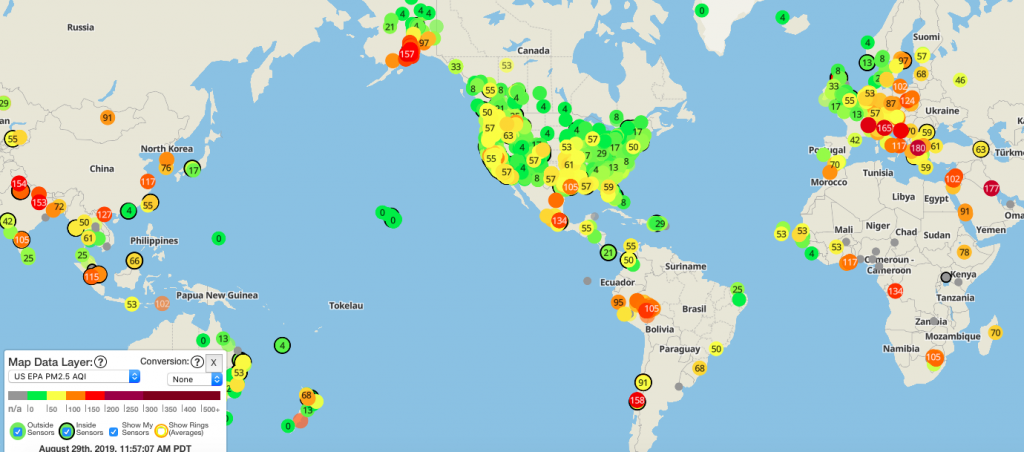
According to purpleair.com, which tracks real-time air quality around the world, Southcentral ranks the worst in the Western Hemisphere at this time, and among the top five worst air in the world this morning, even exceeding Chinese industrial cities.
Here is the latest update on the Swan Lake Fire from the Kenai Borough Office of Emergency Management:

SWAN LAKE FIRE

New comprehensive area closure orders have been issued for public lands surrounding and including the burned area. A community meeting will be held at the Sterling Community Center on Friday, Aug. 30 at at 6 pm.

Fire suppression activities and dense smoke make travel on the Sterling Highway between Sterling, Alaska and Cooper Landing hazardous, and there are travel delays. Authorities are discouraging use of this section of the highway, if possible. Motorists who choose to travel through the fire area should be prepared for potentially lengthy delays by assuring their vehicle has ample fuel and carrying food and water for occupants. Do not stop along the highway within the fire area. The eastern end of travel restrictions has moved to milepost 40 north of the junction with the Seward Highway. The Kenai Peninsula Borough Office of Emergency Management has the latest information at kpboem.com, on Facebook at KPB Alerts and at their call center at 907-262-INFO (4636).

Cooper Landing: An additional strike team of four engines and one hotshot crew is working from 10:00 am to midnight around Cooper Landing to bolster resources through the more active afternoon and evening hours. They join the other firefighters to continue reducing hazardous fuels around structures, install water sprinklers, and to protect the power line corridor.

Heavy smoke caused poor visibility that significantly limited yesterday’s air operations. The most active portion of the fire was on the eastern flank in the Juneau Creek drainage. It moved slowly, down-slope to the south as well up-valley to the north on the Resurrection Trail. While this growth does not yet present an immediate concern for Cooper Landing, fire managers are evaluating strategies for limiting further spread. Rugged terrain and difficult access present challenges in those areas. Today, three crews are hiking up the drainage to begin constructing new containment lines to arrest further spread.

Wednesday night’s public meeting in Cooper Landing attracted about 200 people to the school and another estimated 360 on Facebook Live. Fire managers and local officials shared information about suppression progress and plans as well as Sterling Highway travel restrictions and contingency plans should evacuations be needed.

Cooper Landing remains in a SET status due to fire activity. All residents should be SET (fully prepared) to evacuate if the situation warrants. If you feel uncomfortable or need additional time, consider leaving before an evacuation notice. The Cooper Landing School is also closed until at least Sept. 3.

Sterling: The southwestern corner of the fire experienced some increased activity near, but inside, containment lines. Work will continue to cool this area as well as securing the perimeter northward to the Sterling Highway by extinguishing any remaining burning or smoldering fuels adjacent to the containment lines. Structure protection on the western flank is effectively in place.

The Sterling neighborhoods east of Feuding Lane and east of Adkins Road remain in a READY status. A READY notification means residents should be preparing for a potential evacuation should the threat level increase.

Weather: High pressure will persist over the fire for the next 48 hours providing very similar conditions to yesterday—light winds, warm temperatures and moderately low relative humidity. A low-pressure storm system is expected to move inland on Saturday and will likely bring cooler temperatures with precipitation. Gusty winds are predicted for Sunday afternoon.

Closures: The Kenai National Wildlife Refuge and the Chugach National Forest have issued coordinated, comprehensive area closures for public lands surrounding and including the Swan Lake Fire. These orders will incorporate the previous individual closures as well as new restrictions on public entry and use. The orders and accompanying maps are available at local U.S. Fish and Wildlife Service and Chugach National Forest offices and online at kpboem.com.

Temporary Flight Restrictions (TFR): A TFR is in place for air space over the Swan Lake Fire (9/7677 NOTAM). The TFR includes unmanned Aircraft Systems (UAS), or drones, as well. Flying drones near wildfires could cause injury or death to firefighters as a result of a mid-air collision with tactical firefighting aircraft.
Balash and Udall trade barbs over BLM decentralization

7

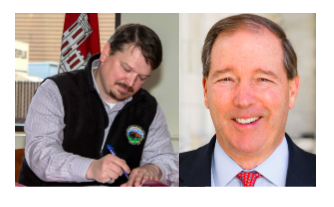
Photo: Joe Balash, left, Sen. Tom Udall

A U.S. senator from the impoverished state of New Mexico (second poorest in the nation) strenuously objects to having the headquarters of the Bureau of Land Management move to the West from the nation’s capital. Those 32 federal jobs his state would get? Not important.

But his objections came too late, and now he’s unhappy.

In a letter to outgoing Assistant Secretary of the Interior Joe Balash on Aug. 22, Sen. Tom Udall of New Mexico and Congresswoman Betty McCollum of Minnesota lobbed criticism at the plans to bring BLM management West, a move announced in July by Balash.

[Read: BLM moving HQ west to Grand Junction, Colorado]

“Based on the incomplete and superficial information that you provided, it appears that the proposal to relocate Bureau headquarters is not based on rigorous financial and organizational analysis, nor is it intended to increase the Bureau’s accountability and improve the management of our nation’s public lands. Instead, we are concerned that the proposal is designed to reduce the Bureau’s effectiveness and relevance. As a result, we object to the Department moving forward with the reorganization of the Bureau and the relocation of its staff,” the lawmakers wrote.

Udall letter-blm-reorg-aug22

The two are unhappy to see the Bureau of Land Management is decentralizing much of its decision making staff to the Western states, where federal workers in charge will be closer to the land they manage. They prefer those decisions be made in Washington, D.C. They say the effort is meant to dismantle the BLM.

Balash, who is with the agency through the end of the month, tapped back a polite letter stating that if Udall and McCollum didn’t want jobs in their states, the agency would happily reconsider whether to put those jobs there.

That infuriated Udall, who took the exchange to the media, leaking the letters a reporter and hit the news at The Hill newspaper, which then published a blustery headline, “Interior official threatens to withhold jobs in lawmakers’ districts after opposition to BLM move.”

‘Threatens’ being the key word.

It was all a bit of August theater, since Udall and McCollum had  missed the 30-day window to object to the move. Udall is a Democrat, and McCollum is a member of the Democrat-Farmer-Labor Party, which is unique to Minnesota. They are both members of their respective Appropriation Subcommittees on lnterior, Environment, and Related Agencies, and they were well aware of the comment window, or should have been.

What Balash’s letter actually said was, in an agreeable tone, “Given your apparent strong feelings about the Department’s actions and intentions, we pledge to review and reconsider the relocation of additional departmental resources to your state. We are also open to working with other delegations that object to additional departmental resources being allocated to their states.”

Udall’s home state of New Mexico was set to receive 32 federal workers, while Minnesota is not included in the plan that would leave 60 employees in Washington, D.C. and move about 300 to western states, with a western headquarters in Grand Junction, Colo., where 27 top BLM managers would be located.

Udall and McCollum appear to be upset that they missed the window to make their objections, and are further upset that Balash called their bluff. It was a slow news day in August in the nation’s capital, particularly since Udall announced in March he will not seek reelection in 2020. As for Balash, he’s only at Interior through the end of the month. Then he’s going fishing.

BP, and its money, will be missed

By ANCHORAGE DAILY PLANET

It is amazing to watch as the news that BP is planning to leave the state rattles through the nonprofit universe in Alaska.

Over the years, you seldom heard anything positive about BP or the oil industry. Plenty of bad. Not much good. You rarely heard they annually gave millions of dollars to nonprofits – BP alone gave something like $4 million just last year – or loaned executives to them, or encouraged employees to pitch in and help in their communities.

BP generously supported more than 200 organizations across the state, gave earthquake aid, built a conference center and supported everything from the Alaska State Fair to the Fur Rendezvous to the Alaska Zoo. It funded scholarships and camps and the Anchorage symphony. The list is seemingly endless. In its 50 years in Alaska, it has been a generous corporate neighbor.

Now that it plans to pull up stakes for greener pastures, folks are starting to remember all that. The worries are that Houston-based Hilcorp, the proposed buyer, may not be so generous. It gave $315,000 to Alaska charities last year, the Anchorage Daily News reported.

But “$13.5 million has been donated by (its) employees to organizations across the United States, according to data on Hilcorp’s website. About 43 percent of that money, or $5.8 million, went to religious causes — by far the biggest donation category,” the newspaper reported.

If regulators agree, the company Alaska loves to hate, the company that for decades fed much of the state and paid for its government, is leaving. It will be missed.

And not only on the North Slope.

[Read more of the Anchorage Daily Planet at this link]

Former Rep. Lynn Gattis battens down the hatches in Bahamas

1

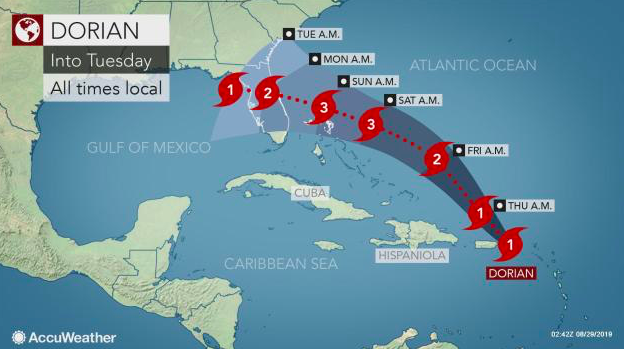
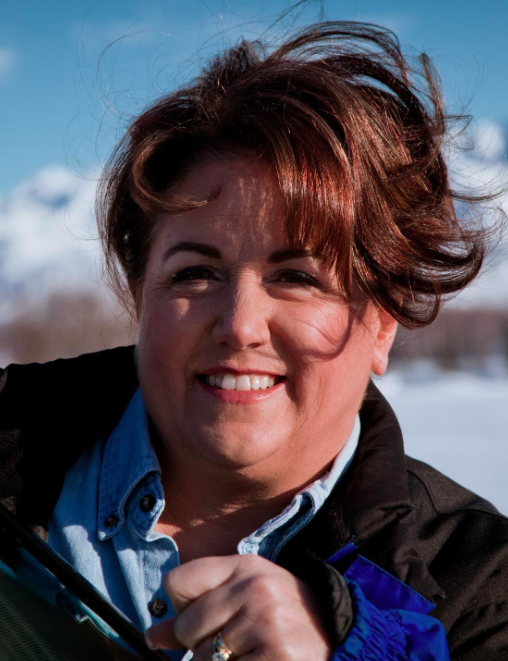
Former House Rep. Lynn Gattis and her husband Rick are building a vacation home in the Bahamas on Abaco Island at Marsh Harbour. Tonight they were securing their building materials with ratchet straps as Hurricane Dorian muscles its way toward the eastern shore of Florida.

The northern islands in the Bahamas, where Abaco is located, are in the path of Dorian, which has sustained winds that increased to 85 mph as of Wednesday night. The National Hurricane Center says it is moving at 13 mph toward open waters of the southern Atlantic, where it is expected to become a Category 3 hurricane as it approaches the island where the Gattises are hunkered down.

Gattis said the island is no more than 9 feet above sea level and storm surge is expected to be as much as 11 feet, so she expects things to get sloppy. She reported that boats and ships are pulling into harbor and being cabled into position in advance of the storm. As for her and Rick, they already made their grocery run and have their provisions to ride out the storm.

Accuweather says “interests north and east of the Bahamas should prepare for hurricane conditions. Some of the far northern islands of the Bahamas will be significantly impacted while the majority of the others will get barely a breeze and a little rain.”

Gattis, who has served on the school board in the Mat-Su Valley and as a Wasilla legislator, said she plans to post photos and video on her Facebook page to the extent possible. Follow her at: https://www.facebook.com/lynn.gattis .

The hay farmer from Wasilla ran in 2016 for the Senate Seat D vacated by Charlie Huggins, but she lost the primary to now-Sen. David Wilson. The vacancy she left in House District 7 is now filled by Rep. Colleen Sullivan-Leonard.

Losing BP: A wake-up call for tax-and-spenders?

The news about BP exiting Alaska came as no surprise to industry participants in the state; it had been rumored for months, with increasing buzz in recent weeks after Petroleum News advanced the news. But there was still a lot of folks on pins and needles, waiting for the big reveal.

[Read: BP sale rumors surface again, with credibility]

Having one of the world’s largest oil companies decide to leave Alaska is breathtaking. The company has openly said it was going to divest some $10 billion in business; Alaska was first to go.

That’s right, Alaska was the first to go.

If, as Sen. Bill Wielechowski and his oil tax hike initiative effort would have us believe, companies are making money hand over fist in Alaska, why would BP abandon the state?

It’s the business model, in part, according to Must Read Alaska’s knowledge experts. BP is a behemoth company that doesn’t do aging oil fields. Hilcorp does.

But Alaska has other issues: A high cost of doing business and an ever-changing tax structure from a government that just can’t decide when enough is enough in taxes. The large companies like BP need to plan 10 years out, and Alaska’s oil tax structure is so unstable they are not able to make those plans with any degree of confidence.

Lawmakers like Wielechowski insist taxes have nothing to do with it, but that Alaska just isn’t a good fit for BP anymore. He’s half right.

As a side note, the cost to the State treasury could be in the tens of millions, because unlike BP, which is a C Corporation, Hilcorp Alaska is a limited liability corporation, which does not pay a corporate income tax. Increased production could make up for the loss in corporate income tax, unless tax conditions change again, as Wielechowski would have them.

HILCORP ALASKA

Hilcorp is the kind of company that likes to drain every drop out of an aging oil field. Recently, BP conducted 3D seismic imagery of Prudhoe, getting fidelity that’s never been seen before. Hilcorp is the kind of company that will drill those pools and sidetracks and create a lot of economic activity on the Slope. Many oil industry people say this transaction is a very good thing for the Alaska economy.

Since arriving in Alaska in 2012, Hilcorp has pretty much taken over Cook Inlet gas, to the worry of some who wonder it the company will gouge the Kenai and Southcentral for the gas that runs homes and businesses.

Then Hilcorp acquired some of BP’s fields on the North Slope in 2014, shed a couple of hundred jobs, and, with five years of experience is now the dog that caught the truck. How it will adapt to the increase pressure of being one of Alaska’s “majors” is going to be part of its unfolding story.

Hilcorp Alaska paying $5.6 billion for BP’s assets in Alaska makes it one of the big players now.

NONPROFITS AND PRIVATE SECTOR WORRIES

Already, the nonprofit cartel has sent up the alarm that without BP’s philanthropic largesse, a gaping hole exists for nonprofits and Hilcorp isn’t like BP in the giving arena. BP has given to the nonprofits by the millions — $4 million last year alone.

That, too, was forecast by the leaders in the nonprofit world many years ago. In 2015, the former executive director of the Foraker Group warned that the nonprofit sector was still too reliant on the Rasmuson Foundation and major corporations.

“Appreciate the money that you’re getting from any industry, but understand that industry giving is market driven,” Dennis McMillian cautioned at the time. In Alaska, corporate philanthropy is three times the national average, while foundation funding is twice the national average.

The number of nonprofit organizations operating in Alaska has grown from 6,000 in 2007 to 7,904 in June of 2019. It’s an expanding industry that has grown 31 percent in 12 years in Alaska.

Between 2013-2018, BP has given $26 million to those nonprofits, while in 2017, it spent $855 million on Alaska vendors.

But while nonprofits have gained much from BP’s investment in them, few of them were there for the oil companies during the battle over Senate Bill 21, when tax advocates tried to jack up the taxes on production. In general, the nonprofits have been grateful recipients of the corporate funds, but not exactly besties with the oil sector.

Janus: The unions will play for time

32

THEY’LL LITIGATE UNTIL THEY CAN ELECT A DIFFERENT GOVERNOR

By ART CHANCE
SENIOR CONTRIBUTOR

I’ve been the bad smell in the Republicans’ ballroom ever since Janus v. AFSCME was handed down since I didn’t greet it with much enthusiasm. There is a lot less to it than meets the eye.

Yes, the U.S. Supreme Court held that compelling union dues as a condition of employment violated the First Amendment rights of public employees, but the court didn’t give out handy-dandy instruction books on how to implement its decision, an action that will be an existential battle with unions and Democrats.

Now Attorney General Kevin Clarkson has issued an opinion that labors to set out the obvious: the State’s labor agreements and payroll processes do not comply with the Janus decision.  It has only been nine months since the Administration took office and a year since the Janus decision was handed down.

There seems to be the idea that the Governor can hand down an administrative order to make it right with the Constitution. And there’s the notion that the Divisions of Personnel and Labor Relations and Finance can put out some payroll standard operating procedures and the State will be in compliance with Janus and the Constitution.

Were it only so easy!

I don’t have insomnia this evening so I didn’t read all the labor agreements but I looked at the two big ones: the Supervisors and the General Government Unit, between the two covering about 10,000 State employees.

Both current agreements were negotiated under the union-owned Walker Administration and the union rights and union security language is very familiar; it is essentially identical to the language in them when I retired 13 years ago and not that different from what it was when I first started with State Labor Relations in 1987.

Not only does the language not comply with Janus, it barely complies with Abood, Hudson, and their progeny, the earlier authority on dues, now supplanted by Janus.

Additionally both have a veritable Mare’s Nest of contractual prohibitions against the employer interfering between the union and members of the bargaining unit it represents. Note that term “bargaining unit.” That means you are someone in a job class that the union’s certification covers and it doesn’t matter if you’re a union member or not.

Both as a matter of law (the unfair labor practices section of the Public Employment Relations Act) and of contract, there are stringent limits on an employer’s right to even the most basic and neutral communication with a member of recognized bargaining unit.

The Administration is going to make all well with the Constitution by promulgating an administrative order.

[Read: Attorney General puts guardrails on collection of union dues]

The unions can elect their route(s) to remedy. They can go straight to court, arguing that the administrative orders violates the Public Employee Relations Act. It wouldn’t be hard for the unions to find a friendly Superior Court judge who would find that s/he could and should decide the case strictly on State law grounds and not reach a constitutional question.

Then the State could take it to our Supreme Court or pursue the constitutional issues as a federal question in the US District Court.

No matter which party wins, that one is going to the Ninth Circuit and then on to the U.S. Supreme Court, if they’ll take it. The only exception is if the State is on the losing end, and the appeal becomes trade goods in the next gubernatorial election. If a Democrat wins, the State just says “never mind,” and the case and controversy go away until the next time there is a Republican willing to tilt with this particular windmill.

[Read: A conversation with Mark Janus on the Alaska decision]

Or, the unions can file an unfair labor practice with the Alaska Labor Relations Agency alleging that the changes are first an unbargained unilateral change in a mandatory subject of bargaining and further that the administrative order is an unlawful interference with the employees’ right to “form, self-organize, and join” a union.

The Labor Relations Agency really has no jurisdiction over constitutional questions. And as a State law question, the State loses.

And finally, the unions can file a grievance(s) on myriad contract terms that they can somewhat credibly allege are violated by the State inserting itself into the question of whether a bargaining unit member chooses to become a union member and pay dues. The advantage this has for the unions is that they can waste a year working through the grievance/arbitration process before the question can even get to the courts.

At bottom, from the day Gov. Michael Dunleavy issues a directive in any form, an administrative order or a simple memo, there is a minimum of a three- to five-year, maybe more, court battle ahead. The unions have nothing to lose but their economic life and their political power, so nothing will deter them from taking this question up until they run out of courts, and even if they run out of courts, if they can scrape some money together, they’ll be trying to buy a Democrat governor who will save them.

There is no simple, short, or easy path to resolution of this question. My strategy would be to take the quickest path because the unions are playing for time, their standard ploy on matters in the courts; they don’t have to win the case, they just need to win the next election.

In my time with the State I had some very meritorious fundamental bargaining rights cases sold right out from under me in gubernatorial elections, and you can rest assured that any Democrat running for governor would promise his/her union friends to take care of an inconvenience like this for them.

I would try to bundle it all together, the contract provisions and the sections of PERA that authorize them, and if possible get straight to the US District Court.

This path leads through the Ninth Circuit and there are no guarantees there. The Ninth proved willing to stand the First Amendment on its head trying to protect the union security arrangements in Washington State and fortunately the U.S. Supreme Court stepped in and reversed the Ninth. In any event were the State to lose in the Ninth, it has no assurance that the Supreme Court would take an appeal. This, too, is a multi-year process but is simpler than the other routes. If it goes past the next gubernatorial election and Gov. Dunleavy or another Republican wins, it can continue as far as necessary to get the desired result or until the State runs out of courts.

If the unions buy themselves a Democrat governor, or maybe even another “false flag” governor, the question ends there for the foreseeable future.  And finally, if the Attorney General tries to handle the litigation with State staff, he should be aware that every State employee who touches this issue will be a former employee if a Democrat is elected Governor. They all know that, and it won’t just be assistant attorneys general and other appointees; the last time the unions faced an existential challenge, they elected a Democrat and purged employees who had been involved well down into merit system ranks.

I other words, if the administration really wants to take this on, it should consider contracting for outside counsel.

Art Chance is a retired Director of Labor Relations for the State of Alaska, formerly of Juneau and now living in Anchorage. He is the author of the book, “Red on Blue, Establishing a Republican Governance,” available at Amazon. 

Why we changed from ‘undeclared’ to Republican

16

By PAUL AND SUZETTE HUBER

We have always been conservative, but originally did not want to be limited to vote for one specific party. We preferred to consider the individual candidate, not the party. And like most independent/undeclared voters in Alaska, we were Republicans but didn’t want to be pigeon holed. Typically though, there hasn’t been any other vote for us than the Republican candidate, especially of late.

This year it became a necessity to declare our Republican affiliation because of the high‐profile betrayals, abuse of voters’ trust, and violation of voters’ mandates. The Left has manipulated the election process in their win‐at‐any‐cost mentality so that being registered as undeclared or independent is just the Left’s subterfuge.

Just look at the House Speaker; does anyone truly believe he is an independent? Or is he rather another Democrat who is willing to do anything to get what the Left wants?

That’s the problem with the Left, they have minimal foundational values to stand on, but only a sliding scale of what is good for their agenda at the time.

A January 2018 article on the Politico website outlined the left’s appalling tactic:

They have also started to manipulate the Republican Party so that weak, power hungry, greedy and/or hate‐filled elected officials that registered as Republicans no longer even attempt to adhere to the party’s platform. We saw it happen in the 2018 30th Legislature and even worse with this year’s 31st Legislature.

It has even reached the point to where the Senate President, a “Republican”, recently removed a conservative Republican from the head of the Republican Majority in the Senate and appointed a Democrat. This newly appointed Senate majority leader then promptly began denouncing Governor Dunleavey’s budget cuts.

This must end. We can no longer be passive or stay on the outside and look on without taking action. By registering with this party, we are taking a stand. We want to assist this party to become one that, if you claim to be a Republican, you will have to closely adhere to their stated ideals in the platform. If you can’t, leave the party. No more RINO’s like Lisa Murkowski, Cathy Giessel, Gary Knopp or the rest of their ilk. When you vote for a Republican, you should know with confidence they will stand by the Republican platform.

Will all Republicans always agree with every item on the platform? No, but a genuine Republican will identify with the vast majority of them and never turn against the party to align with a group in opposition. This is the party that formed in 1854 to oppose slavery, now it is the party that stands against the destruction of our country by the Left.

We urge other genuinely conservative voters that are not registered as Republican to join us and register as Republicans and get involved to make your voice count and make a difference. It’s time for people to declare their allegiance and work to protect the real Alaska, not the Alaska that left‐wing socialist groups outside our state are pushing to create. Do it, and do it now.

Paul and Suzette Huber live in Nikiski, have been married 30 years and Alaskan residents since 1994. Paul is retired after serving 25 years with the United States Coast Guard and Suzette just completed 21 years as a homeschool teacher to their four children.  Paul is very active in his community and is on numerous local boards and committees.

MRAK Almanac: Budget Cuts and UA Town Hall

0

8/28: Fairbanks Emergency Planning Committee, 10 am, Fairbanks Regional Fire Training Center, 1710 30th Avenue, Fairbanks. Info here.

8/28: Tower of Power plays at the Alaska State Fair.

8/28: Ketchikan School Board, 6 pm.

8/28: Ketchikan Special City Council meeting, port reconfiguration recommendations. 7 pm.

8/28: Homer City Council special meeting. Agenda.

8/29: Budget Cuts and UA Town Hall:

8/29: Scott Hawkins Memorial, 5 pm, Petroleum Club, Anchorage.

8/29: Slightly Stoopid plays at the Alaska State Fair.

8/30: Dropkick Murphys plays at the Alaska State Fair.

8/31: Last day to change your options for donating to charities with some or all of your Permanent Fund dividend through Pick. Click. Give.

8/31: Honoring 60 years of Statehood & former Lt. Governor Loren Leman, 5 pm,Land’s End Resort, Homer.

8/31: Nascar/Inex Season Finale, Alaska Raceways, 3-9 pm, 599 S Race Way, Palmer.

8/31: Cole Swindell at the Alaska State Fair.

9/1: Labor Day weekend Races at the Alaska Raceway Park drag strip, points races all day! Spectator gate opens at 10 a.m.

9/1: Jeff Foxworthy at the Alaska State Fair.

9/1: Last day to register to vote for various municipal and borough elections being held Oct. 1.

9/1: Deadline for parties to expand or limit ballot participation with Division of Elections. “Not later than 5 pm Alaska time, on Sept. 1 of the calendar year before the calendar year in which a primary election is to be held, a political party 06 shall submit a notice in writing to the director stating whether the party bylaws permit a voter registered as affiliated with another party to participate in the primary election for selection of the party’s candidates for elective state executive and state and national legislative offices. A copy of the party’s bylaws controlling whether a voter registered as affiliated with another political party may participate in the primary election for selection of the party’s candidates, documentation required under (b) of this section, and other information required by the director, must be submitted along with the notice.

9/2: Labor Day Monday.

9/2-4: Salmon Music Festival, Ninilchik.

9/3: Kenai Borough Assembly Meeting, 6 pm,  Betty J. Glick Assembly Chambers, George A. Navarre Borough Administration Building, 144 N. Binkley Street, Soldotna. Agenda.

9/6: Fundraiser for the Alaska Republican Party with special guest Congressman Don Young. Details in the poster above.

9/14: Rodeo Alaska – September to Remember, 7 pm George M Sullivan Sports Arena.

Sterling Highway open, but travel not advised by borough

1

COOPER LANDING SCHOOL CANCELLED WEDNESDAY

The Kenai Peninsula Borough at 10 pm on Tuesday said the Sterling Highway remains open, although conditions can change. Travel on the Sterling Hwy from Watson Lake to the Seward Hwy (Milepost 71-36) is not advised, however.

“We have had calls and see posts from people saying the highway is closed but it is not closed. There is a barrier with the wording “Road Closed” that is being used for a side road and may be confusing to motorists. Thank you for your patience; public safety is the first priority,” the borough’s virtual joint information office said.

“There may be long lines as people wait for the pilot car to shuttle them between mile 71 (Watson Lake) and the intersection of the Sterling and Seward Highways, Mile 36. Please be prepare to wait; bring food and water and have a full tank of fuel.”

Find the Swan Lake Fire updates at this site.