Wednesday, July 15, 2026
Home Blog Page 1448

Dunleavy bypasses reporters, goes straight to the people

Over the past few days, the Governor’s Office has dramatically changed the way Gov. Michael Dunleavy is reaching Alaskans with his messages about how he is delivering on his campaign promises.

He’s no longer relying on reporters to translate his words through their own biases and editorial filters. Instead, he has created a version of a multimedia newsroom and is speaking directly to the people.

Today, he called out the Anchorage Daily News for an inaccurate headline, and he did so on Facebook Live video:

“On Monday, we made a direct appeal to the people of Alaska with regards to the budget and the PFD. We wanted to talk straight to the people unfiltered by anyone including the press.

“Today, we took a look at the newspaper and we saw this headline in the newspaper, that ‘Dunleavy sets the dividend at $1,600.’

“This is why we’re going to continue to go directly to you, the people of Alaska. The headline simply is not true. I did not set nor would I set a dividend at $1,600. I’ve always said and will continue to say that we should be following a decades-old calculation, and whatever that calculation comes up with, which is approximately $3,000 this year, that’s what we should be doing.

“But again, if the press isn’t going to get it right, we’re going to go directly to you with all the facts and all the figures so you understand what’s going on,” he said in his brief statement on Facebook.

Dunleavy showed his discontent with the way the press has treated him since he took office, and perhaps even before he was elected. His communication team has now taken that to heart, setting up an “AKGov Press” site on Facebook, where they have started calling out media by name and telling the public what information was given to the media that they chose not to report. These posts have only started showing up over the past few days, and they are content-rich.

“But again you may hear from those in the press that we’re not as accessible as some others may have been in the past. We’ll continue to be accessible to the press, but again, when we see headlines like this, which aren’t true, we have to correct those mistakes by going directly to you.

“So you’ll see more of us going to you through Facebook Live, live broadcasts, as well as recorded broadcasts to get the message out,” Dunleavy said. As a former school teacher, he had a bit of a scolding demeanor, as if he’d caught some kids smoking behind the school.

Dunleavy’s multi-media newsroom approach appears to be catching on with the public. His PFD message on Monday instantly had more than 2,000 viewers tuned in to hear what he had to say about budget cuts and the Permanent Fund dividend. His reproach of the Anchorage Daily News reporting of his Monday message was shared more than 480 times in four hours, with the vast majority of the comments and reactions being positive toward his message.

The reach Dunleavy has without having to hope for fairness from a reporter or editor with a bias has potential and may be a game-changer for this governor, who has from the beginning been treated by the press in the same manner they treated Gov. Sean Parnell.

Or, on the other hand, it may ratchet up to a war between the Governor’s Office and the entire media establishment in Alaska.

The reporting scrum has been fascinating to watch for media observers in recent days. They have been in full attack mode. One TV reporter asked Dunleavy three times during three separate press conferences last week a pointed question: “Do you feel like you owe Alaskans an apology?”

Dunleavy called out the reporter, saying he had already asked the question twice and it was getting fairly predictable.

“I’ll try to be less predictable next time,” the reporter responded.

That exchange may have been the final straw that caused the governor’s press team to change course with the media.

Joe Balash resigns from Interior

3

Alaska’s biggest champion in the Department of the Interior has resigned, Sec. David Bernhardt announced today on Twitter.

Joe Balash was appointed by President Donald Trump to serve as Assistant Secretary of State for Land and Minerals Management. He came from the staff of U.S. Sen. Dan Sullivan, where he had served as chief of staff. Prior to that, Balash was the Alaska commissioner of the Department of Natural Resources.

In his resignation letter, Balash expressed his gratitude for all that had been accomplished and gave no indication about why he is leaving.

Bernhardt wrote on Twitter: “Assistant Secretary Joe Balash announced today his plans to move on from @Interior and I stand with @POTUS in thanking him for his exemplary service to the American people.”

Balash said he is leaving on good terms. The big headline issues for Alaska — ANWR, NPRA  — are priorities of this administration so will not fall through the cracks, he said. There are many strong Alaska voices inside the Administration — Steve Wackowski, Tara Sweeney, Gregg Renkes, and Kate MacGregor.

Return to ACES? Group files initiative to hike tax on Alaska’s oil producers

0

Robin Brena speaks at Gov. Bill Walker’s “Tax Camp” in the spring of 2015. Brena is leading the charge to raise taxes on oil production with an initiative that could go before voters.

Feel that chill?

It’s not winter coming. It’s a posse of experienced Alaska politicos with a voter initiative application for a major tax hike on oil production in Alaska. The group filed its application with the Division of Elections near the close of business on Friday.

The Office of the Lieutenant Governor has 60 days to review it before Lt. Gov. Kevin Meyer must decide whether to approve the petition for signature gathering, and then it could go to the voters at the next all-state election, which could even be during a specially called recall election. Meyer will likely consult with Commissioner of Revenue Bruce Tangeman and Attorney General Kevin Clarkson before making his decision.

The three-member initiative committee is headed up by well-known foes of oil producers: Attorney Robin Brena, who bought the law office of Gov. Bill Walker when Walker became governor, but who now has Walker as his business partner; Sen. Bill Wielechowski, an Anchorage Democrat and Big Union lawyer; and Merrick Peirce, who was a Bill Walker colleague at the defunct Alaska Gasline Port Authority, where he was chief executive officer when Walker was lead counsel.

Gov. Walker is in the background, and both he and Brena represent oil interests that may or may not benefit from this voter initiative effort.

The committee also contains more of the usual suspects: Jane Angvik, whose husband Vic Fischer is a chairman of the Recall Dunleavy campaign; Joe Paskvan, a Gov. Walker acolyte and former state senator; Ken Alper, former Tax Division director for Gov. Walker; Kay Brown, former executive director of the Alaska Democratic Party and former legislator; and former House Rep. Harry Crawford.

If certified, the Division of Elections will prepare signature petition booklets, after which the initiative committee has 365 days to collect signatures. Signatures must be equal in number to 10 percent of those who voted in the 2018 general election. That’s about 29,000 signatures.

The group is recycling some of the parts of the Alaska’s Clear and Equitable Share tax policy that put the industry to sleep in Alaska. It’s also cribbing from the nomenclature of Our Fair Share, a phrase used by many anti-industry groups including Cook Inletkeeper.  Calling the petition the Fair Share Act. Our Fair Share continues the drumbeat that Brena has been pounding on for several years. It’s catchy, and it has appeal.

[Read: Brena’s ‘Our Fair Share’ drumbeat]

“Alaskans should receive their fair share from the sale of our oil,” Brena said in the group’s press release. “We are currently giving away $1-$2 billion per year in tax breaks for oil produced from some of our largest and most profitable fields. Alaskans need to get a better deal for our oil from these fields.”

Kara Moriarty of the Alaska Oil and Gas Association saw it differently:

“Today’s news is no surprise,” Moriarty said. “But the proposed ballot measure would dramatically increase taxes on the heart of Alaska’s oil patch. No industry in Alaska can sustain an increase of this magnitude without causing a disaster for our state’s economy.”

She described it as an extreme policy shift that would have an impact on industry.

“This initiative raises taxes on over 90% of Alaska’s current production. The sponsors are proposing this at a time when Alaska is just barely crawling out of a recession. According to the Anchorage Economic Development Corporation the oil industry is one of the few bright spots for the economy, yet the proposed initiative puts any potential recovery at risk and job growth in the industry will be sacrificed.”

“While the sponsors are trying to portray that new fields will be held harmless, any successful production, such as production from ANWR or large new discoveries will eventually be under this new system. Make no mistake, the entire industry is at jeopardy with this initiative.”

Moriarty said the effects of such a major policy proposal has not been evaluated and is a bad way to make policy.

The petition would change the tax rates for the largest and more profitable fields, and take at least $1 billion out of the private economy every year for government.

The petition requires producers on the North Slope to make all their documents concerning revenue from the North Slope open to the public.

Additionally. the proposed act would “permit commonsense solutions for funding essential services, capital projects, and our PFDs.” In other words, it’s a tax to keep government flush with money.

[Read: The petition language here.]

The petitioners know that the public is anti-oil, and that their chances are good. The last time a group formed up to jack up oil taxes was in 2014, when Democrats tried to overturn SB 21, Alaska’s oil tax reform, by taking it to the ballot via referendum. That effort failed because a consortium of energy companies banded together to fight it. Alaskans decided to give oil companies a chance, and since 2014, the investment in Alaska returned. Last year and this year the investment in North Slope prospects have been between $1 billion and $1.2 billion a year in Alaska.

The rewards from that investment include taxes and royalties that will come when some of the big fields come on line in 2022.

But companies like Oil Search could balk at bringing fields online if they think a new tax is coming. Oil Search the Willow and Pikka Units and board room decisions still need to be made about whether to continue investing.

The petition is somewhat vague, but it adds a concept called “progressively” back into the calculation of oil taxes, for some producers, but not others. It targets the larger companies, but doesn’t spare companies like Hilcorp or Oil Search, that could emerge as bigger players on the North Slope.

The threat of a new tax could, in fact, jeopardize investments during the coming year, and slow down the promised renaissance on the North Slope that SB 21 had set into motion.

By targeting per-barrel credits for some oil fields but not others, the initiative seems to pick winners and losers in Alaska’s oil patch.

For now, expect the Department of Law to get involved, and modeling will be needed by the Department of Revenue to determine if what the Fair Share Act is promising is what it can deliver.

Opponents of the zig-zagging of Alaska’s oil tax structure may take comfort in knowing that the repeal of SB 21 failed in 2014. But back then, there was a consortium of companies that spent millions of dollars to make the case to Alaskans that they should allow SB 21 to see if it could draw investment to the state.

Oil companies today will no doubt feel uneasy about yet another attempt to attack their profitability. Will they have the ability to come together as they did last time? Some of the new players haven’t been through this before.

Alaska is pulling out of a recession. The renaissance on the North Slope is underway. Right now when things are getting good, a punitive tax could actually stop all of this economic recovery.

Clubbing with Don Young, surprise star of Mr. Whitekeys Show

5

There’s never been a Whale Fat Follies like Monday night’s Whale Fat Follies.

During the last week in the 34-year run of Alaska’s top political vaudeville show, Alaska Congressman Don Young made a surprise appearance at the Hard Rock Cafe in downtown Anchorage.

Mr. Whitekeys was surprised when Young approached him on the stage to greet him. Alaska’s congressman has been the subject of Whitekeys’ humorous pricks throughout the decades. The plain-speaking congressman, has always given Whitekeys more than enough material to work with in his 24 terms in office.

In fact, other than former Gov. Sarah Palin, no other Alaska politician has been skewered as much by Whitekeys as Don Young.

Ann and Don Young and Mr. Whitekeys at the Hard Rock Cafe.

At one point, Whitekeys introduced the “special guest” of the evening, to a roar of applause and whistles from the audience. Then Young went up on stage and did a bit of “improv” with Whitekeys, at one point providing a solid one-man comedy routine.

Young thanked Whitekeys for helping get him elected over the past 34 years of his show.

“So long as you keep saying ‘Young,” and I keep getting elected, I don’t care what you say about me,” Young quipped.

The political satire show always features a conga line and Don and Ann Young took part in the revelry.

Ann and Don Young join in the conga line at the Whale Fat Follies.

Young also gave Whitekeys a bolo tie with the image of a can of spam etched onto the antler fastener.

The show began about 7 pm and was over by 9:30 pm but Young wasn’t able to leave until after 10, what with all the selfies that people were asking for. Quite a few young ladies sat on his lap on Monday night and took selfies with him.

Young told Whitekeys and the audience, “I really enjoyed tonight. You have to be able to laugh at yourself.”

McKinley, Deshka Landing fires: Small but close to human settlements

11

For as much damage, smoke and inconvenience it has caused, the McKinley Fire had only encompassed 3,012 acres by Monday.

Firefighters focused on protecting buildings and infrastructure along the Parks Highway, where an evacuation order is in effect from Milepost 82-91. Anchorage and other parts of Southcentral Alaska experienced smoke-filled air with conditions categorized as unhealthy.

Additional resources were on the scene by Monday evening, with a dozen fire engines from Fairbanks and two crews from the Lower 48 expected to arrive on Tuesday. With the additional resources, the Alaska Type 2 Interagency Incident Management Team will be adding night shifts to patrol subdivisions in the fire area.

The McKinley Fire, which began Saturday near Milepost 91 of the Parks Highway when a tree, pushed by strong north winds, fell onto a power line. The wind fueled the flames, burning along both sides of the Parks Highway for seven miles, and consuming 50 structures in its path.

Traffic is moving slowly with the help of pilot cars along the Parks Highway between Milepost 71-99, with long delays and occasional highway closures. Alaska State Troopers and the Alaska National Guard are assisting with traffic control efforts.

The Alaska Railroad cancelled service from Fairbanks to Denali National Park while it removes trees and other debris from the tracks. Service is expected to resume on Wednesday.

The State Fire Marshal’s Office and Alaska State Troopers are working to account for persons in the evacuation area. If you know of persons who may be unaccounted for, contact the Mat-Su Borough call center at 907-861-8326.

The Interagency Incident Management Team produced this “Break it Down”:

DESHKA LANDING FIRE

The Deshka Landing Fire, which also started Saturday afternoon, is burning about five miles west of the Parks Highway near Mile 68, just south of West Deshka Landing Road and west of Nancy Lake Parkway.

Air support dropped retardants on the western flank of the fire to keep it from reaching a large area of fuel.

Ten smokejumpers focused their attention on removing brush and trees around approximately 45 cabins surrounding Red Shirt Lake, south of the fire, while also plumbing the cabins with pumps, hose and sprinklers to protect them if the fire gains steam and continues south. The smokejumpers utilized a boat to access the cabins.

More help will arrive late Tuesday in the form of three hotshot crews from the Lower 48 that will be flying into Alaska, as well as another helicopter that will be used for water drops and logistical support to transport crews and supplies. Another two crews are expected to arrive from the Lower 48 on Wednesday.

Status of the lawsuits against Dunleavy Administration

12

The Democrat-led opposition to Gov. Michael Dunleavy has not only been collecting name for a recall, they’ve also kept his administration busy in court defending itself against legal complaints. Here’s an update on the various lawsuits:

Libby Bakalar, Jan. 10:  This was an assistant attorney general who was not retained by the Dunleavy Administration after Gov. Michael Dunleavy was sworn in in December. She is also a left-wing blogger who cusses a blue streak, is a relentless Twitter commenter, and was a highly visible opponent to the confirmation of Brett Kavanaugh to the U.S. Supreme Court. Thus, she believes her First Amendment rights have been curtailed because she was released from her position.

She filed her lawsuit against the Dunleavy Administration with the help of the ACLU. Discovery is going forward, and that includes any documents between former Chief of Staff Tuckerman Babcock and the governor, although it has to relate in some way to admissible evidence. Both the governor and Babcock will need to respond to written questions. The Department of Law is handling this with outside counsel.

Bakalar and four of her Twitter allies have put in public records requests for any communication between the governor’s office and Must Read Alaska. Specifically, Bakalar said on Twitter, she wants to know who in the Governor’s Office ordered a “hit piece” about her (nobody gets to “order” content at Must Read Alaska, but she’s paranoid). It’s unclear if this is related to her lawsuit.

Bakalar, as a high-level attorney at the Department of Law, was an “at will” employee, subject to dismissal. Since her dismissal she has also become involved with the Recall Dunleavy effort and has announced she will defend, pro bono, any State worker who faces retribution for signing a recall petition.

Anthony Blanford, John K. BellvilleJan. 10: This is another case where the plaintiffs feel they were wrongfully terminated. They were on the psychiatric staff at Alaska Psychiatric Institute and were not retained by the Dunleavy Administration. They refused to send in their letter of resignation as requested of most at-will employees by the Dunleavy Administration. They filed their lawsuit at the same time as Libby Bakalar, using the ACLU to represent them. It is likely his case will be combined with Bakalar’s, since they are similar. Blanford has since been hired back by the management that took over Alaska Psychiatric Institute in February and is employed at API, through Wellpath, at this time.

Coalition for Education Equity, May 1:  This nonprofit advocacy group sued the governor for not releasing funds to school districts that had been appropriated by the Legislature and signed by the former governor. The lawsuit came in the middle of a deliberative process, where Gov. Dunleavy was asking the legislature to roll back some extra payments promised last year to schools. The Legislature refused and the funding was eventually released before the end of the fiscal year. The group has not dropped the lawsuit, however, although the case appears moot since the funds were released within that fiscal year. Oral arguments on motions are set for Sept. 23, 2019 at 3:30 p.m.

Legislature – Legislative Council: The Legislature, through the Legislative Council, sued the governor in July in Juneau District Court, over education funding. The question is: Does the Legislature have the authority to encumber funding in the future or is this recent habit of “forward funding” actually a violation of the Alaska Constitution. This is an amicable lawsuit because the Legislature recognizes that it needs to be constitutionally resolved. Megan Wallace, the head lawyer for Legislature, is handling the dispute from the Legislative Council’s side. The State must file its response no later than Aug. 27.

Kevin McCoy, Mary Geddes, July 15:  The two liberal attorneys from Anchorage sued because the governor called a special session in Wasilla. The State’s response is due Aug. 26, but it’s likely a moot case because the governor eventually relented and moved the Special Session to Juneau.

ACLU, July 17: American Civil Liberties Union of Alaska, Bonnie L. Jack, and John D. Kauffman, sued the governor over what they say are punitive cuts to the court system. Gov. Dunleavy had explained in his veto rationale that if the Supreme Court insisted that the State pay for elective abortion, then it should come out of their budget. The State filed a motion to dismiss on July 26. There has been a request by the ACLU to extend the deadline for the plaintiff’s response; it was granted by the judge. There is no factual dispute that the governor can legally exercise a line-item veto for any reason. For instance, Gov. Bill Walker vetoed half of the Permanent Fund dividend line item in 2016. In his Aug. 19 final budget decisions, Dunleavy retained those cuts to the court system.

Other lawsuits we are following:

Al Vezey, through his attorney Bill Satterberg, vs. Bryce Edgmon and Cathy Giessel: Vezey sued the presiding officers of the House and Senate for not convening the second Special Session in Wasilla, as ordered by the governor. Gov. Michael Dunleavy called the session for July 8 in Wasilla, but Sen. President Cathy Giessel and House Speaker Bryce Edgmon refused the call and convened in Juneau. The governor on July 17 relented and called the Special Session to Juneau. The legal question is whether Dunleavy has the right to name the venue for a special session that he calls. The Attorney General says the governor has that right, by Alaska Statute. The last court action was a motion for an expedited consideration of the Vezey/Satterberg’s motion for a declaratory judgment and preliminary injunction, filed July 17.

Listicle: The vetoes; and the restored funding in the budget

DEMOCRAT-LED HOUSE UPSET ABOUT VETOES

Gov. Michael Dunleavy restored numerous programs in the HB 2001 spending package that was sent to him by the governor.

These are programs that he had originally vetoed when legislators Key programs and services restored in HB 2001:

  • $21.5M to Senior Benefits Program
  • $110.25M to the University of Alaska
  • $8.8M to Early Learning Programs, including Head Start, Early Childhood Grants, Parents as Teachers, and Best Beginning
  • $759,100 to Alaska Legal Services Corporation
  • $809,100 to Online with Libraries and Live Homework Help
  • $3.8M to Alaska State Council on the Arts
  • $100,000 to Office of Veterans Affairs for an additional Veterans’ Services Officer
  • $2.2M to Human Services Matching Grants and Community Initiative Grants
  • $533,500 to reopening the Utqiagvik (Barrow) Law Office
  • $2.7M to Agricultural Programs

A restored items of interest document can be found here.

*A restored items summary can be found here.

Line-item vetoes in this bill include:

  • The elimination of unconstitutional commitments of future year funding;
  • The elimination of optional Medicaid services to ensure adequate funding for federally required Medicaid programs; and
  • The elimination of debt payments on behalf of other entities, which are not a core function of the State.

*A vetoed items of interest document can be found here.

*A vetoed items summary can be found here.

It is the largest budget cut in state history and only paid a little more than half of the statutory Permanent Fund dividend to Alaskans. The budget, with the vetoes, eliminated just one-third of the deficit with the $650 million in vetoes.

The Democrat-led House Majority was not satisfied with the number of restored programs.

Speaking for the Majority that includes a few Republicans, Speaker Bryce Edgmon said: “In a way, the signing of HB2001 represents good news for Alaskans. We will officially receive a $1,600 dividend, more than we have received in many years since the program’s inception. The governor also decided to follow the Legislature’s leadership and restore programs and services that are essential to elders and children across our state. At the same time, the governor made many cuts without analysis to determine impacts on people and our economy, and he continues to perpetuate the myth that we can afford the largest PFD in history without significant negative consequences.” 

The governor also took heavy fire from his pro-PFD base, the people who voted for him when he said he would fight to restore the dividend. Several commenters indicated disappointment and said that Dunleavy “caved.”

“I disagree with the governor’s caving on the PFD,” wrote Larry Wood, expressing the views of some who were disappointed in Dunleavy not vetoing the $,600 and calling a special session for the $3,000 full dividend. “I also disagree with his caving on so many of the Left’s pet programs. Dunleavy’s concessions will be viewed as a victory by those who support the House Dems. The Legislature took the governor’s measure and denied him his centerpiece promise. Dunleavy should have understood real politik, the Left plays to win no matter the cost. He was unwilling to weather the storm, and caved. Another special session is pointless, the Left won.”

Dividend: $1,600, and a special session for the rest

74

STATE COUNCIL ON THE ARTS SPARED THE VETO PEN

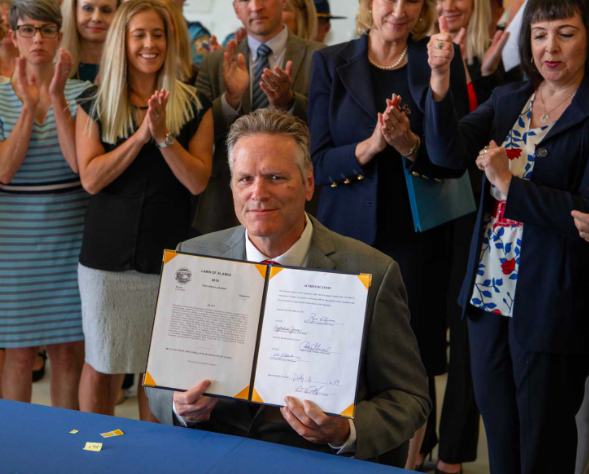
Gov. Michael Dunleavy signed HB 2001, and in a major video address today said he will call a special session to try to get the Legislature to release the rest of Alaskans’ Permanent Fund dividend.

But for now, the dividend that arrives in early October will be $1,600. Dunleavy views it as a partial PFD.

“Fighting for the full PFD would have left Alaskans with no PFD this fall. A veto would have been a win for those who want to eliminate the PFD in its entirety,” he said.

The governor will call for another Special Session to fund the rest of the dividend, about $1,400 that is determined by statute, and a constitutional amendment to fix the payment of the dividend into the Alaska Constitution.

The payment for the rest of the PFD would come from the Earnings Reserve Account of the Permanent Fund.

“I will not let up until the full funds are appropriated for the full PFD,” he said.

The mainstream media pounced on the video, which bypassed them as interpreters of the message and went directly to Alaskans via social media.

Among items the governor chose not to veto in this round is the Alaska Council on the Arts.

Excerpt from the video address were released by the Governor’s Office:

A Difficult Conversation

“There is no doubt Alaskans got engaged, and a much needed and, at times, difficult conversation took place in the media, at the dinner table, and amongst friends and family. I believed, and still believe, that in order for this discussion to be successful and to be taken seriously, we have to show Alaskans exactly what our fiscal picture looks like and what it will take to solve it.”

We Can No Longer Pretend the Problem Will Fix Itself

 “Alaskans need to understand that we can no longer afford to spend at our current rates. We can no longer afford to deplete our savings and hope for higher revenues. We must begin making the long-term changes to put ourselves on a path to a more sustainable future, and we can no longer pretend the problem will fix itself. It will take difficult decisions to get us to a sustainable budget, and I am prepared to make those difficult decisions.”

Result: Eliminated 1/3 of the Deficit, Reductions of $650 Million

“…important steps are being made to address our deficit, to right size our government and to put Alaska on a more sustainable path. Effective today, through the enactment of HB 2001, we have eliminated over 1/3 of the state’s deficit through reduction of approximately $650 million in state spending. Reforms have been initiated to make services and programs, such as Medicaid, University of Alaska, and the Alaska Marine Highway System more efficient and more sustainable.”

Multi-Year Step Down Requires Us to Rethink the Way We Provide Services

The driver for these reductions continues to be Alaska’s current fiscal outlook, requiring all of us to rethink the way we provide services, the way we prioritize limited state resources and the way we spend state dollars moving forward. While state savings will continue to be exhausted as we move into a multi-year step down, reducing our rate of spending must be a priority for all Alaskans. More must be done in the coming months, but we as Alaskans are resilient, and I honestly believe our future remains bright.”

Budget Approach and Timing Caused Significant Angst Among Alaskans

I understand that this budget approach and timing, being so late in the legislative year, caused significant angst among Alaskans, I really do. This was certainly not our intention. However, certain programs, programs we value, got caught in a budget discussion that went on way too long. The seriousness of the deficit, the need to begin making reforms and the length of our legislative session all contributed to the level of uncertainty we experienced the past several months. We have listened and we have learned from this past year’s budget process.”

Reduction to State Spending of 8 percent

 Overall, this year’s budget limited 1/3 of the deficit, reduced state spending by 8 percent and began the difficult process of changing the way we deploy limited state resources. The discussion that occurred ultimately helped Alaskans understand the seriousness of our challenges, forced the conversation about priorities and, in the end, helped shape this year’s budget.”

PFD: Arbitrarily Set Political Football

Unfortunately, this process was thrown into chaos the past several years when oil prices fell. Too many in the legislature now treat the PFD as a political football, arbitrarily setting its amount rather than following the statutory formula Alaskans know and trust.

McKinley Fire: Is it time to bring in the super tankers?

40

With wildfires raging on the Kenai Peninsula and in the Interior, Alaska’s firefighting crews are stretched thin. More are being brought from out of state, but the firefighting is tough right now in Alaska as days grow shorter. Fires have jumped the Sterling Highway and the Parks Highway, hurting commerce and tourism, as well as forcing many Alaskans out of their homes during evacuations.

For fire suppression from the air, the interagency fire fighters have the use of Convair tankers, which hold about 2,100 gallons of water or fire retardant. They are being deployed out of Palmer in support of crews on the ground.

But more robust assets are available. Super tankers, which typically are converted 747 jets, are approved to hold nearly 19,000 gallons, and can operate out of Ted Stevens International Airport, Fairbanks International Airport, or even Eielson Air Force Base or Elmendorf, with certain conditions.

[McKinley Fire consumes 50 structures]

These super tankers have been used in Oregon, California, and Arizona successfully. There are barricades to their use in states unless they are “carded” by the state for such use. Alaska currently hasn’t carded any super tanker companies and has no call-when-needed contracts.

Must Read Alaska checked out the B747-400 Super Tanker from Global SuperTankers. This tanker could reach Alaska in about four and a half hours hours from its land base in California (the company is based in Colorado Springs). Another company, 10-Tanker, operates from Albuquerque, NM. Between them, they are the only VLAT (Very Large Air Tankers) contractors in North America.

In situations such as Alaska is experiencing along the Parks Highway, a super tanker could drench a mile-long, 50-foot-wide swath of retardant in one pass, just what some neighborhoods and hamlets are in need of right now.

Alaska managed to get one in use on the Railbelt Fire of 2009, when Evergreen, defunct since 2014, was looking for a way to test out a super tanker for free.

In the current situation, it appears that without a contract with the State of Alaska, super tankers just are not available for this series of fires — unless the governor called for them under emergency orders, which he has the power to do.

If Dunleavy calls for a super tanker, there’s one waiting just four and a half hours away.

Addendum: The US Forest Service does have access to four of the DC-10 super tankers.