Saturday, October 10, 2026
Home Blog Page 1439

Alaska Life Hack: Turning the clock back an hour

4

FALL BACK, SLEEP IN, AND FIND THE WHITE LIGHTS

Into the four months of “double darkness” we go. On Sunday, Nov. 3, Alaska moves from Daylight Savings Time back to Standard Time.

As Alaska ends eight months of extra evening hours, the clock-changing exercise gives Alaskans the illusion of having more daylight in the morning, but the days feel suddenly shorter after work.

Welcome to winter. Changing the clocks, added to the fact that Alaskans are experiencing sunlight fade at warp speed, sends everyone looking for their strings of white lights to cheer up the darkness.

After all, between Nov. 1 and Nov. 15, the majority of Alaskans will lose more than 70 minutes of daylight — that’s about 5-1/2 minutes per day during these first two weeks of November. Adding the sudden loss of an hour in the evening when the clock changes to Standard Time gives Alaskans a “wow, that was fast,” experience as winter descends.

The exact time when clocks change Saturday night is 2 am, but most people fuss with their wall and stove clocks before going to bed or when they rise in the morning.

Your digital devices will generally adjust themselves to the proper time, but for those with older cars that don’t have smart-time devices, drivers have a semi-annual struggle to reset clocks, and an increasing number of people simply abandon the effort. After all, there’s always a smart phone somewhere nearby, so who cares if the car is wrong for four months out of the year?

When it comes to travel, that’s where things can get confusing. If you’re flying through Arizona or Hawaii, just remember they don’t change their clocks, like other states. And Unalaska observes Hawaii-Aleutian Daylight Time, although no commercial flights are heading that way until next week.

Politically, the debate over the biannual clock confusion is getting picked up in legislative halls with increasing frequency. At least 26 states have considered stopping the flip-flop, according to the National Conference of State Legislatures. Lawmakers cite safety of children standing at bus stops as a main reason for staying going on Standard Time. But the origins of the time warp go back to World War 1 and an effort to conserve coal in home furnaces.

[Read: The origins of Daylight Savings Time at Farmers Almanac]

THE MOOD IS TO STOP THE CLOCK

This year 46 bills were introduced in 26 states proposing to move to either Standard Time or Daylight Savings Time on a permanent basis. Most of those bills are still pending, but the Washington State Legislature passed a law this year to stay on Daylight Savings Time.

The problem is, federal law doesn’t allow that without congressional approval, and Congress is paralyzed with impeachment proceedings. So Washington state will be turning its clocks back like the rest of us.

Other states that passed legislation to make Daylight Savings Time permanent are Alabama, Arkansas, Florida, Nevada, Oregon, and Tennessee and Washington.

Alaska has had a parade of bills to end the clock flip flop: In the 21st Legislature (1999-2000), 22nd (2001-2002), 24th (2005-2006). During the 2015-2016 session, Sen. Anna MacKinnon’s bill to make Alaska Standard Time permanent passed the Senate, only to die in the House.

In Congress, Sens. Marco Rubio and Rick Scott of Florida this year introduced a bill to make Daylight Savings Time permanent. Florida Congressman Vern Buchanan introduced the companion legislation in the House.

The Sunshine Protection Act, legislation is the second time Rubio has introduced the measure since Florida passed legislation enacting year-round Daylight Savings Time if Congress ever acts.

A one-page summary of the bill is at this link.

Alice Rogoff, former ADN publisher, gets charity status for Arctic publication

2

Alice Rogoff took her online webzine Arctic Today with her when she parted out the the Alaska Dispatch (formerly and now once again the Anchorage Daily News).

[Read: The Alice Rogoff chronicles]

Rogoff, who had hosted President Barack Obama at her Campbell Lake home in 2015, told the bankruptcy court two years later that her Arctic Today online publication was not worth anything.

[Read: That time when Alice Rogoff threatened personal bankruptcy]

The bankruptcy judge, seeking to simplify a mess of limited liability corporations that had been set up to move money around the Alaska Dispatch world, allowed Rogoff to take the publication, then known as Arctic Now.

None of the creditors fought for it. In fact, it didn’t look like it was worth fighting for as a publication with barely a pulse.

Now, it appears Rogoff was right — it’s not worth anything, at least as a commercial concern. Last year, she was recruiting for an ad sales person, trying to grow the bottom line. This year, after trying to make a go of it financially with Arctic Today, and after paying her skeleton staff out of her own resources, Rogoff has turned it into a nonprofit.

She advised readers of the change, and she asked them for tax-deductible donations to be mailed to a Potomac Falls, Virginia address.

Rogoff is the incorporator and president of the nonprofit, which is registered with the State of Alaska Department of Commerce. She is using her home address on Campbell Lake in Anchorage for that purpose.

But no charity filing appears at the Internal Revenue Service, GuideStar.org or CharityNavigator.org. An organization must have an IRS 501(c)(3) status in order to be tax exempt and must comply with other federally established rules.

Having that special tax status will allow Rogoff to receive grants from many source, whether it’s the Rasmuson Foundation, the Woodrow Wilson Center (where she serves as co-chair of the Arctic Initiative), or perhaps organizations such as the Pew Charitable Trust.

Others are involved: Dwayne Menezes is vice president. He is the founder and managing director of the Polar Research and Policy Initiative, a London-based think tank.

Directors include University of Alaska journalism professor Elizabeth Arnold, and former Lt. Gov. Mead Treadwell, who has launched a company that plans to ship natural gas from the North Slope via ocean routes.

Also on the board are Halla Hrund Logadóttir, who is the co-founder and co-director of the Arctic Initiative at Harvard Kennedy School of Government; and Tero Vauraste, president and CEO of Arctia Group, a company owned by the nation of Finland.

Rogoff, Treadwell, and Vauraste circle back with Menezes in another nonprofit: All serve on the advisory board for Menezes’ Polar Research and Policy Initiative.

Previous incorporators no longer associated with the nonprofit include John Tichotsky, a former special assistant to former Gov. Bill Walker.

Rogoff is familiar with setting up nonprofits. She set up an art gallery in downtown Anchorage, making it a nonprofit supported by both federal and State of Alaska grants. Many in the downtown business world viewed it as a bit of a scam to market Native art in competition with the private sector, which was already doing that.

But it brought in millions of dollars in grants while it lasted.

Rogoff also founded the Alaska House in New York City, another nonprofit gallery that opened with a splash in 2008 and closed in 2015 after the Alaska Legislature refused to giver her $600,000 to keep it open. It had depended on the generosity of philanthropists such as billionaire Mayor Michael Bloomberg and Daisy Soros, sister-in-law to George Soros.

And then there was Rogoff’s husband at the time, supporting all of these ventures: Carlyle Group cofounder David Rubenstein.

When Rogoff bought the online Alaska Dispatch in 2008, and the Anchorage Daily News in 2014, most Alaskans who paid attention to the wealthy East Coast socialite, thought of her as the richest person who had ever run away to Alaska.

Later, when through her various limited liability companies she stiffed contractors and workers, as well as her former business partner Tony Hopfinger, the other side of her finances started to show, especially in bankruptcy court, where it became evident she was nearly completely dependent on the good will and checkbook of her estranged, now-former husband Rubenstein.

[Read: Rogoff loses to former business partner Hopfinger]

(Craig Medred photo)

Caltagirone drops bid for Anchorage Assembly

5

Just a week after announcing his decision to run for Anchorage Assembly, Peter Caltagirone has said it’s too much — his job at DNR is his concern that takes his entire attention; the campaign would need more time than he’d estimated. He’s withdrawn from the race.

That leaves Rick Castillo as the leading conservative candidate up against Democrat Suzanne LaFrance.

This narrowed quickly, but the election begins in mid-March, so twists and turns may be ahead. Will a spoiler jump in and hand the seat to the Democrat incumbent for this heavily Republican district?

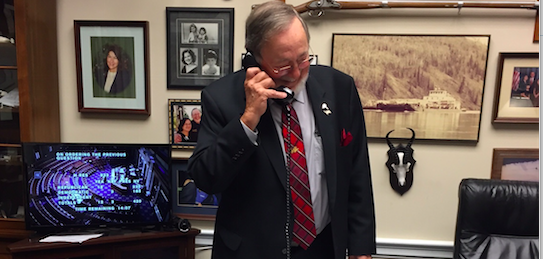
Epic: Classic Don Young, locks antlers with ‘Move On’ predator camera

Move On is an organization that began as a group to defend Bill Clinton against impeachment.

Ironically, its activists were stalking Republicans in the Longworth House Office Building to harass them over their impeachment vote, when they stalked the wrong guy: Congressman Don Young.

After chasing and haranguing the congressman down a hall and to an elevator, the Move On activists found themselves literally face to face with the Dean of the House, who came up to the camera and briefly locked horns with it, tapping “hello” to it in the most polite fashion possible.

Watch the exchange here:

The media, in its usual fashion, said Young “head-butted” the camera, but the evidence shows otherwise. It’s almost as if they wanted Young to do something outrageous, but he was pretty mellow, considering the dogged persistence of the fellows following him.

(An observer noted “it was no head butt. If Congressman Young had intended a head butt, the camera would be in the repair shop.”)

Recall effort harms Alaska’s ability to right its fiscal ship

23

By CRAIG RICHARDS

I have been retained to represent a group that opposes the recall of Gov. Mike Dunleavy.

I was surprised when reading the recall application. The stated grounds for recall are a hodgepodge of accusations, none of which appear legally sufficient nor honestly reflect the reasons behind the effort. They are not really attempting to unseat the governor because he appointed a judge 27 days late or over the nuances of how he used the line-item veto.

Instead, the energy around recall appears twofold. First, a group of partisans began organizing a recall in early February, just after Gov. Dunleavy took office, because they were dissatisfied with the election results. Second, and more meaningful, Gov. Dunleavy aggressively tried to cut government spending, which displeased those affected by the cuts. The latter passion is real and translates at a visceral level among voters. But for the sake of all of us, it does not justify a recall.

Since the drop in oil prices in 2014, the state has been careening toward a monumental fiscal cliff. Repeated multibillion-dollar deficits — the fiscal year 2020 deficit is about $1.6 billion — have been funded by spending savings.

When Gov. Bill Walker took office, state savings were more than $10 billion. At their highest point, in fiscal year 2013 under Gov. Sean Parnell, savings were more than $16 billion. Today that number is shy of $2 billion, or about one year of savings left at current oil prices.

The five-year luxury of kicking the can down the road and burning through savings in lieu of hard decisions is over. We have to close the fiscal gap.

Practically, there are only four available actions that can be taken to balance the state budget: spending cuts, increased oil taxation, adoption of broad-based taxes (sales or income) and a different dividend formula that, in the medium-term, reduces the dividend. The magnitude of the fiscal gap is such that only implementing one or two of these options is insufficient; likely, it will need to be some combination of three or all four.

But each of these options is unpopular and has motivated constituencies protecting the status quo.

I was Gov. Walker’s attorney general when he first considered vetoing part of the dividend in 2016. He made a hard decision, quickly became one of the least popular governors in the country, and a group formed to recall him.

Gov. Dunleavy chose to focus on spending cuts first. Same outcome — affected constituencies are upset and have moved to toss him out. Had Mark Begich won and implemented an income tax, others would be beating the recall drum. And state policy makers who advocate for increased oil taxes will no doubt be targeted politically (I know, I’ve been there).

We all have our preferred fix to balance the budget. But the fiscal decisions required to keep the state from going over the cliff will not be what I — or anyone else — wants. It will be a compromise, and it will be hard. Individual Alaskans, government agencies, and businesses large and small will be significantly affected.

Yet the cost of inaction is greater than the cost of any particular solution. If we close the deficit we can always adjust the “how” over time; if we run out of savings before we balance the budget the damage to our state and economy will be catastrophic.

It is self-destructive to spend a year plus fighting over a potential recall because the order and magnitude of actions taken on the deficit differ from what some prefer. No governor could make meaningful yet popular decisions that address our fiscal challenges — the problem is too large.

When Gov. Walker faced recall for vetoing part of the dividend he said, “I respect these Alaskans’ right to voice their objections over my budget vetoes. However that does not sway my decision on how to address the state’s fiscal challenges.”

Gov. Dunleavy is likewise in the unenviable position of having to make difficult decisions that will negatively affect Alaskans. But leadership requires difficult decisions, and we are out of time and our elected officials must make them.

That is why I will work in the coming months to stop the recall effort. It is a misguided distraction from the hard work of governance necessary to right our fiscal ship.

Craig Richards is an attorney in private practice in Anchorage. He represents Stand Tall With Mike, a group that opposes the recall of Gov. Dunleavy.


Exclusive video: Dunleavy talks about White House visit

6

Must Read Alaska has obtained exclusive video of Gov. Michael Dunleavy debriefing on his 40-minute meeting with President Donald Trump on Oct. 30, 2019. This was his fifth meeting with Trump since Dunleavy took office 11 months ago. The meeting took place in the Oval Office.

Rather than virtue signaling, look to Kodiak and Galena as models for reducing carbon

1

By CONGRESSMAN DON YOUNG

Energy production and its role in driving climate change — very rightfully — is as important a topic as ever.

While the United States leads the way in developing energy in significantly cleaner ways than Russia, Venezuela, and China, Democrats continue to promote a policy agenda that would cripple our economy and cause energy prices to skyrocket for Americans.

This month, Democrats on the House Natural Resources Subcommittee on Energy and Mineral Resources held a hearing on their latest virtue-signaling messaging effort: Net-Zero Emissions.

Their goal, while well-intentioned – is to implement a federal mandate to achieve net-zero emissions by the year 2050.

For those not well-versed in left-wing policymaking, “net-zero” means that once all greenhouse gas emissions from humans are eliminated, the remaining emissions will be removed from the atmosphere by natural and artificial sinks.

How do Democrats plan on getting us to net-zero? Through unrealistic and unattainable mandates that will only harm average Americans.

What happens if we end all fossil fuel development as House Democrats and their leading presidential candidates propose? First and foremost, the destruction of the 10.3 million jobs directly and indirectly supported by the oil and gas sector. In fact, some of my Democrat colleagues have proposed pie-in-the-sky legislation that would eliminate cars, air travel, and even meat. Yes, meat.

Additionally, they have called for the elimination of nuclear energy and natural gas, two energy resources that have helped the U.S. lower our emissions.

Finally, pursuing net-zero in the manner prescribed by Democrats would cause American household energy bills to skyrocket.

House Democrats are 10 months into their majority, and they are still only offering unrealistic promises instead of actual solutions.

We do need to reduce our emissions and lead by example for other nations that have lower environmental standards than the U.S. But we don’t need to resort to mandates and trillion-dollar spending plans to do this.

A truly all-of-the-above American energy approach – not net-zero – is what’s needed to reduce emissions and protect our environment. To that end, I’ve been happy to work with colleagues on both sides of the aisle to explore and support renewable energy resources.

Alaska is home to vast amounts of streams, rivers, and other waterways, and we should harness these resources to strengthen our hydropower production. Hydropower is clean, renewable, and sends exactly zero emissions into our atmosphere. Last Congress, I authored legislation to expedite the Terror Lake Hydroelectric Project on Kodiak Island. Alaskans are strong proponents of renewable resources, and my legislation, which was signed into law, has helped Kodiak reach its ambitious goal of receiving 99 percent of its energy from renewable sources.

Our country is rich with opportunities for hydropower, and to help achieve meaningful and realistic reductions of emissions, Congress should pursue new hydro projects and bolster support of existing ones. Alaskans are proud of Kodiak’s accomplishments, and with the right policies in place, we can use Kodiak as a model across the Lower 48.

Alaska can teach the rest of the country when it comes to finding renewable energy resources, all one needs to do is look in their back yard. With millions of acres of forests, Alaska has become home to many successful biomass projects. Biomass – which comes primarily from wood and sawmill waste, has helped a school in Tok displace 65,000 gallons of fuel oil per year.

It doesn’t stop there. In 2017, the City of Galena started operating their own biomass facility, displacing 200,000 gallons of fuel oil since their biomass operation went online. It’s a no-brainer for municipalities to pursue these renewable options, but it’s up to us to ensure that they have the support necessary to work in conjunction with traditional oil and gas.

Finally, the simple truth that radical environmentalists don’t understand is that oil will continue to play a role in reducing our emissions. Simply put, if America isn’t developing our oil resources, countries with lower environmental standards will.

Recently, House Democrats, many who have never even stepped foot in Alaska, voted to reverse the progress we made under the 2017 tax bill to open the 1002 Area of ANWR’s Coastal Plain to oil exploration.

I know Alaskans to be both good environmental stewards and responsible resource developers. Their work to make America energy independent is exactly what we need to break free of Chinese, Russian and Venezuelan oil. Alaska leads by example, and if the rest of the country follows, we won’t need the allure of empty promises to protect our planet.

The choices for America’s energy future are clear. We can find ourselves endlessly pursuing the unrealistic proposals put forth by liberal interests intent on placating their vocal base with the so-called net-zero and in the meantime kneecapping our economy and hurting communities across our country. Or we can recognize that an all-of-the-above approach including renewables allowed to operate on a level playing field with responsible oil development, is the most realistic option to cut emissions and empower states and municipalities to move into America’s energy future.

It’s incumbent on Congress to support policies to make this future a reality, and we must choose wisely.

Congressman Don Young is a member of the House Natural Resources Committee, for which he previously served as chair.

Halloween vote: Formal inquiry on impeachment

DON YOUNG: DEMOCRATS ACTING OUT OF HATRED OF TRUMP

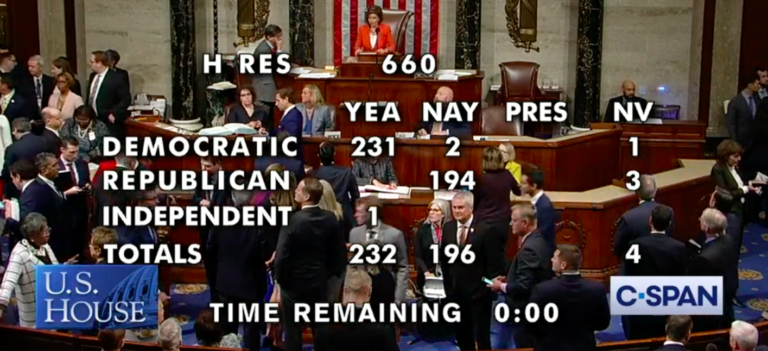
House Democrats and Republicans queued up mainly on party lines on Thursday, with just two Democrats voting against moving ahead on a formal impeachment inquiry on President Trump.

The final vote was 232-196, with House Republicans sticking together to oppose it.

A more secretive committee process led by Rep. Adam Schiff of the House Intelligence Committee has been the subject of partisan political drama for a month.

The next stage involves a formal inquiry, that includes new rules, into a phone call between Trump and Ukrainian President Volodymyr Zelensky, which Democrats say prove the president used foreign aid “quid pro quo” to prompt Ukraine into investigating the shady dealings of Joe Biden and his son Hunter Biden.

Whether or not Trump did so directly, or suggested such an investigation was important to him politically, is problematic for the Democrats, since Ukraine received the aid that had as it had been appropriated, and since all presidents use leverage when it comes to foreign aid.

The inquiry, once started, can expand to encompass just about anything, and will become a part of the presidential race in 2020. Schiff will now have much more power over the White House, including the president and his top aides.

After the inquiry, another vote is taken, and the charges — or articles of impeachment — are sent to the Senate. The Senate would need to vote, by a two-thirds majority, to remove the president.

Congressman Don Young of Alaska issued a statement after the vote:

“This is a sad day for this great institution. Today’s vote to formally pursue an impeachment inquiry is just the latest political stunt by House Democrats. This is not a question of whether there are sufficient grounds for impeachment, it is simply a sham vote to allow House Democrats to continue to trample on the longstanding impeachment process in the House. Everyone in this country deserves due process, but this vote is unfair and a total charade.

“Our Founders included an impeachment mechanism in our Constitution for a reason, and very frankly, House Democrats are trampling not only on their constitutional duties, but on the longstanding precedent in the House. Until the House approves a formal resolution authorizing an impeachment inquiry, the Democrats’ illegitimate effort will continue. 

“In 1998, when the House was pursuing impeachment against President Clinton, we made it a point to ensure that the process went through proper channels, specifically the House Judiciary Committee. Democrats may not have agreed that President Clinton should have been impeached, but what matters is that they were included in the process. The process was held out in the open, it was fair, and the public could see it. Twenty-one years later, House Democrats have chosen to pursue impeachment against President Trump, but this time through a totally one-sided process with total disregard for precedent.

“I continue to believe that Democrats are pursuing impeachment only out of their hatred for President Trump, and not out of concern for our country. If Democrats insist on continuing this pursuit, it must be brought out into the open, give Republicans equal access and input, and provide the due process that President Trump is entitled to under the Constitution.”

Read the House resolution here:

[Read: Murkowski clarifies stance on impeachment]