Saturday, October 10, 2026
Home Blog Page 1438

Unexploded ‘ordinances’ and other Palmer curiosities

2

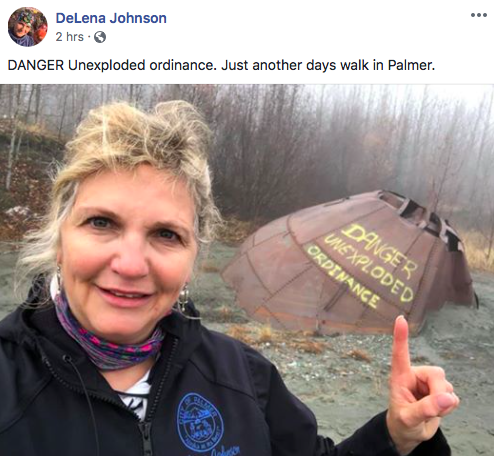
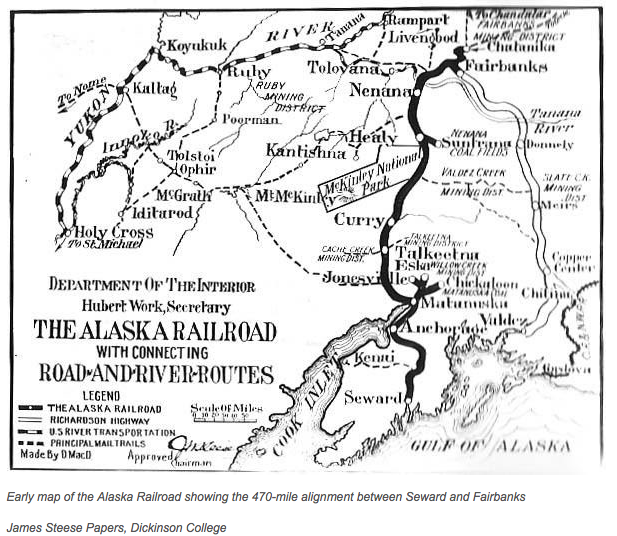
Rep. DeLena Johnson and her husband Steve took an eight-mile walk on Sunday along the riverbed of the Matanuska River, when the couple came across an artifact from yesteryear — a piece of riveted steel from when the railroad was torn up and rerouted north to Fairbanks.

There was a time, Johnson said, when the railroad went to Chickaloon because of the high-quality coal at Wishbone Hill. That coal was valuable because it was used to fire the warships in World War I.

But in 1923, when President Warren Harding drove the golden spike at the Nenana, signaling the completion of the railroad to Fairbanks, the tracks to Chickaloon had all been torn up and left to rust.

Rep. Johnson doesn’t know who took a can of yellow spray paint to the rusting steel with the words “DANGER UNEXPLODED ORDINANCE,” but she found it amusing, misspelled “ordnance” notwithstanding. It’s a bit of graffiti on a 10-foot-tall item of railroad trash that looks like … well, her friends on Facebook had all sorts of amusing theories.

The riverbed is littered with steel that was dumped by the railroad as they tore up the tracks to Chickaloon, but the “Apollo space capsule” behind her in the photo is an artifact that perhaps railroad historians will be able to identify.

Anyone?

Due Monday: Attorney General Kevin Clarkson’s decision on Dunleavy recall

Alaska Attorney General Kevin Clarkson has until Monday to announce his decision on whether the recall petition to remove Gov. Michael Dunleavy can move ahead to the second phase of signature gathering.

His decision will be to say whether the group wishing to recall the governor has adequate grounds: Misconduct, incompetence, or failure to perform duties prescribed by law.

The Recall Dunleavy group says the governor failed to perform his duties when he didn’t appoint a judge to the Palmer District Court seat within the 45 days mandated by law. Dunleavy was engaged in making the appointment, and was negotiating with the Alaska Judicial Council over their nominees. He appointed that post late, but not before it was vacated by the retiring judge.

The group also says that the Dunleavy Administration made an error in a budget decision. That error was corrected quickly, but the group says it is evidence of incompetence.

Finally, the Recall Dunleavy group says the Governor’s Office used State resources to push partisan ads on Facebook. Those ads were actually targeted at legislators who were opposing the governor’s budget policies, but whether they were partisan in nature will be up to the courts to decide.

All of these are fig leaf reasons, critics say, to mask the real discontent with the governor for cutting the budget. In its own words on its Recall Dunleavy website, the group admits as much:

“His brief time as governor has brought us an atmosphere of fear and distress, as people worry about whether they will be able to care for special-needs children or whether they will lose their jobs, their homes, and their ability to live in Alaska.

“We cannot allow a governor who doesn’t understand the concept of the separation of powers to remain in power.  He cannot be allowed to attack the judiciary because courts make decisions he doesn’t like. He cannot be allowed to keep the legislature from upholding its constitutional responsibilities to fund programs that provide for the health, education, and well-being of Alaska’s people.”

In other words, it is really about things like cutting the court’s funding and shifting that money over to pay for court-ordered abortions.

This reason, along with the actual stated reason in the recall petition itself concerning a delay in appointing a judge, put the judges in an awkward position. They do, in fact, have a dog in the fight because the governor has made decisions about their budget — decisions that Alaska Supreme Court Justice Joel Bolger has already said on the record were adverse to the courts, and he asked the Legislature to reverse the governor’s decisions.

History gives no particular hint about how the judges would rule.

A recall campaign against a sitting governor in Alaska last occurred in 1992, when a group formed to recall Gov. Wally Hickel. The Department of Law and Director of the Division of Elections certified the application on Aug. 26, 1992, against the advice of outside counsel.

Lawsuits were filed in Juneau and Fairbanks Superior Courts on Aug. 27, 1992 and Sept. 25, 1992.

On Sept. 5, a judge instructed the director of the Division of Elections to cease petition activity. One year later, on Sept. 14, 1993, the Fairbanks Superior Court determined that certain ground for recall were not legally sufficient, while other grounds were, but overall the grounds were insufficient. The matter died.

[Read: A list of all the recall outcomes in Alaska, chronologically]

If Clarkson approves the recall petition language, the Recall Dunleavy group will be able to start collecting its 71,252 signatures needed to force the matter into a special election. The group has already shown its political clout by collecting an initial 49,006 signatures, which it submitted to the Division of Elections on Sept. 4. The Alaska Democratic Party is pushing hard to help the Recall Dunleavy group, and will be a staunch ally if there is a legal battle.

The Attorney General is in a slightly awkward position, as both legal counsel to the governor and the top attorney for the people of Alaska.

If he rules that the recall rationale is sound enough to take to the voters, then he would not be able to represent the governor, who would probably challenge that ruling, and have to rely on a private attorney to do so.

But Clarkson is more likely to rule that the recall campaign has not provided sufficient grounds; he’ll see it in favor of defending elections and not creating a condition where elections are immediately overturned by the disgruntled through a never-ending churn of costly court challenges.

If he turns them down, that would trigger a lawsuit being filed at Alaska Superior Court by the Recall Dunleavy group, which has already promised it will challenge the ruling.

After the decision is announced on Monday by Clarkson, Scott Kendall, Alaskans can anticipate that an immediate news release will come out from the Recall Dunleavy group, which is being funded by Ed Rasmuson. The details of the challenge will likely come at a press conference that Scott Kendall and his group will hold, for maximum exposure in the media.

Kendall, who is the group’s legal counsel and who was chief of staff to the disgraced Gov. Bill Walker, will probably file the appeal in Anchorage Superior Court. The hearings could take place within weeks, and the decision from the Superior Court judge would be appealed to the Alaska Supreme Court by whichever side loses.

STAND TALL WITH MIKE GROUP FORMS

Meanwhile, the Stand Tall With Mike group is beginning to get organized and is raising funds for the defense of the governor — eight full months after the recall group started its activities.

“Right now in Alaska, Mike Dunleavy’s opponents have near total control of the airwaves and the news most Alaskans are seeing, hearing, and reading. Your generous donation will allow us to get the other side of the story out. This will lead to increased public support for Mike and his conservative agenda that Alaska so desperately needs,” the Stand Tall With Mike website says.

Listicle: The history of prior recall attempts in Alaska

3

The list of previous recalls that made it to the Division of Elections and Department of Law goes back to 1986. Most applications were denied.

Of the 21 attempts to recall, 10 were denied due to insufficient grounds, while five had application deficiencies and were denied on that basis. The others ended with various results, including elected officials who simply resigned.

Of those three recall attempts that ultimately went to the voters, all were for school board seats in the rural areas of the state, and all three subjects of the recalls were indeed recalled by voters, 173-67, 178-61, 174-64.

Details of Alaska’s recall history:

09/12/2014: John Atchak, Kashunamiut School District (REAA 22) Board member, Seat B. Following review by the Department of Law (9/30/2014), the Director of Elections denied the application due to a number of insufficiencies within the application.

11/06/2013: Representative Lindsey Holmes, House District 19. Following review by the Department of Law (12/16/2013), the Director of Elections denied the application due to insufficient grounds.

08/29/2011: Representative Kyle Johansen, House District 1. Following review by the Department of Law (10/10/2011) , the Director of Elections denied the application due to insufficient grounds.

04/15/2010: Jody J. Leisholmn, Annette Island School District (REAA 20) Board Member, Seat B. Following review by the Department of Law (6/7/2010), the Director of Elections denied the application due to insufficient grounds and multiple insufficiencies.

06/22/2007: Shelly Wilson, Chatham School District (REAA 18) Board Member, Section I, Seat A. The Director of Elections certified the application on 7/31/2007. The petition was certified by the Director on 9/13/2007 following verification of supplemental signatures filed by the recall committee on 9/6/2007. On 9/17/2007 the Lt. Governor called a special election to be held on 11/20/2007. The Election was certified on 12/6/2007. The voters approved the recall by a vote of (Yes 173) to (No 67).

06/22/2007: Edward Gamble Sr, Chatham School District (REAA 18) Board Member, Section I, Seat B. The Director of Elections certified the application on 7/31/2007. The petition was certified by the Director on 9/13/2007 following verification of supplemental signatures filed by the recall committee on 9/6/2007. On 9/17/2007 the Lt. Governor called a special election to be held on 11/20/2007. The Election was certified on 12/6/2007. The voters approved the recall by a vote of Yes (178) to (No 61).

06/22/2007: Irene Paul, Chatham School District (REAA 18) Board Member, Section I, Seat C. The Director of Elections certified the application on 7/31/2007. The petition was certified by the Director on 9/13/2007 following verification of supplemental signatures filed by the recall committee on 9/6/2007. On 9/17/2007 the Lt. Governor called a special election to be held on 11/20/2007. The Election was certified on 12/6/2007. The voters approved the recall by a vote of (Yes 174) to (No 64).

10/11/2005 & 12/14/2005: John Zabielski, Alaska Gateway School District (REAA 16) Board Member, Section II, Seat B. Following review by the Department of Law (1/17/2006), the Director of Elections denied the application due to insufficient grounds.

10/11/2005 & 12/14/2005: John Zabielski, Alaska Gateway School District (REAA 16) Board Member, Section II, Seat B. Following review by the Department of Law (1/17/2006), the Director of Elections denied the application due to insufficient grounds.

12/14/2005: Doug Hosken, Alaska Gateway School District (REAA 16) Board Member, Section II, Seat C. Following review by the Department of Law (1/17/2006), the Director of Elections denied the application due to insufficient grounds.

12/14/2005: Eric Hannon, Alaska Gateway School District (REAA 16) Board Member, Section II, Seat E. Following review by the Department of Law (1/17/2006), the Director of Elections denied the application due to insufficient grounds.

08/04/2005: Senator Ben Stevens, Senate District N. Following review by the Department of Law (9/7/2005), the Director of Elections denied the application due to insufficient grounds.

02/17/2004: Senator Scott Ogan, Senate District H. Following review by the Department of Law (4/8/2004) The Director of Elections certified the application on 4/9/2004. On 8/25/2004 Senator Ogan resigned from his senate seat. The Director of Elections certified the recall petition on 8/26/2004. However, due to the vacancy created on 8/25/2004 following the resignation of Senator Ogan, the recall effort was not completed.

08/07/1996: Pat Madros, Yukon-Loyukuk School District (REAA 12) Board Member. Following review by the Department of Law (9/25/1996), the Director of Elections denied the application due to a number of insufficiencies within the application.

12/31/1997: Nancy James, Yukon Flats School District (REAA #13) Board Member, Seat C. Following review by the Department of Law (2/25/1998), the Director of Elections denied the application due to a number of insufficiencies within the application.

06/29/1992 and 06/30/1992: Governor Walter Hickel and Lt. Governor Jack Coghill. Following the review by the Department of Law (8/24/1992), the Director of Elections certified the application on 8/26/1992 against the advice of outside counsel. Lawsuits were filed in the Juneau and Fairbanks Superior Court on 8/27/1992 and 9/25/1992. On 9/5/1992, the court instructed the director to cease petition activity. On 9/14/1993, the Fairbanks Superior Court determined that certain grounds for recall were legally sufficient and other grounds were not. The recall attempt was not completed.

03/13/1986: Kathleen Wright, Delta-Greely School (REAA 15) Board Member, Seat D. The Director of Elections certified the application on 3/27/1986. The petition was certified by the Director on 5/5/1986. An election was scheduled for July 15, 1986. However, the election was enjoined according to a lawsuit filed in the third judicial district in Anchorage.

03/13/1986: Cynthia McClain, Delta-Greely School (REAA 15) Board Member. The Director of Elections certified the application on 3/27/1986. The petition was denied by the Director on 5/5/1986 due to insufficient signatures.

03/13/1986: Doris Fales, Delta-Greely School (REAA 15) Board Member, Seat E. The Director of Elections certified the application on 3/27/1986. The petition was certified by the Director on 5/5/1986. An election was scheduled for 7/15/1986. However, the election was enjoined according to a lawsuit filed in the third judicial district in Anchorage.
03/13/1986: Jackie Fett, Delta-Greely School (REAA 15) Board Member, Seat F. The Director of Elections certified the application on 3/27/1986. The petition was certified by the Director on 5/5/1986. An election was scheduled for 7/15/1986. However, the election was enjoined according to a lawsuit filed in the third judicial district in Anchorage.

Washington Post chronicles long, costly Supreme Court journey of Alaskan moose hunter John Sturgeon

0

On the front page of Sunday’s Washington Post, writer Robert Barnes does a deep dive into the 12-year legal battle of one Alaskan, who just wanted to hunt moose in his traditional way, but who was stopped by U.S. Park Service employees on the Nations River in the Yukon-Charley National Preserve.

His crime? Using the wrong kind of boat to navigate the river. Sturgeon was using a small hovercraft. He knew the river to be navigable, and he knew the Park Service had no jurisdiction over Alaska’s navigable waters. So he took the federal government to court on behalf of all Alaskans.

Barnes, who writes about Supreme Court issues for the Washington Post, travelled to Fairbanks this summer and spent time interviewing Sturgeon, and he went on a fundraising excursion on a riverboat owned by the Binkley family, where 200 people joined together for the “thanks a million” cruise to raise money to pay back Sturgeon’s legal fees after his historic “second win” at the Supreme Court.

“For 12 long years, John Sturgeon has fought for something he believes in, something that is bigger than himself. He took on the biggest of foes, the United States federal government.” — Craig Campeau, who sells boats and ATVs in Fairbanks, quoted in the Washington Post.

Here are the first few paragraphs of Barnes’ story and the link to the entire article at the end:

An Alaskan moose hunter beat the odds at the Supreme Court. It cost $1.5 million

FAIRBANKS, Alaska — Moose hunter John Sturgeon serves as both inspiration and warning for anyone who has ever gotten worked up over a perceived injustice and vowed to fight it “all the way to the Supreme Court.”

An inspiration because Sturgeon took on the federal government and — not once but twice — beat the odds to get the high court to accept his case and rule in his favor.

Why a warning? Because Sturgeon’s 12-year, only-in-Alaska battle to travel on a forbidden hovercraft through national parkland to his favorite hunting spot cost well north of $1.5 million.

“I had no idea how much it was going to cost, but you start down this slide and there’s no stopping it,” Sturgeon said. “Not many people could do what I did, because they don’t have the financial resources, which I don’t either. But I did have a cause that really ignited people.”

Sturgeon agreed to let The Washington Post examine the details of his costs and the donations to his cause to illuminate what it takes to bring a lawsuit before the Supreme Court.

Among his donors: the Alaska Wildlife and Conservation Fund, the National Rifle Association, the Alaska Conservative Trust, national and international hunting groups, hundreds of ordinary Alaskans and one very wealthy one.

Edward Rasmuson read about Sturgeon’s case, called him up and found him sincere, and then offered to help pay the legal bill. “I maybe gave $250,000 to $300,000 to $400,000 — hell, I don’t know,” Rasmuson said in an interview. “But I’m fortunate. I’m wealthy, I can afford it.”

Read the rest of the story at the Washington Post, which may be behind a paywall if you have exceeded your story limit.

What else is in that ML&P, Chugach sales agreement?

ANCHORAGE DAILY PLANET

The Anchorage Assembly, with little fanfare the other day, moved the city closer to selling the Municipal Light and Power utility to the Chugach Electric Association for $999 million.

The measure, mostly housekeeping and finalization of technical elements of the sale approved by voters last year, passed 11-0.

Alaska Public Media reported the sale could be finalized by June of next year, and he said among the myriad details of the sale there was this:

“And one unexpected provision will put $15 million toward substance abuse treatment. That measure is framed as a community benefit from the sale. The funds will go towards a new entity named the Alaska Center for Treatment in public documents, though according to the mayor’s administration, the concept will need to be refined going forward.”

Huh? Who knew the sale would spin off $15 million for an “Alaska Center for Treatment” that “will need to be refined” in the future?

Hughes reported Municipal Attorney Rebecca Windt Pearson told the Assembly:

“This is by no means the end of the public process around that idea. The agreement here is simply that we have said $15 million dollars will go toward this idea, this project, or else it will become an offset to payments under this deal after five years.”

It is enough to make us wonder what else is in the agreement.

Read more at the Anchorage Daily Planet.

Is capping cruise ship visitors a good idea?

6

By WIN GRUENING

The idea of imposing a cap on the number of cruise ships and visitors allowed in Juneau has once again been raised.  The concept was last seriously discussed when Juneau hosted around 500,000 cruise ship visitors.  This past summer season 1.3 million cruise visitors were served – certainly a healthy increase.

While there are impacts from cruise ships, the economic benefits are substantial. Cruise visitors spend over $200 million annually in Juneau and Juneau’s municipal budget gains $25 million yearly directly through sales taxes (that can be spent on anything from schools to streets) as well as passenger and port fees. 

Despite assertions 20 years ago that further tourism growth in Juneau was unsustainable, impacts as evidenced by resident complaints have substantially decreased in the interim.  Prior to 2000, complaints to the tourism hotline routinely exceeded 250 calls over the course of the visitor season.  In the last 10 years, total hotline calls have averaged only 50 calls per season – a 90% decrease – an average of 10 calls per month.

This dramatic improvement in managing impacts is attributable to the cooperative efforts of Juneau tour operators, cruise lines, transportation providers and the City and Borough of Juneau (CBJ).  Begun in 1997, a program called Tourism Best Management Practices (TBMP), was established to minimize the impacts of tourism.

Since then, TMBP has formed partnerships with the U.S.  Forest Service, National Oceanic and Atmospheric Administration, and the National Park Service. If anything, it’s become a model for other cruise ports – especially in SE Alaska – where a half dozen other communities are considering establishing similar programs. 

The legal and logistical obstacles in promulgating and enforcing a limit on cruise visitors is a significant concern.  Would we try to limit the small “niche” cruises or just the big ships?  Which ones? And whose grandmother will be denied a once-in-a-lifetime cruise to Alaska?

Furthermore, at the very time Juneau has successfully resolved a contentious lawsuit and re-established a working relationship with the cruise industry, this effort will undermine cooperative efforts going forward.

It should be noted that while the impacts of Juneau cruise ship visitors are spread over 32,000 residents, our neighboring town of Hoonah with its 760 residents hosted 138 ships carrying 250,000 cruise visitors – almost eight times the Juneau per capita visitation.  

The impacts can be managed. The question is how.

Imposing a cap is akin to using a sledgehammer when a flyswatter will suffice.  The TMBP program has identified several areas for continuing improvement this year, including impacts of whale-watching and traffic congestion.  Doesn’t it make more sense to mitigate specific identified impacts instead of penalizing every business and family in Juneau whose livelihoods depend on cruise visitor spending?

The irony should not be lost on us that many amenities Juneau residents enjoy are directly attributable to the growth in the cruise industry – such as the seawalk, improved downtown streets, expansive docks, downtown parks, and improved harbor facilities and parking. 

Dozens of small businesspeople in Juneau have invested their life savings and sweat equity to establish restaurants, breweries, food trucks, and gift stores, many of which wouldn’t be open year-round if not for the influx of summer visitors.

Despite TMBP’s successes, it will never be able to totally eliminate all impacts to all residents. For most of us, this is the trade-off we make in order to sustain a vital component of our economy that provides so much to our community.

That’s not to say we shouldn’t always be looking for better ways to manage growth.  We all need to recognize the challenges and we shouldn’t be afraid to talk about how best to manage tourism impacts. Towards that end, Mayor Weldon has established a task force to determine whether the city’s current approach to managing tourism is effective.

No doubt, the controversial topic of limiting the number of cruise ship visitors will be discussed.

But the path forward lies not in ending the successful TBMP program but continuing to improve it.  That should be the focus of the Mayor’s Task Force in the months ahead.

That’s the way we’ll make Juneau a great place to visit, but more importantly, a great place to live.

Win Gruening retired as the senior vice president in charge of business banking for Key Bank in 2012. He was born and raised in Juneau and graduated from the U.S. Air Force Academy in 1970. He is active in community affairs as a 30-plus year member of Juneau Downtown Rotary Club and has been involved in various local and statewide organizations.

John Coghill files for his Senate Seat B, Fairbanks

15

Senator John Coghill is “in” for the 2020 election cycle: On Friday he filed for reelection to Senate Seat B, representing a wide swath of the Western Fairbanks and and North Pole.

Coghill has served in the Legislature since 1999, when he started his political career in the Alaska House. District B includes some of the more liberal University of Alaska Fairbanks neighborhoods, although it is generally considered a safe seat for a Republican.

Coghill is a social conservative whose decisions are firmly grounded in his Christian faith. Although he was the sponsor of Senate Bill 91, which many blame for a crime wave because of its lenient sentencing provisions, he ultimately voted for its overhaul and repeal when it came time to vote on House Bill 49, the “repeal and replace” bill.

A third-generation Alaskan, he was born in Fairbanks and raised in Nenana. During his first semester at UAF, he received his draft notice, and enlisted in the Air Force. After five years, he returned to Nenana to work with his family’s business, Nenana Fuel Co. He and his wife Luann are active in their church, and Coghill has served as a prison minister and as the pastor’s administrative assistant. He has taught adult Bible classes through his church and leads private prayer meetings while in Juneau.

District B leans right. In 2018, Gov. Michael Dunleavy won the district, 6,057 to Mark Begich’s 3,843 votes. During that same election, House District 3’s Tammie Wilson, a Republican, won with 92.14 percent of the vote, while House District 4 was taken by hard-left Democrat Grier Hopkins, with 51.74 percent of the vote, while Republican Jim Sackett pulled in 43.35 percent. A third candidate, Tim Lamkin, ran in that race, skimming 4.69 percent.

Back in 2016, President Trump did much better than Hillary Clinton in this district, with Trump winning 9,473 votes to Clinton’s 4,903.

But down ballot, Coghill was challenged by the former mayor Luke Hopkins, a Democrat and an acolyte of Gov. Bill Walker. The final vote on the 2016 General Election ballot was a strong 53 percent for Coghill, and 46 percent for Hopkins.

Coghill is Rules Committee chairman for the Senate Republican majority.

Ben Carson relays ‘big hairy men’ story from Alaska, gets grilled by hard-left Democrat

10

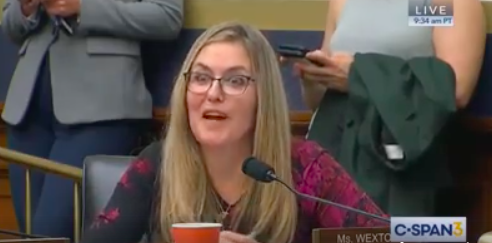
The Downtown Hope Center When Rep. Jennifer Wexton from Virginia asked HUD Secretary Ben Carson to apologize for saying that transgendered “big hairy men” were trying to get into women’s shelters, Carson would not apologize.

After all, the brain surgeon serving in the Trump Administration had only been relaying a story he had heard from Alaskan women regarding an organization in the 49th state that was being asked to admit men into its women’s shelter.

Which organization? Wexton pursued.

Carson couldn’t remember the name of it, but went on to criticize the politically correct enforcement on free speech that seems to have infected the U.S. House of Representatives and the rest of the public square.

The brief exchange came during a House Financial Services Committee hearing on access to affordable housing, particularly by protected classes. Wexton said she was giving Carson a “chance to apologize” for remarks made to HUD employees during a recent meeting.

Take a look at his response to Wexton:

In 2017, the Downtown Hope Center found itself at a crossroads when a man, who was dressed as a woman, asked for a floor mat for the night. He wanted to sleep among all the other women who were there that night.

The shelter only serves women, and specifically women who have been abused or trafficked. And the man-cum-woman was drunk and belligerent.

The shelter said no, the individual and the Anchorage Equal Rights Commission sued the center for violating his/her rights. Eventually the case was settled, with the Downtown Hope Center and the Alliance for Defending Freedom winning a large settlement from the municipality.

The person at the center of the controversy, who was Timothy Coyle but is now known as Samantha Coyle, is interviewed in this KTUU report, where News Anchor Mike Ross refers to Samantha by the pronoun “they” in the story’s introduction. Coyle says her government identification says that now she is female.

Since that interview with KTUU, Coyle’s woes have continued. Although she was able to get into an apartment, she has been recently served with eviction papers for nonpayment of rent for the Weidner apartment. A court hearing was held last on Oct. 24, with a pre-trial conference scheduled for Dec. 5.

Rep. Revak gets nod, moves from House to Senate Seat M

8

When Lt. Gov. Kevin Meyer showed up at the Legislative Information Offices in Anchorage at 2:40 pm on a Saturday with a folder in hand, the reason was obvious: The Alaska Senate Republicans confirmed they accepted Rep. Josh Revak as the senator for District M, south Anchorage.

Rep. Revak disappears into the elevator at the Legislative Information Office for his interview with Senate Republicans.

Revak’s name was chosen by Gov. Mike Dunleavy after the Senate Republicans refused to approve Rep. Laddie Shaw, for reasons they left unstated.

The meeting between Revak and the Senate Republicans took place at the Legislative Information Offices in Anchorage.

Revak will represent District 25 and 26. He lives in Abbott Loop and Lower Hillside’s District 25.

District 25 Republicans will convene on Nov. 11 to begin the process of replacing Revak.

Revak was born in 1981, into “very humble conditions,” spending his first years in a mobile home, with land to grow crops and raise livestock in rural Minnesota.

Revak enlisted in the U.S. Army as a battle Tank crew member at age 20. He joined the Army January 2002 and by May 2003 he deployed to Iraq with 1-37 Armor, 1st BDE, 1st Armored Division. He was redeployed to combat in January 2006 where he was severely wounded by an enemy mortar attack.

He was hired as Military and Veterans Affairs Liaison to Congressman Don Young in December 2009, were he worked for six years and moved to Alaska with his wife Marta and their two daughters Keilah and Sydney. In May 2016 was hired by Senator Dan Sullivan where he worked for over two years, spearheading issues in the Department of Defense and the Department of Veterans affairs.

Revak earned an MBA in business administration and management from Alaska Pacific University, was awarded a Purple Heart Medal and Presidential Unit Citation Award recipient, served as Treasurer in the Abbott Loop Community Council, is a life member in the Military Order of the Purple Heart, VFW and NRA, Safari Club International, Alaska Chapter (where he works with the organization’s Wounded Warrior on Safari Program.)