Friday, October 9, 2026
Home Blog Page 1423

Journalist who signed recall petition will work at CNN

6

Blake Essig, a journalist at KTUU in Anchorage, is one of the newest hires at CNN, where he will be the Tokyo correspondent for CNN International.

Essig joined KTUU in 2012. In 2019, he signed the petition to recall Gov. Mike Dunleavy.

He was still working for KTUU in November when Must Read Alaska reported that he was among several journalists and media managers in Alaska who signed the recall petition during the summer months. However, he is no longer listed on the news company’s website.

‘Intent’ is good enough for judge in Homer city council election-residency case

11

An Anchorage judge has decided that a person’s intent to move into a political district is good enough for them to run for office.

According to Judge Josie Garton of Alaska Superior Court, the intent to live somewhere puts the seal of legitimacy on that aspect of a person’s candidacy.

Judge Garton has explained her reasoning for her Dec. 9 decision not granting a temporary restraining order against Homer City Councilwoman Storm Hansen-Cavasos.

[Read: Round One: Homer litigants denied in court]

Tom Stroozas, the Homer resident bringing the complaint against the Homer City Council for seating Hansen-Cavasos, is unlikely to pursue the case; without the temporary restraining order, the court matter could last for two years.

The judge’s ruling means that the case won’t be fast-tracked by the court system and that Hansen-Cavasos will be able to serve for most of her elected term before the case actually would ever be resolved. By then, they’ll be into another election cycle in Homer.

Dropping the case, however, allows the ruling to stand as case law, and has impacts in other jurisdictions.

BACKGROUND IN A NUTSHELL

Storm Hansen-Cavasos lived outside of Homer city limits, and intended to move into the city during the year prior to the Oct. 1 municipal election. There was a lot of evidence that she had not moved before October, 2018. She had, however, moved by August, 2019, filed for city council in August, and was elected to the post in October.

According to the judge’s explanation, while verifying the qualifications of candidates running for Homer City Council, a deputy clerk noted that Hansen-Cavasos was not on the October, 2018 voter rolls. She notified the city clerk, who had a conversation with Hansen-Cavasos, and researched the matter with the Alaska Division of Elections, before deciding that Hansen-Cavasos met the criteria for living in the city limits for the year leading up to the election.

Judge Garton used the word “intent” several time in her legal explanation, released Dec. 10. She noted that the likelihood of the plaintiffs winning the case was improbable. Must Read Alaska’s efforts to reach Stroozas for comment were unsuccessful.

Dept. of Law has reviewed ‘Pirate’ case dismissal, and says it was appropriate

14

The reappearance in Fairbanks of a man who calls himself Pirate has led to both citizen outrage and media focus in recent weeks. Pirate had been indicted by a grand jury in 2015 for many counts of sexual assault, kidnapping, and assault that occurred after he took a woman to his cabin in Manley Hot Springs and allegedly brutalized her.

[Read: Pirate back in Fairbanks, some are concerned]

Formerly known as Daniel Lloyd Selovich, the now-mostly homeless man with tattoos on his face was released when in 2016 the victim died and the Fairbanks District Attorney dismissed the charges. 

In response to citizens’ concerns, the Fairbanks District Attorney and Deputy District Attorney conducted a review of the 2015 case against the defendant and the circumstances of its dismissal. 

“The Department of Law has completed its review of the evidence and concluded the dismissal of the 2015 case, while extremely frustrating, was appropriate under the law,” according to a statement from the Department of Law on Thursday. The case dismissal came because without a victim to testify, Pirate would not be given a fair trial in which he could face his accuser and where she could be cross-examined by his attorney.

A group on Facebook formed to keep an eye on Pirate and report sightings of him, and the news media has reported about how others with extensive and similar facial tattoos are being confused with Pirate and have been harassed.

Principal in Bethel busted by FBI Child Exploitation unit

3

Gladys Jung Elementary School Principal Christopher Carmichael has been arrested by the FBI, Bethel Police Department and Alaska State Troopers.

The FBI’s ‘s Child Exploitation Task Force on Tuesday confiscated various forms of digital media from the school, where Carmichael has worked as principal since 2014. He has been with the Lower Kuskokwim School District since 2000.

The arrest came on Tuesday, with charges expected by Thursday, and he was booked into the Yukon Kuskokwim Correctional Center after midnight on Dec. 11. No charges are posted, as of Wednesday evening.

By Wednesday afternoon, Carmichael had been removed from both the school district and the school’s website, and a press release had been issued:

For a thriving economy, government spend must come down even more

58

By DONNA KAURANEN

One year ago, Gov. Mike Dunleavy submitted a budget representing the starting place for his budget challenge, a gap of $1.5 billion dollars on a $6.7 billion state funds budget, over a 20% difference between annual revenues and expenditures.

While Alaska’s budget gap had developed over time, the governor directed his Office of Management and Budget team to provide him options to close that gap in one year with no new revenues and no borrowing from reserves.

Alaska had borrowed from reserves for six years, drawing down rainy day funds and racking up a debt of over $10 billion to the Constitutional Budget Reserve (CBR). OMB worked with state agencies and brought options to the governor to meet his direction.

The Permanent Fund Dividend is not included in these numbers because, while the Alaska courts have ruled the Legislature can ignore statute and set a dividend amount through the budget, the governor has been, rightly, steadfast in his policy that dividends must be distributed according to decades-old law to Alaskans who are the owners of subsurface resources.

After the governor’s final budget submission in February, he made presentations around the state, some with Commissioner of Revenue Bruce Tangeman and me, laying out the case in numbers and graphs that Alaska had been spending beyond its means for years and needed to cut its budget, and that it was running out of time to do so, given the squandering of reserves that preceded his governorship.

He has more than one year to fulfill his policies, but seems to be taking budget reducing options off the table and is instead tilting toward additional taxes.

In addition to the mathematical reality, there was an economic reality to the governor’s policies. My former colleague and Alaska economist Ed King has been telling us consistently, Alaska is a high-taxed state. While this economic fact may not be obvious, as Milton Friedman said:

“Keep your eye on one thing and one thing only: how much government is spending, because that’s the true tax … If you’re not paying for it in the form of explicit taxes, you’re paying for it indirectly in the form of inflation or in the form of borrowing. The thing you should keep your eye on is what government spends, and the real problem is to hold down government spending as a fraction of our income, and if you do that, you can stop worrying about the debt.”

Every dollar government spends is a dollar not used for labor or investment in the private economy. If Alaska desires a diversified economy with a thriving private sector, it must reduce the amount of money government spends.

Alaska’s state government spends more than twice the amount on government than the national average of states on a per capita basis, or $13,000 per every man, woman and child in Alaska compared to $6,000 in other states.

While Alaska enjoys a strong GDP per capita, a significant portion of its GDP goes to government. In addition, Alaska’s private economy is significantly dependent upon government.

Compare Alaska to Florida, for example, a state whose existence was largely developed after the U.S. Army Corps of Engineers dredged the Everglades and when the availability of electrical air conditioning occurred not long before Alaska’s Statehood.

Florida’s state government spending per capita ($3,640) is only 27.6 percent of Alaska’s government spending per capita of $13,000.

State spending compared to state GDP in Alaska is over 18 percent while Florida’s is 7.5 percent.

Alaska’s government debt compared to state GDP is almost 20 percent, while Florida’s is just over 12 percent.

Alaska consistently loses population to other states, while Florida has had the second highest net domestic migration over the last decade.

The Fraser Institute measures the economic freedom of states based on taxes, spending, and labor market freedom. The Frazier Institute ranks Florida second best and Alaska third worst state on its economic freedom index.

I have learned through my vast experience that sticking with fiscal and economic policies that are politically difficult in the short run are economically beneficial for the long term. Washington D.C. has shown us this recently as the U.S. economy is enjoying the benefits of the Tax Cut and Jobs Act of 2017, including a 50-year low in the nation’s jobless rate.

Alaska is a beautiful state with tremendous opportunities if its leaders are willing to do what’s necessary to embrace them.

Donna Arduin Kauranen  is the former director of the Office of Management and Budget and is the president of Arduin, Laffer & Moore Econometrics .

Breaking: Governor’s budget stays flat, pays full PFD, despite lower revenues

18

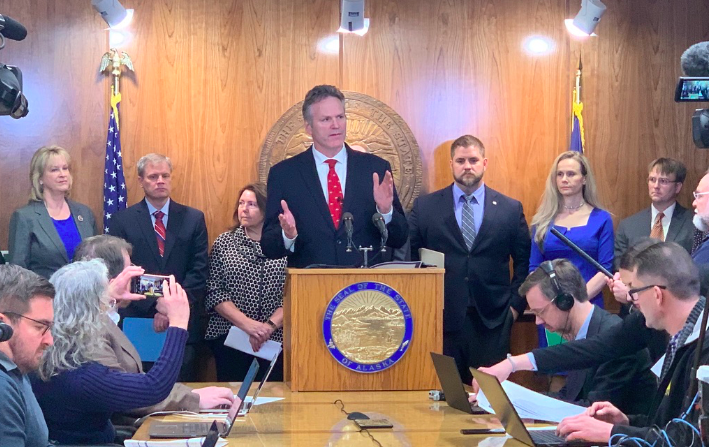
The State’s 2021 budget continues the vision of an administration that seeks to grow the private sector economy in Alaska, and wants to ensure government has a smaller, more sustainable footprint.

Gov. Mike Dunleavy appeared as a confident budget hawk during his press conference on Wednesday, where he was flanked by nearly his entire cabinet.

He gave brief remarks, answered some questions, before he empowered his commissioners to answer questions that related to their specific budgets, while he left for other meetings. Last year, commissioners were less involved in the actual crafting of their departmental budgets.

Dunleavy said he wants the State’s budget to be truthful and transparent, and that he is expressing the fiscal discipline that he was elected to do, following the priorities of public safety, education, and economic development — commitments he made when he ran for office.

[Budget documents are at this link]

He also vowed to continue discussions with the public and listen to Alaskans this winter as the budget is being debated in Juneau by the Legislature.

The 2021 fiscal year’s budget relies on a large portion of the Constitutional Budget Reserve to balance, but the spending itself is flat.

That came as a surprise to some political reporters, who had been predicting in their advance stories this week that the governor would continue his larger proposed budget cuts from last year.

The budget provides more for more State Troopers, more funds for courts, prosecutors, and the Department of Corrections, and it fully funds Education, as well as the statutory Permanent Fund dividend at the amount to be determined later (but thought to be about $3,000).

Dunleavy said the formula for calculating the dividend has been in statute for decades, and that he intends to follow that statute, saying the PFD does more for Alaska families than any single line item.

Dunleavy has deviated from past governors by proposing the state’s operating budget, capital budget, Mental Health budget and supplemental budget all at once. Some of the highlights:

  • Capital budget: $1.3 billion with the State’s portion at $143 million.
  • Operating budget: $4.39 billion.
  • Supplemental budget: $270 million.
  • Fully funds Court system.
  • Funds three new prosecutors.
  • Funds 15 new Alaska State Trooper positions.
  • Increases funding for Corrections by 17.4 percent.
  • Increases Pioneer Home spending by 18.3 percent.
  • Provides $43 million for homelessness programs.
  • Draws on the Constitutional Budget Reserve: $1.5 billion, leaving $540 million in that account.
  • Draws from the Earnings Reserve Account according to SB 26 in the amount of $3.1 billion, $2.1 billion of which would pay for the full Permanent Fund dividend.

In order to accommodate the built-in growth drivers, such as set Medicaid formulas and union contracts, Dunleavy had to find cuts elsewhere. Commissioner of Administration Kelly Tshibaka said many of those will be found with travel reductions and efficiencies, with the end goal of looking for savings that also meet the mission of the departments.

If in Year One, Dunleavy showed Alaskans what a balanced budget looks like, with serious reductions in some program favorited by some Alaskans such as ferries, Pioneer Homes, and Senior Benefits, in Year Two, he is showing what a budget looks like when it’s holding steady.

His balanced budget was not accepted by the Legislature last year, which added back most of his cuts, but also didn’t override his vetoes for other spending.

This year, the Legislature will have to decide if it wants to take $1.5 billion from the Constitutional Budget Reserve, and then go into next year with not enough money to do a repeat of that. The result will likely be that the Democrat-led House and the Senate will once again take half of the statutory PFD and use it to pay for government services this year, and preserve more of the Constitutional Budget Reserve than is being proposed by the governor.

The budget is not sustainable at this point, which underscores the importance of the cuts he was able to make last year. Tough choices are clearly ahead.

Dunleavy also indicated he’ll be offering legislation to strengthen reading and algebra outcomes in the public schools, and will be looking at the 55 percent of the budget that is tied to formulas, giving budget writers little room to work with as they try to pay for everything that is mandated in statute.

This once-assistant attorney general now says she was fired by an anti-Semite

65

Libby Bakalar has made a lot of claims since she lost her job a year ago as an assistant attorney general for Alaska. She labeled members of the Dunleavy Administration “amateur hour shitgoblins,” “trifling hos,” and “cockamamie ineptitude.”

And, of course, filed a lawsuit against the State of Alaska for wrongful termination in January.

Now, she is claiming that Tuckerman Babcock, former Chief of Staff to the governor, fired her because she is Jewish. She also claims her kids are being coached by white supremacists. And she worries to the Twitter Universe that she and her kids will be killed in a holocaust.

The case that Bakalar has against the Dunleavy Administration is due to a snarky letter she wrote to the transition team last December, which led the new administration to believe she wasn’t a great fit. He’s was the first of many lawsuits against this governor, and possibly the most ludicrous.

She’s been playing the Jewish card for nearly the entire year, but now is calling Babcock an anti-Semite. A year since her departure from State service, her conspiracy theories grow and she is now bringing her children into a “holocaust” fantasy on social media. Some have questioned whether she is able to care for them properly. Is it time for a welfare check or is it OK for moms to use their children in this way?

Democrats define their top target for 2020 election

23

The Alaska Center for the Environment, a group of Democrats who work to upend Republican lawmakers, has defined its main target for the 2020 campaign cycle: Republican Rep. Sara Rasmussen, House District 22, South Anchorage.

Rasmussen in 2018 took out no-party incumbent Jason Grenn in a district that Grenn won by posing as a conservative, when he ran against former Rep. Liz Vasquez.

After being elected, Grenn organized with the Democrats.

By 2018, Grenn was done. He only received 41 percent of the vote in his district, which is conservative. He has returned to the nonprofit sector and is now trying to do away with the Alaska Republican Party via ballot initiative (Alaskans for Better Elections), to dismantle the primary ballot in Alaska.

In an “independent expenditure” filing with the Alaska Public Offices Commission this week, Rep. Rasmussen was shown to be the Alaska Center’s prime target, but the group has named three others it wants to take out as well: Reps. Mel Gillis of House District 25, Lance Pruitt of House District 27, and Sarah Vance of House District 31.

Some of the usual suspects show up on the list of deputy treasurers for the campaign against these four Republicans, and the AFL-CIO shows prominently with labor leaders Vince Beltrami, Joey Merrick, Jake Metcalfe, and a man who has called for violence against Republicans, Brandon Fifer.

[Read: Who is Devilsmile and why does he promote violence?]

The kind of tactics that Fifer promotes are a step beyond what the Left took last year, when they published the private home phone number of Rasmussen and sent protesters to her door during evening hours when she was tucking her children into bed, all because of Gov. Mike Dunleavy’s budget.

Now that she’s entering her first re-election cycle, it appears the union bosses are going after her. Why? Rasmussen is young, smart, informed, good-hearted, and hardworking — just the kind of Republican that Democrats want to remove now, rather than wait for her to become all those things, plus experienced.

It’s clear that a Republican like Rasmussen represents a threat to the Democrats, and they’re willing to spend money this cycle to stop her.

Remember Amelia, Ohio

THE ANCHORAGE DAILY PLANET

A note to the Anchorage Assembly: Residents of a 119-year-old Ohio town who had grown weary of government taxation have voted to dissolve and disband their city government.

That’s right: Seventy percent of Amelia’s 5,000 residents voted to shut it down after a year-long slugfest over a dead-of-night income tax.

What set it all off? The Amelia City Council secretly levied a 1 percent income tax on residents – without bothering to ask how they might feel about it. It supposedly notified them by letter. Residents already were paying about $1,400 annually in state income taxes; about $780 each annually in a state sales tax and $130 in local sales taxes. Property taxes? About $3,300 per year.

The new levy would have added more than $600 annually to individual tax bills – and that lit the fuse. People wondered where their hard-earned dough was going.

They should have. Among other things, the city spent hundreds of thousands of tax dollars on upgrading city offices to a Victorian-style building. The mayor claimed city workers were cramped in their old digs.

“Free Amelia” PAC founder Ed McCoy told Fox News the Ohio residents’ decision to dissolve their village was “bizarre” but warranted.

“Some people, to this day, never did receive a letter. There’s people out there that don’t even realize that they’re being taxed 1 percent of their income. So, they pretty much just changed the law, right? What they did was illegal.”

The residents of what once was Amelia will be added to other municipalities.

While our august Assembly scratches hither and yon for more money to spend, even asking us on occasion to ignore the city charter in things such as utility sales and sales tax votes, you have to wonder when Anchorage will have had enough – and what its residents will do about the city’s incessant yen for more money.

Will we see them in the streets shouting, “Remember Amelia”? Time will tell.