A note to the Anchorage Assembly: Residents of a 119-year-old Ohio town who had grown weary of government taxation have voted to dissolve and disband their city government.
That’s right: Seventy percent of Amelia’s 5,000 residents voted to shut it down after a year-long slugfest over a dead-of-night income tax.
What set it all off? The Amelia City Council secretly levied a 1 percent income tax on residents – without bothering to ask how they might feel about it. It supposedly notified them by letter. Residents already were paying about $1,400 annually in state income taxes; about $780 each annually in a state sales tax and $130 in local sales taxes. Property taxes? About $3,300 per year.
The new levy would have added more than $600 annually to individual tax bills – and that lit the fuse. People wondered where their hard-earned dough was going.
They should have. Among other things, the city spent hundreds of thousands of tax dollars on upgrading city offices to a Victorian-style building. The mayor claimed city workers were cramped in their old digs.
“Free Amelia” PAC founder Ed McCoy told Fox News the Ohio residents’ decision to dissolve their village was “bizarre” but warranted.
“Some people, to this day, never did receive a letter. There’s people out there that don’t even realize that they’re being taxed 1 percent of their income. So, they pretty much just changed the law, right? What they did was illegal.”
The residents of what once was Amelia will be added to other municipalities.
While our august Assembly scratches hither and yon for more money to spend, even asking us on occasion to ignore the city charter in things such as utility sales and sales tax votes, you have to wonder when Anchorage will have had enough – and what its residents will do about the city’s incessant yen for more money.
Will we see them in the streets shouting, “Remember Amelia”? Time will tell.
The group that is challenging the election of Homer City Councilwoman Storm Hansen-Cavasos was denied a preliminary injunction or temporary restraining order that would have prevented her from serving until the case is decided.
The group, led by former council member Tom Stroozas, wanted to make sure Hansen-Cavasos wasn’t able to vote on matters important to Homer while the question of her residency is being argued in court.
Judge Josie Garton favored the City Council of Homer in her decision, but said her rationale for allowing Hansen-Cavasos to serve, for now, would be provided on Tuesday. Courtroom observers said she had appeared to have already made up her mind about the case.
The plaintiff is alleging that Hansen-Cavasos didn’t live within city limits during the year leading up to the Oct. 1 municipal election and, in fact, had renewed her lease outside the city limits, and was registered to vote outside the city limits.
Stroozas and a group of conservatives in Homer believe the City Council erred in giving Hansen-Cavasos the benefit of the doubt when she said she was moving into town and it just took awhile, due to a pending divorce.
The judge did not decide the case itself, but rather she chose to allow Hansen-Cavasos to continue in her official capacity. No date has been set for the actual argument over the case.
Alaska is one of eight states where 100 percent of healthcare plans offered in the Obamacare exchange provide for federally subsidized abortions.
Alaskans who wish to buy health insurance on the private health insurance market must sign up by Dec. 15.
26 states do not allow elective abortion coverage in any plans offered on their state exchanges.
Premera Blue Cross Blue Shield of Alaska (5): All plans cover elective abortion in 2020.
Moda (4): All plans cover elective abortion. Reentered the Alaska market for the 2020 sales year after being out for three years.
Abortion critics say paying for abortions with the use of federal health insurance subsidies is a violation of the Hyde Amendment, which prohibits using taxpayer dollars for elective abortion.
The average subsidy for Alaskans on the Affordable Care Act plans was $718 in 2018.
Enrollment in Alaska’s health insurance exchange peaked in 2016, when 23,029 people enrolled in private plans. Since then, the number of enrollees has dropped sharply:
19,145 people enrolled for 2017, a 17 percent drop from 2016. Most states only saw a 5 percent drop that year. Alaska’s percentage drop-off in enrollments was one of the biggest in the country. But prices on the Alaska healthcare exchange are some of the highest in the country, and the individual mandate (law that you must buy it) has not been enforced since President Trump took office in 2017.
I am moved to hear how successful the Republican Party Unity Gala was on Friday evening in Anchorage.
It broke my heart to miss the event, but I attended the 2019 American Legislative Exchange Council, which was very educational. Alaska Attorney General Kevin Clarkson was a guest speaker, and he did a fabulous job representing the great state of Alaska. He received a standing ovation.
At least 10 members of the Republican League of Anchorage/Eagle River Club, known as the Republican Women of Anchorage, were in attendance at the gala. They shared pictures with me through the evening, because they knew I longed to be there to share this special event. Anyone that knows me, knows I appreciate the value of “Unity”.
I would first like to thank our Alaska Republican Party Chairman Glenn Clary, gala organizer Jodi Taylor, and all those who worked endless hours in putting this event together.
I would also like to give a special shout out to those that made donations so that our active duty military members and veterans were able to participate in this powerful unity of people who love our Alaska. I know they enjoyed this event and felt apart of our ARP community.
I feel we needed this event after a challenging year. This shows the resilience of our people and gives hope for better years to come.
I’ve learned a lot as a freshmen legislator but there are two things that are at the top the list of many:
1. Treat every day as a new opportunity to do the best I can for the people of Alaska.
2. Learn to separate what people do from who they are. It makes it easier to forgive and remember we are all human, and pray we have another day to right any wrongs we have done to offend anyone.
It is important to keep our integrity in the Republican Party we represent and the love for God, family and country. Representing the voices of the people who depend on us to do the “right” thing, I have faith that the Unity Gala’s success shows there is promise for a victorious 2020. “United We Stand, Divided we Fall.”
Let’s move into 2020 to “Make Alaska Great Again.”
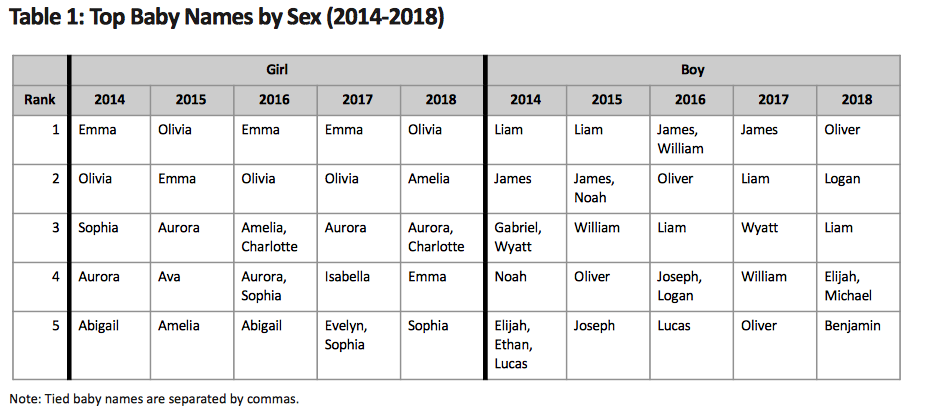
OLIVIA WAS TOP NAME FOR GIRLS, OLIVER WAS TOP FOR BOYS
The Alaska Division of Public Health’s Vital Records Section published its annual report on Alaska’s vital statistics, and came up with these facts for 2018:
Alaska resident mothers gave birth to 10,092 babies.
Births delivered by cesarean sectionmade up 22.4 percent of all births. Cesarean sections were highest among Black/African American mothers, at 27.3 percent.
5.9 percent of births were low weight. Low weight births were highest among Black/African American mothers, at 10.4 percent.
Premature babies — before the 37th week of gestation — made up 10.7 percent of all births. Preterm births were highest among Black/African American mothers, at 15.0 percent
August had the largest number of births by month (934).
The most popular girl’s name was Olivia.
The most popular boy’s name was Oliver.
The mean age of mothers was 28.6 years old,
The mean age of fathers was 31.3 years.
Teenage mothers (aged 15-19) gave birth to 422 babies.
The youngest mother was 14 years old, while the oldest was 49.
The youngest father was 15 years old, while the oldest was 71.
There were 4,461 deaths.
Malignant neoplasms (cancers) were the leading cause of death.
November had the largest number of deaths by month (404)
.The oldest male decedent was 102 years old.
The oldest female decedent was 105 years old.
The mean and median age of death for males was 64.2 and 67.0 years, respectively.
The mean and median age of death for females was 69.3 and 73.0 years, respectively.
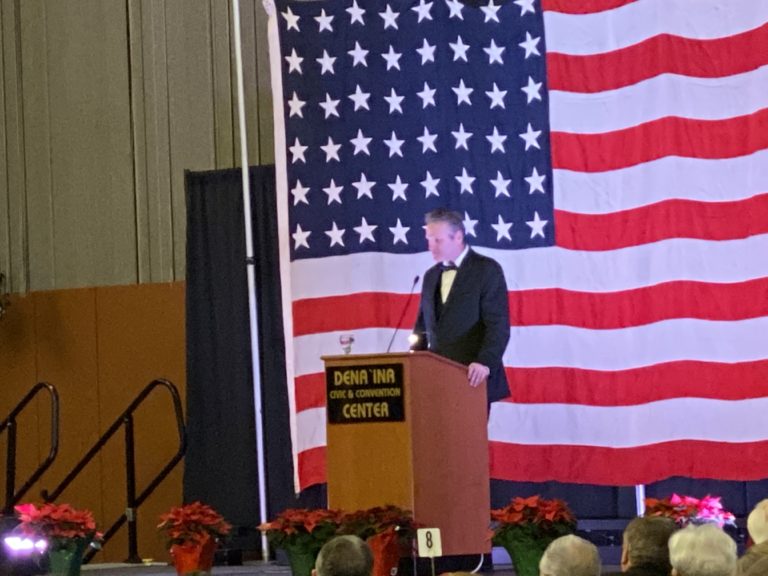
The ballroom was packed with ladies in beaded gowns and gentlemen in tuxes, and every table was full at the Republican Party’s Unity Gala on Friday at the Dena’ina Center in Anchorage.
The actual numbers were not released by the party, but counting over 500 heads, and multiplying that by the $200 tickets, adding the $10,000 and $5,000 tables, and all the auction items (Ted Stevens cufflinks, anyone?), it’s clear the party netted more than $100,000 on the event. The funds are dedicated to running the party office, doing an absentee ballot chase program, and a get-out-the-vote effort for the 2020 election cycle.
Observers and insiders said that there’s never been a more successful fundraiser for the Alaska Republicans in the history of Statehood. Those who scoffed at the “Unity” theme before the event were surprised at the strong showing of a broad base of conservatives, and even when a liberal gossip blogger and tracker snuck in the door to take his seat at the table of Sen. Josh Revak, guests and party officers were gracious and non confrontational.
Only a handful of legislators made an appearance — Sen. Natasha Von Imhof, Sen. Mia Costello, Sen. Shelley Hughes, Sen. Revak, Rep. Colleen Sullivan-Leonard, Rep. Bart LeBon, Rep. Laddie Shaw, Rep. Sara Rasmussen, Rep. Chuck Kopp, and Rep. Mel Gillis.
Backed by a massive, historic pre-Statehood U.S. flag, Party Chairman Glenn Clary spoke of how the nation pulled together during World War II, and now is the time for the Alaska Republican Party to also pull together. He reminded people that the anniversary of the bombing of Pearl Harbor was Dec. 7.
“Yesterday, December 7, 1941 — a date which will live in infamy — the United States of America was suddenly and deliberately attacked by naval and air forces of the Empire of Japan,” Clary said.
“Tomorrow, we will remember the sacrifices that were made, and the lives lost to preserve the freedoms and liberties that we enjoy today. We will commemorate American’s victory over imperialism and socialistic regimes.
“Unity was the glue necessary to defeat America’s enemies in 1941 and it will be the glue necessary to provide Republicans the strength to defeat our enemies to infinity and beyond.”
Clary’s remarks were right for the occasion: The flag behind him with 48 stars had been supplied by Marti Goldberg, who inherited it from her father. Lt. Commander Elwood Schaffer served on a submarine chaser (U.S.S. PC-474) off the coast of North Africa during World War II. Goldberg noted that the flag was also draped vertically in front of her family home in honor of her neighbor, Dougie Irwin, when he returned home from Vietnam, during a time when many did not respect returning warriors.
Sen. Dan Sullivan also spoke along the the historic theme, about how Republican Administrations have always been good to Alaska — from President Lincoln forward.
William Seward, Lincoln’s Secretary of State, arranged for the purchase of Alaska. Alaska became a state under Eisenhower, and oil became our economic driver under Nixon. President Trump has taken an interest in helping Alaska move forward with new energy exploration and development, as well as building the road to King Cove, and allowing at least some multiple uses of the Tongass National Forest.
Conversely, the Democrat presidents have sought to shut down Alaska, and under the Democrats in Congress, Alaska always suffers. President Clinton killed ANWR by vetoing legislation after it passed Congress, and it was Clinton who locked up the Tongass with the Roadless Rule. President Obama treated ANWR like a monument, and closed off 80 percent of the NPRA. Under Obama and Interior Secretary Sally Jewell, the King Cove Road was killed.
The stakes for 2020 are high, he said. The direction national Democrats are leading the country are not in line with where reasonable, moderates want to go in Alaska. For example, the Green New Deal would get rid of fossil fuels in 10 years.
Sullivan said Alaskans are united for policies that are in the best interest of this state. Republican policies, he said, are in the best interest of Alaska.
Gov. Michael Dunleavy spoke about how Democrats on the national level are trying to use impeachment to unseat the president, and how on the local level, they’re using the same tactics. He said that we are, at this time, debating the essence of America — Republican Democracy vs. socialism.
Dunleavy rattled off a list of “good news” items for Alaska, including:
.9 percent GDP growth in the first half of 2019
Lowest unemployment in Alaska’s history, (records go back to 1976)
1,800 new jobs added this year
Alaska’s wages up $355 million
5.6 percent personal income growth
The gala, which began at 6:30 pm, was still going strong at 11 pm on Friday night, with hundreds lingering in the Dena’ina Center.
Only a small handful of protesters stood outside in the cold with “RINO Safari” signs demanding a full Permanent Fund dividend, but they did not dampen the spirits of the broad base of attendees who came to celebrate all the values they have in common.
House Speaker Nancy Pelosi lectured a reporter during a press availability, when he asked her if the impeachment proceedings had to do with her hatred of the president. She referred to her Catholicism, and said she has a heart “full of love.”
“Do you hate the president?” the reporter had asked.
Pelosi replied, “”I don’t hate anybody…As a Catholic, I resent your using the word hate in a sentence that addresses me. I don’t hate anyone…So, don’t mess with me when it comes to words like that.”
It’s clear that Sinclair Broadcast Group reporter James Rosenwill not be invited to the cool-kids’ table at the next reporters’ luncheon. After the exchange, “#DontMessWithNancy was a hashtag that raced to prominence on Twitter, where politics is a blood sport.
Rosen maintains that it is a fair question in the context of Pelosi hurrying the impeachment proceedings along in the House of Representatives.
The Alaska fall revenue forecast for the coming fiscal year is out, and it’s not a pretty picture for how the state will pay for services.
While Unrestricted General Fund revenue totaled $2.6 billion in Fiscal Year 2019 and is forecast to be $2.1 billion in FY 2020, it will drop to $2.0 billion in FY 2021.
The drop of $600 million in three years of revenues makes the coming budget cycle at least as challenging as the last one, where Alaska lawmakers and the governor struggled to balance spending with diminishing revenue. After the governor offered his budget last year, it was only days before the drumbeat of “Recall Dunleavy” started among Democrats.
The revenue forecast excludes some $2.9 billion that the Permanent Fund Earnings Reserve Account will transfer to the General Fund this budget cycle. That figure will increase to $3.1 billion in FY 2021 — funds that pay for Permanent Fund dividends and for general government.
One of the main drivers of the falling revenue forecast is the anticipated price of oil, which is falling. While North Slope crude averaged $69.46 in FY 2019, it’s now projected at $63.54 for FY 2020. But for FY 2021, it will drop to $59 a barrel, according to the Department of Revenue.
While prices are softening, the overall production is still sagging, and new oil fields and finds won’t fill the gap until later in the 2020s, when production will come roaring back due to the stable tax policy of SB 21, passed in 2013 by the Legislature and given a vote of confidence by the public in 2014 during a referendum to toss it out.
But bringing oil online in today’s regulatory environment is a long game, and if tax policies change under the Our Fair Share initiative that is now collecting signatures, the investment decisions on new fields may be put back on the shelf by the oil companies that would bring that oil to market.
For FY 2019, North Slope oil production averaged 496,900 barrels per day. The forecast assumes that production will decline to 492,100 barrels per day in FY 2020 and 490,500 barrels per day in FY 2021.
That is a 1.25 percent drop, but represents millions lost in taxes and royalties to the state. The Department of Revenue projects there will be $200 million less in those payments by oil companies, primarily because of the downward trend of oil prices.
Gov. Dunleavy is expected to roll out his proposed state budget for the coming year. It’s due before Dec. 15, and it’s a solid bet that he will not release the budget on Friday, Dec. 13, but likely will do the big reveal midweek.
The revenue forecast is a piece of the process, meant to advise the governor and Legislature in making budget decisions for the fiscal year that will start July 1.
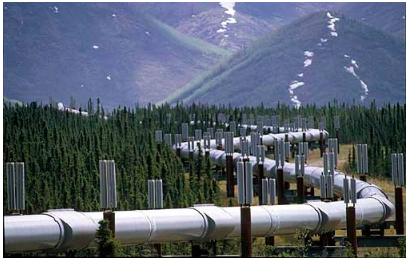
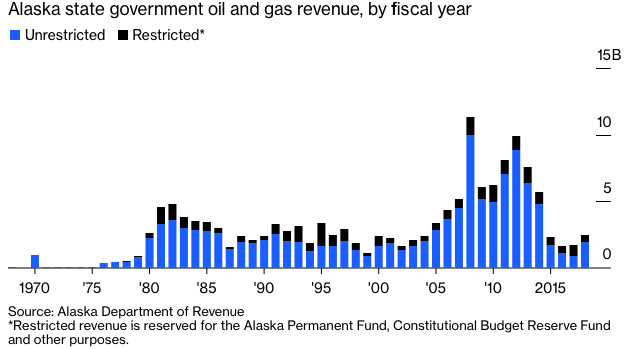
In the 42 years since oil started moving through the Trans Alaska Pipeline system, Alaska has paid for state services using oil and gas revenues, which have comprised 83 percent of the unrestricted State General Fund. The pipeline is currently moving less than one-quarter of its capacity.
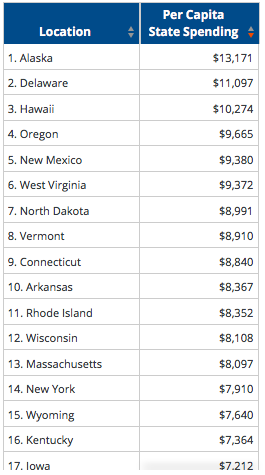
Since the 2015 drop in oil prices, however, the revenue hasn’t kept up with the expenditures, which are the highest per capita in the nation, according to KFF.org.
Late Thursday night, Alaska State Troopers responded to a report of gunshots, with injuries in a neighborhood in Wasilla. The report said three men had walked away from the scene near Hollywood Road and Sylvan, holding what appeared to be weapons.
Troopers found three men on an ATV trail close to the incident and arrested Peter Anthony Williams, 32, Darin Jacobs Smith, 26, and Andre Miller Franklin, 41.
They are held at Mat-Su Pretrial Center on a no-bail status pending charges of Attempted Murder x 3, Assault One x 3, Kidnapping x 2, Robbery, Misconduct Involving a Weapon 2. All three have prior brushes with the law in Alaska.
Three injured people were transported to Mat-Su Regional Hospital. One person has life-threatening injuries.
Charging documents are still pending, but arraignment of the men began Dec. 6 and will continue on Monday at the Palmer Courthouse.