RECALL PETITIONERS ALSO RAISING FUNDS TO GET SIGNATURES
PSEA, the Public Employees Safety Association, which represents Alaska State Troopers, local police, and other public safety professionals, today donated $5,000 to the Stand Tall With Mike committee, continuing their support of the governor. PSEA endorsed Dunleavy during the 2018 election cycle and Dunleavy has made public safety his top priority.
On the other side of the political issue, the Recall Dunleavy Committee is also busy raising money while waiting to get petition booklets issued by the State Division of Elections. Superior Court Judge Eric Aarseth ruled last week that the Division has until Feb. 10 to issue those booklets.
When they do get their hands on the petition booklets, the recall organizers will fan out across the heavily Democrat and liberal parts of the state, such as Juneau, Anchorage, downtown Homer, and Fairbanks, and gather the 71,252 signatures needed to get the recall onto the ballot in what they hope will be a special election.
The signature gatherers are looking for a slightly larger raw number — probably about 76,000, to be sure they have met the threshold of legitimate signatures. They must turn in 25 percent of the number of Alaskans who voted in the 2018 general election.
The group gathered 49,006 signatures during the first round when they applied for petition booklets, although they only needed to collect 28,501.
As it turns out, there are 74,424 registered Democrats in the state, most of which would be happy to recall any Republican governor.
Those trying to recall the governor have the contact information for each of them through their election database software that they can cross-reference with Division of Elections records.
They also have the contact information for the 125,739 “likely voters” who cast a ballot for Democrat Mark Begich in 2018. This information is fairly easy to determine with today’s sophisticated campaign software.
The Stand Tall With Mike group, opposing the recall, is preparing to appeal Judge Aarseth’s ruling to the Alaska Supreme Court. They may also ask for a stay to prevent those petition booklets from being issued while the matter is in court.
Getting a delay, while unlikely, would make it more possible that the recall question goes to the Primary or General Election ballot, although there is no guarantee. The Recall Dunleavy group is hoping for a special election.
The Recall Dunleavy group can gather signatures up until 180 days prior to the termination of Gov. Dunleavy’s first term in office. That means the opponents of the governor can continue their efforts up until about June 1, 2022, putting pressure on the governor for essentially his entire term. Those signatures, whether gathered now or later, will be used by the next Democrat Party opponent to rally forces to take the seat away from Republicans.
From the day that the Recall Dunleavy Committee turns in the signatures, the State would have 30 days to certify the signatures and the election would be held between 90 and 120 days.
The Alaska Supreme Court, with its liberal bent, is likely to allow the recall election to go forward.
While both sides are raising funds, the Recall Dunleavy group has been more aggressive. A fundraiser was held at the IBEW Hall in Anchorage on Sunday, and another one will be held Jan. 23 at the home of Eleanor Andrews of Anchorage.
Alaskan Noel Rea is the new interim chief executive officer at the Alaska Psychiatric Institute, according to the Alaska Department of Health and Social Services.
Meanwhile, the department said that on Dec. 27, 2019, the Centers for Medicare and Medicaid Services notified DHSS that API is “in substantial compliance” with requirements and found no deficiencies.
API had been flagged by CMS by CMS in September after a complaint had been made about federal compliance.
The team at API addressed the deficiencies through a plan of correction and after the unannounced survey, CMS withdrew their notice.
At the same time, API’s “deemed status” through The Joint Commission, an independent accreditation organization, was restored and it was removed from the State Survey Agency Jurisdiction.
Noel Rea comes to API with 30 years of experience in Alaska working for public, private and tribal health care delivery systems. He was a senior director at NetworxHealth, a health care consulting division of Virginia Mason Medical Center, and has served as an interim CEO for other Alaska hospitals, including South Peninsula Hospital, Cordova Community Medical Center and Southeast Alaska Regional Health Consortium (SEARHC).
He received his Master in Business Administration in Health Care Administration from Alaska Pacific University and a Bachelor of Science in Psychology from Colorado State University. Rea is active in the community, serving as a current board member for Anchorage Project Access, an organization that works to increase access to health care for low income, uninsured individuals; past board member for the Anchorage Neighborhood Health Center; and he just completed his term as president of the Alaska chapter of the American College of Healthcare Executives.
John Lee, who served as acting CEO, returned to his role as director of the Senior and Disabilities Services Division.
Alaska has lost population — about 8,000-10,000 people is the estimate of the drop in residents in the past three years. That means a shift in the political landscape. Not only has the migration been to other states, but within the state, people are also on the move.
Some of the more interesting demographic numbers are found in the voter registration logs comparing Jan. 3, 2018 and Jan. 3, 2020.
(Keep in mind that the overall voter rolls are artificially high due to the new automatic voter registration with Permanent Fund dividend applications. Approved by voter ballot initiative in 2016 with Ballot Measure 1, the automatic voter registration puts unregistered voters into the Undeclared category.)
Here are some shifts that will be of interest to candidates, campaigns, and political activists this year as the election cycle ramps up:
Interior Alaska (Districts 1-6) lost 348 Democrats, and lost 605 Republicans.
Mat-Su (Districts 7-12) lost 65 Democrats and gained 1,448 Republicans.
Eagle River-Chugiak (Districts 13-14) lost 45 Democrats and lost 116 Republicans. This is a heavily Republican area.
District 13, however, was the only one in the Anchorage area to gain Republicans, adding 65. The district is served by Republican Rep. Sharon Jackson, who is running for reelection.
Anchorage (Districts 15-28) lost 656 Democrats and lost 1,582 Republicans, a blue trend in the largest metropolitan area of the state. There are still 41,932 Republicans in these Anchorage districts, compared with 31,028 Democrats.
Republicans lost voters in Anchorage Districts 15, 17, 18 21, 22, 24, 25, 27.
Kenai lost 90 Democrats and gained 315 Republicans. The region lost Democrats in all three districts and gained Republicans in all three.
Kodiak lost 45 Democrats and lost 135 Republicans.
Southeast lost 240 Democrats and gained 55 Republicans.
Rural Alaska lost 450 Democrats and lost 5 Republicans.
Juneau District 33 lost 93 Democrats and picked up 59 Republicans; (there are 3,603 Democrats to the 2,107 Republicans in this district).
Southeast Districts 34 and 35 lost 8 and 131 Democrats in respectively, while Republicans gained 78 and 40 voters in those districts.
OVERALL VOTER BASE SWELLS BY OVER 9 PERCENT
Alaska’s voter rolls are growing, in spite of the drop in population. Alaska lost about a half a percent of its population between 2018 and 2019, but increased voters by 9 percent between 2018 and 2020, a gain of 49,852 voters in those two years.
On Jan. 3, 2018, 531,749 voters were registered in Alaska.
141,636 were Republicans,
76,362 were Democrats
85,176 were Nonpartisan
200,461 were Undeclared.
By Jan. 3, 2020, 581,601 voters were registered in Alaska.
140,920 were Republicans
74,424 were Democrats
84,023 were Nonpartisans
253,960 were Undeclared.
During that time period:
Republicans lost 716 voters, or .51 percent of the R voter base.
Democrats lost 2.54 percent of the D voter base.
WARNING BELLS FOR SOME CANDIDATES
Republican registrations are sneaking up on Rep. Jonathan Kreiss-Tomkins, whose Southeast District 35 has continued to become more and more Republican. The district lost 131 Democrats and gaining 40 Republicans in just two years, a trend that has continued since Democrat Kreiss-Tomkins was elected in 2012.
2,419 registered Democrats and 2,986 Republicans call that Sitka-Hoonah-Angoon District 35 area their voting home.
Also at risk is Rep. Daniel Ortiz, who is not with a party but caucuses with Democrats since being elected in 2014. He is the only non-Republican to win in this district, which has voted for President Trump, Gov. Dunleavy, and the rest of the Republicans on the ballot year after year. The district is still 2:1 Republican over Democrat.
Neither Kreiss-Tomkins nor Ortiz have opponents yet for the 2020 cycle, but both are largely out of step with the regions they represent.
The Senate prefiled bills from Friday, Jan. 10 include a major rewrite of Alaska’s oil taxes, to increase the taxation on the largest fields on the North Slope. The list of bills filed by senators on Friday:
SB 128, sponsored by Mia Costello: Requiring legislative approval for certain state charges, rentals, and fees related to aviation. Details here.
SB 129, sponsored by Bill Wielechowski: Relating to the oil and gas production tax; relating to credits against the oil and gas production tax; relating to payments of the oil and gas production tax; relating to lease expenditures and adjustments to lease expenditures; making public certain information related to the oil and gas production tax; relating to the Department of Revenue; and providing for an effective date. This bill is similar to the oil tax voter initiative called “Our Fair Share,” and has a slim chance of passage, but shows that the Our Fair Share initiative is not as simple as it’s made out to be, a case made by the Attorney General’s opinion on the initiative language. Details here.
SB 130, sponsored by Gary Stevens: Relating to a seafood product development tax credit; repealing secs. 32 and 35, ch. 61, SLA 2014. Adds pollock and cod to the list of seafood covered by this tax. Details here.
SB 131, sponsored by Elvi Gray-Jackson: Relating to special registration plates for vehicles owned by a person with a disability. People can can get special license plates if deemed disabled by a speech therapist, physical therapist or occupational therapist under this bill. Details here.
SB 132, sponsored by Tom Begich: Limiting the pay of certain state officers and employees in the executive branch. No head of a department would be able to be paid more than the governor. Details here.
SB 133, sponsored by Elvi Gray-Jackson: Relating to testing of sexual assault examination kits. This is companion legislation to that filed by Rep. Geran Tarr in the House, requiring the processing of rape kits in six months, rather than 12. Details here.
SB 134, sponsored by David Wilson: Relating to medical assistance (Medicaid) reimbursement for the services of licensed professional counselors. Details here.
SB 135, sponsored by Shelley Hughes: Relating to health care insurers; relating to availability of payment information; relating to an incentive program for electing to receive health care services for less than the average price paid; relating to filing and reporting requirements; relating to municipal regulation of disclosure of health care services and price information. Bill is also known as Alaska Health Care Consumer’s Right to Shop Act. Details here.
SB 136, sponsored by Gary Stevens: Providing for the establishment of public schools through state- tribal compacts. Appears to not be coordinating with legislation coming from the Office of the Governor. Details here.
SB 137, sponsored by Peter Micciche: Extending the termination date of the Board of Parole. Details here.
SB 138, sponsored by Elvi Gray-Jackson: Relating to correctional facilities; relating to the authority of the commissioner of corrections to designate the correctional facility to which a prisoner is to be committed. Companion to legislation filed by Rep. Zack Fields to strip the Department of Corrections of its authority. Details here.
SJR 12, sponsored by Click Bishop: This is considered a “butt-hurt bill,” as it proposes to strip the governor of much of his veto authority over budget items. Details here.
“Alaska’s Fair Share” oil tax initiative proponents say that they have collected over 40,000 signatures to place their initiative on the ballot.
On Friday, Jan. 17, the group will turn their petition booklets in at the Division of Elections between 2-3 pm. There will be some fanfare for the television cameras at the 2525 Gambell Street building where Elections is located.
The initiative asks voters to radically change Senate Bill 21, Alaska’s stable oil taxation system that voters approved in 2014. The change would boost the tax rate and eliminate net tax credits for the largest oil fields. The leader of the initiative is Robin Brena, the law partner of former Gov. Bill Walker.
The first batch of pre-filed bills for the Legislature includes the spectrum of the sublime to the ridiculous. Most of the bills in the first release of bills are sponsored by Democrats or members of the Democrat-led House Majority. Those have a better chance of passing the House because of the sponsors’ majority status:
HB 180, sponsored by Adam Wool: Relating to the Board of Regents of the University of Alaska. It would, among other things, allow the president of the University of Alaska System to cast a tie-breaking vote on the Board of Regents. Details here.
HB 181, sponsored by Matt Claman: Relating to mental health education. “Health guidelines must provide standards for instruction in mental health and shall be developed in consultation with the Department of Health and Social Services and representatives of national and state mental health organizations.” Details here.
HB 182, sponsored by Geran Tarr: Relating to testing of sexual assault examination kits; and providing for an effective date. It reduces the length of time that rape kits must be processed from one year to six months. Details here.
HB 183, sponsored by Zack Fields: Relating to the duties of the Department of Health and Social Services; relating to the duties of the Department of Labor and Workforce Development; and relating to staffing and wage standards for the Alaska Psychiatric Institute. Among other things, the bill says this state-owned facility, now being run by a private contractor, must pay prevailing wages. Details here.
HB 184, sponsored by Tammie Wilson: Exempting veterinarians from the requirements of the controlled substance prescription database. Details here.
HB 185, sponsored by Louise Stutes: Relating to the registration of commercial vessels; and providing for an effective date. This is a streamlining bill. Details here.
HB 186, sponsored by Louise Stutes: Naming the Irene Webber Bridge at Mile 9.5 of the Copper River Highway. Details here.
HB 187, sponsored by Zack Fields: Relating to correctional facilities; relating to the authority of the commissioner of corrections to designate the correctional facility to which a prisoner is to be committed; and providing for an effective date. Basically ties the hands of the Corrections officials. Details here.
HB 188, sponsored by Zack Fields: Relating to education tax credits for certain payments and contributions for child care and child care facilities; and providing for an effective date. Details here.
HB 189, sponsored by Dave Talerico: An Act relating to the identification, location, and notification of specified family members of a child who is in state custody. If a child is taken out of a home by the State, within 30 days it will perform due diligence to inform a noncustodial parent or adult family member. Details here.
HB 190, sponsored by Dave Talerico: Relating to allowable absences for a permanent fund dividend; and providing for an effective date. If an Alaskan is accompanying a person, such as child or family member, out of state for an extended period of time (such as medical treatment), that Alaskan will be granted the time as an allowable absence, when it comes to the Permanent Fund dividend. Details here.
HB 191, sponsored by Tammie Wilson: Relating to church attendance of a child who is in state custody. If a foster child is placed in a home, efforts will be made to ensure that child can continue attending his/her church of choice. Details here.
HB 192, sponsored by Matt Claman: Removing certain limitations on campaign contributions made by nonresidents. Allows out-of-state people to contribute to campaigns. Details here.
HB 193, sponsored by Andi Story: Adding a second verse to the official state song. The new second verse has been bandied about for years, but few people find it artful. Details and lyrics here.
HB 194, sponsored by Sarah Vance: Relating to consolidation of school districts; and providing for an effective date. The Department of Education shall consolidate school districts in the state from 54 school districts in the state to 18 school districts in the state. Consolidation of school districts in regional educational attendance areas must be based on common geographic or cultural needs, as determined by the department. Details here.
HB 195, sponsored by Andy Josephson: Relating to the Board of Regents of the University of Alaska. Changes the requirements so that a quorum is seven regents, rather than six. Details here.
HB 196, sponsored by Zack Fields: Relating to the maximum annual awards for Alaska performance scholarships. Changes the maximum amount of the scholarship to $4,755. Details here.
HB 197, sponsored by Chris Tuck: Extending the Alaska Seismic Hazards Safety Commission. Details here.
HB 198, sponsored by Andy Josephson: Relating to aggravating factors considered at sentencing. Adds gender identity and sexual orientation as aspects that would intensify the sentence of someone who perpetrated a crime against these categories of victims. Details here.
HJR 22, sponsored by Jonathan Kreiss-Tomkins: Proposing an amendment to the Constitution of the State of Alaska repealing the repayment requirement of the Constitutional Budget Reserve. This bill is merely an admission that the Legislature has no intention of repaying the fund, but would need to be voted on by the public. No more sweeping of unspent funds into the CBR. Details here.
Alaska Democrats are not going to caucus in gymnasiums to determine who their nominee is for president this year.
They are adopting a plan similar to that used by Alaska Republicans, which is a caucus-by-ballot. You don’t stand around a gym for hours, you simply mark your ballot and get on with your life. But it’s not a state-run or state-funded operation. It’s operated by volunteers — political volunteers.
Part of an MRAK exclusive series on the 2020 presidential election.
The Alaska Democratic Party barely received approval from the Democratic National Committee in time to execute its plan, and is now scrambling to get enough volunteers and materials to make the process go smoothly. The clock is ticking and the credibility of the party is certainly on the line after the disastrous experience Alaska Democrats had with their own party in 2016. Back then, the delegates that went to national convention didn’t vote for Bernie Sanders, as they had their instructions to vote for Hillary Clinton.
Party insiders still are not thrilled that the DNC held onto Alaska’s new primary plan for six months before issuing its approval, giving the state party little time to get their logistics in place, as well as their people, their training, and their checks and balances. Their first big deadline is less than two weeks away.
For now, the Democrats’ struggle seems to be to set up meetings in every one of the 40 House district to try to get the word out about how it’s going to work this cycle.
Details have begun to emerge as to how Democrats will nominate their presidential candidate:
All presidential candidates wanting to appear on the Democrats’ private primary ballot must file with the the Alaska Democratic Party by Jan. 24, 2020. There is a fee of $2,500, which will help the party pay for the logistics and a coordinator who has yet to be hired.
All registered Democrats in Alaska will receive a postcard from the Alaska Democratic Party about six weeks before the primary polling process begins.
That postcard will be mailed on Feb. 19, and will describe how to cast an absentee ballot or how to vote in person at one of the several voting centers that will be set up around the state. The postcards will arrive around Feb. 20-21, giving absentee participants little time to send in a request for a mail-in ballot.
Absentee ballots must be postmarked by the voters by March 24 to be counted.
On April 4, the Democrats will hold in-person, caucus-by-ballot voting from 10 am until 2 pm at centers in these communities and boroughs: Anchorage, Fairbanks, Juneau, Mat-Su, Kenai, Dillingham, Bethel, Nome, and Kotzebue. The voting will be overseen strictly by volunteers; there are no paid staffers in most of this process. Ballot security will be an issue. People can register as Democrats on the spot and then vote in this party process.
Democrats who find themselves in other communities can choose to vote at any of the sanctioned Democrat polling stations — they do not need to vote in their home community or precinct.
RANKED VOTING, HERE THEY COME
Democrats will also roll out “ranked choice” voting for their private primary process.
Ranked voting in Democrat-run private primaries being experimented with in Alaska, Hawaii, Kansas, and Wyoming this year. Nevada Democrats will use it for early voters in their 2020 caucuses.
CONFUSED? RANKED CHOICE, THE ICE CREAM ANALOGY
Many people are confused by ranked-choice voting. The ice cream analogy is one of the easiest to understand:
Suppose you are voting for your favorite ice cream: Chocolate, Vanilla, Strawberry are the choices.
The final vote is Chocolate wins with 40 percent of the vote, Vanilla comes in with 36 percent, and Strawberry has 24 percent. But none gets 51 percent.
The Strawberry vote is tossed out as the lowest vote getter.
The second choice of those Strawberry voters went 70 percent for Vanilla and 30 percent Chocolate.
Now, 70 percent of the 24 percent Strawberry voters is awarded to Vanilla, and 30 percent of the 24 percent of Strawberry voters is given to Chocolate.
That means Vanilla now gets 17 more votes. Voila! 36 plus 17 = 53 percent of the vote, so Vanilla wins because Chocolate, once ahead, now only has 47 percent of the vote.
TOP CHOICE LOSES
In our ice cream analogy, voters who selected the least favorite ice cream as their first choice have their votes added to the totals of their second favorite ice cream, allowing them to vote twice. And although Chocolate was the favorite, when Vanilla and Strawberry combined their votes, they were able to topple Chocolate.
Ranked choice voting is something that the liberal Outside-funded “Alaskans for Better Elections” is trying to put into law in Alaska through a ballot initiative.
But it could work against the Democrats in Alaska, and their primary experiment will tell them a lot more about whether they want to go down that road.
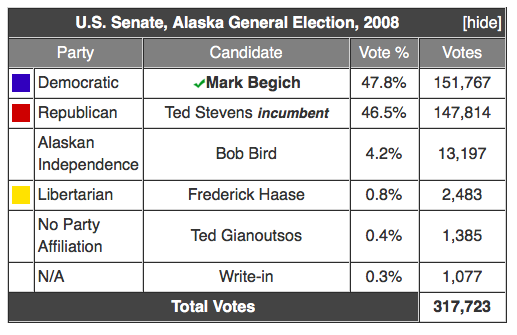
In 2008, when Sen. Ted Stevens was being challenged by Mark Begich, Stevens would have won under the ranked-voting scenario. The spoilers in the race were the Libertarian and Alaska Independence Party candidates. Those Libertarian and AI voters would probably have ranked Stevens as their second or third choice, rather than Begich:
For the Alaska Democratic Party’s upcoming experiment in ranked voting, the party could have five candidates on its caucus ballot.
Depending on whether Bernie Sanders or another Democrat gets a ground game going in Alaska, ranked-choice voting could mean that the more radical Democrat nominees prevail for Alaska Democrat delegates heading to the national nominating convention.
Why? A person voting for Bernie Sanders (as 82 percent of participating Democrats did in the 2016 Democrat Party caucuses) will not likely choose Joe Biden as a second choice, but will choose someone like Elizabeth Warren. Likewise, a Joe Biden voter will probably not pick Bernie Sanders as their second choice, if they have someone like a Michael Bloomberg or Tom Steyer on the ballot.
The youth vote could also be a factor: All voters who are 17 years old and who would turn 18 by the General Election will be allowed to participate, which may further skew the vote for Sanders in the upcoming vote.
Results of the Democrats’ private primary will be announced before midnight on April 4. Any candidate getting more than 15 percent of the ultimate tally could be entitled to “soft” bind a delegate for the national convention.
DEMOCRATS WILL STILL CAUCUS
Each House district Democrat committee will hold caucuses on Saturday, April 18 to elect officers and delegates for the 2020 state convention, which will be held in Fairbanks this year on May 15-17.
Delegates elected to the state convention will elect delegates to the national convention, July 13-16 in Milwaukee, Wis.
The Democrats’ delegate selection process is going to be gender-sensitive, to the point that it may serve to disenfranchise natural-born women in favor of transgendered individuals who are identifying as women. (According to data from the Social Security Administration, transgendered men-to-women outnumber women-to-men nearly two-to-one.)
“To ensure the district-level delegates are equally divided between men and women (determined by gender self-identification) delegate positions within each district will be designated by presidential preference beginning with the highest vote-getting presidential preference. This assignment of delegate positions will continue with the next highest vote-getting preferences in descending order, with positions assigned to either male and female,” the Democrats’ manual reads.
The manual, approved by the national party, states that in the case of people who don’t want to choose a gender, they will not be required to: “In the case of non-binary gender delegates, they shall not be counted in either the male or female category.”
The DNC in December awarded the Alaska Democratic Party one additional at-large delegate for the 2020 national nominating convention. In 2016, the Alaska Democrats sent 20 delegates to the national convention.
ILLEGAL POLL SOFTENS TARGET FOR INFLUENCE CARPET-BOMBING
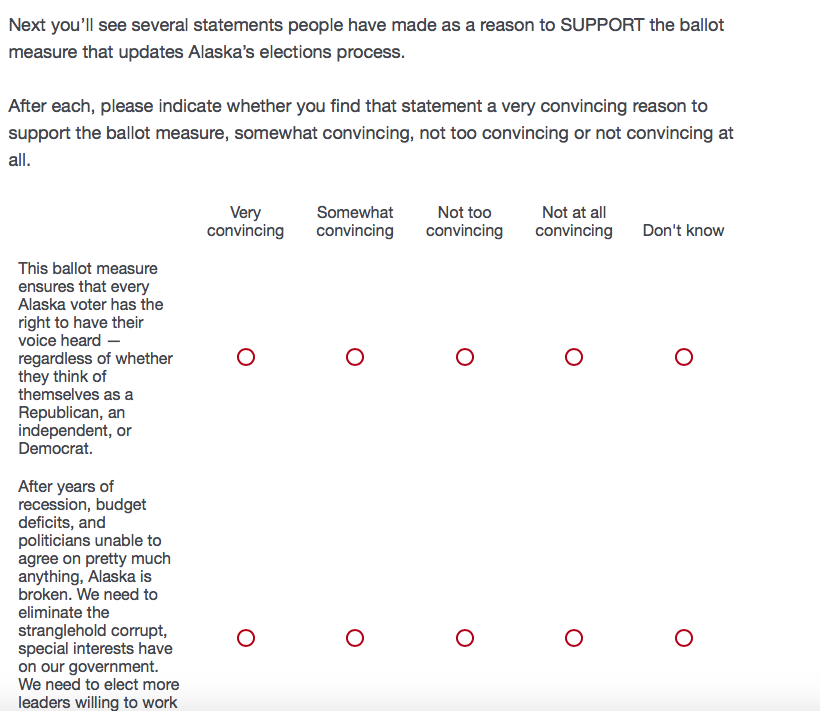
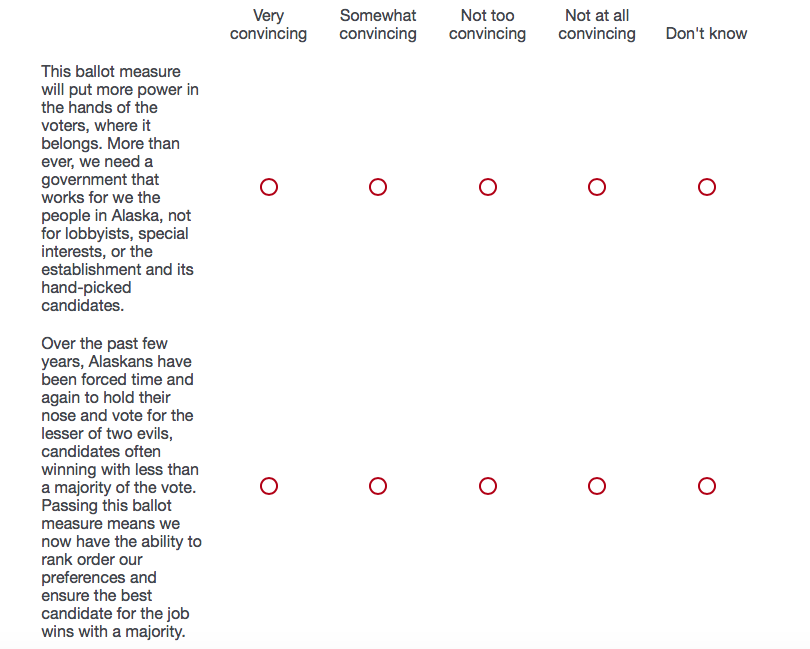
The “Better Elections” ballot initiative, funded with money from progressive groups outside Alaska, is running a web-based poll to find out what messages would make Alaskans more likely to vote for the initiative, which will likely appear on a statewide ballot this year.
“If you qualify and complete the survey,” the polling company says it will give you a $5 Visa gift card or $5 Amazon gift card. The entire poll appears to be in violation of state election laws, and there’s no real $5, nor any way for Alaskans to determine how they might actually qualify.
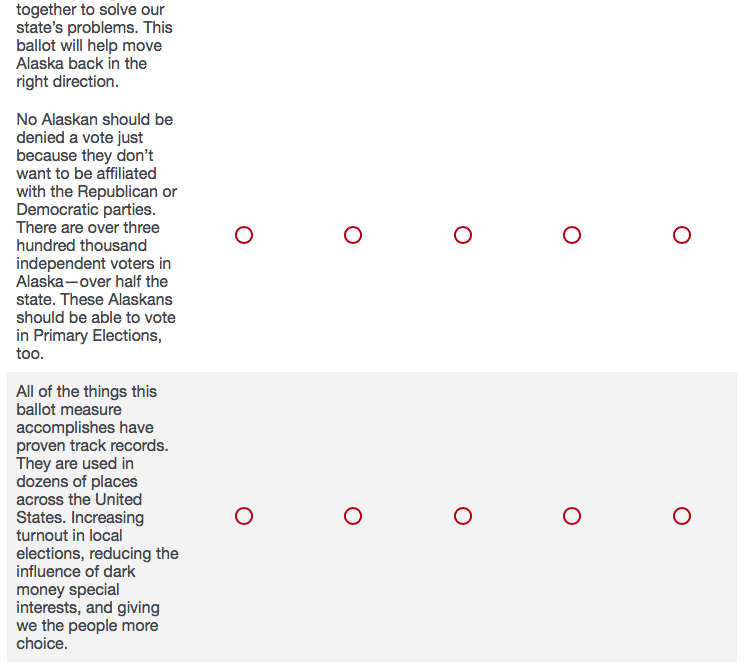
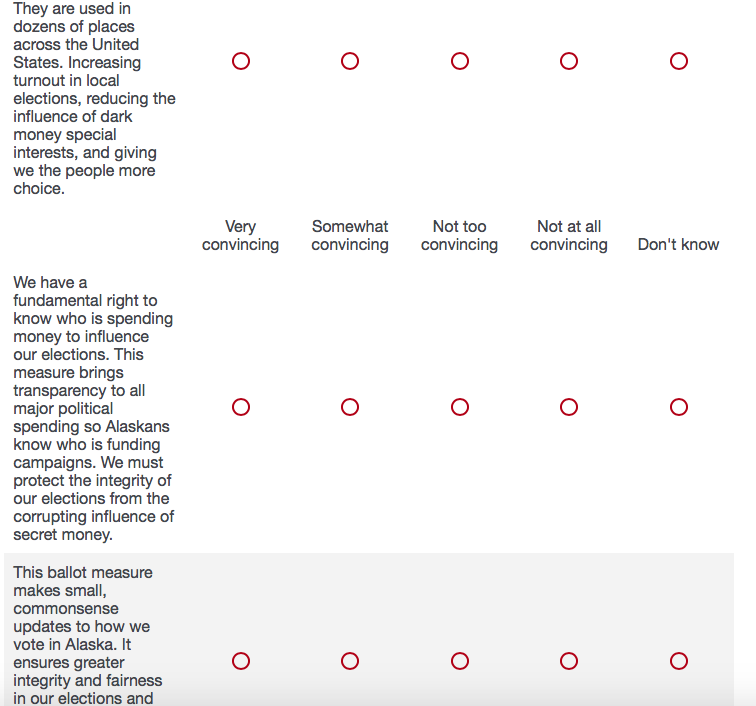
The poll asks participants to identify if they are an Alaskan, are male or female, Democrat, Republican, or other, where they live, their phone number, and what they think about people like President Donald Trump, former Sen. Mark Begich, among other recognizable names. The poll asks you how likely you are to vote in the upcoming election, and then gets down to the real matter at hand: What argument will most likely persuade you on the Better Elections Initiative:
The questionnaire then proceeds to ask participants which messages would most discourage them from voting in favor of the ballot initiative.
The Better Elections ballot initiative would dismantle party primaries, allowing anyone to vote for any candidate across party lines during the Alaska primary. It would also institute ranked voting. And it would make it harder for third-party groups to conceal the identities of their donors.
Unite America, a liberal group that is trying to take over Alaska’s election system, has contributed over $600,000 to the Alaskans for Better Elections group.
No group has yet formed to oppose the ballot initiative, which many believe would harm conservative candidates.
Ranked voting depends on a complicated computer calculation that could reduce voters’ confidence in the integrity of the election process, since it makes it more likely that the top candidate would ultimately lose in an “instant run-off,” if he/she didn’t get over 50 percent of the vote.
The “instant run-off” works like this:
If a candidate wins over 50 percent of first-preference votes, he/she is the winner. But if no candidate reaches over 50 percent of first-preference votes, the candidate with the fewest first-preference votes is dropped. Then, the first-preference votes cast for that failed candidate are eliminated, which changes the percentage for the second and first choice candidates. A new count is made to see if one candidate reaches the majority. If not, the candidate with the lowest votes is dropped off and the process is repeated until someone has an outright majority.
The poll doesn’t describe the exact mechanisms of the Better Elections initiative, but only the propaganda surrounding it. There is no disclaimer on the poll, which is likely a violation of state law since it is an issue that is heading for the ballot. It’s unlikely that the Alaska Public Offices Commission will be able to track down the shadow group and penalize it, since it’s impossible to see who is actually authorizing the poll.
The Alaska Department of Revenue, which has $7.7 billion in public fund investments, sold off some of its key holdings at the end of 2019, including shares in Berkshire Hathaway, Apple, Verizon, and Broadcom, according to Barron’s, a financial publication..
“The Alaska Department of Revenue, which collects and invests public funds, cut back on holdings in some of America’s largest companies. It sold class B shares of Berkshire Hathaway (ticker: BRKb), Apple (AAPL), Verizon Communications (VZ), and Broadcom (AVGO) in the fourth quarter. Notably, three are lagging behind the 1.1% gain in the S&P 500 so far in January through Friday’s close. The department disclosed the changes in a form it filed with the Securities and Exchange Commission,” Barron’s reported.