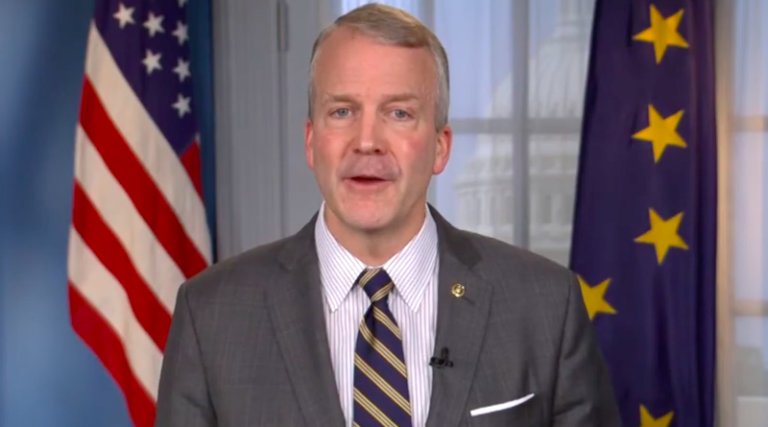
Sen. Dan Sullivan took environmental hypocrites to task today during a hearing in the Senate Environment and Public Works Committee on Wednesday.
He rebuked 16 Democrat senators for signing several letters to the heads of the nation’s 15 largest banks, calling on the institutions to refrain from investing on Alaska’s North Slope, particularly within the 1002 Area of the Arctic National Wildlife Refuge.
“Unprecedented. I’ve been here five years. Over one-third of Democrats in the Senate sent a letter to some of the top bankers in America to further impoverish my constituents. Unprecedented,” he said. He went on to say he doesn’t tell other senators how to run their states, but this action by mainly Democrats is something he’s seen time and again.
“I’m beyond steamed on this one. I’m disappointed. It’s sad,” he said.
“Nothing fires me up quite like Senate Democrats, who represent states that have already degraded their environments with irresponsible development, telling Alaskans how to manage our pristine environment and seeking to further impoverish some of our poorest citizens,” Sullivan said.
I’ve always wondered what went through my 16-year-old mother’s mind when she found out she was pregnant. Did a doctor tell her how easy it would be to end my life? That no one would have to know, not her boyfriend, not even her parents? Did she worry about being shamed and embarrassed? About not living up to someone’s expectations?
Unfortunately, this scenario occurs millions of times every year in the United States, but it’s a situation that I, by the grace of God, escaped from unscathed.
My mother chose to give me life. She was undoubtedly given an opportunity to choose a path that the world tells women is an easy way out – a quiet exit from pregnancy where no one would never know of her “mistakes.”
But she didn’t take that route. She took the hard path, and I’m here today because she did.
Because of her selflessness, I’ve lived to give birth to three beautiful children of my own. I get to tell my story today because my biological mother chose life, and because God blessed me with wonderful adoptive parents, David and Charlotte Richards, who exemplified what it meant to be kind, loving, and gracious.
Because of my personal history, I value the sanctity of life to the very core of my being.
Over the weekend, I had several Right to Life supporters contact me because they had been told that I voted against a pro-life bill. I shared my testimony with them, and we talked about creating a culture of life in Alaska.
I told them about our House Finance team’s efforts last year that stripped abortion funding from the state budget – and how we fought and won the battle to keep that amendment in place through the entire budget process. I told them how much the cause of life means to me.
Ronald Reagan’s phrase, “trust but verify,” is a reminder to Americans that we shouldn’t simply believe everything we hear.
These engaged Alaskans may have trusted what they had initially heard about my vote, but they also did what every conservative should be willing to do: they called me to verify.
These open-minded, kind, compassionate people now know that they have a true pro-life advocate working on their behalf – not just one who screams loudly at others and files dozens of bills without any plan to bring them to light.
Kelly Merrick represents Alaska’s 14th District, Eagle River, in the Alaska House of Representatives.
You’ve heard the saying “pull yourself up by your bootstraps” to explain how you can succeed by working hard and using your own resourcefulness, without the help of others.
One Democrat in Congress wants you to know that it’s impossible to pull oneself up by shoelaces or bootstraps — that it is a physical impossibility.
Rep. Alexandria Ocasio-Cortez, a Democrat from New York City, lectured a room on Wednesday during an Oversight Committee hearing:
“You know this idea and this metaphor of a bootstrap started off as a joke?” Ocasio-Cortez asked the room. “Because it’s a physical impossibility to lift yourself up by a bootstrap — by your shoelaces. It’s physically impossible. The whole thing is a joke,” she said emphatically.
In case you didn’t quite grasp what she was getting at, here’s the video of the congresswoman, who later that day skipped the State of the Union address by President Trump.
During the public testimony at the Regulatory Commission of Alaska concerning the purchase of BP assets in Alaska by Hilcorp, Rick Whitback, representing Power the Future, gave the commissioners encouragement and a warning about the testimony that was going to be given by the environmental lobby over the next six hours.
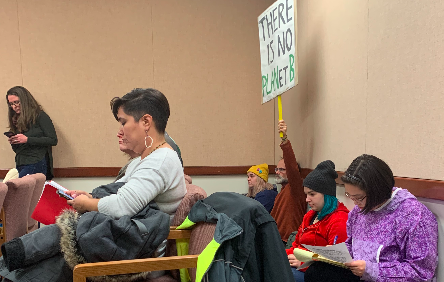
Whitbeck’s 3-minute testimony upset the environmentalists who spoke after him, and during a break in the six-hour public hearing they could be heard cursing him with the F-bomb.
Those opposing the sale said they want to see Hilcorp’s financial details first to know if the company is wealthy enough to take over BP’s assets on the North Slope. One testifier, a former newspaper writer who is now with the left-leaning Alaska Grassroots Alliance, said Hilcorp should be required to build light rail from the valley in exchange for the RCA approval of the sale.
Here’s the testimony by Whitbeck, state director for Power the Future, that got the Left so distraught:
I appreciate the opportunity to put my comments on record. My name is Rick Whitbeck and I am a 35-year Alaska resident who serves as the State Director for Power The Future, a national non-profit focused on energy workers and their importance in national security, American energy independence and energy dominance, as well as employees’ roles in Alaska’s cornerstone industries.
Throughout this hearing, you are going to be inundated with the same drivel over and over. That some poll said that some number of Alaskans want Hilcorp to open its books – and you know what they say about polls – you can write one to obtain any result you want. You’ll also hear that Hilcorp isn’t worthy of carrying on the 50-year BP legacy in the state, for some litany of reasons. All of which are factually unfounded, but instead, based on an unhealthy and near-lunatic fringe level of anxiety and fear.
What these commenters really are deviously implying– on all accounts – is that in your role as Commissioners, you lack the objectivity, clarity of purpose and intelligence to do your jobs without this horde of angry, always-disenchanted malcontents besieging you with how to do it right. News flash. You’re good. They need to get over themselves. – Rick Whitbeck, Power the Future
The facts are clear. Hilcorp has complied with all legal requests from state and federal agencies to-date. They’ve opened their books to the extent required by law. They’ve provided written and oral testimony, business plans and content as requested.
What you won’t hear from these annoying critics is that Hilcorp is capable, ready and willing to take an asset that BP was looking to rid itself of, and enhance its future operations. This is a clear free-market win for Alaska – Hilcorp will run Prudhoe Bay and the other assets in ways BP didn’t want to going forward. They will keep employees working and keep families in Alaska. They will allow communities to have continued involvement from the hundreds of energy workers who make up large portions their very societal fabric.
Adding delays to this buy/sell process will add anxiety to employees who already have been under pressure for many months. Let’s have this process move forward, denying the dissident voices what they really hope to accomplish, which is having oil and gas stay in the ground, revenues failing to hit state and local coffers, and paychecks failing to be paid, without any regard for the families affected by their egregious actions.
Let’s go back and just ask the employees involved what they think of that above-mentioned poll. I know their answer. 100% of them will want to continue what they’re currently doing – safely, efficiently, effectively and responsibly developing Alaska’s oil and gas reserves, just under the Hilcorp banner.
Please consider the workers. They are Alaska’s greatest resource. They deserve protection from this mob of protestors who gnash their collective teeth, questioning your aptitudes, abilities and judgment, while having nothing factual to stand on.
The RCA is the ultimate authority deciding if a major portion of the sale of BP assets to Hilcorp can go through.
Over the hours of testimony, about 100 people spoke. During the first half of the day, the testimony swung in favor of the sale, but as the day wore on, the anti-sale group took over and won the day with more people either opposed to the sale, or saying there needs to be more information.
DIGITAL CONVERSION PROJECT AFTER 6 YEARS IS HALF BAKED?
Commissioner of Administration Kelly Tshibaka says state has given more than $4.6 million to Alaska Public Broadcasting Inc. over six years to convert rural public broadcasting stations from analog to digital so they will be in compliance with federal law. But despite her department’s efforts, she can’t find out how many are actually converted.
Of the 76 to 115 sites APBI said it “converted” or “deployed” (mailed) conversion equipment to, APBI has no record of which sites are actually transmitting digital signal as of November, 2019, when APBI did not have its contract renewed with the state.
“There is no accurate record of which communities actually have equipment installed,” Tshibaka said. She said her department has anecdotal information that shows that equipment was sent to some communities, but either wasn’t installed or wasn’t maintained by APBI.
For years, Tshibaka said, the State believed that a list of sites labeled as “deployed” or “converted” by APBI means those communities are successfully transmitting digital signal and receiving public media over those digital communications system, but there is no way to knowing if that is accurate because APBI and Alaska Public Broadcasting Commission have been unresponsive.
Tshibaka said that the Alaska Public Broadcasting Commission itself had not met since last June, even though her department is willing and able to provide administrative support to help the commission, so it can fulfill its statutory duty of applying for grants.
It appears that more than 100 of the stations in rural Alaska remain to be converted to digital. But in her presentation, Tshibaka had put a big question mark in that spot, because the information her department has assembled in its investigation has come up against a commission and a public-private corporation that has been resistant to being transparent.
Democrats in the committee room were appalled at the presentation.
Reps. Zack Fields and Jonathan Kreiss-Tomkins said it proved the Dunleavy Administration is hostile to public broadcasting, and Kreiss-Tomkins abruptly left the room to call APBI Executive Director Mollie Kabler to get some points for a rebuttal.
When he returned, he said that the commission and the corporation had a bad relationship with the Dunleavy Administration, and that he wanted to put a stop to the presentation about the performance of the publicly funded entity.
“It feels so unconstructive to have such an antagonistic attitude. It feels as though bad faith or incompetence is being ascribed to the corporation or commission. It’s unfortunate we’re going down this rabbit hole. I suspect a lot of this will be refuted and I suggest we stop doing it,” Kreiss-Tomkins said.
Mollie Kabler, the executive director of APBI, had made a presentation earlier in the week asking the committee to give her corporation more funds. She lives in Kreiss-Tomkins’ district and has been in charge of the contract for its entirety. Kreiss-Tomkins was defending a friend, laying the blame for APBI’s failure on the Dunleavy Administration.
Rep. Zack Fields criticized Tshibaka for her pronunciation of Kwigillingok, saying it was little wonder their equipment wasn’t working since the commissioner of Administration was not pronouncing their community’s name correctly.
“If you can’t pronounce it you can’t maintain it,” he said.
Update: Must Read Alaska has verified that Tshibaka pronounced Kwigillingok correctly.
Fields, earlier this week, had pounded the Dunleavy Administration for an $8,000 a month sole source contract that the Alaska Industrial Development and Export Authority has with Clark Penney.
But during the hearing today, he did not mention any problems with the sole-source contract that the state has had with APBI to convert all the rural communities to digital signals.
In fact, it’s not Tshibaka’s responsibility to install and maintain the equipment; it’s APBI’s contract to perform the work. But the Democrats were shocked that the presentation had information they didn’t want to hear about public broadcasting grants.
Tshibaka’s presentation showed an email exchange between APBI’s technical manager and the tribal leader of Kwig from November, 2019:
Technical Manager, APBI: “I understand the ARCS DTV system in Kwigillingok is still not operating….We have not been able to schedule a technician to come out there over the past several months as we had hoped, due to scheduling and availability issues. … we may be able to send areplacement part, however that would require someone in Kwig to remove the suspect part, packand ship it to us, and take the replacement to the site and install the equipment per our directions.”
Kwigillingok’s Tribal Leader Response: “…we have been promised the technician will be scheduled togo on site visit to make some technical assessments, this is getting exhausting of having to listen todelays! WHO DOES THIS!”
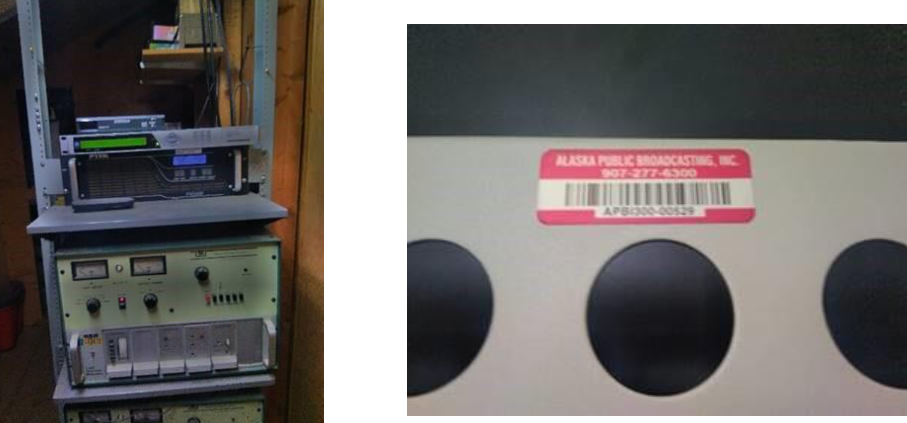
Larson Bay equipment from APBI remains on a shelf since it was sent to the village in 2015.
FACTS, NOT FEELINGS
Tshibaka’s presentation showed the difficulty in getting either APBI or its commission APBC to be responsive with information about how it had spent the $4.6 million that was to be used to convert all the 185 rural stations over the pst six years.
Efforts to call each community, using the list of point-of-contacts provided by APBI, resulted in “most of the listed contact numbers were not functional,” Tshibaka said. That indicates that APBI itself had not contacted the communities to monitor the status of their equipment, one could infer from Tshibaka’s statement.
“At this time it is unknown how many of the 185 communities have operational updated digital ARCS systems,” Tshibaka said. “APBI has reported 115 sites out of the 185 sites have been deployed, but it also provided a spreadsheet to DOA of a status of the 185 communities and it shows that 97 sites have been deployed, in contrast to the 115 sites APBI claims.
APBI provided another list to DOA of 98 sites that had been deployed and another list of 77 sites that had been converted, she said.
Deployed means the equipment was sent to the community, while converted means it was successfully installed and is operational.
Dillingham has the equipment deployed, Tshibaka said, but it lacks funds for the electricity to run it so it’s not installed and “converted.”
Larson Bay has the equipment, but no one qualified to install it.
Tshibaka said installing it and getting it operational is APBI’s responsibility — but it appears APBI washed its hands of the problem after mailing the conversion box to the village.
APBI is funded by the state to operate a hotline to help communities troubleshoot problems when their equipment doesn’t work.
The contract with APBI was several contracts, she said, to provide management fees, installation labor, equipment and management of the hotline. Of the $4.6 million, $1.671 is going to the management fee, with $2.96 going to equipment, or “wireless acquisition.”
Committee Chairwoman Rep. Jennifer Johnston said it is evident that time has moved on from Downton Abbey, and public broadcasting is an aging service. “It’s time to modernize,” she suggested, adding that this is a chance to take a look at the whole “old approach” system and “energize” it.
Alaska Sens. Dan Sullivan and Lisa Murkowski both voted on Wednesday to acquit the president for the charges brought by the House Democrats.
Sullivan released a video to explain his vote. In it, he says that the one thing that all seem to acknowledge is that it was a partisan exercise from the outset.
“Nearly everyone—both in the House and in the Senate, and when you look at the sweep of American history—agree on one thing: that purely partisan impeachments are not in our nation’s best interest.
“The Framers of our Constitution, like Alexander Hamilton, actually highlighted this as a specific danger to the Republic. They feared, as do I, the weaponization of impeachment as a regular tool of partisan warfare.
“If that were to happen — partisan impeachment every few years – it would incapacitate our government, undermine the legitimacy of our institutions, and tear our country apart for decades to come,” Sullivan said.
“Nevertheless, the House still took the dramatic and consequential step last fall of launching the first purely partisan impeachment in U.S. history. That’s a precedent we should not endorse,” he said. His entire remarks are in a short video released on Wednesday:
It’s not just the costliest forest fire season in America in 2019 that has driven the supplemental budget past $262 million.
It’s the residual effect of the Obamacare expansion under Gov. Bill Walker, whose Administration brought Alaska two types of Medicaid expansion — one where the federal government would pay 90 percent of the cost, and the other where the federal government would only pay 50 percent, with the State picking up the other 50 percent.
That 50-50 expansion is causing continued and unsustainable growth in state Medicaid.
Under Walker, a concerted effort was made to sign up the “50-50” population along with the “90-10” population.
Walker succeeded in his mission of signing Alaskans up. In 2013, 122,334 Alaskans were on Medicaid. By 2018, that number had burgeoned to 209,000 people.
Today, Medicaid pays for 220,690 Alaskans’ medical bills. There is no cap on the expenditures.
The legacy of the Obamacare expansion in Alaska has cascaded on this year’s state treasury, and the the supplemental budget shows just how much Medicaid expansion is now stressing state resources. Medicaid add-on expenses are nearly half of the supplemental request:
$110.5 million in State funds to cover expenses following last summer’s devastating wildfires in the Southcentral and Interior regions of the state
$3 million in State funds for infrastructure repairs from the 2018 Cook Inlet Earthquake
$128 million in State funds for Medicaid services
$6.7 million in State funds to hire new Alaska State Troopers, Wildlife Troopers, and purchase Trooper equipment
$1 million in State funds for the Pioneer Home Payment Assistance Program
$6 million in State funds to achieve full capacity at the Alaska Psychiatric Institute
$12.050 million in Marine Highway receipts for the Alaska Marine Highway System
Last year’s supplemental appropriation was $73.1 million. This year, it’s $262.5 million, with the lion’s share going to forest fires and Walker Medicaid expansion.
This column is the first of four-part series exploring current data presented on the Department of Education and Early Development website. The data is the State’s and a result of individual districts and schools reporting on various components of attendance, proficiency, and expenses.
Last month, I had a conversation with a very educated and articulate person who has children in our local Eagle River schools.
I had mentioned that I chair the Alaska Republican Party Districts 13 (Chugiak) and 14 (Eagle River), as well as EAGLEXIT, an organization proposing the detachment from the Municipality of Anchorage and incorporation as a separate municipality.
As the Republican chair, I was calling people about our District Convention on Feb. 22 and I struck up a friendly conversation. In my discussion, I was impressed at the certainty and conviction this person shared with me regarding Alaska’s political atmosphere as well as its government services, especially public education.
I considered for some time how this person praised our public schools. I had just published a column on the problems in Alaska’s education system.
As a result of that conversation, I reviewed Alaska’s education system a bit more to see if my first article missed important information.
This link is a website that provides valuable public information for Alaskans to review the current status of our government schools and school districts in both the Unorganized Borough and the Organized Borough.
It is organized by district and then categorized by individual school. The link to the individual school has the name of the school, the attendance rate, grades served, number of students, average math and English language arts proficiencies in percentage, and number of teachers.
What is also revealed on this website is each school’s “Overall School Index Value”, “Safety & Well Being”, “Teacher Quality”, and “Student Demographics.” We’ll talk about these in another column soon to come.
Here’s what anyone can discover on this website:
Alaska has a total of 18 School Districts in the Organized Borough.
The state has 36 school districts in the Unorganized Borough.
That is a total of 54 school districts.
The Organized Borough has 323 schools.
The Unorganized Borough has 180 schools.
The total number of Alaska schools is 503.
The Organized Borough has approximately 104,575 students and approximately 5,996 teachers.
The Unorganized Borough has approximately 22,794 students and approximately 1,450 teachers.
Teacher-student-ratio in the Organized Borough is 17.44:1
Teacher-student ratio in the Unorganized Borough 15.72:1.
The national average teacher-studio ratio is 16:1.
Attendance average for the Organized Borough is 92.69%.
Attendance average in the Unorganized Borough is 91.24%.
The next set of data is startling, sad, and frightening:
Average math proficiency in the Organized Borough is 39.45%.
Average math proficiency in the Unorganized Borough it is 25.17%.
Average English language arts proficiency in the Organized Borough is 44.30%.
Average English language arts proficiency in the Unorganized Borough it is 28.85%.
In other words, more than 60 out of every 100 children in the Organized Borough and almost 75 out of every 100 children in the Unorganized Borough are not meeting state average math proficiency.
More than 55 out of every 100 children in the Organized Borough and more than 71 out of every 100 children in the Unorganized Borough are not meeting state average ELA proficiency.
This is from the state’s own website, a stark representation of the current state of education for the entire state.
Would anyone reviewing these statistics from the State’s own website reach the reasonable conclusion that Alaska is knowingly raising a functionally illiterate future citizenry?
Michael Tavoliero is a realtor at Core Real Estate Group in Eagle River, is active in the Alaska Republican Party and chairs Eaglexit.
Donald Trump Jr. is traveling to Southeast Alaska for a deer hunt with his son in November, to take place after the Nov. 3 General Election, when his father, the president, will find out if he has another four years in office.
But long before that, Trump Jr. will be in Nevada, for the Safari Club International convention on Feb. 8, where a slot in that November, week-long, Sitka black-tailed deer hunt will be auctioned off to the highest bidder.
Trump Jr., author of the recently published book, “Triggered,” will be accompanied by his son as they partner with Coastal Alaska Adventures, a Douglas-based guiding firm owned by Master Guide Keegan McCarthy.
The current online absentee bid is now $17,500, and has risen by $2,500 since the author started this article.
The hunt is part of a newly launched “Hunter Heritage Series,” intended to bring youth and new hunters to the sport and hunting lifestyle, and to create the next generation of hunters.
Trump Jr. is giving the keynote address at the convention, which begins Wednesday.
Each hunter on Trump Jr’s trip will be able to harvest two Sitka black-tailed deer. The auctioned item includes accommodations, trophy fees, meals, guide service and field prep . The trip embarks on a yacht out of Juneau.
Trump Jr.’s book, “Triggered, How the Left Thrives on Hate and Wants to Silence Us,” was published in November. The publisher describes it as “the book that the leftist elites don’t want you to read — Donald Trump, Jr., exposes all the tricks that the left uses to smear conservatives and push them out of the public square, from online “shadow banning” to rampant “political correctness.”‘
The book made it to No. 1 on the New York Times list of bestsellers for nonfiction.