Saturday, April 25, 2026
Home Blog Page 1399

Don Young fundraiser brings together bipartisan support

What could possibly get Attorney General Kevin Clarkson and Alaska State Employees Association Executive Director together in the same room for lunch today?

Oh, maybe a fundraising lunch for Congressman Don Young, Alaska’s iconic U.S. representative, who held a luncheon today in Midtown Anchorage.

Clarkson and Metcalfe may not agree on the implications of the Janus decision, and are now on opposing sides in court over it, but they evidently agree that Don Young is still the congressman for the times we live in.

[Read: State will enforce Janus decision; employees will need to opt in]

Young talked to the group of 90 supporters — mostly from Anchorage — about the importance of bipartisanship in the House, and how he is worried about the current crop of far-left members of Congress, such as “The Squad.” He said of the over 2,000 members of Congress he has worked with since 1973, “This is the strangest set of ducks I have ever worked with, pushing a Socialist agenda.”

Congressman Don Young speaks during a luncheon today in midtown Anchorage.

“I can’t believe I’m saying this, but Nancy Pelosi is practically a moderate,” compared to the growing number of Socialists in the Democratic Party, he said.

Young took the time today to announce that one of his staff members, Truman Reed, is going to head up his reelection campaign starting in January. Reed is a legislative aide to the congressman for foreign policy, government affairs, tax, judiciary, and other matters, and is a growing force in politics in Alaska.

Reed, a registered nonpartisan, is the son of well-known lobbyist and former died-in-the-wool-Democrat Ashley Reed, who today also spoke at the luncheon, and said that when he moved to the state from the East Coast in the 1980s, he was a Democrat, but three years ago registered as a nonpartisan, as he saw the Democratic Party move more and more to the left.

Also attending the lunch was Finance Chair for the Alaska Republican Party Seth Church, Alaska Policy Forum Senior Education Research Fellow Bob Griffin, and longtime Young supporter Ken Maynard, widow of Young’s longtime campaign staff member, the late Myrna Maynard.

Spotted at a table were Senate President Cathy Giessel, Senate Finance Chair Natasha Von Imhof, and Rep. Josh Revak, along with former State House Speaker John Harris and former Sen. Lesil McGuire.

Dave Stieren joining administration

13

Dave Stieren, host of the Dave Stieren Show on KFQD, is joining the Dunleavy Administration, but in what capacity?

Word is he is going to be out in the community, from Anchorage to Fairbanks, listening and communicating for the Dunleavy Administration in the place where he is a familiar voice who tells it like it is. It’s a combination of roles for an Alaskan who thinks on his feet but pulls no punches.

The governor has not yet replaced Matt Shuckerow as press secretary, but the role for Stieren is not that job — it’s a combination of communication and outreach.

Stieren is a familiar voice in the Railbelt area, as he has had a daily talk show for years. Must Read Alaska has learned he will start later this month.

Update: A statement will be issued later today as the governor reworks the communication strategy heading into his second year and facing a budget deficit that is nearly as large as the one he faced upon taking office.

Anchorage voters to decide on commercial pot smoking

8

The Anchorage Assembly debated, deliberated, and decided last night that it will be up to voters to say if pot retailers can offer pot smoking rooms in the city limits.

Over a dozen people testified during Tuesday night’s regular Assembly meeting. Those testifying in favor of allowing a public vote on the matter were primarily those representing the cannabis trade.

They argued that people who don’t own their own homes often can’t smoke in their rental units, and so there are two classes of citizens — some who can smoke in their own homes. and some who have no place to smoke but in their cars. They said tourists need places to smoke pot legally. And they argued that people who work in marijuana establishments already are smoking pot, and are accepting the risks associated with their work.

Speaking against sending it to the voters were those concerned with public health and who said the voters already overwhelmingly chose to make Anchorage a smoke-free city.

“As one of the sponsors of the secondhand smoke ordinance, I can’t believe you want to do this again,” said Dick Traini, a former Assembly member who testified against the proposal. “As an asthmatic, I can tell you smoke is smoke, and affects you just the same. The last time we looked at this [Anchorage secondhand smoke ordinance], 70 percent of Anchorage voters said they wanted to keep it,” he said, referring to the Anchorage smoking ban.

Former Assembly member Eric Croft also spoke against the proposal to have a popular vote, saying it’s a step backward in public health, will lead to more driving under the influence. He argued that Anchorage doesn’t have to be “first” in the move toward pot smoking establishments.

American Cancer Society Cancer Action Network’s Government Relations Director Emily Nenon said the ordinance would create a new class of employees who are not protected from secondhand smoke: “No one should have to choose between their job and their health,” she said.

Although the testimony went heavily against sending the matter to voters, most Assembly members said that pot smoking is different enough from tobacco smoking, and that the public will want a say in the matter.

Voting in favor of sending it to the ballot in April were Assembly members John Weddleton, Meg Zaletel, Forrest Dunbar, Felix Rivera, Pete Petersen, Christopher Constant, and Austin Quinn-Davidson. Against it were Crystal Kennedy, Kameron Perez-Verdia, and Fred Dyson.

The next municipal election ends on April 7, 2020, but because mail-in ballots are the voting method in Anchorage, the election starts a month earlier in March.

AFN cues up an agenda: ‘Bash Gov. Dunleavy’

The Alaska Federation of Natives’ annual convention in Fairbanks next Thursday through Saturday is shaping up for 72 hours of bashing of the Dunleavy Administration, with a brief time allotted for the governor himself to speak.

The theme for the conference is “Good Governance, Alaskan Driven,” and is focused on “the basic necessity of sound, fact-based government policy amidst Alaska’s current fiscal challenges.”

AFN isn’t saying it would prefer the last Administration of Gov. Bill Walker and Lt. Gov. Byron Mallott, but its agenda shows it clearly disapproves of this governor.

This year’s lineup is infused with opportunity to critique the Dunleavy Administration, now in its 11th month and facing yet another budget deficit.

Last year, the AFN convention was held in Anchorage, as it is during major election years. The convention was a meltdown of the Walker Administration, as Lt. Gov. Byron Mallott was forced to resign from office over his still-untold, but much-discussed bad behavior toward a young lady. During the convention last year, Gov. Walker announced his decision to end his bid for re-election, and he threw his endorsement to Mark Begich, the Democrat in the race.

Last year’s agenda theme was “Past, Present, and Future,” and it was upbeat, at least until the collapse of the Walker Administration began.

But there’s no looking to the past this year. It’s on to the theme of what constitutes “Good Governance” in the present.

And it’s likely to include an appearance by the radical faction, Defend the Sacred.

Gov. Dunleavy will be one of the first speakers of the convention. He’ll be at the microphone at 9 am on Oct. 17, and he’s been given 15 minutes for his address.

Following him, House Speaker Bryce Edgmon will have 20 minutes to share his views from a rural Alaska perspective.

On Thursday morning, the theme of good governance will be introduced in a session that targets the Dunleavy Administration and how it “tested the bounds of this principle”:

“‘Good government’ refers to how well the state’s meeting the needs of Alaskans. In 2019, the Dunleavy Administration tested the bounds of this principle. By example, the governor’s budget and vetoes eliminated (or encumbered) the state’s obligation to provide several constitutionally mandated services. #GoodGovernment requires Alaskans—particularly Alaska Natives—to assess the quality of state government in 2020.”

The panel will include April Ferguson, Executive Vice President and General Counsel, Bristol Bay Native Corporation and AFN Board Member; and Greg Razo, Vice President of Government Relations, Cook Inlet Region, Inc. and AFN Board Member. His corporation has taken a position as a leader in the Recall Dunleavy movement.

Later that morning, a second panel on the topic of “Good Governance” will take aim at those not born in Alaska:

“Alaskans, as opposed to outside special interest groups, should be the ones driving state policy. Early Native leaders like those of the Alaska Native Brotherhood and Sisterhood, William Paul, and Elizabeth and Roy Peratrovich understood this, and led the fight to secure basic rights guaranteed to all Alaskans. This panel discusses why Alaskans—particularly Alaska Natives—must fight for strong, credible solutions that force the state to once again work with and for the people.”

It will be moderated by Nicole Borromeo, executive vice president and general counsel of AFN. Panelists are born-and-raised Alaskans, Senate President Cathy Giessel, House Speaker Bryce Edgmon, and former Alaska State Senators and AFN Board members Georgianna Lincoln and Albert Kookesh.

Thursday will also feature panels on public safety and violence against women, two serious topics for all Alaskans, rural and urban. The focus will be the lack of public safety in rural Alaska.

On Friday, one of the leaders in the Recall Dunleavy movement will give a special report. Sophie Minich, President and CEO, Cook Inlet Region, Inc., will speak on the topic of “Taking a Stand.” Minich has signed the CIRI Native Corporation up as a leader in the anti-Dunleavy sector.

Much of Friday will be devoted to the topic of the State of Alaska’s constitutional responsibility to provide education, health care, and welfare to the citizens of the state. Panelists will discuss how they see the Dunleavy Administration’s approach to cutting state spending.

All there members of Alaska’s congressional delegation will be given time to speak.

[Read the entire agenda at this link]

The AFN Convention will take place Oct. 17-19, 2019 at the Carlson Center in Fairbanks. Live television coverage is available on GCI Cable, 360 North, and ARCS, as well as a live webcast on AFN’s newly upgraded website. 

Anti-Pebble bloc sues EPA

11

THEY WANT PREEMPTIVE VETO REINSTATED

Five groups opposing the Pebble Mine have sued the Environmental Protection Agency, hoping to stall or halt the environmental review process for the Pebble Project until, perhaps, a regime change at the White House would bring a Democrat back in office.

Bristol Bay Economic Development Corporation, Bristol Bay Native Association, Inc., United Tribes of Bristol Bay, Bristol Bay Reserve Association, and Bristol Bay Regional Seafood Development Association,  filed the lawsuit today.

Scott Kendall, former chief of staff to former Gov. Bill Walker, is the lawyer representing Bristol Bay Regional Seafood Development Association.

The complaint says the proposed “Pebble mine would destroy thousands of acres of critical habitat and miles of salmon streams that are essential to Bristol Bay’s commercial, recreational and subsistence salmon fisheries.”

The groups are challenging what the are calling EPA’s “unlawful withdrawal” of its preemptive veto of the mine, which is located on State of Alaska mining land located over 100 miles from the actual bay where fish are caught by commercial fishermen each year by the millions.

Highlights of recent Pebble legal zigzagging:

February, 2014: EPA issued its Proposed Determination under Section 404(c) of the Clean Water Act to preemptively veto ay permitting for “discharge of dredged or fill material related to mining the Pebble deposit into waters of the United States. …” This occurred under the Obama-era EPA.

May, 2014: Pebble Limited Partnership sued the EPA in three separate lawsuits.

May, 2017: EPA and Pebble settled the litigation. The EPA committed to “initiate a process to propose to withdraw the Proposed Determination.”

July, 2017: EPA issued a proposal to withdraw the Proposed Determination, requested public comments, and received over one million comments, most of them against reversing the pre-emptive veto of the mine permit.

July, 2019: EPA announced its decision to withdraw the pre-emptive veto.

October, 2019: The groups are asking the court to vacate the EPA decision to withdraw the preemptive veto of the permitting process, saying the EPA’s decision “is arbitrary, capricious, an abuse of discretion, and not in accordance with law.”

Pebble Spokesman Mike Heatwole said, today “They want to restore the preemptive veto, which vast majority of Alaskans thinks is horrible public policy and would be used to shut down all development going forward.”

Pebble is anticipating a final environmental impact statement to be issued early next year, followed by a “record of decision” later in 2020.

Homer City Council winner faces residency challenge

11

Storm Hansen-Cavasos, an apparent winner of a seat on the Homer City Council, has had her residency challenged by City Council member Tom Stroozas, who has filed an affidavit at the Homer City Clerk’s Office, along with a $750 surety bond.

Hansen-Cavasos is a newcomer to politics, and is a third-generation Homer-area resident. But whether she lives in the city limits is what is in question.

Her Alaska Public Offices Commission filing shows her living at a rental on Rangeview Drive, inside city limits. But a voter registration record from 2018 shows her living off of East End Road, a few miles past the actual city limits of Homer. A more recent voter registration record shows her living in Homer Precinct 1.

Her husband, Jason, was as of last year listed as a voter on Rolling Meadows Road, outside city limits. And in January, Storm was listed in the Fritz Creek precinct, which is well outside of city limits. Was Hansen-Cavasos using an in-town address or did she just recently move — and how recently?

Eligible candidates need to be residents of the city for 12 months prior to an election.

Melissa Jacobsen, the Homer City Clerk, said that, as far as she knows, Hansen-Cavasos was a legitimate candidate.

The matter of whether she was a legitimate candidate will be taken up at the Monday meeting of the City Council, when normally the council would certify the election and swear in the winners.

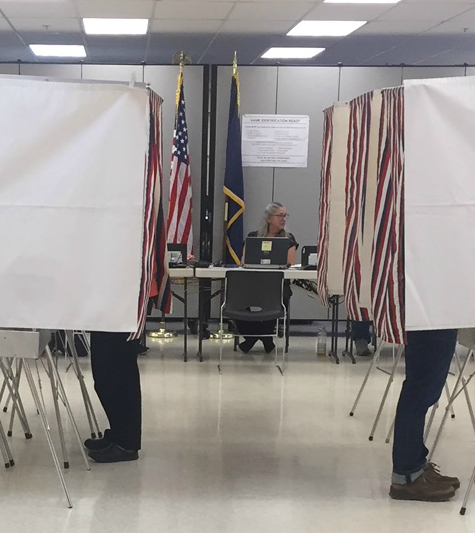
Hansen-Cavasos unseated Homer City Council incumbent Shelly Erickson by seven votes, according to results confirmed by the Canvass Board on Friday. The final tally was 663-656.

Joey Evensen won a seat with 922 votes and incumbent Tom Stroozas came in fourth.

Both Erickson and Stroozas represent the conservative voters on the City Council.

With the challenge now before them, the City Council will likely initiate an investigation as to the real residency of Hansen-Cavasos. If the matter is decided against her, the Council would need to set a special election for that seat.

The two faces of Janus

8

By ART CHANCE

Mark Janus was an Illinois teacher who didn’t like his compulsory union dues being used for the political activities his union chose. He took the union all the way to the United States Supreme Court, which ruled in his favor in Janus v. AFSCME Council 31.

[Read the Janus ruling at this link.]   

Compulsory dues from unionized public employees are the life blood of organized labor and organized labor’s organization and money are the life blood of the Democrat Party. 

Art Chance

Even organized labor estimates that anywhere from 20 percent to 70 percent of public employees would not pay union dues if paying dues weren’t required to keep their job. That is consistent with my experience with the State when we stopped enforcing the compulsory dues provisions of contracts.

If unions and the political leadership of the blue states cannot come up with a “work-around” for Janus, it is a serious, perhaps even mortal blow to Democrat hegemony in the blue states and their resulting national power.

Once among the reddest of red states, Alaska these days is trending a very bluish purple. Although we maintain the polite fiction of non-partisan elections, Alaska’s largest political subdivisions are firmly in union/Democrat control and that control or at least strong influence extends to many of the medium and small communities as well.   

At the state level, the Democrat/union program to recruit false flag candidates and co-opt quislings has led to union/Democrat dominance of the Legislature and in large measure the negation of Republican policies and programs. 

Effective implementation of the Janus decision is vital to the future of a red or even purple Alaska.

The Dunleavy Administration has given the unions a one-year “bye.”  They didn’t have that year to give.   

I didn’t get elected governor and I’m not a lawyer, but I’ve done public sector labor relations a lot longer than Mike Dunleavy or Kevin Clarkson, or anybody else working for the State for that matter. I can’t for the life of me understand why they took nine months to do anything about implementing Janus and I have no idea why we’re playing the unions’ delaying game in State courts. 

Here’s why: If you have any controversial initiatives, you get them underway immediately so there is time to work through the courts.   Otherwise, your initiatives just wind up as trade goods in the next election.

 There is nobody left working for the State that has any experience from the controversial days following the 1980s oil price crash and the decade-long war between the State and its unions to change the “throw some money at it” paradigm of State bargaining in the 1970s and early ’80s.  

I hired three of the people in State Labor Relations and one of the civil attorneys in the Law Department, so they saw a little of what being an actual employer looked like.  That said, after the first year we had pretty peaceful relations with the unions, so none of them left have any experience with actual controversy and conflict.   

The unions are drawing on a “peace dividend;” a decade and a half of peace has made the State relatively unable to engage in conflict and controversy. Yet, conflict and controversy is built in to what the unions do. I lived through the steep employer learning curve in the mid-80s, when the State then, too, didn’t have a clue what to do.  

The Dunleavy Administration is like the dog that finally caught one of those cars it has been chasing all those years; it has no idea what to do with the government now that it has caught it. They’ve let the unions slip into their tried and true stall tactics.   

As I predicted, the unions got a temporary restraining order against any changes in the State’s processes for handling union dues. The unions and the bureaucracy are acting like nothing has changed in dues administration and now the courts are barring the Administration from making any changes.   

The unions will get an injunction against changes that will protect the status quo until the Superior Court renders a decision. Rest assured the unions will kill all the time they can and the court — and most likely the Department of Law will let them, if not outright help them. They can easily keep this from being heard and decided until well into next year, and then there is a gubernatorial election looming.

The Legislature is so precariously balanced that the unions might be able to pass legislation intended to thwart Janus in the next session. There are plenty of Republicans stupid enough to believe that if they do something for unions, the unions will like them.

The preferred play for the public sector unions seems to be direct financing of the collective bargaining process; that gets around those icky constitutional issues, at least the individual rights issues. 

Direct financing assumes that collective bargaining is such an unalloyed good that the government should pay the costs rather than unionized employees paying the costs through dues and fees.

By my back-of-the-matchbook calculation, Alaska State Employees Association takes in about $4 million a year in dues income.   

Under direct financing the State would appropriate and pay to ASEA $4 Million from the General Fund rather than collect it from employee dues and fees and transmit the money to ASEA.   If the State pays for the union to operate, there are no freedom of speech or freedom of association issues, the basis of Janus.  

There are all kinds of laws prohibiting use of State money for political action, have been since time immemorial, just like there are still laws against adultery; that must be why nobody does it.  The unions have evaded prohibitions against using dues money for politics for years; they’ll have no trouble evading laws against using State funds for politics, and once they get enough union friendly politicians elected, nobody will even try to enforce such laws as there might be.

Whether or not they are successful in securing direct funding, the unions can keep the status quo in place through a Superior Court decision and through an appeal to the Supreme Court.   

My money would be on the State losing in the Superior Court and then having to find the courage in an election year to push an appeal to the Supremes.   It might get argued before the next gubernatorial election but it is unlikely to get decided; the Alaska Supreme Court justices can read the news, too, just like the rest of us.

The court knows that if the unions can elect a Democrat governor this case gets settled and dropped like a hot rock the second the new Governor’s hand comes off The Bible, so why should the SC go out on a limb and decide it before the election?

As I’ve said in earlier pieces, both compulsory dues/fees and the unions’ processes for withdrawal from membership are perfectly legal under State law.  I think the State law violates the Alaska Constitution and the U.S. Supreme Court has held that such language violates the U.S. Constitution.   

Our State Supreme Court has been very reticent to repeal legislation on grounds of a conflicting statute or because a statute violates the State Constitution unless it involves some sexy leftist issue like privacy for smoking dope or abortion.   

The Alaska Supreme Court could easily evade the constitutional issue. If you think I’m being fanciful or paranoid, just look at what both the Washington Supreme Court and the Ninth (aka Soviet) Circuit did to try to preserve the Washington Education Association’s unconstitutional dues scheme.

This matter needs to be in the federal courts, the State needs to push it as aggressively as possible, and the State really needs to retain outside counsel to represent it because every State employee in a position to have any influence on this knows that everyone who touches this case will be a former State employee the second the unions buy themselves a Democrat governor.  

 Gov. Dunleavy had three years to deal with this.   He’s wasted most of one already.

Art Chance is a retired Director of Labor Relations for the State of Alaska, formerly of Juneau and now living in Anchorage. He is the author of the book, “Red on Blue, Establishing a Republican Governance,” available at Amazon.

Alaska Life Hack: Road lighting curfew starts on Glenn Highway

16

Alaska Department of Transportation & Public Facilities is extending its lighting curfew program to stretches of the Glenn Highway between Anchorage and the Mat-Su Valley, a distance of 34 miles.

A lighting curfew turns off street lighting between interchanges during late night and early morning hours.

The Glenn Highway lighting curfew will be between 1 a.m. and 4 a.m. 

Electricity is a significant part of DOT’s Central Region operating budget, the department noted, costing $2.2 million each year for approximately 8,500 fixtures.

Late night and early morning hours (midnight to 6 a.m.) account for 50 percent of the department’s electrical budget for lighting, when less than 5 percent of the traffic is on the road. 

The department estimates a savings of approximately $190,000 in electrical costs once the lighting curfew is fully implemented. The savings will be used to prioritize winter maintenance tasks, such as snow and ice removal.

DOT has implemented lighting curfews along three sections of highway, including: 

  • Minnesota Drive: International to Old Seward, 5.0 miles (started in July of 2017) 
  • Sterling Highway MP 80-83, 4.0 miles (started March, 2019) 
  • C Street-Tudor to O’Malley, 3.8 miles (started July, 2019) 

The department plans to expand the lighting curfew to in the Valley, on Trunk Road from Parks Highway to Seldon Road, a distance of 3.5 miles. 

The department is converting eligible roadways to LED lighting with federal funds as repair cycles occur. Recent LED Lighting Retrofit Projects have generated $70,000 in annual savings. Combined LED retrofits and curfews have the potential to reduce state costs by up to 75 percent of the existing system costs. 

Alaska Life Hack: September weather highlights

1

Ted Stevens Anchorage International Airport weather in September, according to the National Weather Service, was warmer and wetter than usual. Here are the stats from the Weather Service:

  • The warmest September day on record – 69 degrees (tied) was set on Sept. 2. Anchorage missed setting its 50th 70-degree day of 2019 by just one degree. It ties multiple years for the 9th warmest monthly high temperature.
  • Fourth warmest September on record. The average temperature was 52.7 degrees, 4.6 degrees warmer than normal.
  • Nineteenth consecutive month of above average temperatures.

The top five warmest Septembers on record:

1 ) 2018: 55.0 Degrees
2-3) 1995-1965: 53.6 Degrees tied
4 ) 2019: 52.7 Degrees
5 ) 2019: 52.0 Degrees

  • The average high in September 2019 was 58.7 degrees, 3.6 degrees above normal of 55.1 degrees.
  • The average low for the month was 46.6 degrees, which is 4.6 degrees above the norm of 42 degrees.
  • 24 days in September had above-normal temperatures.
  • 5 days in September had below normal temperatures.
  • 1 day in September had normal temperatures (within 1/2 degree).
  • A streak of 113 consecutive days with above normal temperatures started on May 31 and ended on Sept. 21.
  • The coldest monthly low temperature in September was 32 degrees, set on Sept. 26 and 27. Those tie multiple years for the 14th warmest monthly low temperature. The average monthly low temperature in September is 30 degrees.
  • Eleventh snowiest September (tied). It was hail, but it counts.
  • Eighteenth wettest September, with 3.78 inches of rain, compared to the normal 2.99 inches. That’s more than 25 percent more rain than normal. It ended a three-month streak of abnormally dry weather.
  • The wettest day was Sept. 18, with .66 inches.
  • 25 of 30 days in September had some measurable amount of precipitation.
  • The first freeze of the fall occurred on Sept. 26, three days later than normal but it’s a month earlier than the first freeze of 2018, which didn’t happen until Oct. 28 and stands as the latest on record.
  • Compared to 2018, September of 2019 was cooler and wetter, with 52.7 degrees vs 55 degrees in 2018 on average, and 3.78 inches of rain vs .87 inches of rain in 2018.
  • The period of record includes 67 Septembers.

As for October at Ted Stevens International Airport, the last day with more than 11 hours of daylight was Oct. 5, and the last day of the year with more than 10 hours of daylight will be Oct. 16.

The average high for October is 40.5 degrees, with the average low at 29.1 degrees, making the average October temperature 34.8 degrees. Average precipitation for the month is 2.03 inches, and 7.9 inches of snow.