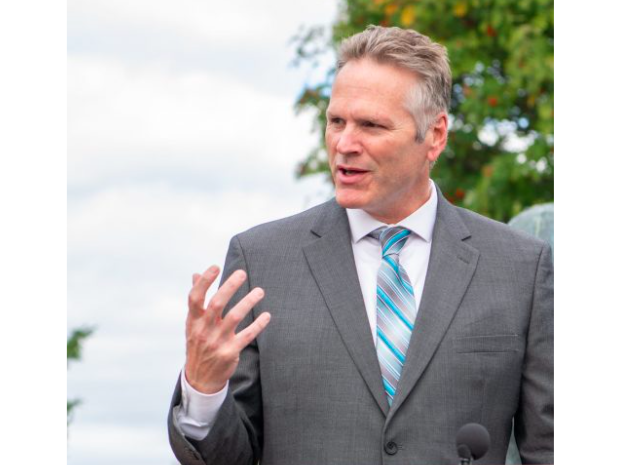
The group calling itself Keep Dunleavy launched its website today. The group is in response to an effort by former Gov. Bill Walker employees to recall Gov. Mike Dunleavy.
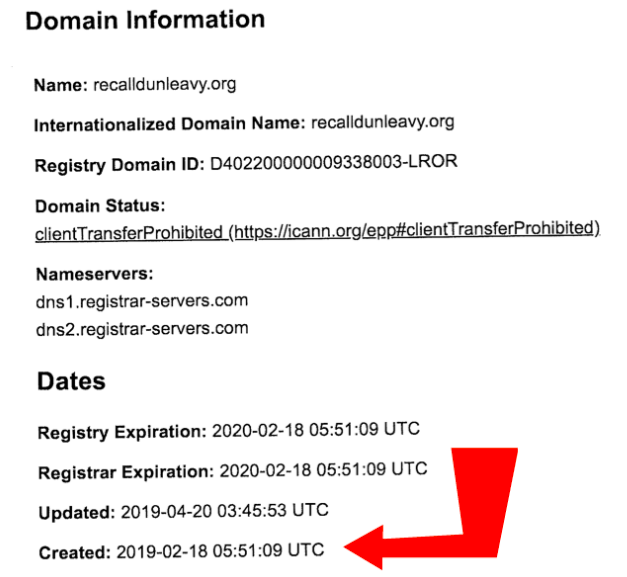
Dunleavy was elected with over 51 percent of the vote in 2018 in a three-way race that included Former Gov. Bill Walker and former Sen. Mark Begich. Shortly after he took office, two members of the Walker team led the effort to recall the governor, purchasing the recalldunleavy.org domain name in February of 2019. Since then, the efforts of former Walker Chief of Staff Scott Kendall and former Attorney General Jahna Lindemuth have been funded largely with public employee dues through the Alaska State Employees Association and AFL-CIO.
The Keep Dunleavy group is chaired by Cynthia Henry, who is also the national committeewoman for the Alaska Republican Party.
“If people will log on and make any amount of a contribution, they will help us get the word out and show our strength through people who support the governor,” Henry said. “We’re already getting lots of calls and comments.”
Stand Tall With Mike, the initial group that formed to fight the court case, is merging with Keep Dunleavy, Henry said.
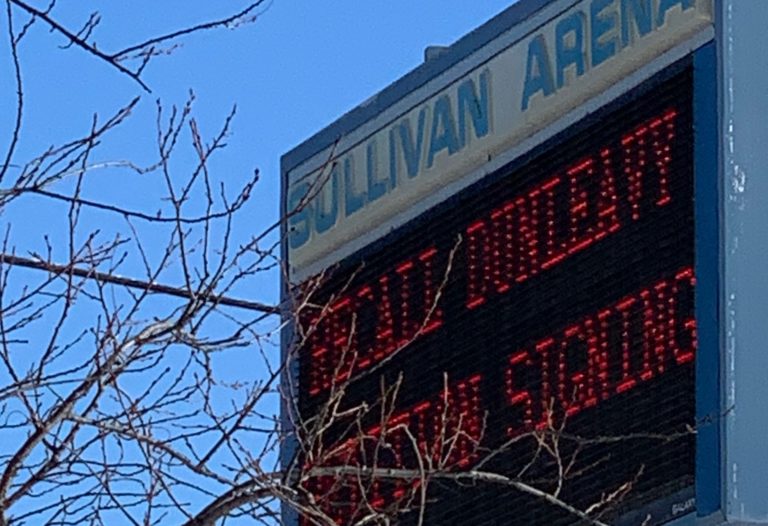
The Recall Dunleavy Committee rented the biggest venues in three Alaska communities for a statewide kickoff this weekend for signature-gathering on the petition booklets the court allowed them to use.
The group says it is hosting 49 kickoff events around the state, but the biggest by far will be at the Sullivan Arena in Anchorage, the Carlson Center in Fairbanks, and Centennial Hall in Juneau, where people can sign petitions this weekend and grab some bumper stickers and other swag. The kickoff will be an event designed for maximum media exposure.
The group needs over 71,000 signatures to put the recall of Gov. Mike Dunleavy on a ballot, something which the primary organizers — former Gov. Walker employees Scott Kendall and Jahna Lindemuth — hope to do by July in a special election.
The ability to rent the biggest venues in the state shows that the group is well funded; it has had paid staff for over nine months.
But because the final Supreme Court decision hasn’t been issued on the actual validity of the recall, there is no way to discover who the major funders are at this point. These funders do not need to be reported to the Alaska Public Offices Commission.
However, Must Read Alaska has learned that the Alaska State Employee Association and the AFL-CIO have stepped forward with a “blank check” to support the recall committee’s court costs, which are said to be approaching six figures. Other costs are being handled by private donations. One of the lead treasurers for the effort is Joelle Hall of the AFL-CIO.
The final court decision will be on or about March 25, after which the recall effort is considered a “real campaign,” and the usual finance reporting must begin.
On the campus of UAA, students report that paid recall signature gatherers are telling passersby that they should sign the petition because the governor is trying to take people’s Permanent Fund dividends.
Defending the traditional PFD was, of course, one of the governor’s key campaign issues, and he has long defended the statutory calculation for the dividend. He requested the Legislature allow the people of Alaska to vote on what the formula should be, and put it into the State Constitution so it is no longer a political football, a request that has been denied.
Recall Dunleavy Committee has just passed its first anniversary. The group, led by Kendall and Lindemuth, purchased its domain name a year ago Feb. 18 — just 11 weeks after the governor was sworn into office.
KEEP DUNLEAVY HIRES CAMPAIGN MANAGER
On the other side, the Keep Dunleavy group was organized after the Alaska Supreme Court ruled that the recall group would be able to collect signatures even without a final ruling on the legitimacy of the recall.
Cynthia Henry of Fairbanks chairs that group, and Kelly Goode is the campaign manager. Goode is the former deputy commissioner of the Department of Corrections.
Fundraising has picked up for Keep Dunleavy, since it was announced, according to MRAK sources. Sources say millions of dollars will need to be spent defending the governor, who took office 14 months ago.
In addition to that group, there’s the Stand Tall With Mike group that has been primarily involved with the court case, trying to convince the court that the justifications given by Recall Dunleavy cheapen the concept of elections and of the recall process itself.
The group had two lawyers fighting the ballot initiative, but the only remaining lawyers now involved are with the Department of Law. The Stand Tall group decided to save its money for the campaign side after it became evident the Alaska Supreme Court was going to allow the recall to go to the ballot. The formal decision is still weeks away, but most political observers now see that as a formality.
LEAKED POLL
Democrat pollster Ivan Moore leaked polling results from December, which showed the Dunleavy recall in a dead heat with voters. Moore sampled 694 registered voters statewide, and the poll, he says, has a margin of error of 3.8 percent:
Yes, do recall – 48.4%
No, don’t recall – 47.6%
Not sure – 4.0%
Moore says it is not actually a dead heat but a .8 percent lead to “yes.” He is encouraged by that number.
However, Moore is also the pollster who had Alyse Galvin in a statistical dead heat with Congressman Don Young in 2018, but in the end, Young won over Galvin, 53.3-46.7. Moore also predicted that Ethan Berkowitz would win over Don Young in 2008 — by a 9-point margin.
He’s 23 years old and he’s going big — up against an expert campaigner and veteran of the Legislature.
David Nelson today announced his run for the Alaska House of Representatives, challenging incumbent Rep. Gabrielle LeDoux in the Republican Primary for District 15.
If he wins, Nelson will be the youngest legislator in Alaska.
During their annual meeting on Feb. 17, District 15 Republicans adopted a resolution withdrawing support from LeDoux, who has held the seat since 2012. Part of that resolution was that the district would recruit a new candidate to run against LeDoux. Nelson is the result of that vetting process.
The district resolution will be forwarded to the party’s state convention in April for the consideration of the entire party. Two years ago, LeDoux was sanctioned similarly, but won her reelection in the district she has represented since 2012.
Nelson, a former staffer for U.S. Sen. Lisa Murkowski, works for a military contractor with the Missile Defense Agency on Joint Base Elmendorf Richardson, and is the former District Executive for the Great Alaska Council of the Boy Scouts of America. He is an officer in the Army National Guard and was state director for Students for Rubio in 2016.
Nelson announced his candidacy on the Dan Fagan Show on KENI radio. His Facebook page was created today and he will file with the Alaska Public Offices Commission this afternoon.
“My neighbors and I have had enough of the never-ending mess in Juneau,” he said. “It’s time to elect new people in the Legislature who will crack down on crime, stop playing politics with our Permanent Fund dividend, reject reckless and wasteful new tax plans, and get their work done on time without resorting to costly, lengthy and pointless special sessions.”
His community involvement is substantial for a young candidate: He’s president-elect of the Anchorage Midtown Rotary Club, is a leader in the Northeast Community Council Safety Patrol, and was appointed to the Alaska Juvenile Justice Advisory Committee.
LeDoux in 2015 was a member of a breakaway group of Republicans that called themselves the Musk Ox Coalition. That group was responsible for the House Republicans losing control to the Democrats in 2016, which ended 20 years of Republican control.
In 2019, she left the Democrat-led majority but did not rejoin the Republican minority.
The Year Start Reports are in, and nearly $1 million has been logged into the Alaska Public Offices Commission portal for the legislative seats up for election this year.
The Year Start Report, due Feb. 18, details what candidates had on hand at the beginning of the year through Feb. 1, and it’s all in the interest of transparency in campaign finances.
The larger campaign bank accounts, with the exception of candidate Liz Snyder, belong to incumbents; only six of the 21 heavy-hitters are Democrats. For the top three, Republican Sen. Natasha Von Imhof tops the list with over $82,662, followed by Sen. Josh Revak at $55,000, and Rep. Sara Rasmussen at $45,560. For all three, they are finishing their first terms in office and this will be their first reelection campaign:
Senate
Sen. Natasha Von Imhof, Republican, District L: $82,662
Sen. Josh Revak, Republican, District M: $55,000
Sen. Tom Begich, Democrat, District J: $35,223
Sen. Cathy Giessel, Republican, District N: $30,786 (updated Feb. 26)
Sen. Shelley Hughes, Republican, District F: $22,661
Sen. John Coghill, Republican, District B: $19,275
Sen. Bill Wielechowski, Democrat, District H: $16,661
House of Representatives
Rep. Sara Rasmussen, Republican, District 22: $45,560
Rep. Gabrielle LeDoux, Republican, District 15: $44,899
Liz Snyder, Democrat challenger for District 27: $86,472; (incumbent Rep. Lance Pruitt has not yet filed for reelection.)
Rep. Mell Gillis, Republican, District 25: $47,165
Rep. Matt Claman, Democrat, District 21: $41,777
Rep. Kelly Merrick, Republican, District 14: $30,137
Rep. Laddie Shaw, Republican, District 26: $28,587
Rep. Chuck Kopp, Republican, District 24: $27,728
Rep. Sarah Vance, Republican, District 31: $24,895
Rep. Sharon Jackson, Republican, District 13: $21,255
Rep. Jonathan Kreiss:-Tomkins, Democrat, District 35: $21,058
Rep. Jennifer Johnston, Republican, District 28: $19,716
The Alaska House of Representatives passed a supplemental budget that would pay for the response to the wildfires of 2019, federal program healthcare costs the state is on the hook for, and Alaska Marine Highway System costs that resulted, in part, from shortfalls caused by a strike of ferry workers during the high season.
The $526.2 million bill has $298,6 million of State funding and balance is federal funding. It passed 35-2, with Rep. David Eastman and Mark Neuman voting against it.
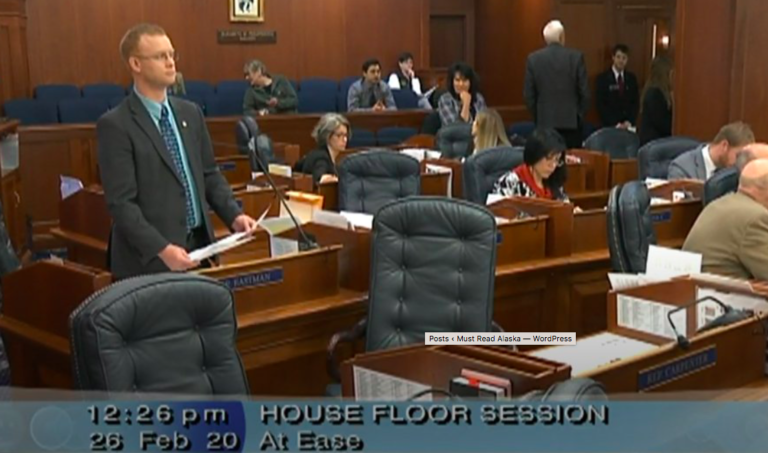
The vote came after a raucous session in which Rep. David Eastman of Wasilla was admonished by House Speaker Bryce Edgmon to cease his disruptions to the proceedings or risk being thrown out — it was unclear if he meant thrown out of the House Chambers or expelled from the Legislature altogether, although several staff members were seen thumbing Mason’s Manual. During an at-ease, the House minority Republicans met briefly to discuss Eastman’s behavior and it was unclear if there were enough votes to throw him out of the minority caucus.
After the session ended, discussions continued as to the fate of Eastman, who had apparently worn on every last nerve of some of his fellow legislators. Those talks are underway in the Capitol.
$120 million of State funds and $143.4 million of federal funds for Medicaid.
$110.5 million for wildfires.
$8.6 million for Adult Public Assistance, welfare payments previously vetoed by the governor.
$8.3 million to restore the Adult Preventive Dental Program, also vetoed by the governor last year.
$7.1 million for the Alaska Marine Highway System. This is in addition to the $12.5 million requested by the governor.
$6.7 million for the Department of Public Safety to address a shortfall within the Alaska State Troopers and Alaska Wildlife Troopers due to a lower than expected vacancy rate.
$6 million to help the Alaska Psychiatric Institute increase its capacity.
$3 million to address the severe damage caused in Anchorage, Kenai, and Mat-Su by the December 2018 earthquake.
$150,000 to re-open the District Attorney’s Office in Utqiagvik.
A new bill offered by Fairbanks Democrat Rep. Adam Wool would take even more of Alaskans’ Permanent Fund dividends and give it to the University of Alaska, K-12 education, capital projects, and more.
Under HB 300, the annual draw on the Permanent Fund Earning Reserve account would be first allocated to state programs, and what remained would be split 50/50 between the General Fund and the Permanent Fund dividend. That means the dividend would be about $700 this year, according to Wool’s formula.
The bill takes the 5.25 percent of market value from the Permanent Fund Earning Reserve account, and routes it to various state funding pools:
40 percent would go for k-12 education.
10 percent would be for the University of Alaska
10 percent would go into capital projects.
10 percent would go back to communities through the community assistance fund.
That would consume 70 percent of what is available from the POMV draw, and leave 30 percent to work with.
Half of that 30 percent would be used for Permanent Fund dividends, and the other half would be allocated to the General Fund.
“This plan allows a dividend that is sustainable while also addressing the needs of our communities,” Wool said. “Businesses, public servants, municipal governments and Alaskans all deserve stability. By protecting the Permanent Fund, committing funding to essential services, and directing funds to capital projects and communities, we can now focus on building Alaska’s future.
The bill has been referred to House Finance Committee.
The Alaska Senate today unanimously passed a bill to allow breweries and distilleries more options for how they operate.
SB 52 would extend the time tasting rooms can be open from 8 p.m. until 10 p.m.; allow venues to host up to four live music concerts per year; and set more clear rules for fundraisers, brewery tours, and functions such as art shows.
“With a primary focus on public health and safety, SB 52 provides clarity for licensees, local governments, law enforcement and the public, and will result in the common-sense, consistent and less burdensome regulation of Alaska’s alcoholic beverage industry,” said Sen. Peter Micciche, R-Soldotna, the bill’s sponsor and a long-time advocate for updating laws covering alcohol.
“SB 52 is the product of an eight-year, unprecedented collaboration of over 100 stakeholders from a diverse group of public health and safety entities, legislators, alcohol industry representatives, local governments, advocates for youth and the public who collectively volunteered over 13,000 hours and testified extensively to effectively improve the effort. It will modernize and reorganize the 35-year-old hodge-podge of Alaska’s alcohol laws into a comprehensive, effective Title 4 re-write.”
Resistance to the bill came from owners of beverage licenses, which cost sometimes hundreds of thousands of dollars. Those bar and restaurant owners have for years been concerned about the unfair competition created by establishments that don’t have to have such a license.
Senate Bill 52 passed the Senate by a vote of 19-0 and is now on its way to the Alaska House of Representatives for consideration.
If you are among those who believe Alaska is such a conservative state that no politician ever would pose a threat to Second Amendment rights you might take a moment to review House Bill 62.
Introduced by Democratic Reps. Geran Tarr, Harriet Drummond and Andy Josephson all of Anchorage, it would, among other things, require “physicians, psychologists, psychological associates, social workers, marital and family therapists, and licensed professional counselors” to annually report to a “central registry” all “serious” gun threats – even if that information is not corroborated. What would be “serious” is not clear.
Such statutes are known as “red flag” laws and this one would give “physicians, psychologists, psychological associates, social workers, marital and family therapists, and licensed professional counselors” incredible power over those who own guns.
Never a hotbed of gun rights advocates, information from the health care industry would be used in building the state threat “registry.”
MustReadAlaska.com points out: “Social work is intrinsically political by virtue of the fact that it is concerned with social change and a quest for social justice,” according to a paper published in the SocialWorkHelper, a publication of the International Journal of Social Welfare.
So, the very people those in crisis need to trust and talk with openly would be required to report their rants to a central state registry. Under the bill, the health care professionals “may” withhold the names of those involved. Or they may not.
Imagine, if you will, someone in the middle of a messy divorce uttering something angry and stupid to their psychologist, who then, if this proposal were to become law, could report them to the “registry.”
Peace officers, under this proposal, also would be able to petition a court for a “gun violence protective order,” allowing them to take guns from people until a later court hearing if they deem them to be “in crisis.”
If the proposed legislation were to pass – and one can only hope most Alaska legislators are too concerned with concepts such as fair play and due process to allow that – Alaska would join 11 other states in enacting a red-flag law since the shooting at Parkland, Fla. on Feb. 14, 2018. Connecticut was the first state to pass such a law, after a mass shooting in 1999, and it has been used more than 1,500 times since its passage.
Such laws are clear invitations to abuse, the House proposal perhaps more so than others because it requires reporting, not proof. Unless and until such laws provide for adequate due process and punishment for false reporting, they simply are yet another way to grab guns.
Alaska lawmakers should reject House Bill 62 because it fails on all counts.
MustReadAlaska.com notes the bill is in the House Judiciary Committee, which is chaired by Rep. Matt Claman, who rated 43 percent by the National Rifle Association on gun rights issues.
The Bureau of Alcohol, Tobacco, Firearms and Explosives executed search warrants resulting in federal charges against 16 people for federal firearm and drug trafficking crimes.
Seized were 82 illegal firearms, some of which were listed as stolen; approximately seven pounds of methamphetamine, and approximately 300 grams of heroin, according to U.S. District Attorney Bryan Schroeder.
The arrests came during “Operation Cold Snap,” which took place over several months.
Facing charges in 10 federal indictments:
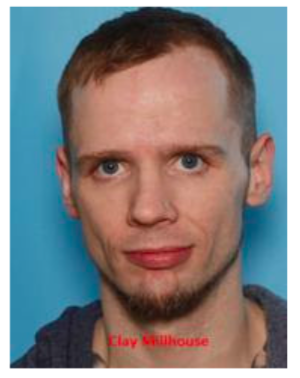
Clay Millhouse, also known as “Bear,” 34, and Shad Rider-Sorden, also known as “Shadow,” 28, both of Anchorage, are charged with conspiracy to possess and sell stolen firearms, and possession of stolen firearms. Millhouse is also charged with being a felon in possession of firearms. He is a graduate of Service High School. He is still wanted by authorities. Rider-Sorden attended Bartlett High School.
Michael Proctor, 34, of Anchorage, is charged with distribution of methamphetamine, carrying a firearm during a drug trafficking crime, and being a felon in possession of firearms and ammunition. He attended Bartlett High School
Nathaniel Sofianos, 30, and Korina Thompson, 32, both of Wasilla, have been charged with distribution of controlled substances, possession of firearms in furtherance of drug trafficking, and being felons in possession of firearms. Sofianos is from Portland, Thompson is from Sweet Home, Ore.
Xenophon Xayamonty, also known as“Rexy,” or “X,” 31, of Anchorage, is charged with distribution of methamphetamine, and carrying a firearm during a drug trafficking crime;
Realann Odsigue, 27, and Rene Laxa, 26, both of Anchorage, are both charged with conspiracy to distribute methamphetamine, and distribution of methamphetamine. Laxa was previously arrested in August, 2019, for firing a firearm while intoxicated and possessing a stolen firearm.
Dorian Topps, 26, Isaiah Cross, 27, and Kevin Glover, 37, all of Anchorage, are charged with distribution of methamphetamine.
Christopher Poindexter, 34, and Roxanne Reed, 37, both of Anchorage, are charged with distribution of a controlled substance. Poindexter is also charged with carrying a firearm during a drug trafficking crime, and Reed is also charged with being a felon in possession; Reed is still wanted by law enforcement.
Dana Dwyer, 43, of Wasilla, is charged with being a felon in possession of firearms.
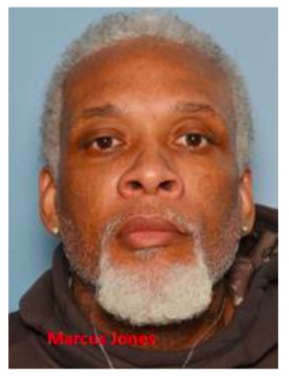
Marcus Jones, 48, of Anchorage, is charged with being a felon in possession of a firearm. He is still on the lam.
Lanyegia Davis, 29, of Anchorage, is charged with distribution of heroin.
Operation Cold Snap was led by the ATF Anchorage Field Office, with assistance provided by the Anchorage Police Department, the Alaska State Troopers, the Drug Enforcement Administration, the Federal Bureau of Investigation, the U.S. Marshals Service, the Anchorage Airport Police, and the Coast Guard Investigative Service. The cases are being prosecuted out of the U.S. Attorney’s Office for the District of Alaska.