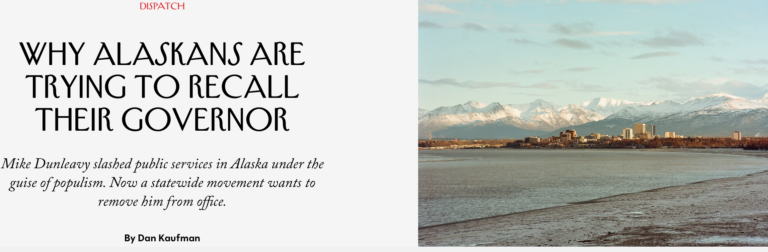
TRUTH TRAMPLED BY ‘PARACHUTE JOURNALISM’
Dan Kaufman, a writer for The New Yorker, infers Gov. Mike Dunleavy has no one to blame but himself for the recall effort that launched against him.
That is an arguable position. Even Dunleavy supporters might yield an inch on that point. But most would say the $1.6 billion deficit left to him by the former governor, and the insatiable appetite of Alaskans for programs that were never sustainable, are equally to blame.
But in Kaufman’s newest long-form article, straight off the talking points of the Recall Dunleavy Committee, his conclusion is supported by dozens upon dozens of half-truths and outright inaccuracies.
In that sense, Kaufman has met the expectations of conservative Alaskans for the type of journalism they’ve come to expect of the East Coast liberal elites.
In his story, Kaufman writes that: “The day after Dunleavy’s budget was announced, eight House Republicans and two Independents joined the Democrats to create a broad coalition that opposed it.”
The timing is off, and details matter if you’re The New Yorker. The coalition was actually forged in late 2018, but had been bubbling on the back stove for Democrats and soft Republicans since the prior session, as the noose tightened around Alaska’s fiscal imbalance.
Dunleavy’s budget was not submitted in its amended format until February 13, 2019, after that coalition was formed. The budget he had submitted in December was merely the placeholding budget of Gov. Bill Walker. The placeholder budget was offered for legislators because Dunleavy had just taken office and had not had time to craft budget revisions before the statutory deadline of Dec. 15.
That budget, built by Gov. Walker, had a $1.6 billion funding gap. Dunleavy met that funding gap in February through drastic cuts to programs. He had not run for office on taxes or giving the the Permanent Fund dividend a big haircut. He said government would have to live within its means.
And yet the entire tale sounds plausible because Kaufman is a great storyteller. It has just enough truth to pass muster with The New Yorker fact-checkers.
Kaufman also has misstated several other items of note, this one being an example that shows the writer and magazine didn’t fact-check what the Democrat sources had told them:
“In early July [of 2019], Dunleavy hosted a separate legislative session in a middle school in the city of Wasilla, a base of his support, with twenty-one legislators who supported the full dividend. The move made it impossible for lawmakers in the state capitol, in Juneau, to override his vetoes.”
That’s a stretch for all but the most leftist among Alaskans. Gov. Dunleavy, as he is entitled to do by law, asked the Legislature to meet in special session in Wasilla, since they had not had any success passing key budget legislation in Juneau and it was well into June. By statute, the Legislature should have adjourned in mid-April.
Legislative leaders could have convened in Wasilla and then recessed to another location, such as Juneau or Anchorage, but the Democrat-led coalition in the House and the Republican-led Senate decided not to go to the heart of conservative Alaska, where a fiscally hawkish public would have more influence.
Thus, one group of legislators followed the governor’s call to the session in Wasilla, and the other refused to go, and went to Juneau instead.
In the end, it mattered little, since the governor relented and called the session to Juneau, and the Legislature finally was unified physically, if not politically.
The story in The New Yorker has more inaccuracies — dozens of them. But this recasting of history we cannot let pass. Kaufman writes:
“In 2013, Palin’s successor, the Republican Sean Parnell, a former executive for ConocoPhillips, repealed Palin’s oil-company tax increase, a move that cost the state two billion dollars in revenue in the first year alone. By then, oil prices had plummeted, which created a gaping financial deficit. The dilemma over what the cash-strapped state should do about the dividend has persisted ever since.”
In reality, the House and Senate passed a repeal of the ACES oil tax regime, and put in place SB 21, a flatter tax structure in 2013, one that was upheld by voters during a robustly argued ballot referendum in August of 2014.
SB 21, also known as the More Alaska Production Act, has taken in more money than the state would have under ACES, because it collects more at low oil prices than ACES would have.
ACES was a progressive tax that scooped more revenue from the oil patch when prices were high, as they were in the Palin days. But by 2014, the prices were dropping, and that’s when SB 21 fulfilled its promise.
Indeed, Parnell signed that legislation, which had been crafted by his administration. But it had gone through an extensive legislative process.
Now, Alaska collects more from oil companies because the price of oil has been low for several years. The bill also brought new exploration and production and has stemmed the decline of oil flowing through the Trans Alaska Pipeline System.
But that didn’t fit the narrative for The New Yorker.
The facts are flattened throughout Kaufman’s hit piece:
- Gov. Walker did not, in fact, veto the Permanent Fund dividend for the first time in Alaska history in order to balance the budget. The truth is, he sequestered that money into the Permanent Fund Earnings Reserve account and did not use it for the budget that year.
- Dunleavy did, in fact, include back pay of the Permanent Fund dividends in legislation — but it was separate from the budget.
- The cut to the University System was not, in fact, 40 percent. It was 40 percent of the state portion of the UA budget, but only 17 percent of the UA entire budget, most of which comes from the federal government.
We could go on, but it’s tiresome. Judging from his past work, he considers himself a prophet for the Left, to help them find their way in taking over conservative bastions.
In his book, The Fall of Wisconsin, he writes about the recall effort against Gov. Scott Walker. Those fawning praises offered by his colleagues for his work tell what the real purpose is for him — not journalism or truth, but giving comfort to liberal activists:
“Dan Kaufman shows how the state became a conservative test case…. Kaufman believes that Wisconsin’s extreme makeover portends something scary for the rest of us.”
—Jennifer Szalai, New York Times
“Kaufman’s taut primer on Wisconsin progressivism hits his mark…. [A]n indispensable guide for activists who wish to have any hope of taking on the vast Republican infrastructure.”
—Jake Wertz, Los Angeles Review of Books
To the intelligentsia of New York, Los Angeles, and Boston, Kaufman tells quite a tale about Alaska, her budget, and her political landscape; it has that ring of “truthiness” to it that will appeal to the East Coast elites.
But it’s the kind of story that will make Alaska political conservatives sigh and shake their collective heads, while uttering that now familiar phase, “Fake News!”
Read The New Yorker article at this link.