Wednesday, October 7, 2026
Home Blog Page 1383

Another conservative nominee takes on Rep. Zack Field’s Thunderdome

7

JAMIE ALLARD GOES INTO THE RING, COMES OUT UNSCATHED

A nominee for the Alaska Human Rights Commission got to experience the now-common public character assassination by House State Affairs Committee Chairman Zack Fields.

Conservative women nominees who have had their reputations, religious beliefs, and personalities brutalized by Fields during confirmation hearings are now numerous enough to have their own club.
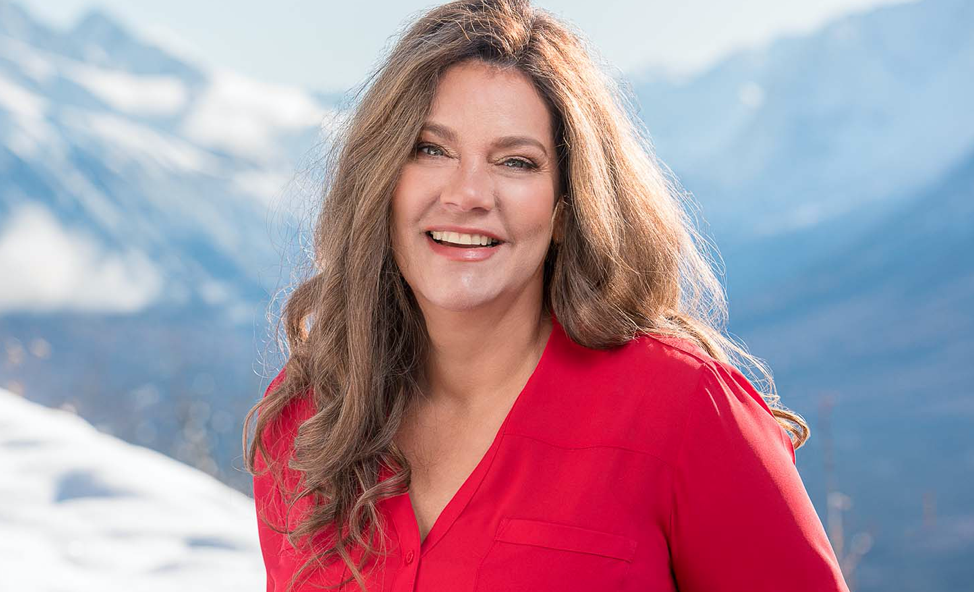
Jamie Allard

Fields set up a surprise hearing for Jamie Allard, who is also a candidate for Anchorage Assembly, but who is the governor’s choice for the Human Rights Commission.

With just 24 hours to prepare, Allard phoned in to the committee hearing, only to be called a racist by Fields because of a social media post she made that questioned some of the terms of tribal sovereignty as it pertains to law and order in rural Alaska.
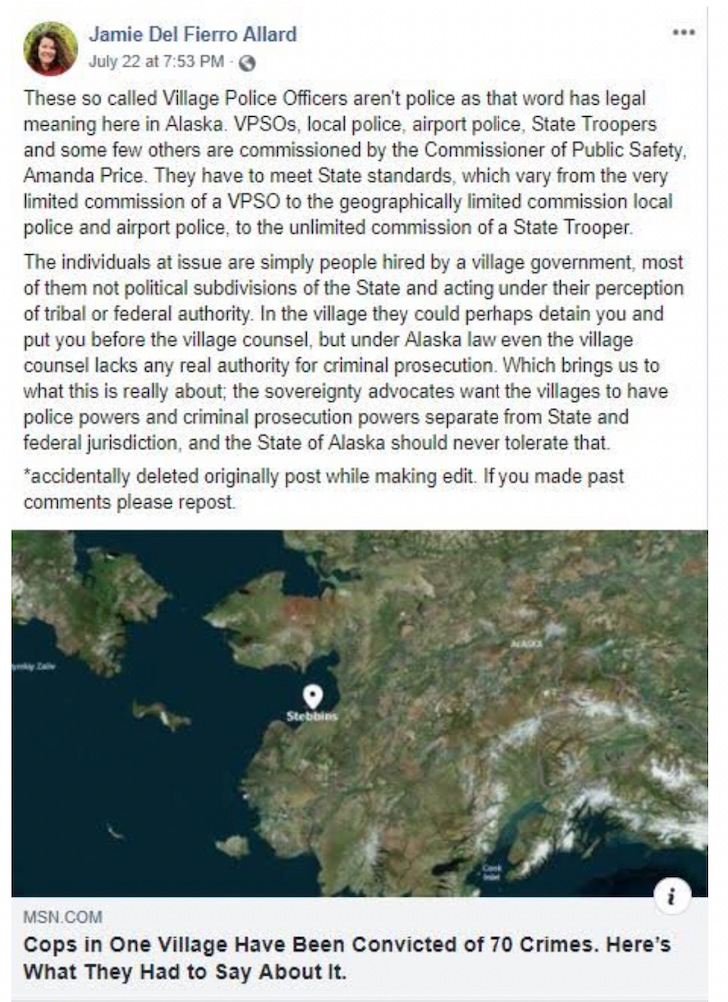
Fields also accused Allard of being fired from the State Department of Military and Veterans Affairs.

She said it wasn’t so.

He accused her of ordering lots of office furniture and forcing people to move offices at DMVA.

She said it was a printer she needed so that personnel documents could be printed confidentially, and the printer was repurposed from elsewhere in the department.

And finally, he accused her of having an abrasive personality.

But Allard was having none of it. “Are you calling me racist?” the U.S. Army veteran asked Fields at one point. Allard is Hispanic, and she was loaded for bear on that question.

He quickly backed down and said he didn’t “know her heart” but other people, whom he would not name, might think she is racist.

He also said that “other people” had told him she had been fired, and that others told him that she ordered several office remodels at DMVA. He believed them, not her, he said.

At once point, Rep. Sarah Vance had to intervene during what had become a battering, asking what Allard’s work at DMVA had to do with a volunteer position on a state commission. Allard had worked for the Dunleavy administration for about six months, before resigning to run for Anchorage Assembly.

When Fields needed a break from the inquisition, Rep. Andi Story jumped into the fray and asked Allard what kind of activities she has planned to reduce racism or sexism, and asked her whether she supports gay rights.

Allard responded that she would be working on topics pertaining to the commission and that she would follow the law.

Fields had finally had enough of Allard and recessed the committee, after it appeared she wasn’t going to lose her cool or allow him to take unfair shots at her reputation.


This is our ‘rainy day’: Alaskans need the PFD now

33

IF NOT NOW, WHEN?

By JOE GELDHOF, GUEST CONTRIBUTOR

Alaska is at a critical point.  Oil prices have tanked.  The threat from the COVID-19 virus is obvious.  Our state’s fiscal and budgetary situation is in chaos.

The wealth Alaska has received in the last four decades from oil belonging to the citizens has largely been spent.  Looking back, it is easy to determine we spent too much of our non-renewable oil wealth and saved too little.

As a result of our spending habits, we face a fiscal crisis, one that is augmented by the COVID-19 virus, low oil prices and a volatile stock market.

Our organization, the Permanent Fund Defenders, believes prompt action is required to prevent Alaska from falling in economic catastrophe.  Instead of managing this crisis, we fear our elected officials will accelerate the raids on the Permanent Fund earnings and deny Alaskan citizens the direct benefits of their savings account.

Now is the time for all Alaskans to stand together to defend the Permanent Fund and use our savings wealth for the benefit of every Alaskan.  

Wealthy Alaskans and those with power want to divert funding for the PFD into government, so they do not have to pay taxes. This hurts those among us with the smallest resources and builds the budget on the backs of the poor.

Given the crisis we face, the wise thing for our elected officials to do is immediately make an additional PFD payment based on the 2018 application process. Using the 2018 application process (for the 2019 check) will allow for payment of a $1,400 within 60 days, benefiting every eligible Alaskan and especially those most in need.  

Payment of $1,400 to every Alaskan eligible for a PFD last year will provide a buffer to the economic uncertainty caused by low oil prices and the COVID-19 virus. 

Alaskans need relief today, not down the trail. Governments like Hong Kong are making immediate cash payments to every adult resident to stimulate their economy, a move hailed by many economists as a sound way to protect the economy and reduce economic uncertainty. 

Alaska’s people and our economy will benefit from an immediate payment to every person of $1,400. Payment now, based on the eligibility requirements from last year when the PFD was reduced, will help Alaskans through these difficult times.

The earnings generated by the Permanent Fund belong to the people of Alaska, not the lobbyists and special interests trying to deny Alaskans from obtaining a responsible share of their saved wealth.

For too long, Alaska’s politicians have avoided making the hard choices that would put our state government spending on a sustainable trajectory.  Our politicians have spent too much, avoided tough calls on making government more accountable and toyed with various borrowing and fiscal incentive schemes that favor powerful special interests. It’s past time for Alaska’s elected officials to put the citizens first and stop pandering to special interests.  

Now is the time for the legislature to act by appropriating a portion of the earnings wealth to the people. The earnings wealth derived from the Permanent Fund belongs to the citizens of Alaska, not the special interests.  Payment of an additional $1,400 as part of the 2019 PFD program will help individuals in our state and mitigate the economic impact caused by the COVID-19 virus and a diminished economy. 

Going forward, what Alaskans deserve and need is a constitutional amendment that permanently protects the Permanent Fund. 

The mineral resource wealth from our commons belongs to all Alaskans equally. Every Alaskan deserves an equal share of our wealth.

After the legislature appropriates a supplemental PFD payment, they need to put a constitutional amendment before the voters allowing for a sensible draw from Permanent Fund earnings, perpetual protection of the Permanent Fund from the ravages of inflation and a guaranteed payment of a dividend to every eligible Alaskan.  

Permanent protection of the people’s wealth and payment of a dividend is hardly a radical proposition. After all, the wealth belongs to the people of Alaska, not the lobbyists and special interests trying to deny Alaskans from obtaining a responsible share of their saved wealth.

The Permanent Fund Defenders Board includes: Chairman Clem Tillion (Halibut Cove), Jack Hickel (Anchorage), Rick Halford (Aleknagik), Joe Geldhof (Juneau) & Juanita Cassellius (Eagle River). Website: www.pfdak.com

Relief for laid-off workers speeding through Legislature

5

The Alaska House passed HB 308, which will waive work-seeking requirements for those collecting unemployment insurance, extending that requirement to 120 days.

The bill has the support of Gov. Mike Dunleavy and passed the House 38-0, with two members excused. The bill:

  • Allows Alaskans who are unable to work, or who are underemployed because of public health measures, to become eligible for unemployment benefits and help prevent the spread of COVID-19;
  • Waives the standard 1-week waiting requirement to begin receiving unemployment insurance benefits;
  • Increases the weekly per-dependent benefit from $25 to $75, providing relief for families who have lost childcare and income simultaneously.

The bill has a companion measure in the Senate and is expected to move quickly to the floor of the Senate by Friday.

The bill reflects the Trump Administration’s signing of H.R. 6021, which is an emergency relief package driving unemployment benefit relief to states. It required Alaska to develop some flexibility in its own legislation.

Dunleavy asks feds for waiver on REAL ID deadline

8

The Dunleavy administration has asked the federal government for an extension on the REAL ID deadline, due to the ongoing national emergency caused by the COVID virus outbreak.

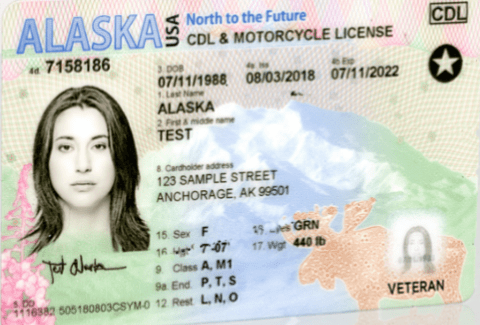
The REAL ID law stipulates that on Oct. 1, 2020, all people will need a REAL ID-compliant identification, such as a REAL ID driver’s license or a U.S. passport, in order to board commercial flights, enter federal buildings or gain access to American nuclear plants.

In many parts of rural Alaska, people have not yet acted to bring their identification into compliance. The new Alaska driver’s license that is REAL ID compliant has certain design features that indicate the holder of the card has been verified by the state Division of Motor Vehicles.

Nationally, according to the Department of Homeland Security, only 95 million out of 276 million total drivers and ID cards met the Real ID standards, although many Americans hold passports, and those are considered REAL-ID compliant and may be used to get through the TSA checkpoints at airports.

No response has yet been received by the Department of Homeland Security, sources in the Administration said.

Recallers relent, call end to signature gathering due to COVID outbreak

4

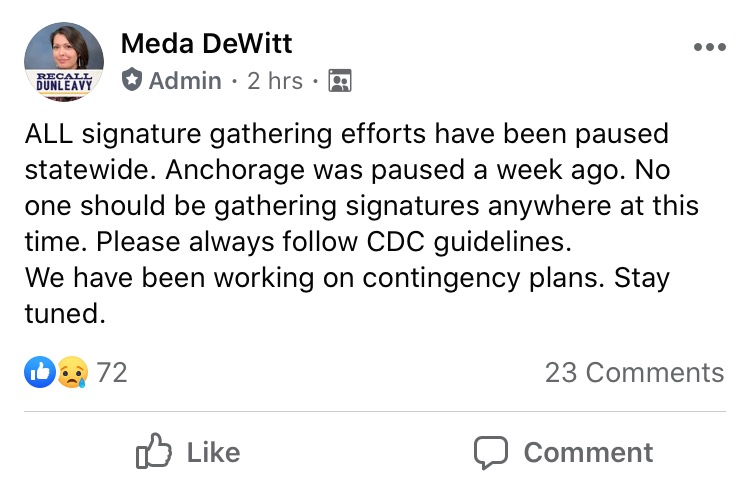
The official signature gathering on the petition to recall Gov. Mike Dunleavy has been suspended, as of March 18.

According to a social media message from the paid staff of the Recall Dunleavy Committee, the signature gathering in Anchorage had been paused a week ago. However, several observers said that they saw it and some documented it continuing in the malls, even after a state of emergency had been announced.

Meda Dewitt with Recall Dunleavy said on Wednesday: “No one should be gathering signatures anywhere at this time. Please always follow CDC guidelines. We have been working on contingency plans. Stay tuned.”

The group is believed to have about 30,000 of the 71,252 signatures it needs to force a recall election of the governor. The group had hoped to collect the signatures by April to force the question onto a special election ballot. However, unless the group can convince the court to allow it to collect signatures digitally, it may not make that goal, since the state is now in a state of emergency due to a rapidly spreading virus.

Cases of the virus have popped up in Ketchikan, Seward, Anchorage, and Fairbanks, with a total of nine cases in the state so far. All were travel related, but several appeared to be asymptomatic for some time, which means community transmission is now highly likely, if other communities’ experiences are repeated in Alaska.

The CDC and the State of Alaska’s Chief Medical Officer Dr. Anne Zink has advised that people keep a six-foot distance from each other during the outbreak.

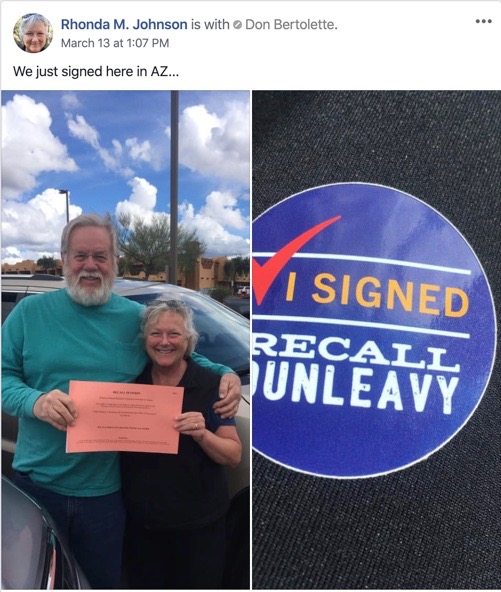
However, although the Recall Dunleavy group had stopped its pop-up event signature gathering and static gathering on March 13, it had urged individual signature gatherers to continue their efforts. Out-of-state signature gathering has also continued, according to several social media reports from individuals who had signed the petition.

Work requirements waived for food stamp recipients

2

The Dunleavy Administration has received a waiver from the federal government for the requirement that food stamps recipients who are able bodied adults without dependents must be employed, minimally at least.

U.S. Department of Agriculture Food and Nutrition Service (USDA FNS) finalized a rule to narrow state options to waive work requirements for able-bodied adults without dependents (ABAWDs) participating in the Supplemental Nutrition Assistance Program (SNAP), formerly known as food stamps.

Under federal law that went into effect in December, able-bodied individuals 18 through 49 who are not disabled or caring for children or other dependents – may only access food assistance through SNAP for three months in a 36-month period, unless they are working at least 20 hours a week or are enrolled in an employment or training program.

In 2017, 2.8 million of these persons participated in SNAP, representing 7 percent of total food stamp program enrollees.

The statewide waiver means all these enrollees in food stamps are exempt for the time being.

Many Alaskans who might suddenly qualify for SNAP benefits under the current economic circumstances brought about by the COVID outbreak might not be able to find employment in Alaska due to the closures of restaurants, bars, and other service establishments.

Our existing policy permits us to waive work requirements for SNAP for good cause.   Our teams are working on implementation for all recipients of the SNAP program for the duration of the state’s efforts in dealing with the effects of the virus.  

“As this is all very new for many of us and for our federal partners too, we are working to make sure we are taking advantage of any and all options to ease the burden and workload for eligibility requirements of our programs to make it easier for people to qualify and remain eligible during this critical time. This means the waiver applies to work requirements for ABAWDS and to the general work requirements,” said a source in the Department of Health and Social Services.

For more information on how to apply for SNAP benefits, go to this link.

ConocoPhillips shuts down travel to North Slope camps

3

Those on the North Slope are sheltering in place during the COVID outbreak. ConocoPhillips has taken major steps today to prevent the COVID virus from reaching North Slope oil field workforce.

Effectively immediately, all business-critical North Slope personnel supporting ConocoPhillips operations (both contractor and ConocoPhillips employees) are extending their shift by two weeks.

All flights north for regularly scheduled shift changes have been cancelled for the next two weeks. The company will be working to arrange transportation off the Slope for those who cannot extend their stay.

All non-essential personnel will leave the North Slope at the end of their current shift and asked to work from home or placed on extended leave until further notice, as appropriate.

All Anchorage based employees have been encouraged to work from home unless their job requires they come into the office.

The company has also asked all workers who live or have traveled out of state and are scheduled to travel to the North Slope to self-quarantine for two weeks before the start of their next scheduled shift.

By self-quarantine, the company means that workers should not travel outside of Alaska and should comply with all measures issued by the CDC and State of Alaska. If circumstances change, the company may require stricter self-quarantine measures.

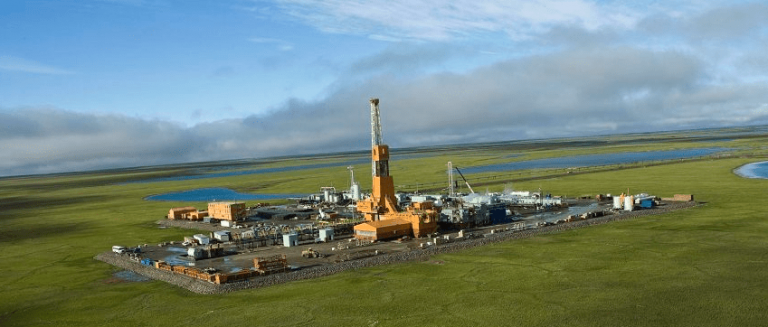
The company will be demobilizing its exploration drilling rigs (Doyon 142 and Doyon 141) when they finish the wells they are currently drilling. Doyon 142 will be redeployed at Kuparuk.

The company is not planning on shutting production. The only change for the time being this year is the reduced drilling activity in Kuparuk and Alpine that was announced as part of the ConocoPhillips news release issued on Wednesday addressing steps the company is taking in light of the drop in oil price.  

The company does not have a timeframe for resuming business as usual, according to a company memo that said, “We will be monitoring conditions on a daily basis.”

“As we move through this, our priorities remain: protect the health and wellbeing of our workforce and their families; help mitigate the spread of the virus; and safely run our business,” the memo stated.

Supplemental budget includes COVID funds

0

The Alaska Senate has passed House Bill 234, the largest supplemental budget in Alaska history, at $612 million. The bill includes more community assistance funding: $33.5 million in relief, in addition to the $14.1 million already appropriated to help communities mitigate the spread of the coronavirus COVID-19.

The bill passed unanimously, 16-0.

Details of the package, which were requested by the governor: 

  • $8.5 million in grants to municipalities for COVID-19-related commercial passenger vessel operations;
  • $5.5 million for medical and protective equipment, including testing supplies;
  • $3.5 million for transportation to housing for medical assistance;
  • $2.5 million for housing individuals under quarantine;
  • $1.5 million for the state epidemiology lab for IT systems related to testing;
  • $1.5 million for personnel including lab, support, emergency operations, and 24-hour
  • facility staff; and
  • $500,000 for public distribution of vital health recommendations and information.

The bill also provides funding for last year’s unpaid wildfire and healthcare costs:

  • $142 million in state funds and $160 million in federal funds for Medicaid services, including $8.3 million to restore the Adult Preventive Dental Program;
  • $110.5 million for wildland firefighting costs incurred last summer and fall;
  • $8.6 million to restore Adult Public Assistance.
  • $7.1 million for the Alaska Marine Highway System.
  • $6.7 million for the Department of Public Safety to address a shortfall within the Alaska State Troopers and Alaska Wildlife Troopers due to a lower than expected vacancy rate;
  • $6 million to help the Alaska Psychiatric Institute increase its capacity;
  • $3 million to address severe damage caused in Anchorage, Kenai, and Mat-Su by the December 2018 earthquake.

Anchorage will get an additional $4.5 million,

The bill, which originated in the House, needs concurrence from the House before it goes to the governor’s desk for approval.

Fourth, fifth, sixth coronavirus cases: Ketchikan, Anchorage, Fairbanks

34

NEW HEALTH MANDATES FROM STATE: CLOSING RESTAURANT

Ketchikan, Anchorage, and Fairbanks are the locations of new cases of coronavirus of coronavirus in Alaska. All cases are considered travel-related cases, with people who had traveled in the Lower 48.

Dr. Anne Zink, the chief medical officer for the state, took a previous advisory that says if you traveled within 14 days to a Level 3 country, home quarantine yourself for 14 days and made it a mandate.

Another health mandate statewide, effective March 18 at 5 pm, all bars, breweries, restaurant, food, kiosks, closed to dine in services. No on-site consumption is permitted.

The mandate does not include grocery stores but does include salad bars.

Zink said all Alaskans should minimize gatherings or being around other people in close settings.

The people with the virus are quarantined in their homes. Zink said 80 percent of those who get the virus will not need hospitalization, and so it’s best for them to stay at home.

Sen. Cathy Giessel, president of the Senate, said the Legislature stands with Gov. Dunleavy. “We stand with the governor in addressing the economic impact.”

Dunleavy asked Alaskans to take the issue more seriously. There is no vaccine. “We all need to do our part. This is a new virus. This is a virus that is easily spread. If you’re a young person you may not know that you have the virus,” he said. But he admonished young people to practice social distancing.