ANCHORAGE ELECTIONS ARE UNDERWAY; WHERE ARE THE SIGN-WAVERS?
Jamie Allard, a candidate for Anchorage Assembly, faces the same problem as all other candidates for office right now — no gatherings of 10 or more people and the State health mandate to stay 6 feet apart make it difficult to have rallies and fundraisers. And with everyone staying home, what’s a candidate to do, while protecting everyone from the spread of the COVID-19 virus.
But sign-waving in an era of COVID-19 has brought out the creative in Allard, an Army veteran.
Allard had some signboard images made of some of her favorite people, and put them up along the highway with her while she waved to voters in what is a new twist to a well-known Anchorage elections tradition of sign-waving. Call it the “Allard wave.”
Starting with a cartoon image of President Trump, she also added one of former Lt. Gov. Loren Leman, former Assembly member Amy Demboski, and current Assembly Member Crystal Kennedy. Former Mayor Dan Sullivan and well-known political personality Susan Fischetti also joined the cardboard sign-waving force for Allard.
In the middle of the medley, on the ramp to Hiland Road in Eagle River, was Allard’s big sign that said, “Practicing social distancing, but still here for you.”
Allard said the response she received was encouraging — lots of honks and hand-waves, and some people even stopped to take selfies with the Trump sign.
“The things you come up when you’re quarantined,” Allard said.
DR. ZINK SAYS HOMEMADE MASKS MAY BE GOOD FOR PUBLIC HEALTH
Today’s coronavirus count in Alaska went from 143 statewide to 147, a gain of eight cases.
The reason the number is not 151, which it should be mathematically, is that the State Department of Health and Social Services has changed the way and the timeframe it is reporting on cases; they are now reported through midnight, rather than through 3 pm, as they were earlier. Some cases would have been counted twice due to the change of the timeframe.
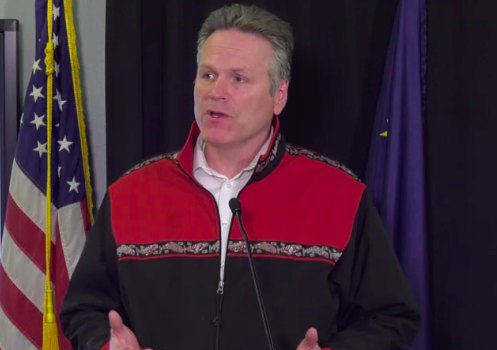
Hospitalizations went from 9 to 13 today. Gov. Mike Dunleavy today said that 5,530 Alaskans have been tested as of today and there are no additional deaths attributed to the virus, beyond the first three already announced.
Alaska is among the top 10 states for testing per capita in the country. Two percent of the tests coming back are positive, said Dr. Anne Zink, Alaska’s chief medical officer. Alaska has the fewest cases of any state, she said. The numbers announced today are probably those of people who acquired the virus two weeks ago.
STATE LAUNCHES COVID-19 DASHBOARD
The Alaska COVID-19 Dashboardis designed to provide Alaska-centric data, including geographical data using information provided by local hospitals, commercial labs, and state labs. The dashboard connects Alaskans with federal and community partner websites and will be continuously updated.
“I thank our DHSS data team, epidemiology team, and lab team for helping to make this information-filled dashboard a reality as we continue to provide transparency of all data available,” Zink said. “We understand this new look may take time to get familiar with and encourage Alaskans to check back in the coming days and weeks as we continue to make updates and changes.”
“The interactive Alaska COVID-19 Dashboard provides the public with the latest data while keeping in mind the confidentiality and sensitivity surrounding each individual case,” Dunleavy said. “I thank my team for standing up this tool so quickly and for their ongoing work as we navigate this pandemic together.”
NEW INFORMATION ON ‘SIX-FOOT RULE,’ FACE MASKS
Zink said that the current recommendation of six-foot distance between people is the minimum, and that people need to give as much space to others as possible because there is increasing evidence that droplets of the virus can linger in the air, especially in places where people are coming in and out of a lot, such as grocery stores. She said to think of “at least six feet,” and to stay out of places where there is a lot of in-and-out traffic.
She recommended using shopping delivery services and limiting your amount of time in stores.
ZINK also said that while a homemade surgical-style mask may not protect you from someone else who is sick, there is evidence that a homemade mask can prevent the spread of the disease because people can be asymptomatic spreaders of the disease. She said people should consider wearing a tightly woven homemade mask.
Slide from Dr. Anne Zink on personal protective gear shipped to health care organizations.
Eleven pallets of personal protective gear have been shipped to Alaska Native Tribal Health Consortium, Zink said.
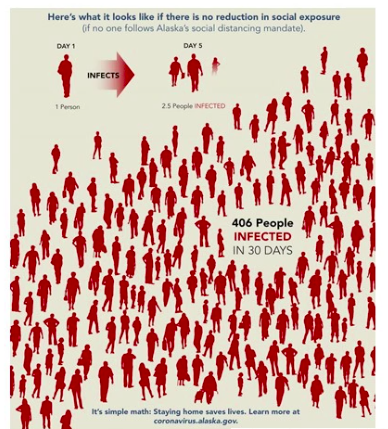
Zink said without social mitigation, there could be up to 11,000 deaths in Alaska from COVID-19.
In the state’s current modeling, Alaska is not shooting up in cases, the way it occurred in Washington State. The social mitigation efforts are working, Dunleavy said, encouraging Alaskans to keep their distance because they are making a difference in helping the state medical community prepare for an uptick in cases that is expected in the next couple of weeks.
With the passage of the governor’s SB 241, the Alaska Department of Revenue anticipates that it will be signed by Gov. Mike Dunleavy.
In anticipation, the Tax Division has extended the payment deadline of any corporate income tax and estimated payments otherwise due on or after April 15 and before July 15. The new deadline is July 15, 2020.
The time to file a return otherwise due on or after April 15 and before July 15 is extended to Aug. 14, 2020.
Penalties and interest will begin to accrue on any remaining unpaid balances as of July 16, 2020. Corporate taxpayers may request an extension and should do so by July 15, 2020 with the Internal Revenue Service; the State of Alaska will honor that request automatically. Be sure to check the appropriate extension box on the state return when filing and attach a copy of federal Form 7004.
In Alaska, pass-through corporations, such as S corporations, limited liability companies, partnerships, and sole proprietorships, are not subject to the corporate income tax, which applies only to traditional C corporations.
Ravn Air announced this morning it will reduce passenger and mail service immediately to rural Alaska — over 140 rural communities in all.
Ravn Air owns Hageland and Pen Air and is the dominant carrier for much of rural Alaska.
Last week, Pen Air’s planes were parked and all pilots and crews were laid off, and this morning, most of Hageland planes were repositioned to Palmer and Fairbanks.
Ravn is only going to be running three of its 30 aircraft, a 90 percent reduction. The Dash-8s will fly reduced service to Kenai, Homer, Valdez, King Salmon, Dillingham, Sand Point, Cold Bay, Dutch Harbor, Bethel, Aniak, St. Mary’s, and Unalakleet.
All other scheduled passenger flights researched by Must Read Alaska appear to have been cancelled.
Gov. Mike Dunleavy responded to the news quickly with a statement:
“We want rural Alaskans to know the aviation industry is working cooperatively to ensure essential passenger service, bypass mail and freight service is maintained to their communities during these uncertain times,” said Gov. Dunleavy. “This morning I also spoke with officials from the United States Postal Service and they assured me they are working with contract carriers to maintain scheduled service to rural areas. The importance of the supply chain to rural Alaska communities is a priority for my administration.”
Many rural villages have put themselves on lockdown and are not allowing planes to land because no one is allowed in the community during the global pandemic. Reports have come into MRAK that some villages have positioned trucks on their runways to prevent landings.
The supply chain to these villages can continue with chartered services, but no commercial passenger services will be available to dozens of villages across Alaska for some time.
I read with interest the MRAK story about Superior Court Judge Matthews siding with the State in denying the Alaska State Employees’ Association’s motion to basically shut down State government and let ASEA members “work” from home.
ASEA represents the General Government Bargaining Unit (GGU) of State employees. Technically they are defined as “classified, non-supervisory employees.”
There are 8,000 or so of them; they are by far the largest unit of State employees. The reality is that they really are the unit of State employees who couldn’t get themselves put in another unit.
The law says that bargaining units are to be defined by “community of interest” and unnecessary fragmentation is to be avoided (AS 23.40.090).
Yet, bargaining unit determinations have always been sloppy and political and the GGU is no exception. They try to represent employees with general equivalency diplomas who work in entry- level jobs as well as people with PhDs making over $100,000 a year.
One of their national representatives lamented to me back in the 1990s that it was “hard to find a sense of social justice in engineers making over $50,000 a year.” That salary would buy you a couple of decent pick-ups back then.
Leaving aside the ferry system unions and their unique obstinacy, if you’re going to have labor problems in the State workforce, they’re likely to start in the GGU/ASEA.
ASEA is an affiliate of the American Federation of State, County, and Municipal Employees, AFL-CIO (AFSCME). ASEA was also the first of the State’s white and gray collar units to affiliate with an AFL-CIO union, and when AFSCME came to Alaska in 1988, they brought Saul Alinsky with them.
By the early Nineties, those leather-bound hornbooks and treatises in my office were gathering dust and had been replaced by well-thumbed copies of Alinsky’s “Rules For Radicals.”
ASEA couldn’t do labor relations very well, but they sure knew how to make noise and raise hell. Being soundly thrashed by the State on numerous occasions has made them somewhat more circumspect, but even today, if there is going to be labor strife, it is likely to start with ASEA.
There is a plaintive wail in the comments to the MRAK story from a commenter claiming to be a conservative Republican and Dunleavy supporter going on about how unfair the State’s position on working at home is. For a conservative Republican and Dunleavy supporter, the commenter sounds amazingly like an ASEA shop steward parroting the party line.
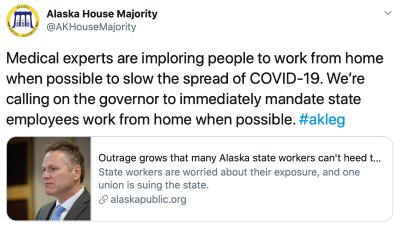
The Democrat-led House Majority called for the governor to essentially shut down state government and send workers home.
The State has never embraced telecommuting, and especially not for the sort of employees ASEA represents. Most ASEA members are direct service employees; they provide direct services to citizens at front desks or at Division of Motor Vehicles, Department of Health and Social Services, or support professionals who provide direct services. Some, but only a minority, are degreed professionals who don’t have supervisory duties.
Professionals who don’t have supervisory duties can telecommute if they’re trust-worthy, high-performing employees, and even with those, you make them clock in and clock out and watch their work production.
LIABILITY
It is an enormous liability for the State to let an employee work at home. If you are “at work,” the State has the same liabilities for your health and safety in your home as it does in a State office and it has little control over the health and safety conditions in your home.
If I work at all, I work from home, and my wife telecommutes under federal rules. Our home office is actually better equipped than the typical government office, but it isn’t ADA compliant and would never withstand a Division of Occupational Safety and Health inspection.
Were I working for the State and got up from my desk to go to the restroom, there is an unsecured throw rug over fairly slick ceramic tile, a cord under the throw rug that runs the recliners and another cord in front of the bathroom door that goes to a surround-sound speaker and that I’ve been too lazy to get behind a cover on the wall. Should I slip or trip during that 10-foot distance to the bathroom, my injuries are the State’s liability.
If I’m a State employee working at home, I’m working on my home computer and a home network. If the State insists on a specific security protocol, it has to provide it and require me to use it.
But how does that work out if your teenage son also uses the same network? I’m not the only one who has had to clean up a teenage boy’s virus-infected computer. You don’t want to try to convince his mother that her son, not you, downloaded that stuff.
State management is the same way.
The State has a somewhat objective definition of an “essential employee,” one whose services cannot be done without for the shortest period of time. That definition is from the Public Employment Relations Act and defines those employees who are prohibited from striking because the strike would pose a threat to public health and safety.
As I discussed above regarding bargaining unit definitions, the application of the law has been both sloppy and political, but at least it is a written definition that can be objectively contested.
However, using the strike class definition doesn’t really answer the question in ASEA’s suit. ASEA does have employees that are prohibited from striking, such as Alaska Psychiatric Institute and Pioneer Home employees and some administrative workers in Corrections and Public Safety, but the real issue is with the employees at the Department of Health and Social Services — the ones who take welfare applications, or Labor and Workforce Development workers who take unemployment insurance applications, and other direct service and front desk employees.
The State should make the determination based on the function, not the employee. The State can say that there will be no driver’s license renewals or registration renewals for 30 days and no enforcement for expired licenses and registrations.
Then, it can just lay off the employees associated with that function. The unions have never meaningfully cooperated with furlough arrangements so it’s best to just lay them off, pay them off, and maybe call them back if you ever need them again; you reap what you sow.
Layoff is expensive; you have to pay off the laid-off employees’ benefits, but the unions bought a Legislature and got the State’s personal services budget fully funded; it doesn’t cost any more to get rid of them that it does to keep them. Be careful what you ask for.
Art Chance is a retired Director of Labor Relations for the State of Alaska, formerly of Juneau and now living in Anchorage. He is the author of the book, “Red on Blue, Establishing a Republican Governance,” available at Amazon.
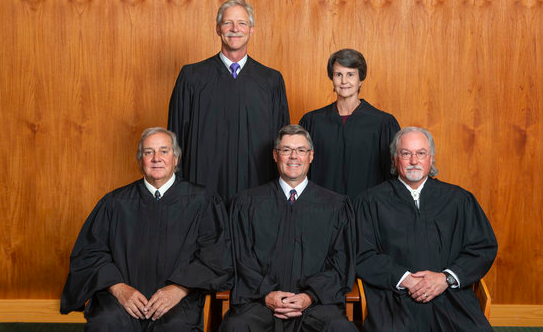
The Alaska Supreme Court today asked for further information in the matter of whether or not the recall of the governor meets legal criteria.
The court will now not rule on the question of the recall until after April 20 as it awaits further written arguments from each side – the group wanting to recall the governor, and the Division of Elections, which says the recall grounds are insufficient.
The question in the court’s deliberation is the third ground for recall in the petition by Recall Dunleavy Committee, which now has gathered 30,000 signatures, after the Supreme Court allowed the group to proceed with signature gathering:
That third ground is apparently in question: “Governor Dunleavy violated separation-of-powers by improperly using the line- item veto to attack the judiciary and the rule of law.”
The court asked the Department of Law’s attorney and the attorneys for the Recall Dunleavy Committee to submit supplemental briefs addressing the following issues:
The historical basis of state constitutional provisions, and particularly the Alaska Constitution, Article II, section 15, regarding a governor’s discretionary authority to veto items in appropriation bills and the related requirement that the governor provide a statement of objections to the vetoed items;
The constitutional limits, if any, that exist on a governor’s exercise of the authority to veto items in appropriation bills; and,
In light of the foregoing, the legal framework this court should use for determining whether the third ground for recall is “legally sufficient” as required by our case law. How should the governor’s statement of his objections inform the analysis? Can the statement of objections itself demonstrate an “improper” use of the governor’s veto authority sufficient to support recall? Is an “improper” use of the governor’s veto authority a violation of the separation of powers doctrine? As used in the recall petition, is “separation of powers” a law — which the governor either violated or did not violate — or is it shorthand for something else? How should voters interpret the phrases “separation of powers” and “the rule of law”?
The court has asked for briefs of no more than 20 pages filed no later than April 13, 2020. Simultaneous responses of no more than 10 pages shall be filed no later than April 20, 2020.
It appears the court understands that constitutionally the governor has the power of veto, and is supposed to provide an explanation with his veto. It’s possible the justices are preparing to cut one or more of the four grounds that were submitted by former Attorney General Jahna Lindemuth, who is a political operative from the former Gov. Bill Walker Administration, and Scott Kendall, who was Walker’s chief of staff.
The wording of the recall petition and ballot language that the justices are considering is as follows:
Statement of Grounds:Neglect of Duties,Incompetence, and/or Lack of Fitness, for the following actions:
Governor Dunleavy violated Alaska law by refusing to appoint a judge to the Palmer Superior Court within 45 days of receiving nominations.
Governor Dunleavy violated Alaska Law and the Constitution, and misused state funds by unlawfully and without proper disclosure, authorizing and allowing the use of state funds for partisan purposes to purchase electronic advertisements and direct mailers making partisan statements about political opponents and supporters.
Governor Dunleavy violated separation-of-powers by improperly using the line-item veto to: (a) attack the judiciary and the rule of law.
Governor Dunleavy acted incompetently when he mistakenly vetoed approximately $18 million more than he told the legislature in official communications he intended to strike. Uncorrected, the error would cause the state to lose over $40 million in additional federal Medicaid funds.
References: AS 22.10.100; Art. IX, sec. 6 of Alaska Constitution; AS 39.52; AS 15.13, including .050, .090, .135, and .145; Legislative Council (31-LS1006); ch.1-2, FSSLA19; OMB Change Record Detail (Appellate Courts, University, AHFC, Medicaid Services).
Alaska Democrats planning to go to the party’s national convention in July will need to change their tickets.
The Democratic National Committee was scheduled to convene in Milwaukee, Wisconsin on July 13-16, but due to the COVID-19 coronavirus, the convention is now set to begin Aug. 17.
That is the week prior to the Republican Party convention, scheduled to gather in Charlotte, N.C.
Pressure from Joe Biden, who currently leads in the delegate count (1,217 to 914 for Bernie Sanders), and numerous Wisconsin residents led to the decision. A Marquette University Law School poll shows that 62% of Wisconsin residents think that the convention should not even be held at all as an in-person event.
Jason Hoke is out as the federal co-chair for the Denali Commission. Hoke offered his resignation effective this week, Must Read Alaska has learned.
Four workplace-based complaints had been lodged against Hoke for his interactions, particularly with women.
According to earlier reports from Alaska Public Media, “Hoke’s mistreatment of employees began at his first staff meeting, when Hoke shared a Serbian quote that Hoke translated as: ‘Whether women are laughing or crying, they’re always lying.'”
Hoke had been appointed on the recommendation of Sen. Dan Sullivan and Lisa Murkowski to the position running an agency that was established in 1998 through the efforts of Sen. Ted Stevens. The commission has an annual budget of $15 million.
Under the umbrella of the U.S. Department of Commerce, the commission has directed millions of dollars to projects in rural Alaska, bringing water and sewer infrastructure as well as power projects to rural communities. In recent years, the commission has been involved with relocating villages that are disappearing to coastal erosion, such as Kivalina and Shishmaref.
Hoke had one year ago replaced former State Sen. John Torgerson, who was the interim federal co-chair. Prior to him, Joel Neimeyer had served as federal co-chair for several years.
Hoke had previously served as a program director for the Ahtna Inter-Tribal Resource Commission. He had also been executive director for the Copper Valley Development Association Inc. and was the tribal administrator for the Cheesh’Na Tribal Council. Originally from New York, he came to Alaska to teach in rural schools.
RESTAURANT AND BARS WILL REMAIN CLOSED TO DINE-IN FOR NOW
The number of cases of COVID-19 coronavirus rose to 143 today in Alaska with 10 new cases diagnosed since yesterday. More than 5,000 Alaskans have been tested for what some call the “Wuhan Virus,” which originated in Wuhan, China.
The cases were Anchorage (2), Fairbanks (3), North Pole (2), Juneau (1), Ketchikan (1) and Wasilla (1).
That brings Anchorage to a total of 67 known cases, while Kenai Peninsula has 8, Fairbanks/North Pole has 40, Mat-Su has four, Juneau has 10 and Ketchikan has 14.
Dr. Anne Zink, Alaska’s chief medical officer, said that masks that people are now using with greater frequency are a potential way to have asymptomatic people not spread the virus to others, but that it’s important to save the N95 masks for health professionals dealing with the virus.
Zink said she has been looking at data relating to masks from the Czech Republic, South Korea, and China. “And out of an abundance of caution we’re seeing this movement for ‘masks for all.’ Realize that the mask is not going to prevent the disease completely,” she said. Social distancing, hand washing, not touching your face, and sanitizing surfaces is more effective, but masks can help, since so many people have the virus but evidently have no symptoms.
“Some people have the virus in their nose even though they feel well,” she said.
The governor’s press conferences have been feeding the public with a firehose of information on how the State is responding to the pandemic. The topics deal with everything from eligibility requirements for the Pioneer Homes and senior benefits programs, to how children are accessing distance learning.
The health mandates announced two weeks ago that closed libraries, museums, dining establishments and bars through the end of March will continue until at some point in the future, said Adam Crum, commissioner of Health and Social Services.
Gov. Dunleavy said that Alaskans seem to be taking to heart the importance of social distancing, and that Alaska may have a natural advantage in that regard. But he warned that Alaska will be in for a tough ride over the next couple of weeks, if the epidemiological models pan out.