“Nothing is so permanent as a temporary government program.” Milton Friedman
It seems like ages, not just a few months, since COVID-19, coronavirus, and social distancing became part of our everyday vocabulary. The coronavirus is challenging our state, our country and the rest of the world unlike anything we’ve experienced in our lifetimes.
There is much unknown about the virus from a medical and health perspective. Medical researchers and epidemiologists will soon figure this out and provide the tools needed to beat this scourge back.
When that happens, it will be a monumental achievement that saves many lives. Those responsible deserve all the accolades that come their way.
But, that accomplishment, when it happens, may not be what many people will remember. Instead, it may be the cultural and economic impacts that come to mind – and how government and our citizenry responded to them.
We know this event is already changing our lives in many ways.
We’re already more conscious of our health and hygiene habits – especially relating to the people we come in contact with – including healthcare providers on the frontlines of medicine.
We are discovering that our physical presence in an office, classroom, or meeting isn’t as important as we imagined. One wonders how this will affect HR policies, demand for office space, and the need for grand university campuses in the future.
Likewise, regular trips to brick-and-mortar buildings, whether a grocery, department store, bank, or medical clinic suddenly don’t seem so necessary. Even the less computer-savvy among us are learning to order groceries, make a bank deposit, and confer with our doctor online.
Could this mean we eventually will spend more time exercising, pursuing other interests, and interacting with our families and friends?
This new paradigm portends beneficial changes in our culture – as long as organizations, companies, and workers are willing to adapt to consumers’ changing consumption habits. Those that do will be the winners in the new recovered economy.
The direct economic consequences of this crisis aren’t well defined. In the short term, we know it will be devastating.
In Alaska, private employers are especially vulnerable because of our over-concentration in the oil and visitor industries.
The growing world-wide oil glut and current price war will depress oil prices indefinitely, negatively impacting both production and exploration.
Alaska’s visitor industry is fueled almost exclusively by discretionary purchases – the first to be reduced in a recessionary economy. Negative stories surrounding the ease of viral transmission in airports, aircraft, and cruise ships will linger in the public’s mind. Unfortunately, this means our visitor industry won’t likely recover for several years.
Many other businesses – from restaurants to retail stores, hair salons, dog groomers, and dry cleaners – are all taking a hit. Few areas of our economy will escape unscathed – except, it seems, maybe the government workforce.
This unprecedented economic disruption has triggered a massive government response at every level. Congress passed a $2 trillion relief package and Gov. Dunleavy has proposed millions in state economic assistance. Local municipalities are formulating their own aid plans.
Short term, this is necessary and helpful. But it won’t be enough over the long run. Ultimately, history will judge us on how we individually and collectively rebuilt our economy. Holding government itself harmless from economic impacts doesn’t help accomplish this.
This begs the question: Why did our state legislature just pass a budget that contemplates providing state services as usual – presumably continuing to fund salary step increases and job security for all state workers – when, by some estimates, 39,000 Alaskans will have gotten layoff notices in our private sector?
Alaskans like to think of themselves as a hardy, self-reliant breed. But, without much regard to whether we can afford it, we’ve come to expect “free” PFD’s, unending government assistance and grants galore funding expansive amenities – arts, parks, pools, museums and special programs. We’ve poured billions into education and Medicaid without improving student achievement or health outcomes.
A real long-term danger we face is that this crisis will make us more dependent on government when we need to be willing to restructure our priorities to fit a new reality: Expect less from government and do more for ourselves.
Win Gruening retired as the senior vice president in charge of business banking for Key Bank in 2012. He was born and raised in Juneau and graduated from the U.S. Air Force Academy in 1970. He is active in community affairs as a 30-plus year member of Juneau Downtown Rotary Club and has been involved in various local and statewide organizations.
Judy Eledge, Randy Ruedrich, and John Binkley are the three electors for the Alaska Republican Party this presidential cycle. They were chosen as a slate forwarded by Nominations Committee and passed by convention to cast the electoral college votes in December. There were 221 delegates to the convention, and the slate passed 117-28, with some delegates not voting.
In December, electors meet in their respective states to cast their votes for president and vice president. The position of an elector is historic, symbolic, and prestigious. Each state gets a number of electors equal to its U.S. Congressional representation. Alaska has three electors.
Democrats and Republicans choose their electors through an election process at their state conventions.
In Alaska, each elector must pledge that he or she will cast his or her electoral vote for the winning candidate of the party.
Eledge, of Anchorage, is the chair of the Anchorage Republican Women’s Club, and Ruedrich, also of Anchorage, is the former chair of the Alaska Republican Party. Both are deeply involved in party politics. Binkley, of Fairbanks, is a former state representative and senator and ran for governor in 2006. His family business purchased the Anchorage Daily News from Alice Rogoff in 2017, saving the state’s largest newspaper from bankruptcy.
Mike Tauriainen was elected to be the party’s national committeeman, and Cynthia Henry was reelected to national committeewoman during the party’s convention, which was held by teleconference for the first time.
Tauriainen was a delegate to the 2016 Republican National Convention from Alaska and was one of 12 delegates from the state who was bound by state party rules to support Ted Cruz that year. He and his wife Kay live in Kenai and are longtime activists in the party. Tauriainen replaces Peter Goldberg.
Henry was first elected as national committeewoman in 2016. She also was a delegate to the 2016 Republican National Convention from Alaska. Like Tauriainen, Henry was one of three delegates from Alaska bound by state party rules to support Ted Cruz in 2016 at the national convention.
Glenn Clary was re-elected as ARP chairman and Vice Chair Ann Brown was also re-elected. Newly elected to positions in the state party were Secretary Chris Carter, and Assistant Secretary Debbie Clary.
GRANT, YUTE, RYAN WILL START PICKING UP MAIL SERVICE RAVN CANCELED
Clearing up confusion created when RavnAir Group suspended flights to most of rural Western Alaska this week, the company said it will continue flying to Unalaska, one of its main routes.
The company, which ended service to most of the nearly 140 rural communities it serves, will run four flights a week to Unalaska, and will provide charter flights as needed to what is the top fishing port in the United States.
Last week, the company announced it was ending service to nearly all rural communities and halting 90 percent of its flights.
Grant Aviation and Yute Air, however, are stepping up to fill the void for many communities formerly served by RavnAir, grabbing up the mail contracts from the U.S. Postal Service. The situation is in flux as the companies look for opportunity, but struggle with the small fleets they operate.
Writing to the people of Western Alaska via Facebook, Yute Air said, “With everything that’s going on we wanted to make sure you knew we are still here and flying strong. With Ravn’s abrupt departure we will try to fill any needs that may arise. Until this is over Yute is here with you ‘Wings of the People.'”
Grant Aviation General Manager Dan Knesek stated his company will do what it can to make sure the mail gets delivered and emergency needs are taken care of.
The rural carriers also include Ryan Air, which is jumping into fill the void left by Ravn. The company will add Stony River to its Upper Kuskokwim mail and freight route that includes Chuathbaulk, Crooked Creek, Red Devil, and Sleetmute three times a week.
The situation with the air carriers in western rural communities is dynamic and none of the three carriers remaining to serve the small villages have the number of planes needed to fill the void. But for now, many communities that were suddenly without freight and mail have an option emerging, and the reshuffling took place within 72 hours of Ravn announcing its decision to ground its fleet for now.
For Ravn, the question is more difficult since they’ve breached the contract with the Post Office. Mail contracts don’t come around very often. This could permanently damage Ravn’s ability to recover financially in rural Alaska because the bypass mail is a major source of revenue. Few air carriers have succeeded in rural Alaska without having their revenue supplemented by the mail contracts, which can comprise up to half of their revenues.
The aviation community that serves smaller communities in Alaskas is close-knit and the bypass mail contracts are a key part of their business model.
This story has been updated to reflect 14 cases, rather than earlier reported as 13.
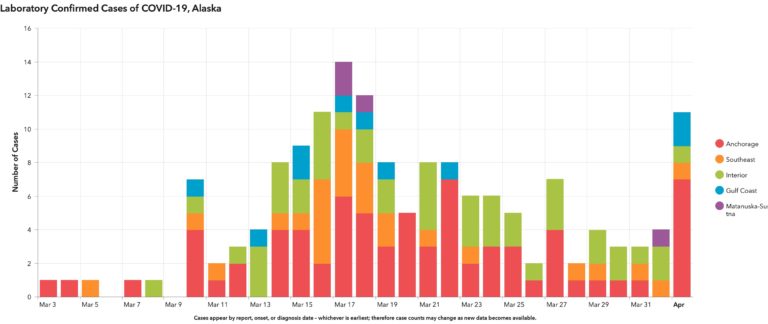
Alaska saw 14 new cases of COVID-19 coronavirus since yesterday, for a total of 172 cases identified statewide to date.
Two more Alaskans have died because of the virus, bringing the deaths to five in Alaska since the outbreak reached the farthest north state at the beginning of March. The first death in Alaska was March 26.
A total of 16 people have been hospitalized for treatment, although not all of those are in hospitals now.
The 172 cases now diagnosed includes the five deaths but does not include the number of Alaskans who have recovered from the virus. Although COVID-19 is a considered a “reportable disease” with the Centers for Disease Control, reporting recoveries is a less exact science and that information is likely to be inaccurate, therefore the State Department of Health and Social Services is not yet announcing the number of recoveries.
Cases reported in the past 24 hours are likely to be from those who caught the virus up to two weeks ago.
51.5 percent of Alaskans who have become ill with the COVID-19 coronavirus are women, and 48.5 percent are men.
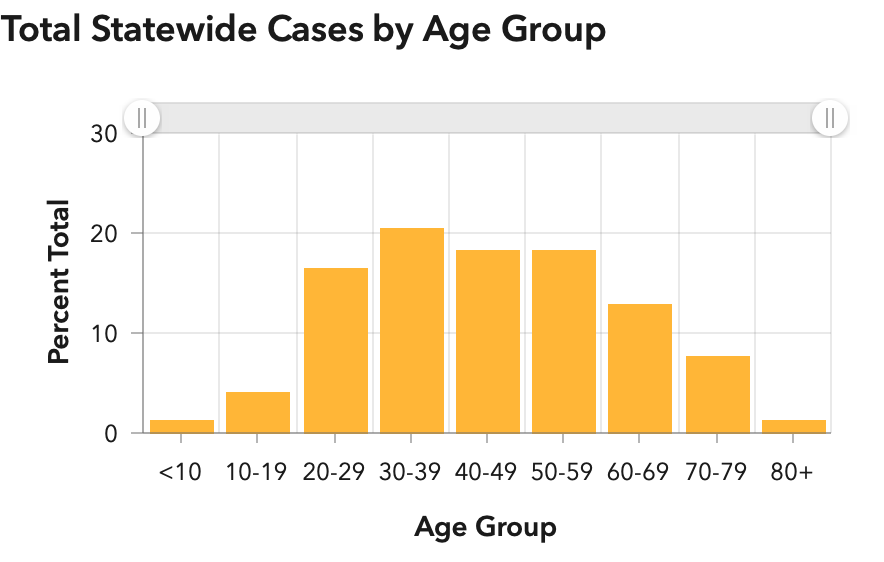
The ages most impacted by the virus are those between the ages of 30-39. They comprise over 20 percent of the known cases so far.
The communities most impacted by the outbreak are in urban or small-town Alaska:
About 2.8 million people per year die in the United States from heart disease, cancer, injuries and various other illnesses, according to data compiled by the Centers for Disease Control (CDC).
Infections related to the coronavirus COVID-19 could kill 100,000 to 240,000 people this year, according to projections offered by government officials on Tuesday.
On paper, those COVID-19 deaths amount to a 3.6 to 8.6 percent increase in American deaths. In reality, the percentage will be lower.
How much lower? No one knows.
But what is known is that COVID-19 strikes heavily at those with heart disease, diabetes, cancer and other pre-existing illnesses.
Italian doctors who examined the charts of 355 patients who died in that country reported to the American College of Cardiology that they found “heart disease (in) 30 percent; diabetes, 35 percent; active cancer 20 percent; and other serious conditions.”
Doctors in China have reported similar findings as have officials at the CDC. A CDC study released Tuesday reported, that “among all COVID-19 patients with complete information on underlying conditions or risk factors, 184 deaths occurred; 173 deaths (94 percent) were reported among patients with at least one underlying condition.
“These results are consistent with findings from China and Italy, which suggest that patients with underlying health conditions and risk factors, including, but not limited to, diabetes mellitus, hypertension, COPD, coronary artery disease, cerebrovascular disease, chronic renal disease, and smoking, might be at higher risk for severe disease or death from COVID-19.”
Given that some people who die “COVID-19 related deaths,” as the Boston Globe refers to these fatalities, were destined to die from pre-existing conditions such as cancer and heart disease before the year is out, the number of people reported dying from those diseases is sure to drop in 2020.
How much will it drop? Again, no one knows.
What is known is that more than 647,000 people per year die from heart disease in this country, according to the CDC; and more than 599,000 die from cancer.
What is also obvious is that many if not most Americans are now living in fear of the newest disease to threaten in ways they never lived in fear of those old, established diseases.
DAILY SCARES
“Coronavirus could kill more Americans than WWI, Vietnam or Korean wars, White House projection shows,” CNBC headlined this week.
“CORONAVIRUS HAS KILLED MORE IN THE U.S. THAN THE WAR IN AFGHANISTAN, DEATH TOLL SOON TO PASS 9/11,” proclaimed Newsweek.
“The coronavirus death toll surged past 4,000 in the United States on Tuesday, eclipsing the total from the 9/11 terror attacks as New York City traded ‘Ground Zero’ for ‘epicenter,’” reported USA Today.
The headlines have stirred a social panic which complicates current government efforts at social distancing, according to a team of researchers at the University of Hawaii, who note that “humans are hardwired to seek safety in numbers, but not hardwired to shelter in place.”
DR. ZINK ISSUES ADVISORY: WEAR FACE MASKS IN PUBLIC PLACES
Alaska now has had 157 cases of COVID-19 coronavirus, an increase of 11 since Thursday. There are no new deaths. The increases have been modest day after day this week, reflecting Alaskans’ compliance with health mandates.
It’s far too soon to declare victory, but what Alaskans are doing appears to be working.
Two new hospitalizations brings the total hospitalized to 15, although some are no longer in the hospital. Of those 11 announced today, one is a traveler who is not from Alaska — only 10 were Alaskans. 6,016 individual Alaskans have been tested.
“We seem to be holding our own and we seem to be doing better than the vast majority of states,” Dunleavy said, speaking about the number of people tested and the number those who are known to be infected. He was also encouraged that no deaths have been reported since last Saturday, when a 73-year-old man died at an Anchorage hospital from the coronavirus. He had been admitted to the hospital five days earlier.
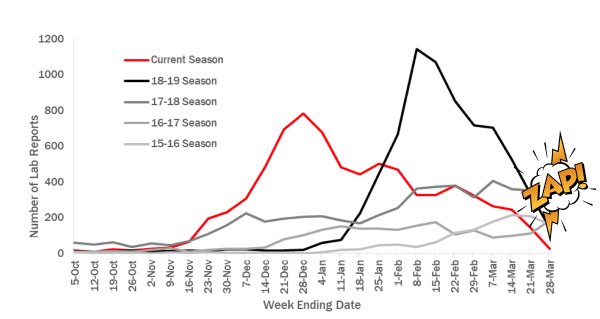
If the state’s influenza chart can be used to track how well Alaskans are adhering to the social distancing and hand washing mandates, then there’s good news on that front.
The Wuhan coronavirus known as COVID-19 is much more contagious than influenza A or B, but the cases of flu in Alaska have fallen almost to zero. That’s important, because flu is transmitted the same way as the coronavirus — through droplets. Last year, 18 Alaskans died of complications from regular influenza.
At the end of March, 2020, after what started out as a heavy flu season, the flu was all but over, as shown by the red line below:
Dunleavy was cautious about the progress Alaskans have made is staving off the spread of the coronavirus. And his caution is understandable, since the numbers could spike at any time for this virus, which spreads in clusters.
But looking at some of the models, it appears Alaskans have a strong desire to not get infected and are minding the advisories and mandates for social distancing and sanitizing.
The University of Washington model for Alaska says Alaska is still 11 days away from “peak deaths” expected from COVID-19. That model predicts there will be five associated deaths per day by April 14, a rate that will continue for several days before tapering off to four deaths per day by April 21. By August, 148 Alaskans will have died from the illness, the model predicts.
From the trends, however, it looks like Alaskans intend to cheat death by beating the models, and they are right now leading the nation in both low case count, numbers tested, and numbers of deaths. The first case in Alaska was detected on March 12, and it’s been growing as more people are tested, but not expanding as exponentially as it has in New York City and other urban areas where people cannot avoid each other.
State Medical Officer Dr. Anne Zink today issued the 10th health advisory for the State of Alaska: Wear a mask when in public to cover both your nose and mouth. This prevents you from spreading the virus if you are an asymptomatic carrier of it.
At this point, Zink said, everyone should assume they’ve been exposed to COVID-19 and could be spreading it. Zink’s advisory has specific instructions for how to use masks, when to use them, and when and how to remove them:
Health Alert #10: Recommendations Regarding the Use of Cloth Face Coverings
Scientific evidence available to date indicates that asymptomatic and presymptomatic shedding of the virus that causes COVID-19 is occurring. This means that people who have no symptoms whatsoever may be infected with the virus and capable of transmitting the virus to others when interacting in close proximity—for example, speaking, coughing, or sneezing. This heightens the need for community-wide implementation of control measures to prevent the spread of COVID-19 among people who are not experiencing symptoms of illness.
The primary ways to do this are through social distancing, frequent hand-washing, and disinfecting high-touch surfaces. Another tool that may help to minimize transmission while people are around others outside of their household is the use of face coverings. Because we are experiencing a nationwide shortage of medical supplies, including facemasks, we recommend that Alaskans make their own face coverings and wear them in public settings where other social distancing measures are difficult to maintain (e.g., grocery stores and pharmacies) — especially in areas of significant community-based transmission. This recommendation aligns with current national guidance from the CDC.
The following measures are highly recommended for all Alaskans:
Wear a cloth face covering in public settings where other social distancing measures are difficult to maintain (e.g., grocery stores and pharmacies).
Make sure the face covering covers both the nose and mouth.
Do not remove the face covering until you return home.
When removing the face covering, avoid touching the front of the face covering (because it may becontaminated). Remove it by grasping the ear loops, ties, or bands and immediately discard or place ina designated container for laundering.
Wash your hands immediately after removing the face covering and before touching anything else.
Wash face coverings in hot, soapy water between uses.
Do not wear N-95 or surgical masks; these are needed by health care workers and first responders.
Do not rely on face coverings as the primary way to prevent COVID-19 transmission, and be careful to
avoid developing a false sense of security through the use of face coverings. Continue to follow social
distancing measures, including maintaining at least six feet between yourself and others, staying at home, avoiding touching your face, and washing your hands frequently.
What is a cloth face covering?
A cloth face covering is a material that covers the nose and mouth. It can be secured to the head with ties or straps or simply wrapped around the lower face. It can be made of a variety of materials, such as cotton, silk, or linen. A cloth face covering may be factory-made or sewn by hand, or can be improvised from household items such as scarfs, T-shirts, sweatshirts, or towels.
How do I make a homemade face coverings?
Cloth face coverings can be fashioned from household items or made at home from common materials at low cost. There are a number of instructional websites and videos that people can refer to for making face coverings; two such videos are available at https://youtu.be/VgHrnS6n4iA and https://youtu.be/1r2C1zGUHbU
How well do cloth face coverings work to prevent spread of COVID-19?
There is limited evidence available on how well cloth face coverings help reduce COVID-19 transmission. Their primary role is to reduce the release of respiratory droplets into the air when someone speaks, coughs, or sneezes, including people who have COVID-19 but have no symptoms. Cloth face coverings are not a substitute for physical distancing and washing hands and staying home when ill, but they may be helpful when combined with these primary interventions.
How should I care for a cloth face covering?
Wash your cloth face covering frequently, ideally after each use, or at least daily. Have a bag or bin to keep cloth face coverings in until they can be laundered with detergent and hot water and dried on a hot cycle. If you must re-wear your cloth face covering before washing, wash your hands immediately after putting it back on and avoid touching your face. Discard cloth face coverings that:
• No longer cover the nose and mouth • Have stretched out or damaged ties or straps • Cannot stay on the face • Have holes or tears in the fabric
House Minority Rep. Lance Pruitt is asking Gov. Mike Dunleavy to direct the Alaska Department of Revenue to distribute this year’s Permanent Fund dividend payments as soon as legally possible.
“The law gives the Governor and Commissioner of Revenue wide latitude as far as payment of the Permanent Fund Dividend,” Pruitt said. “Rather than wait until the traditional October date, releasing the funds as early as he legally can after the July 1 effective date, would give immediate critical financial assistance to Alaskan families and also infuse our state’s economy with cash it desperately needs during this difficult time.”
In a letter to the governor, Pruitt encouraged Dunleavy to notify the Permanent Fund Corporation of his intentions as soon as possible so investments can be liquidated without significant loss. It would also enable the state to get cash into the hands of Alaskans quickly, several weeks after the federal stimulus payments are delivered.
“Alaskans need assistance and our state is well-equipped to provide it,” added Rep. Pruitt. “While many of our members are dissatisfied with the amount of assistance the Legislature chose to provide, every dollar will help Alaskan families during this critical time, and I hope the Governor is receptive to our request.”
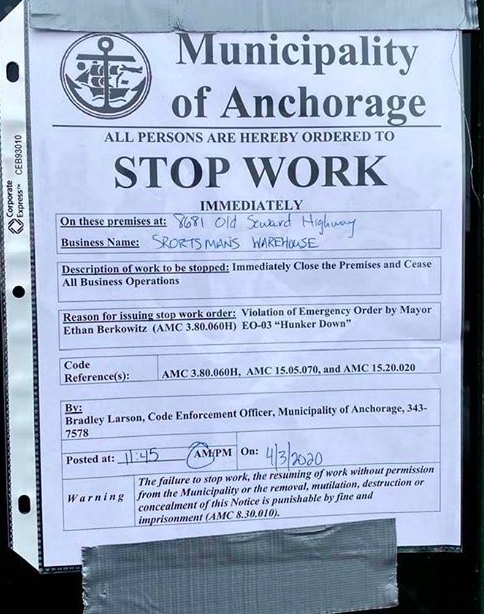
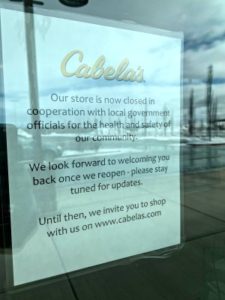
By order of the mayor of Anchorage, sporting goods stores around Anchorage were shuttered today for the duration of the COVID-19 emergency. Municipal workers ordered Sportsman’s Warehouse, Cabela’s and Bass Pro Shop to close until further notice.
A survey of other shops that remain open showed that gun stores are remaining open, as are pawn shops, check-cashing shops, e-cigarette stores, liquor stores, and pot stores. Churches are closed, as are bars and sit-down restaurants.
Target remains open because it has a food department, but Cabela’s, which is next door, was shuttered today.
In other municipal news, as of April 8 at midnight, the People Mover will stop running until further notice.
AnchorRIDES will provide a limited number of trips to People Mover bus riders. Enrollment in this service is required and trips must be scheduled 1-7 days in advance. For details visit:http://www.muni.org/…/…/Pages/COVID19TransitInformation.aspx
Must Read Alaska updates relating to the COVID-19 coronavirus will be included on this running post, where you can see updates throughout the days and nights ahead. Check back for updates.
10:30 am, 04/03/2020: The Carlson Center in Fairbanks has been converted into an overflow field hospital, in the event that the Fairbanks Memorial Hospital reaches capacity. Close to 100 cots have been set up, while Fairbanks and North Pole have reported a total of 42 COVID-19 cases to date, most not needing hospitalization.
10 pm, 04/03/2020: The National Federation of Independent Business (NFIB) Research Center survey results released on Friday show 92% of small employers said they are negatively impacted by the pandemic, up from 76% saying the same just 10 days prior. The survey was taken March 30 among a random sample of 300,000 members of the small business organization.
The survey showed continued decline in the small business sector since the NFIB’s previous similar survey, which was conducted on March 20.
The NFIB on Friday stated, “The severity of the outbreak and regulatory measures that cities and states are taking to control it are having a devastating impact on small businesses.”
10 pm, 04/02/2020: The Department of State says that due to public health measures to limit the spread of COVID-19, it is only able to offer passport service for customers with a qualified life-or-death emergency and who need a passport for immediate international travel within 72 hours.
Life-or-death emergencies are serious illnesses, injuries, or deaths in your immediate family (e.g. parent, child, spouse, sibling, aunt, uncle, etc) that require you to travel outside the United States within 72 hours (3 days).
The State Department advises U.S. citizens to avoid all international travel at this time due to the global impact of COVID-19. Many areas throughout the world are now experiencing COVID-19 outbreaks and taking action that may limit traveler mobility, including quarantines and border restrictions. Even countries, jurisdictions, or areas where cases have not been reported may restrict travel without notice.
3 pm, 04/02/2020: The Alaska Railroad passenger service will be postponed to July, rather than its originally scheduled start date of May 8.
Usually, the summer train season starts with the arrival of cruise ships in Seward and Whittier, where passengers disembark and travel by train to Anchorage and north to Denali and Fairbanks.
Aurora Winter Train is suspended through the end of the 2019-2020 winter season
Coastal Classic Train has daily scheduled service may begin July 1
Northbound service for the Denali Star Train is may begin July 1, with daily bi-directional service starting July 2
Glacier Discovery Train returns July 3
Hurricane Turn Train: operates April 2, May 7, and June 4. Standard Thursday-Monday service begins July 2, 2020
10 am, 04/02/2020: From Flowingdata.com comes this handy toilet paper calculator to help you gauge how many weeks you can go before you’ll need to start scouting for toilet paper again:
In short, if you’re a household of two, using 8 sheets per wipe, and wiping 8 times a day, you’ll need about seven rolls to last you two weeks, according to the calculator, which you can adjust according to number of people, number of wipes, and number of squares used. Other variables are noted in the analysis.
8 am, 04/02/2020: Costco announced this week it changed its guest policy to deal with the influx of panic shoppers. As a temporary measure, the warehouse store will allow members one guest per membership card. Previously, members could bring up to two guests with them. The company is trying to limit the number of people in the warehouse to create the social distancing suggested by the CDC.
1:30 pm, 04/01/2020: Attorney General Kevin G. Clarkson filed a complaint against Juan Lyle Aune, alleging that Aune profited from the spread of COVID-19 by purchasing thousands of N95 respirators from Alaska stores, and then reselling the respirators on Amazon and eBay for unconscionably high prices. The complaint asks the court to impose a separate $25,000 fine for every such sale Aune made.
“Price gouging is simply unacceptable,” said Clarkson. “The Department of Law is fully committed to taking action against those who would engage in unscrupulous behavior to profit off of COVID-19.”
According to the complaint, Aune purchased respirators from several Alaska stores, including Lowe’s, Home Depot, and Spenard Builder’s Supply. On one trip to Lowe’s, Aune purchased the store’s entire supply of 3M N95 Respirators – a total of 293 20-packs. According to the complaint, Aune told a Lowe’s employee that he was “flipping” the masks for a profit of about $50 per box.
The complaint alleges that Aune generally purchased 20-packs of N95 respirators for $17 to $23 in local stores, before reselling the 20-packs on Amazon for an average price of $89.25. Aune also sold 20-packs of N95 respirators on eBay for as much as $89.99.
Alaskans are encouraged to report price gouging, scams, and deceptive trade practices related to COVID-19 to the Department of Law’s Consumer Protection Unit at [email protected] or calling at 907-269-5200 or 1-888-576-2529.
9:30 pm, 03/31/2020: Alaska Municipal League has a running list of links to dozens of communities and their current health mandates, including travel bans to and from villages. The link is here.
9 pm, 03/31/2020: The Ketchikan Emergency Operations Center closed public beaches, parks, and playgrounds on Monday.
10 am, 03/31/2020: 88 percent of Americans have experienced changes to their lives since COVID-19 hit the U.S., according to new Pew Research Center data. Twelve percent report their lives have remained relatively unchanged. According to the research, 51 percent of Democrats say their life has changed in a major way, compared to 38 percent of Republicans.
Republicans are reporting less psychological distress: 17 percent of Republicans report “high distress” compared to 30 percent of Democrats.
2 pm, 03/30/2020: The Municipality of Anchorage is setting up an emergency medical care center in the Alaska Airlines Center, located across from Providence Hospital on the University of Alaska Anchorage campus. The facility may be able to care for COVID-19 patients who are not needing critical care, but do require some medical care. The facility, usually used for basketball games, has been covered with cots in anticipation of a surge of patients, according to the Emergency Operations Center, now operating out of the Loussac Library. Anchorage, including JBER, Eagle River, Chugiak, and Girdwood, has at least 59 confirmed cases of the Wuhan coronavirus.
2:45 pm, 03/29/2020: The “Quick Test” is coming. The number of tests that have been performed in the United States for COVID-19 now exceed 894,000 Americans. Starting April 2, Abbott Labs will be manufacturing 50,000 new test kits a day that give quicker answers. The Abbott “point-of-care” test has received FDA approval and will be available to urgent care clinics next week. It gives a positive result in five minutes and a negative result in 13 minutes.
2:30 pm, 03/29/2020: President Trump said that Cigna and Humana will be waiving the copays on insurance for costs associated with the coronavirus.
2:15 pm, 03/29/2020: President Trump today extended the current federal guidelines on social distancing to April 30. He said the peak for the contagion COVID-19 and death from the virus is expected to come in two weeks from now.
7 am, 03/28/2020: Anchorage has a shortage of personal protective equipment and medical supplies. The following are needed immediately and Anchorage Emergency Operations is asking for donations: – Non-contact medical grade thermometers, Please see picture attached Universal Transport Media (for guidance see: http://dhss.alaska.gov/dph/Labs/Documents/LaboratoryTests.pdf#page=23) – Nitrile exam gloves (no latex gloves) – N95 masks – Surgical masks – Medical gowns – Face shields which protect eyes Open and expired PPE are acceptable for donation. Used PPE is not being accepted. Homemade cloth masks for use by Anchorage Fire Department that are made to the following specifications:
Recommended materials include a single layer of tightly-woven material, such as a dish/tea towel or bed sheets/antimicrobial pillowcases.
The materials used must be able to be washed/dried on high heat.
Please wash your hands and keep your area clean when making the masks.
When completed, please bundle masks in packs of 25 or less in a sealed zip lock bag and drop off at the donation center.
Do not make masks if you have any respiratory illness symptoms.
Masks will be laundered by AFD before use.
Open and expired PPE are acceptable for donation, however used PPE is not being accepted.
Please take donations to: CrossFit Alaska 9191 Old Seward Highway Entrance faces Scooter Ave Hours of donation: 9:00 AM- 5:00 PM 7 days a week.
6:45 am, 03/28/2020: Late Friday night, President Donald Trump authorized Defense Secretary Mark Esper to order units and individual members in the National Guard and Reserves, as well as “certain Individual Ready Reserve members,” to active duty, the Pentagon announced. The troops will assist with response to the Wuhan coronavirus.
“The Secretaries of the Army, Navy, and Air Force, at the direction of the Secretary of Defense, and the Secretary of Homeland Security with respect to the Coast Guard when it is not operating as a service in the Navy, are authorized to order to active duty not to exceed 24 consecutive months, such units, and individual members of the Ready Reserve under the jurisdiction of the Secretary concerned, not to exceed 1,000,000 members on active duty at any one time, as the Secretary of Defense and, with respect to the Coast Guard when it is not operating as a service in the Navy, the Secretary of Homeland Security consider necessary. The Secretary of Defense or the Secretary of Homeland Security, as applicable, will ensure appropriate consultation is undertaken with relevant state officials with respect to the utilization of National Guard Reserve Component units activated under this authority.”
7:15 pm, 03/27/2020: In Ketchikan, the inter-island ferry that operates to Prince of Wales Island will implement a four-day-per-week schedule starting March 28.
The ferry will run Sundays, Mondays, Thursdays, and Fridays. Passenger service will be limited to essential travel, which means those returning home or traveling for critical medical care, or those transporting essential goods and services. The number of passengers on board has been reduced by 75 percent to allow appropriate space between passengers. More information can be found at the ferry system’s link.
6 pm, 03/27/2020: Alaska is the No. 3 state for the number of citizens tested per capita, said Dr. Anne Zink, Alaska’s chief medical officer. New York is No. 1 in testing.
1 pm, 03/27/2020: Mayor Ethan Berkowitz of Anchorage extended the “hunker down” order through at least April 14, but said that date should not be considered a “hard end.” Orders could continue for a while, he said at a press conference today. Berkowitz said property taxes would be delayed for at least a month, and there will be no utility shut-offs for a month. In addition, any state or federal assistance that people receive will not be garnished for municipal fees or taxes due.
Building permit fees will be reduced by 25 percent, he said, and other fees will be either reduced or rebated, since many permitted businesses like restaurants and bars are not operating.
10 am, 03/27/2020: A Navy hospital ship has arrived in Los Angeles to help with the overflow from hospitals. The USNS Mercy has 1,000 beds and will treat non-coronavirus patients, freeing up local hospitals to focus on the surge of COVID-19 patients
9:30 pm, 03/26/2020: North Pole Mayor Mike Welch was tested Thursday for COVID-19 at Tanana Valley Clinic after experiencing symptoms and being asked to come in for the swab test.
7:30 pm, 03/26/2020: Alaska Medicaid will allow 68-day fills on medications that would normally be limited to 34 days. With the allowed accumulation, this permits a patient to be able to have approximately 10 weeks of medication on-hand. If a specific patient condition warrants, individual exceptions for a day’s supply beyond 68-days can be requested of the pharmacist.
6:32 pm, 03/26/2020: More that 2,400 people have been tested for COVID-19 in Alaska, said Department of Health and Social Services Commissioner Adam Crum. That is less than one percent of Alaskans, but a quick uptick in testing since the first case diagnosed in Alaska just 14 days ago.
5:44 pm, 03/26/2020: KUOW, public broadcasting in Seattle, has decided to stop airing the president’s press conferences on COVID-19 because the station feels they are not factual.
At the same time, President Trump’s approval rating among voters has started to climb in recent days, with the survey site fivethirtyeight.com saying his approval is now over 45 percent.
12:15 pm, 03/26/2020: At least 81,321 people in the U.S. are known to have been infected with the coronavirus, more cases than China, Italy or any other country has seen, according to data gathered by The New York Times.
11:45 am, 03/26/2020: The Port of Seattle has delayed the Alaska cruise season indefinitely.
11 am, 03/26/2020: The second phase of the congressional relief package that passed the Senate will bring $1.5 billion to the State of Alaska. It will also deliver rapid relief to small businesses, and expand unemployment. It will send a surge of resources to medical professions, said Sen. Dan Sullivan. It must be approved by the House.
7:28 am, 03/26/2020: State officials have corrected information about how many are hospitalized in Alaska due to COVID-19. The correct number as of March 25, 2020 is 3.
11:30 pm, 03/25/2020:Mayor Ethan Berkowitz of Anchorage has said the city will not enforce the mandatory 10-cent fee per paper bag that the city requires merchants charge their customers. However, he did not say merchants may issue single-use plastic bags for merchandise and groceries.
10:40 pm, 03/25/2020: A second employee of Fairbanks Memorial Hospital has tested positive for the COVID-19 virus. This individual is included in the current count of 59 in Alaska who have been stricken with the virus.
10:35 pm, 03/25/2020: Royal Caribbean has extended the suspension of its cruises through May 12. “Because of announced port closures, we expect to return to service for Alaska, Canada and New England sailings July 1, 2020,” the company said. Norwegian Cruise Line is cutting pay and moving to a four-day work week for most staff.
3 pm, 03/25/2020:The current case count in Alaska is 44. An employee of Fairbanks Memorial Hospital has tested positive for the Wuhan coronavirus. Another Fairbanks person, a patient of the Tanana Chiefs Conference’s Chief Andrew Isaac Health Center, has also tested positive. l
3 pm, 03/25/2020: Jake Metcalfe, the executive director of the largest state employee union in Alaska, is seeking an injunction against the Dunleavy Administration to force all nonessential state employees to work from home for the duration of the coronavirus pandemic. He also wants the court to mandate staggered work hours and social distancing rules for all state employees.
The Alaska State Employees Association represents 7,500 state and municipal employees across the state.
10 am, 03/25/2030: The United States is the world’s third-most infected country by the Wuhan coronavirus. To date, the top three are:
81,661 China
74,386 Italy
60,115 US
5:15 pm, 03/24/2020: The Summer Olympics in Tokyo, Japan have been postponed by the International Olympics Committee, for about a year.
3:45 pm, 03/24/2020: The U.S. Department of Education has stopped collections of federal student loans that are in default.
3:33 pm, 03/24/2020: First COVID-19 hospitalization is in Juneau at Bartlett Memorial Hospital. This is the second case in Juneau and the person is in the critical care unit. The person had been traveling in Washington State and Portland, Oregon, both known hot spots.
Meanwhile, the case count is up to 39 in Alaska, with two more having been identified in Ketchikan. This brings the total of positive cases in Ketchikan to eight. These two individuals, upon experiencing symptoms of illness, self-quarantined and sought testing through the Creekside Family Medical Clinic. The testing was processed by a private lab. The two do not have a history of recent travel, so these are considered community transmission cases.
8:45 am, 03/24/2020: Alaska Airlines will eliminate 200 flights per day through March 31. This is a 15 percent reduction of its normal flights. The airline is parking 30 jets from its fleet of 230 aircraft. Flights to Hawaii will be extremely limited and the airline will stop flying to Costa Rica, although for now it will keep its Mexico and Canada routes.
8:30 am, 03/24/2020: Washington Gov. Jay Inslee issued a shelter-in-place order Monday evening, something he had been pressured to do for several days. Washingtonians are not to leave their homes except for critical tasks in order to slow the spread of the coronavirus.
7:46 pm, 03/23/2020: Three Bears market has instituted a ban on the use of personal multi-use shopping bags.
“Our grocery store workers are on the front lines of COVID-19, working tirelessly to keep our community fed. With identified community transmission, we ask that shoppers keep their reusable bags at home given the potential risk to Three Bears customers and employees,” the store notified shoppers, effective at all locations immediately. The stores are located in Wasilla, Palmer, and Kenai.
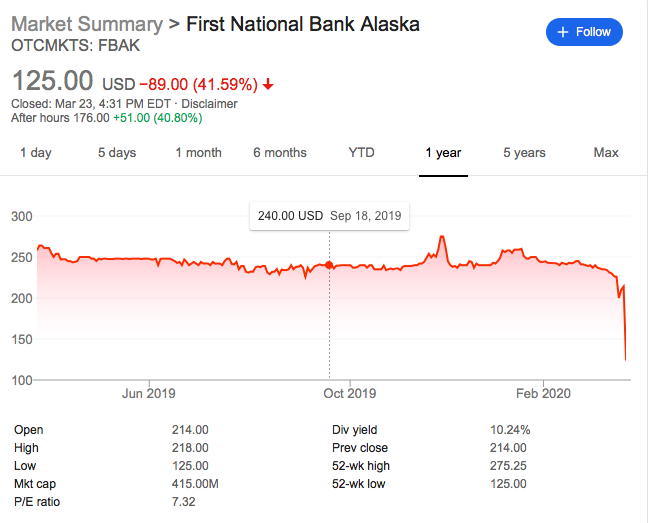
3:15 pm, 03/23/2020: First National Bank stock price went through large price swings today on the stock market before ending sharply lower.
The current stock price is $176, having recovered from its low of $125 at the close of trading. It appears some entity that owns stock in the bank may have dumped the stock this afternoon.
9 am, 03/23/2020: AlaskaUSA Federal Credit Union has temporarily closed several branches and curtailed operates at others:
Branches temporarily closed:
36th Ave
Abbott
N. Eagle River
Juneau St
W. Dimond
W. Northern Lights
N. Pole
W. Fairbanks
Parks Hwy
Vintage Park
Branches with drive-up and appointment services open Monday – Friday, 11 am to 6 pm:
C St
DeBarr
Dimond
Eagle River
East DeBarr
Huffman
JBER
Northern Lights
W. Abbott
Airport Way
Steese Hwy
Homer
Kenai
Soldotna
Palmer
Wasilla
W. Parks Hwy
Glacier Hwy
In-Store Branches open Monday, Wednesday, and Friday, 11 am to 6 pm:
Bethel
Ketchikan
Kodiak
8 am, 03/23/2020: PeaceHealth Medical clinics are closed Monday and Tuesday in Ketchikan after two caregivers who work there tested positive for COVID-19. The medical center is one of the largest employers in Ketchikan.
11:15 pm, 03/22/2020: FEMA has set up a rumor control web page pertaining to COVID-19, available at this link.
11 pm, 03/22/2020: Juneau has cancelled its Fourth of July parade. The Fourth of July parade is the biggest community event of the year.
10:30 pm, 03/22/2020:Anchorage Office of Emergency Management reminded residents that the Hunker Down order is in effect in Anchorage as of 10 pm Sunday.
Emergency Order EO-03 directs Anchorage residents and businesses to stay home to prevent the spread of COVID-19 and reduce the chance of Anchorage hospitals becoming overwhelmed and unable to treat those who need urgent medical care, the department wrote.
When left unchecked, this virus spreads exponentially. Some models show that without an order to hunker down, hospitals could become overwhelmed within weeks. The predictions of these models are borne out by what is happening in other communities that waited too long to prevent the spread of the virus.
The Hunker Down order mandates that non-critical businesses close their premises, and that residents stay home as much as possible.
“Non-critical businesses encompass any business that is not specifically exempted as a critical business. This includes (but is not limited to): shoe stores, hair salons and barber shops, nail salons, clothing stores, makeup stores, jewelry stores, car dealerships (service and parts may remain open), tattoo parlors, acupuncture, art studios, and sporting goods stores, in-home housekeeping services, babysitting (except to provide support for critical workers). This is in addition to the closure of gyms, movie theaters, indoor recreation centers, bowling alleys, and nightclubs that were closed.
“Non-critical businesses must close their premises; it is not acceptable to simply transform to a curbside or delivery business as that still places too many workers and customers in harm’s way for a non-critical purpose.
“The emergency order includes a list of critical businesses that can continue to operate while implementing social distancing techniques to the maximum extent possible—including switching to curbside or delivery service.
“The critical business list includes health care operations, grocery stores, convenience stores, maintenance and operations of critical infrastructure, first responders, criminal justice personnel, critical government functions, defense and national security-related operations, food cultivation, social services, journalism, gas stations, banks and other financial institutions, hardware stores, plumbers, electricians, mailing and shipping services, laundromats, educational institutions for the purpose of distance learning, restaurants (for takeout and delivery only), transportation services, hotels, childcare facilities (to serve workers in critical jobs only), and some legal and accounting services. For a full list, refer to the emergency order. These businesses should incorporate remote working whenever possible and adhere to CDC social distancing guidelines including maintaining six feet between people.”
9:15 pm – 03/22/2020: Anchorage police will begin wearing personal protective gear — things like masks and nitrile gloves — when physically interacting with the public. This doesn’t necessarily mean that COVID-19 is presenting the situation, but that police are protecting themselves from unnecessary exposure. Also, dispatchers and officers will be asking people questions related to COVID-19 exposure to help prevent exposure.
All community engagement activities and events, such as the ride-a-long program, Coffee with a Cop, public appearance requests and more, have been suspended until further notice. The APD front lobby at its headquarters is closed.
8:30 pm – 03/22/2020: The Seattle Times did not print its Sunday edition today due to the restrictions and general conditions caused by the COVID-19 virus. The newspaper was founded in 1891 and has been operated by the Blethen family since 1896. A note from the publisher advised:
5:30 pm – 03/22/2020: Sitka has been given a “hunker down in place” strong recommendation, issued by the Sitka Emergency Unified Command. Sitkans are asked to stay home in order to stop the spread of COVID-19. If residents need to shop for groceries, they may do so if they do not believe they have been exposed to the virus. Work from home as much as possible. Non-essential businesses are urged, but not required to close for 14 days. Those picking up or dropping off at the airport are urged to use curbside, and not go inside the airport. Anyone traveling into Sitka must quarantine in accordance with DHSS mandates.
4 pm – 03/22/2020: The current count of COVID-19 cases in Alaska is 22.
3:38 pm – 03/22/2020: An update on donating blood to the Blood Bank of Alaska. Please call 907-222-5600 to schedule an appointment. The staff will schedule you in.
11:06 am – 03/22/2020: Homeless men in Anchorage are being moved into the Sullivan Arena, while homeless women are being moved into the Ben Boeke Ice Arena next door. They are being given sleeping pads that are spaced six feet apart.
10:30 am – 03/22/2020: The current count of COVID-19 cases in Alaska is 21.
10 am – 03/22/2020: Senator Rand Paul has tested positive for COVID-19, his office announced on Sunday, adding “he is feeling fine and is in quarantine. He is asymptomatic and was tested out of an abundance of caution due to his extensive travel and events. He was not aware of any direct contact with any infected person.”
11 pm – 03/21/2020: Gov. Mike Dunleavy has launched a web page devoted to the work of the Economic Stabilization Team.
The page contains links for Small Business Administration loans, unemployment insurance, home mortgage assistance, and other resources that will be added as details are firmed. Share this page with those who may need help.
9:50 pm – 03-21/2020: Senior citizens in the Mat-Su Valley are getting some needed support from the Santa Cop and Heroes program, which applied for and received a $50,000 grant from Southcentral Health Foundation to provide 400 food kits to seniors 60 and older in the valley. Contact them at this link and get on the list for a food drop if you are running low of food, have no family support, and you meet the age qualifications.
8:30 pm – 03/21/2020: New testing protocols for Alaska have been put in place by the Department of Health and Social Services, in response to a shortage of equipment.
Testing supplies are running low. Until the shortage is resolved, health care providers are now prioritizing testing to specific groups. Health care providers do not need to call the Alaska Section of Epidemiology to approve testing, but those patients who are asymptomatic may not be tested. Here is what the testing technicians are being advised:
Patients who have a clinically compatible illness (e.g., fever, cough, or shortness of breath) AND at least one of the following criteria should be considered for testing:
12 pm – 03/21/2020: North Star Borough Mayor Bryce Ward announced an emergency declaration on Friday. The declaration will help with the procurement of aid and assistance from State and federal agencies when they become available. The borough is home to nearly 100,000 Alaskans and encompasses Eielson Air Force Base, Salcha, Fox, Two Rivers, and Chena Hot Springs.
11:30 am – 03/21/2020: Kenai Borough offices are closed to the public. Borough employees will still conduct government business under modified work schedules during regular business hours Monday – Friday. Those who can, will work from home, while others will come to work and practice the recommended guidance to ensure safe workspaces. You can also find contact information by department at www.kpb.us.
The Central Peninsula Landfill and transfer sites will continue to remain open to the public. Steps have been put in place for staff and the public’s protection. Please follow directional signage and staff instructions.
Dispatch and Fire/EMS will maintain operations; however, public will not be allowed to enter these facilities. First responders are following guidance specific to call outs. Nikiski Fire Service Area will continue their potable water service to residents with modifications.
Kenai Borough residents are asked to use the drop box located by the main front doors of the Borough Administrative Building (BAB) to deposit payments or department-specific documents, or mail delivery:
Kenai Peninsula Borough Attn: Department Name 144 N. Binkley Street Soldotna AK 99669
8 am – 03/21/2020: Anchorage medical community is experiencing a shortage of personal protective equipment such as nitrile gloves, face masks and medical gowns. They are asking providers and businesses to donate. Due to global demand, there is no definitive shipping date for more these items. The national demand for PPE and Alaska’s distance from suppliers, avoiding PPE shortages in Anchorage will require stretching existing supplies as long as possible. The following is needed immediately:
Nitrile exam gloves (no latex gloves)
N95 masks
Surgical masks
Medical gowns
Face shields that protect eyes
Please take Personal Protective Equipment to:
CrossFit Alaska 9191 Old Seward Highway Entrance faces Scooter Ave
Hours of donation: 9 am – 5 pm, 7 days a week. For questions, email [email protected] or call 907-343-4019
4:30 pm – 03/20/2020:The City and Borough of Juneau implemented voluntary temperature checks for travelers arriving at the Juneau International Airport. Passengers with a temperature of 100.4 F will be advised to contact a medical provider and to self-quarantine.
4:15 pm – 03/20/2020: A shortage of testing swabs has led Anchorage Office of Emergency Management to ask doctors to donate swabs, or the current Anchorage supply will be exhausted on Sunday. Due to global demand, there is no definitive shipping date for more swabs.
The following swabs are needed immediately: Nasopharyngeal swab with synthetic tip (ex. Dacron, Nylon, Polyester), with non-wooden shaft. NP swab should have sterile tube containing 2-3ml viral transport media (VTM) Please take swabs to: Drive Thru COVID19 Testing Site 4115 Lake Otis Parkway
Please use the back entrance/ employee parking lot (behind the tan and brown building). Hours of donation: 9:00 AM- 7:00 PM 7 days a week.
3:30 pm – 03/20/2020: Must Read Alaskahas learned that Mayor Ethan Berkowitz will order all Anchorage residents to shelter in place beginning this evening.
3:25 pm – 03/20/2020: An employee of the office of the Vice President has tested positive for COVID-19, according to a statement.
“This evening we were notified that a member of the Office of the Vice President tested positive for the Coronavirus,” wrote Pence Press Secretary Katie Miller. “Neither President Trump nor Vice President Pence had close contact with the individual. Further contact tracing is being conducted in accordance with CDC guidelines.”
11 am – 03/20/2020: President Donald Trump said the U.S. Department of Education will not require standardized testing for students in elementary through high school for the current school year.
10 am – 03/20/2020:The Anchorage Health Department and satellite locations have limited services to phone and appointments only, effective March 19.
Many services and benefits will be available via telephone or limited to in-person appointments; no in-person business or services will be available without an appointment. The contact numbers for the resources are:
• Community Health Nursing: 343-4799 • Aging and Disability Resource Center: 343-7770 • Women, Infants and Children: 343-4668 • Child Care Licensing: 343-4758 • Environmental Health (Food and Air): 343-4200 • Community Safety and Development: 343-4822 • Main Number: 343-6718
9:42 am – 03/20/2020:
How many cases? 255,729 worldwide. Known in Alaska: 12. Every person typically infects two others.
– Did it start in a Wuhan lab? The coronavirus may have originated in a government laboratory 300 yards from the Wuhan fish market where the authorities say the outbreak started, the Daily Mailreports.
– California is sheltering in place: 40 million Californians have been ordered to stay home indefinitely, only going out for essential jobs, errands, and solitary exercise, Gov. Gavin Newsom said. He warned the public that the patients who are contracting the coronavirus — 1,000 now in the Golden State — may soon overwhelm the state medical facilities.
– New York going into lockdown: Gov. Cuomo is shutting down all non-essential businesses across the state, leaving just grocery stores, pharmacies, and other essential operations open. He is banning all non-solitary outside activity, like outdoor basketball games and other team sports and he is requiring all non-essential government and private-sector employees to work from home, starting Sunday.
– President Trump has closed almost all traffic but commercial trucks at the southern border with Mexico.
– The Trump Administration has postponed the IRS income tax deadline to July 15.
10:15 pm – 03/19/2020:The U.S. Supreme Court has closed its building to the public and postponed its March argument session, which was to begin March 23.
10 pm – 03/19/2020:Funerals and weddings are among the events now banned in Washington State, as the epicenter of the coronavirus tries to get a handle on social distancing.
10 pm – 03/19/2020: Alaska Public Offices Commission is closed to walk-in traffic until further notice. APOC offices will remain staffed and will continue to serve the public and respond through alternative forms of contact including post mail, email, fax, and telephone, during its normal business hours of 8 am to 5 pm, Monday through Friday.
9:45 pm – 03/19/2020: Although the Blood Bank of Alaska is in need of blood, it’s asking for a voluntary 28-day deferral for anyone who has traveled out of state and to foreign countries in the last five weeks, and a 28-day deferral for donations for all travel out of state.
2:50 pm – 03/19/2020: An active-duty Airman has tested positive for COVID-19 on Joint Base Elmendorf-Richardson. The member recently returned from overseas travel and is following public health protocols while self-quarantined at his or her off-base residence.
JBER officials have ordered Health Protection Condition Bravo and are continually monitoring the situation while working closely with local, state and federal agencies.
12:50 pm – 03/19/2020: Anchorage Police Department has closed its front counter at its headquarters due to a significant drop in public visits. As a result, APD has put together resources to helping the public online and/or via the phone.
During this time, the traffic citations will be handled via paying by phone at 907-786-2429.
Subject line should be your last name and citation number. Attach these necessary documents, as appropriate:
Proof of insurance- Photo: must show you had insurance at the time the ticket was issued.
Proof of Registration- Photo: must show documents of registration from the DMV and photo of license plate with the new sticker on your vehicle.
Headlight/Taillight- Photo: must show vehicle with lights on and license plate visible.
Window Tint- Two Photos: must show entire driver side door of vehicle and include photo from front of vehicle showing license plate.
Proof of Driver’s License- Call 786-8600, ext 2.
11:30 am – 03/19/2020 – Simon Malls, owner of the Fifth Avenue Mall in Anchorage, has closed all of its malls across the nation until March 29.
“The health and safety of our shoppers, retailers and employees is of paramount importance and we are taking this step to help reduce the spread of COVID-19 in our communities,” the company wrote.
8:40 am – 03/19/2020: The U.S. State Department will announce a Level Four travel advisory instructing all Americans abroad to return home or to shelter in place because of the global threat of the coronavirus. This is its most stringent warning. Just four days ago, the department raised the travel advisory to Level 3, with strong recommendations. Under Level Four, Americans will be strongly advised not to travel abroad.
8:40 am – 03/19/2020: The U.S. embassies in Mexico have suspended routine immigrant and nonimmigrant visa services starting March 18, 2020, and until further notice. The U.S. Embassy and consulates will continue to provide essential consular services to U.S. citizens in Mexico as well as emergency visa services. The closure will effect the seasonal labor supply for American farms and fisheries.
11:32 pm – 03/18/2020: Bartlett Regional Hospital in Juneau has instituted screening for patients and visitors for symptoms of COVID-19, along with travel history and possible exposure to the virus. Families, staff, and departments in the hospital are restricting access and enforcing visitor control policy, including:
For hospitalized patients:
Limit one visitor on the units at any time.
No visitors are allowed in the Hospital from 8 p.m. – 6 a.m. overnight, unless accompanying a newly admitted patient or a maternity patient.
No visitors under age 16.
Visitation rules may be more restricted on units and floors with patients who have reduced immune systems or special populations.
Exceptions: End of life” situations, minor patients (≤18 years old) may have two visitors but this is limited to only parents or guardians, and individuals with significant physical disabilities are limited to one support person in addition to a visitor.
11:25 pm – 03/18/2020: Homer Mayor Ken Castner declared an official emergency in response to COVID-19 in Alaska and in support of COVID-9 prevention measures being implemented throughout the Borough and the State. The declaration will be effective for seven days, and then may extend if the City Council ratifies it at its meeting on March 23. The declaration creates a unified command structure with local responder agencies and South Peninsula Hospital.
4 pm – 03/18/2020: The known positive cases in Alaska increased by three on Wednesday, increasing it the total to nine. Two of the new cases are in Anchorage, one is in the Seward area. All three are travel related, with one coming from Europe, and the other two from the Lower 48.
3:30 pm – 03/18/2020: The first member of Congress to test positive for the coronavirus is Mario Diaz-Balart, a Republican who represents southwestern Miami-Dade County.
2 pm – 03/18/2020:Alyeska Resort has closed the ski area for the remainder of the season. closing its ski area for the remainder of the winter season. “As of today, March 18, 2020, all Alyeska Resort mountain operations, including lifts, aerial tramway, rentals, Mountain Learning Center and restaurants will be closed. Our decision to close the resort was not easily made but we feel these measures are necessary out of concern for the health and safety of our community, guests, employees, and the surrounding communities of Southcentral Alaska,” the management wrote on Facebook.
2 pm – 03/18/2020: Canada and the United States have restricted non-essential travel across the border. Both countries say supply chains will not be impacted, but travelers going north and south for recreational or tourism purposes will be turned back. key supplies will still flow between the two nations. President Donald Trump posted a note on Twitter this morning.
12 pm – 03/18/2020: The U.S. Census has suspended field operations for at least two weeks. The Census Bureau is asking everyone to respond online at 2020Census.gov. Door-knockers will not be utilized for now. The Census will continue to accept online, phone and mail responses.
9 am – 03/18/2020:Pikka, the oil prospect hope for the Alaska economy, has been deferred by Oil Search until prices improve. Oil is in the low 20s today.
8:45 am – 03/18/2020:Seattle area is running out of masks, leading volunteers to start making them by hand for hospitals.
A group of volunteers at Providence St. Joseph Health on Tuesday started sewing surgical masks and constructing face shields with marine-grade vinyl, strips of foam, elastic bands, and double-stick tape.
8 am – 03/18/2020: Blood Bank of Alaska is low on O negative and O positive blood donors and need continual blood donations of all blood types in order to meet the need for blood in Anchorage and throughout Alaska. To meet current blood needs, 700 donations are needed in the coming weeks.
The Blood Bank of Alaska is taking donations by appointment only in order to ensure the safety of donors and staff. To donate call 907-222-5630 or visit www.bloodbankofalaska.org to make an appointment
9:25 pm – 03/17/2020: Amazon has suspended receiving nonessentials such as TVs and toys in its warehouses so it can focus on stocking household staples and medical supplies. The crush of orders forced the decision as Americans are avoiding stores and placing orders online for everyday goods.
8:25 pm – 03/17/2020: A Canadian government official told The Seattle Times on Tuesday that Canada and the US are working on announcing a mutual ban on non-essential travel between the two countries.
8:25 pm – 03/17/2020: Hospital systems in Seattle are reporting two dozen hospital workers have been infected with the coronavirus, putting a strain on the medical infrastructure at the heart of the outbreak in the U.S.
7:20 pm – 03/17/2020: The State of Alaska is closing all bars and restaurants statewide on Wednesday at 5 pm, except for take-out food or deliveries, as well as other closing facilities, such as bowling alleys, by order of the chief medical officer.
The Department of Health and Social Services is also suspending all long-term services and supports that occur in “congregate settings,” including senior centers, adult day services, and any site-based day habilitation or supported employment activities where individuals gather together.
5:40 pm – 03/17/2020: The Port of Alaska remains open and the shippers are on a normal shipping schedule. COVID-19 has not disrupted the arrival of goods to Alaska, according to a news release from the Municipality.
“Food and supplies are at normal levels in Anchorage, and demand is currently high, creating empty store shelves. More goods are on the way, however delays of about one week in restocking shelves may happen due to the time it will take from time of order to stocking shelves in Anchorage and Alaska. The Municipality encourages residents to be patient as store shelves are restocked.”
5:20 pm – 03/17/2020: The State Department of Health and Social Services has issued guidelines for parents whose children attend day care centers:
The department, per CDC recommendation, is advising that child care facilities stay open if they safely can do so. Health officials do not want children to be cared for by elders, because people aged greater than 60 years are at increased risk for severe COVID-19 illness. Employers are encouraged to talk to their workforce. We also know that children, while they may carry the disease, get sick from COVID-19 much less frequently than adults.
The guidance for child care centers is thus:
Follow aggressive measures to screen children for respiratory infection and do not allow any ill child into a child care center.
No child who has been outside of Alaska in the last 14 days should be allowed in a child care center.
No one who has a fever or respiratory symptoms should be allowed to work in a child care center.
Keep numbers below 10 for group settings.
Cohort kids, keeping the same group of kids together.
Adhere to social distancing (at least six feet) to limit mixing.
Spend time in well-ventilated spaces as much as possible.
Practice frequent and rigorous environmental cleaning.
No one over the age of 60 or with underlying medical conditions should be working in child care centers.
Families should consider alternative child care opportunities, if possible.
5 pm – 03/17/2020: A mobile testing station has been set up by Providence in a parking lot on Lake Otis Blvd., right next to Bernie’s Pharmacy:
Mobile testing began on Tuesday, next to Bernie’s Pharmacy, in an adjacent parking lot on Lake Otis Blvd.
3:30 pm – 03/17/2020: Johns Hopkins University says that over 100 people in the United States have died from the coronavirus in less than one month since the community spread of the virus was first reported on Feb. 26. There are now over 5,894 confirmed cases and 105 deaths, and 200,000 cases globally.
3 pm- 03/17/2020: The Alaska Democratic Party has closed its headquarters on Fairbanks Street in Anchorage. The five employees of the party are working remotely. The Alaska Republican Party, which only staffs its offices part time, could not be reached for comment.
The City and Borough of Juneau has declared an emergency, allowing it to draw in more help from the state and federal government for health and safety measures, and purchase needed emergency supplies. The resolution of Monday night will assist local business as they apply for federal loans and assistance.
The Ketchikan Gateway Borough Assembly held a special emergency meeting on Tuesday. Among agenda items was sending a letter to Alaska’s congressional delegation, urging suspension of the Jones Act. The assembly will also discuss emergency measures and the lifting of cumbersome borough code during the emergency.