While business restrictions made at the state level will be nearly completely lifted on Friday, Anchorage Mayor Ethan Berkowitz isn’t so sure he’s ready to let businesses operate at full capacity:
“We make decisions on whether to advance to the next phase of reopening by evaluating the health metrics identified in the Roadmap to Reopening plan. If these metrics remain steady or show improvement by the end of the week, we anticipate being able to move forward to Phase 3: “Maintenance,” starting next week. Emergency Order EO-09 will remain in effect until modified,” Berkowitz said.
“As the Governor directly acknowledged, local communities are permitted to have stricter health restrictions tailored to their specific needs. Phase 3 requirements allow businesses to operate with fewer restrictions, and with the expectation to follow updated criteria for physical distancing and proper hygiene. Keeping these rules in place will give consumers more confidence that reopening is happening safely,” the mayor said, calling it a “slow and steady” strategy.
The mayor said he may have more to share in an announcement on Friday. Berkowitz has taken a heavy-handed approach, in late March announcing severe penalties for businesses that were found to be operating while under orders to be closed. He threatened $1,000 fines and possible criminal charges, and sent inspectors around the city to put stop-work orders on businesses and fine them $1,000.
In general, he has lagged several days behind the Dunleavy Administration’s transition to an open economy. If businesses in Anchorage proceed under the governor’s “open up” announcement on Friday, they may run afoul of Berkowitz and his inspectors.
No cases of COVID-19 were diagnosed in the last 24 hours in the state, and there are just 36 active cases in the state, according to the state’s dashboard.
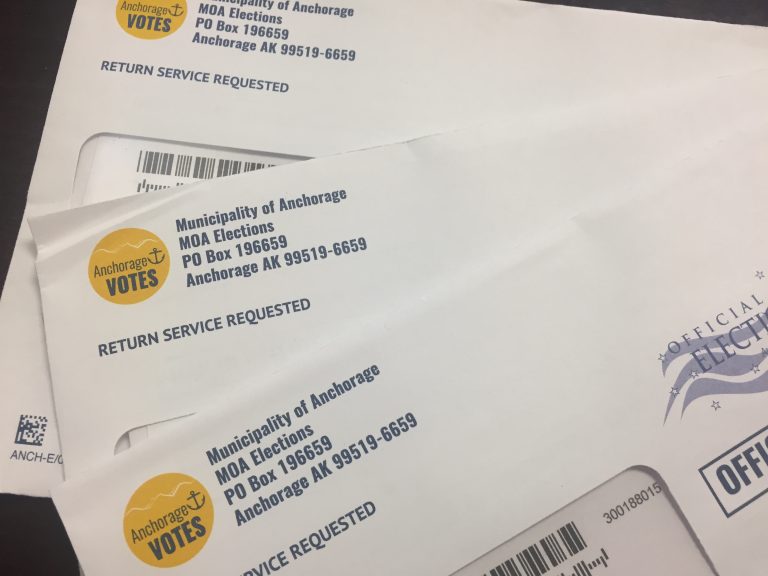
Lt. Gov. Kevin Meyer says the August primary election, despite complications caused by the coronavirus pandemic, will be close to business-as-usual – but with a few modifications.
We especially agree with his stated concerns about unsecured ballots if the primary election or later general election were switched to a mail-in affair.
August primary ballots will include primary races for seats in the Alaska House of Representatives, several Alaska Senate districts, the U.S. House of Representatives and the U.S. Senate, but no ballot questions.
Meyer says Alaskans can vote from home if they wish via absentee ballots and that system allows the Division of Elections to know which of two ballots should be sent to a voter.
An all-mail election in Alaska’s closed and party-run primary system would necessitate sending out hundreds of thousands of ballots, with most voters receiving two ballots, Meyer says.
“So, we figure there’s about 550,000 total voters and about 70% of them would be eligible for either ballot,” Meyer told the Juneau Empire. “Of course, we don’t know which ballot Alaskans want. That’s potentially 450,000 Alaskans that we would have to send two ballots to, which is about 900,000 ballots.”
A typical primary election has only about 30% of registered voters casting ballots, he says.
“So that’s 600,000 unsecured ballots that are either sitting in a post office, sitting on the kitchen table or in a garbage can,” the newspaper quoted him as saying. “That’s very concerning to us to have that many unsecured ballots.”
Us, too.
The opportunity and temptation for voting mischief would be too much for some to bear and that sort of thing would do lasting damage to the public trust. Do not bother telling us it would not happen. You could ask Anchorage Republicrat Rep. Gabrielle LeDoux, whose primary win a few years ago was supported, it turns out, by dead people.
Meyer was right in using caution. When it comes to voting and protecting our voting system, caution is a plus.
Alaska’s business community has taken a beating from the COVID economy, but some businesses are stepping up to give back to their communities during a time of economic crisis.
Joshua Veldstra, a Homer photographer who specializes in weddings, senior photos, family and fashion shoots, is one of those “give back” businesses. Must Read Alaska notes he has been voted the top photographer in Alaska in the Anchorage Daily News annual poll.
This year, in partnership with the Kenai Peninsula-based skincare line WildlyAlaska.com, Veldstra is offering one free senior photo session to some lucky 2020 graduate from somewhere in Alaska.
To play, the seniors in the Class of 2020 just need to “like” the post on Veldstra’s Facebook page and put in a comment about where they’d like their photo shoot to be if they win. The drawing is May 27 and the value of the offer is $2,000.
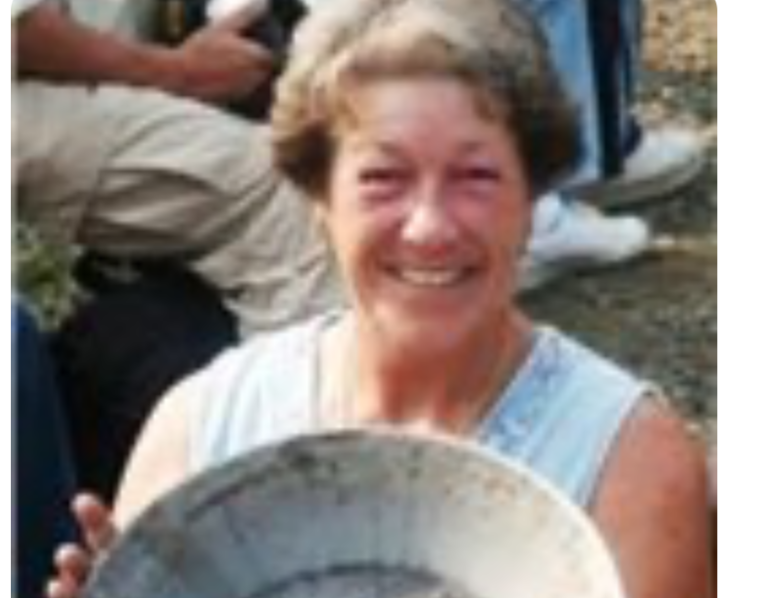
Lynette M. Clark, aka “Yukon” or “Yukon Yonda,” 73, of Fox, died peacefully on Sunday, May 17, at her home less than a week after a diagnosis of metastatic lung cancer.
Alaska’s political observers remember her as a longtime activist with the Alaska Independence Party. But she was much more to many people.
Yukon was born Lynette Marie Stinson on Aug. 9, 1946, in Watseka, Illinois, and grew up in Kankakee County, Illinois, in a wide-ranging, fun-loving family. She finished high school and immediately joined the Air Force, yearning to leave the corn fields for the big world.
Yukon lived not just one, but many lives: USAF Airman, switchboard operator, fashion buyer, pipeline construction camp maid, a bronzed bikini-wearing wife in Rio de Janeiro, bartender, homesteader, gold mine camp cook and laundress, mining partner and wife, heavy equipment operator, foster mother, politician, community organizer and speaker.
She participated in every notable protest against what she felt were attacks on Alaskans’ rights to self-govern, and carved a unique place in history. In the 1980s, she served as aide to Alaska Independence Party founder Joe Vogler, and more recently as party president.
As a tourism speaker at Eldorado Gold Mine and later at the Gold Dredge 8 outside Fairbanks, she was the face and voice of a REAL gold miner for many thousands of visitors over her 27 years between the two venues. She starred in the vacation memories and photos of strangers from all over the world.
She was a surrogate mother, a grandmother figure, a shoulder to cry on, a rock for those who needed friendship, a gift-giver, and a limitless source of love. She didn’t enjoy organized religion, but again before her death, she proclaimed Jesus as her Lord and looked forward to eternity in heaven and reuniting with those who’ve gone before.
As one cousin voiced, “She squeezed about the most life out of these years that anybody could. She was a force of nature, adventurous, a workaholic and an ideologue, a woman of ardent enthusiasms, and she loved this family right down to our molecules. So comforting to read it confirmed here that she knew the Lord. Brace yourself, St. Peter.”
Yukon was preceded in death by her parents, Phyllis M. Walsh, nee Larrigan, of Bourbonnais, Illinois, and Lawrence W. Stinson Sr., of Fairbanks, and stepmother Aviva J. Stinson, of Fairbanks. Survivors include two brothers, William (Pam) Stinson, of Sherman, Texas, and Micheal (Julie Sigwart) Stinson, of Carpinteria, Calif.; sister Patricia “Tricia” (Perry) Brown, of Anchorage; sister-friend, Erleen Enoka, of Kaunakakai, Hawaii; and two half-brothers, Lawrence (Elizabeth) Stinson Jr., of Anchorage, and John (Rachel) Stinson, of Anchorage; and half-sister, Theresa (Jeff) Wilson, of Anchorage; foster daughter Tammi Allen, of Fairbanks; paternal uncles Gerald Stinson, of Bloomington, Indiana, and Conrad (Donna) Stinson, of Evansville, Indiana; maternal aunt Patricia Parbs, of Bourbonnais, Illinois; numerous deeply loved cousins, nieces and nephews, great-nieces and nephews, and many more that she surrogately mothered or grandmothered.
Yukon will be interred at Northern Lights Cemetery in Fairbanks in the Veterans’ Niche. A celebration of life is in planning at the Gold Dredge 8 site for June 21.
The Federal Energy Regulatory Commission (FERC) today authorized the Alaska Gasline Development Corporation to construct and operate the Alaska LNG Project. It was a long-awaited approval for a project that seems unlikely to be built without a major private-sector partner who can pay for it and get financing.
“Today’s federal authorization is a key step in determining if Alaska LNG is competitive and economically beneficial for Alaska. I commend the AGDC team for their diligence. The ongoing project economic review and discussions with potential partners will determine the next steps for this project,” said Gov. Mike Dunleavy.
AGDC President Frank Richards said, “FERC’s authorization validates that the Alaska LNG Project can be safely built and operated, delivering numerous potential benefits with manageable environmental impacts. This approval, a major milestone in the development of the project, signifies the completion of a rigorous and comprehensive evaluation that has engaged environmental and energy experts at dozens of federal and state regulatory agencies.
Alaska’s Congressional Delegation also acknowledged the years of work by AGDC and by the FERC agency to develop Alaska’s vast supply of natural gas.
The gasline was to be the signature achievement of former Gov. Bill Walker, who chased off the private sector partners and developed a partnership with Communist China to develop the $47-60 billion project for Alaska. In order for it to be economically feasible, it will need another major partner, as many Alaskans do not believe the Chinese should have control of the gasline.
The Center for Biological Diversity offered its opposing statement: “Moving forward with this risky Alaska LNG project at a time like this is totally unacceptable,” said Miyoko Sakashita, ocean program director. “The Trump administration should focus on public health and shoring up our economy, not rushing approval of a dirty fossil fuel project that will harm polar bears and our climate. This project is bad for Alaska, bad for America, and bad for our planet.”
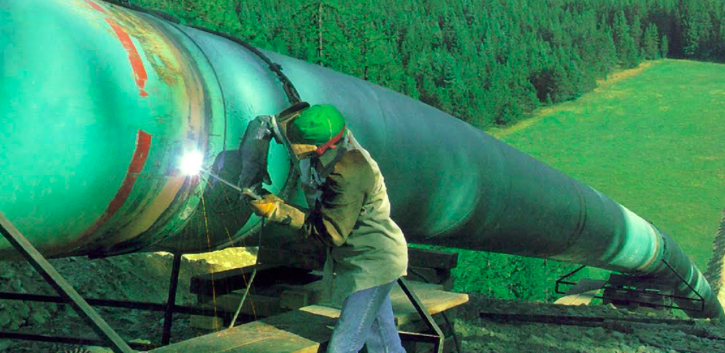
The board of directors of AGDC is meeting today in Anchorage to discuss next steps for the Alaska LNG Project, which consists of a gas treatment Plant on Alaska’s North Slope, an 800-mile pipeline, and an LNG facility in Nikiski, Alaska.
Today’s FERC announcement culminates six years of public input, engineering, science-based environmental research, and cultural resource studies incorporating more than 150,000 pages of environmental, engineering, and cultural data.
When Gov. Mike Dunleavy got the call from Commissioner Adam Crum that the State Department wanted Alaska’s help with 150 or more Americans from Wuhan, China, who were being airlifted out of China, Dunleavy was rightfully skeptical.
He had already been punked by Ukranian pranksters in October, who called him — and spoke to him by phone — while they were posing as the Russian ambassador and his translator. It was a bit out of the ordinary to get such a call from the State Department, and Dunleavy was thinking about the recent prank
“Are you sure about this?” he asked his commissioner of Health and Social Services. Crum was certain: Alaska was being asked to be the first state to be ready for COVID-19.
They got the State Medical Officer Dr. Anne Zink on the phone and began confirming that hospitals in Wuhan were already being overwhelmed with patients and that this was an epidemic that was spinning out of control.
Within a couple of days the plan was in place to bring the jet full of possibly infected Americans into the North Terminal at the Ted Stevens International Airport, and what now seem like thin protocols began to be established. That was the last week of January, and Alaska passed its first big test with the COVID-19 coronavirus. The plane had landed, people were checked over as best as the technology and medical understanding allowed, and it was sent on its way to California, for quarantine of all the passengers and crew.
After that, the Dunleavy Administration never took its foot off the gas, as it war-gamed out what would happen with COVID-19 when it hit Alaska. Models were all over the map, and contradictory information was trafficked by government officials around the world.
Looking back, Dunleavy said, “Major PhD theses will be written about this crisis. Books will be written about it.”
But in January through March, the State of Alaska was flying blind, just as every other nation and sub-governmental unit has done since the outbreak. No one knew exactly what they were dealing with. Leaders from presidents to hospital CEOs and school principals have had to “build the plane as they flew it” to prepare for what was to come.
“Nobody wanted to take them,” Dunleavy remembered, of the plane of people from Wuhan. “People were saying things on Facebook like, ‘let the jet run out of fuel over the Pacific.’ These are Americans they were talking about. There was a lot of fear. It was unreal.”
“My first thought was ‘rural Alaska,'” Dunleavy said, as he and his leadership team began to study what was coming.
Dunleavy had spent many years as a teacher in the Bush. He remembered talking to his mother-in-law, an Alaska Native, and asking her how her own father died. As she sat on the floor sewing, she described how her father died in bed next to Rose Dunleavy’s grandmother. Both had contracted the Spanish flu of 1918. He didn’t make it, while she survived.
So many others in rural Alaska were hit hard by that pandemic.
“I said to my team, ‘We’ve got to protect rural Alaska,'” Dunleavy said. He was well aware that tuberculosis and hepatitis are already big health concerns in the villages, but those are known diseases, with known treatments.
“Look what’s happening to the Navajo nation now,” Dunleavy said. “They have the highest percentage of COVID cases, surpassing New York City.”
The Navajo Nation, population 173,667, spans parts of Arizona, New Mexico and Utah and has over 4,000 cases of COVID-19.
“I was just thinking that during the Spanish flu, Alaska was hit harder than any other place on the planet. The primary purpose of government is public safety, so I called Jay Butler at the CDC and asked him if this was real. Jay said, ‘yes,’ and the modeling coming out at the time, in late January, initially said we in Alaska would have 1/2 million infected, 100,000 hospitalized and that 20,000 could die.”
“We were getting reports out of Italy that the health care system there was collapsing, so we started looking at our own capacity, and how to build that up.”
The first thing was to get more personal protective equipment, or PPE, for medical professionals and others on the front lines of the infection. There was simply not enough masks, gowns and gloves in Alaska — not nearly enough. And Dunleavy got the sense that in the national panic, Alaska’s needs would be forgotten.
Then he remembered his hunting friend John Sturgeon. Sturgeon had asked Dunleavy to volunteer on a wounded veterans hunt on Afognak Island in the fall, and Dunleavy remembered a conversation the two had, where Sturgeon shared that he had a good friend who is a Chinese national.
“The light went on,” Dunleavy said. He started working the problem. This wasn’t going to be easy, since China, too, needed PPE. And China is both a friend and foe to America. There were geopolitics at work.
Dunleavy picked up the phone and called Sturgeon. Soon, they had the Chinese Consulate on the phone from San Francisco, and a few weeks later, a chartered FedEx MD-80 jet from China arrived in Anchorage with $3 million worth of personal protective gear. It included 160,000 face shields, 1.2 million pairs of nitrile gloves, 31,000 protective Tyvek jumpsuits, 100,000 disposable gowns, 20,000 shoe and head covers, and more.
Meanwhile, Alaskan doctors and individuals were donating their PPE. Fish and Game found swabs and test kits in one of their lab. And Dunleavy asked Palmer-based Triverus — a company that manufactures deck cleaning equipment for aircraft carriers — to start making swabs for tests.
By that point, the Seattle health care system was beginning to buckle, as it had in Wuhan, and then in Italy. Dunleavy knew that it was just a matter of time before the virus would get ahead of the fragile health care infrastructure in the state, and that the commercial fishing season would bring an influx of people from out of state to communities ill-equipped to handle an outbreak.
But because of a longstanding relationship with Franklin Graham, rural Alaska had a secret weapon. Dunleavy called Graham and a Samaritan’s Purse jet headed for Anchorage, loaded with test equipment, PPE, and medical supplies expressly for rural Alaska.
“Under the Internal Revenue Code, all section 501(c)(3) organizations are absolutely prohibited from directly or indirectly participating in, or intervening in, any political campaign on behalf of (or in opposition to) any candidate for elective public office.”– Internal Revenue Service
The Alaska Public Interest Research Group (AKPIRG) has the best cover for the partisan work it does on behalf of the Alaska Democratic Party. It simply says it does things in the “public interest.”
This week’s “public interest” is giving Alaskans one more reason to sign the recall petition to remove Gov. Mike Dunleavy. AKPIRG is lighting the fire of a dead movement.
AKPIRG filed a complaint against the governor for allowing the Alaska Republican Party to auction off “breakfast with Gov. Mike Dunleavy” as part of a fundraiser.
The auction came during the winter gala on Dec. 6, and was handsomely bid on — the $6,000 high bid went twice. AKPIRG says the governor violated ethics statutes because the Governor’s Mansion is public property.
Those attending the gala said the breakfast was understood to be at the governor’s discretion at a time and place of his choosing. The Mansion was only one option.
State law allows the Governor’s Mansion to be used for political events because it’s considered the governor’s private residence when he is in office. Whether having breakfast with a donor to the Republican Party is illegal is something that will now be litigated in the court of public opinion. At some point it could be litigated in an actual court room, but that’s not the point of AKPIRG’s complaint. The point is to get the frenzy going just at the time when recall petitions have been mailed to 20,000 Alaska voters.
Alaska Republican Party chairman Glenn Clary said the ethics complaint is just another part of the recall of the governor, and there’s evidence to back that up.
Must Read Alaska cross-checked the names of AKPIRG staff and board members with the list of those who signed the “application” for the petition to recall the governor. MRAK came back with quite the list.
The protestations that this is “not political” from AKPIRG’S executive director Veri di Suvero don’t past the giggle test. di Suvero is a political partisan who cut her teeth on the Bernie Sanders campaign.
From New York and relatively new to Alaska, di Suvero (she goes by the pronoun “they/them”) signed the recall petition, but she is not the only AKPIRGer to do so.
Alexandra Veritas De Suvero, registered Democrat, signed recall
Rochelle Adams, undeclared, signed recall
Benjamin Boettger, nonpartisan, signed recall
Kelsey Schober, registered Democrat, signed recall
Erin Willahan, nonpartisan, signed recall
David Song, registered Democrat, did not sign
Phil Wright, nonpartisan, did not sign
Board
Nelta Edwards, registered Democrat, signed recall
Lois Epstein, registered Democrat, signed recall
Ira Slomski-Pritz, registered Democrat, signed recall
Genevieve Mina, registered Democrat, signed recall
John Kennish, nonpartisan, signed recall
William Kronick, registered Democrat, signed recall
Margaret Wilcox, registered Democrat, signed recall
Critics like Glenn Clary at the Alaska Republican Party say AKPIRG is operating as an unregistered agent of the Alaska Democratic Party, and if this is the case, the organization would be in violation of the tax-exempt status granted by the Internal Revenue Service. If it’s working as a stealth recall group, it would also be in violation of Alaska campaign laws, Such coordination would be hard to prove without a full investigation, however, an unlikely event in an era of stretched state resources.
AKPIRG says it “exists independently from national PIRGs, because Alaska is “independent by location, our people, our legislature, and our lifestyles. Our purpose is to watch-out for Alaskans’ best interest in matters of comsumer awareness and protection, legislation, and corporate interests.” The organization has strayed from its mission of consumer protection, however, and is now dedicated to researching and executing coordinated attacks on Republicans. It’s annual report says “AKPIRG works closely with the Anchorage Mayor’s Office.”
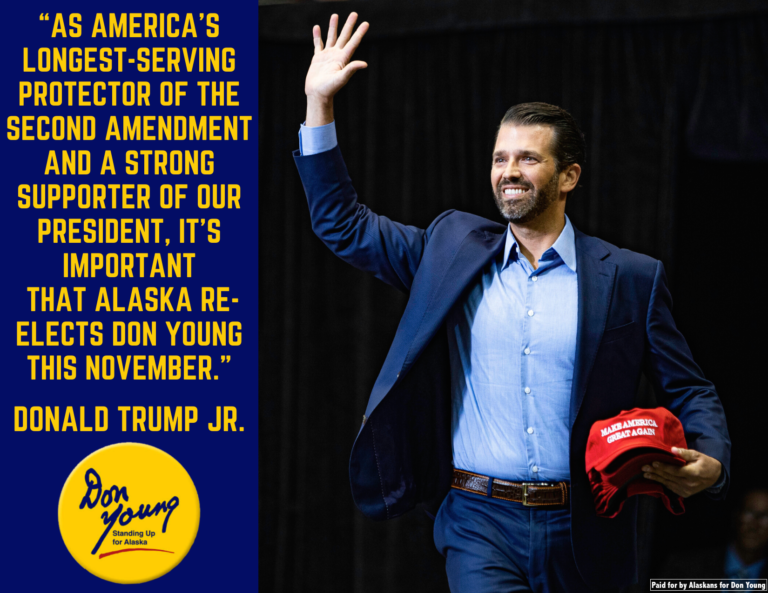
Donald Trump Jr. today endorsed Congressman Don Young for U.S. House. Trump Jr. is the eldest son of the president, is a businessman who has a large social media following, and someone who is known for authoring the best-selling book, “Triggered: How the Left Thrives on Hate and Wants to Silence Us.”
Trump Jr. is also an avid hunter and outdoorsman and has been an advocate for hunting and fishing sports.
He’s an active and a fearless commentator, calling out the hypocrisy of the Left on Twitter and Instagram, as well as on television and radio news and talk shows.
“We’re really proud to receive the support of Donald Trump Jr. It’s just another acknowledgement of Don Young’s effectiveness and respect in the halls of Congress,” said Truman Reed, campaign manager for Alaskans for Don Young.
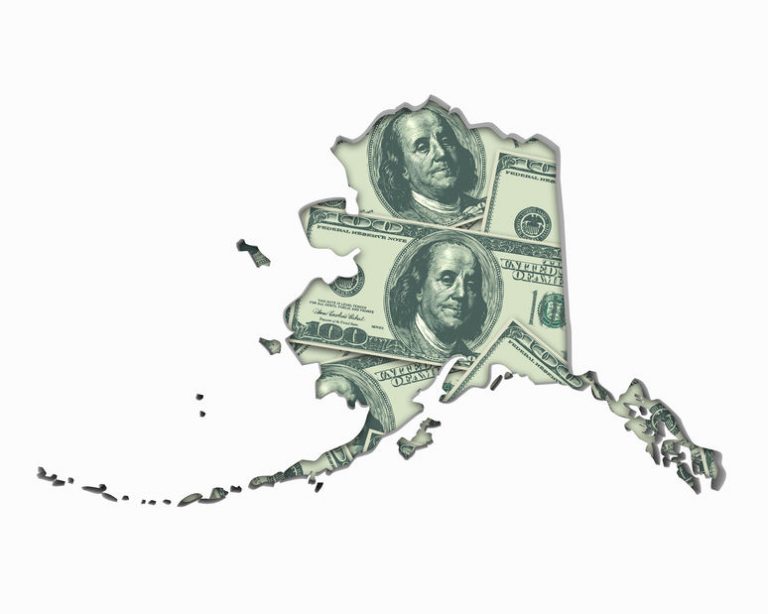
Alaska Gov. Mike Dunleavy today announced the Permanent Fund Dividend Division will begin distribution of the 2020 Permanent Fund Dividend (PFD) to eligible Alaskans on July 1, 2020.
The House and Senate passed a bill to pay about $1,000 for this year’s PFD, far from the $3,100 that is required by Alaska law. Normally the payments are made to eligible Alaskans in October.
“This has been a difficult situation for everyone – individual Alaskans have been hurt economically, businesses have been hurt economically. We’re going to do all we can to get that going in the right direction,” said Governor Dunleavy. “As a result, we’re going to move up the date for the PFD for Alaskans to July 1st. Usually that goes out in October, but we’re in extraordinary times and we need to make sure the people of Alaska have cash in their hands to help with this economy. I can’t think of a better time to do it than now. We’re starting the process right now so come July 1st, we’re going to be sending out the Permanent Fund checks to all Alaskans that qualify and are eligible.”
As of May 20, 2020, the Permanent Fund Dividend Division has received 671,364 PFD applications and 85 percent of applicants’ eligibility has been determined. The Division estimates nearly 600,000 Alaskans will receive payment on July 1. Because not all applicants will be determined by June 19, 2020, Alaskans may receive payments July 23, August 20, or subsequent months thereafter, as the division determines eligibility. The division pays dividends monthly until all eligible Alaskans are paid.