Thursday, July 9, 2026
Home Blog Page 1347

10 new cases; total of 143, no new deaths, hospitalizations

15

RESTAURANT AND BARS WILL REMAIN CLOSED TO DINE-IN FOR NOW

The number of cases of COVID-19 coronavirus rose to 143 today in Alaska with 10 new cases diagnosed since yesterday. More than 5,000 Alaskans have been tested for what some call the “Wuhan Virus,” which originated in Wuhan, China.

The cases were Anchorage (2), Fairbanks (3), North Pole (2), Juneau (1), Ketchikan (1) and Wasilla (1).

That brings Anchorage to a total of 67 known cases, while Kenai Peninsula has 8, Fairbanks/North Pole has 40, Mat-Su has four, Juneau has 10 and Ketchikan has 14.

Dr. Anne Zink, Alaska’s chief medical officer, said that masks that people are now using with greater frequency are a potential way to have asymptomatic people not spread the virus to others, but that it’s important to save the N95 masks for health professionals dealing with the virus.

Zink said she has been looking at data relating to masks from the Czech Republic, South Korea, and China. “And out of an abundance of caution we’re seeing this movement for ‘masks for all.’ Realize that the mask is not going to prevent the disease completely,” she said. Social distancing, hand washing, not touching your face, and sanitizing surfaces is more effective, but masks can help, since so many people have the virus but evidently have no symptoms.

“Some people have the virus in their nose even though they feel well,” she said.

The governor’s press conferences have been feeding the public with a firehose of information on how the State is responding to the pandemic. The topics deal with everything from eligibility requirements for the Pioneer Homes and senior benefits programs, to how children are accessing distance learning.

The health mandates announced two weeks ago that closed libraries, museums, dining establishments and bars through the end of March will continue until at some point in the future, said Adam Crum, commissioner of Health and Social Services.

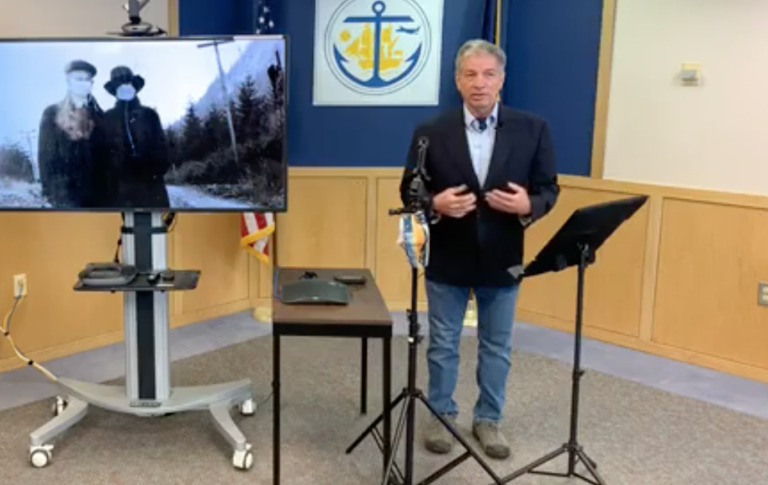
Gov. Dunleavy said that Alaskans seem to be taking to heart the importance of social distancing, and that Alaska may have a natural advantage in that regard. But he warned that Alaska will be in for a tough ride over the next couple of weeks, if the epidemiological models pan out.

Help Alaskans. Pay the full dividend now

By JIM CRAWFORD

Alaska’s fishermen are going to be financially hurt as a result of the COVID-19 coronavirus. Restaurant workers are being furloughed.  Tourism companies are suspending operations. Cruise liners are parked. 

Some suggest the solution for Alaskans is to cut the Permanent Fund dividend to zero.      

The Alaska Permanent Fund is not the Legislature’s money nor the governor’s money.  It’s the people’s fund, a financial stabilizer, managed for you, the beneficiaries. 

The fund was mandated to invest 25 percent of the royalties when established by Constitutional Amendment as a dedicated fund. 

The other 75 percent of royalties plus all the taxes and tariffs and other numerous ways to grab money from the oil patch were retained for legislative purposes. 

Now legislators and others want your 25 percent of royalties plus the entire earnings of the fund. Legislators tell us that we’re lucky to get whatever is left, after their spending.

The Permanent Fund long-term yields have been good and can lead to prosperous Alaskans. With dividends, we have a direct individual benefit for developing our natural resources, just as Gov. Jay Hammond intended.  The PFD diversifies Alaskans’ income stream adding investment income from the fund for education, retirement and making affordable the higher cost of living in Alaska. 

A waitress with a husband and two kids earns $12,000 in dividends this year under existing law. 

That $12,000 can pay rents or mortgages due during the layoffs.  Just change the payout date from October to April. 

Fishermen and tour operators — indeed all Alaskans who will be hurt by the coronavirus pandemic — can get by if their full Permanent Fund dividends are paid.  That’s because of good planning by our forefathers.  

Gov. Hammond would be well pleased that when the fund is left alone, it provides substantial direct benefits to Alaskans. Greater security, more affordable education, and cash reserves for emergencies like the virus are all benefits of abiding by the original calculation of the dividend. 

Make no mistake, we already have the earnings – in cash.  Anyone who tells you we don’t, can’t read the Comprehensive Annual Financial Report of the State of Alaska.

Our problem is our legislators passed two conflicting statutes, both on the books for calculation of the dividend.  The first one is our historic 50/50 split.  Earnings are evenly divided between the people’s dividend and General Fund appropriated by the Legislature. 

But, the Legislature enacted a “per cent of market value” approach that reduces the amount that can be drawn and shockingly, removed the calculation for earnings. 

The Legislature, for three years, has divided the earnings with bloated government as the winner and the people getting the short end of the stick.  

The solution to our fishermen’s cash flow is not to further cut a family’s cash. The same is true of tourism employees, retailers, restauranteurs, and other Alaskans who are experiencing financial turmoil as a result of the virus. Our cash cow has had great earnings.  The Legislature simply wants to butcher it – and use all the money to grow more government. 

Alaskans have had enough and don’t want their PFD reduced or ended.   

An alternative way back to fiscal sanity is to stop the Legislature from dedicating funds.  The Alaska Constitution bans dedicated funds except for federally provided revenue and those funds in existence when we became a state.  Or, we can do as we did when the Permanent Fund was established, with passage of a constitutional amendment by the people.  

One unconstitutional dedicated fund is the Power Cost Equalization Fund at $1.2 billion, housed in the Alaska Energy Authority.  AEA financial statements describe the PCE assets as restricted and not available for government spending.  That’s a dedicated fund.  There are many in state government.

The Supreme Court ruled that dividends must compete with all other appropriations.  But, the Legislature unconstitutionally protects the PCE.  PCE doesn’t compete for appropriations, but your PFD does.  Special interests are pleased.

The Permanent Fund must return to averaging our five-year earnings to calculate the dividend.  The market turmoil of today then becomes a blip on the screen of our long term investment program.  Yes, stocks and oil go up and down.  That’s why we insisted on the five-year earnings average.  A down year is not the end of life.

Most Alaskans are off work awaiting clearance to return. We have time to communicate directions to our Legislators. My message to my Senator, Natasha Von Imhof and my Representative Chuck Kopp is simple:  Rescue our economy from the damage of coronavirus by voting to pay a full dividend.  Please change the date to April 30, 2020.  

If you fail in this effort, I will vote against you. I will not vote for Legislators who damage the people who elected them. Alaskans, if you agree, please share the instruction with your Legislators.  After all, they work for you.

Doctors will solve this coronavirus and in time, we will be stronger as a result.  Doctors take a Hippocratic Oath, paraphrased as “First, do no harm”.  Legislators should take that oath for our Permanent Fund dividend.     

Jim Crawford is a third generation Alaskan entrepreneur who resides in Anchorage with his bride of 36 years, Terri.  He is president of The Alaska Institute for Growth, a local think tank which studies and reports on and may sponsor projects of sustained economic growth for the Alaskan economy.   Crawford was a member of the Investment Advisory Committee, appointed by Governor Hammond to plan and implement the Alaska Permanent Fund Corporation.

COVID daily update: 14 more cases; 133 total in Alaska

The Alaska Department of Health and Social Services today announced 14 new cases of COVID-19 in five Alaska communities – Anchorage (2), Eagle River (2), Fairbanks (5), Juneau (4) and Kenai (1). One is a worker on the North Slope. This brings the total confirmed case count in Alaska to 133.

Two of the new cases are older adults (60+); 10 are adults aged 30-59; and two are younger adults aged 19-29. Five are female and nine are male. Five of the cases are close contacts of previously diagnosed cases; two are travel-related and seven are still under investigation.

So far the communities in Alaska that have had confirmed cases include: Anchorage (including JBER), Eagle River/Chugiak, Girdwood, Homer, Fairbanks, North Pole, Ketchikan, Juneau Palmer, Seward, Soldotna, Sterling and Kenai.

Nine of the Alaskans with COVID-19 are hospitalized, two more than Monday. There have been no additional deaths beyond the three already announced.

Prudhoe Bay worker has COVID-19; Slope work slows

1

Update: The worker is an Alaskan who had recently traveled out of state but returned before the mandatory 14-day quarantine was put into effect.

BP Alaska is stopping all non-essential activity on the North Slope after a worker at Prudhoe Bay tested positive for coronavirus.

In an emailed statement, BP said the company is ” following procedures and protocols to minimize the risk of COVID19 and ensure the safety of our people.” MRAK has learned that at least three other people on the Slope are being tested, but it’s clear that the person who arrived in camp came on a plane with many other workers.

BP, in the Alaska oil business since1959, operates Prudhoe Bay, with a working interest of 26 percent. It accounts for about half of the oil in the Trans Alaska Pipeline System and is in the middle of selling its Alaska assets to Hilcorp.

Earlier this week, BP announced it was donating $2 million to the World Health Organization to fight the spread of COVID-19 through the BP Foundation.

April fools – joke is on you with ML&P, Chugach Electric

7

By BOB MAIER

Filed on April 1, 2019 with the Regulatory Commission of Alaska, Chugach Electric’s application to purchase Municipal Light & Power remains unresolved after one full year.

Extending their decision deadline until May 28, 2020, the issues remaining for further study have centered on the agreed-upon purchase price for ML&P of $1 billion.

ML&P has a net book value of $715 million.

That $285 million difference is what is known as an “acquisition premium.”

Alaska State Statute 42.05.441(b) denies the RCA from allowing the recovery of an ‘acquisition premium’ in a purchase price unless specific criteria are met. With Chugach Electric seeking recovery of all transaction costs including that acquisition premium, by use of future rates, another issue arises.

On the April 03, 2018, Anchorage Municipal Ballot Proposition 10 proposing the sale of ML&P to Chugach Electric passed by a 65% to 35% margin. Stated in that ballot language was “No Increase in Base Rates.”

Chugach Electric’s website ‘Power Anchorage’ further states “Chugach has affirmed, and it was part of the ballot language, that base rates will not increase as a result of the transaction.”

Now two years after that election, discussions center whether the average voter understood what a “Base Rate” actually is.

Did the average voter interpret this ballot language to mean no rate increases at all due to the sale? Those 65% voting ‘yes’ will be surprised what their electric bill will look like if this billion-dollar sale is completed. Factoring in that price tag, the cost savings advertised to ratepayers of combining ML&P and Chugach appear to evaporate.

Another concern of the sale of ML&P is the effect on the Anchorage Water and Wastewater Utility ratepayers. Title 42 of Alaska State Statute identifies the reason that AWWU is a regulated Utility. If ML&P is sold, the Anchorage Assembly becomes the rate making authority for AWWU, replacing the RCA. By not informing the voters prior to the April 2018 election, this aspect of the sale has caused additional conversation at the RCA hearing.

By having Anchorage Electric Utility ratepayers pay Anchorage Municipal government the $1,000,000,000.00 price tag for ML&P through Chugach Electric’s increased rates, the Municipality gains revenue, which is otherwise constrained by the tax cap.

In this scenario, the property taxpayers of Anchorage, who are also the electric utility ratepayers, lose the benefits of ownership of a Municipal asset.

This is not Warren Buffett writing a $1 billion check for ML&P. This is ourselves purchasing ML&P from ourselves and giving it to Chugach Electric.

Moving forward … dissolving both ML&P and Chugach Electric and forming one new electric utility is the path to follow. Without the electric utility ratepayers having to pay a purchase price provides benefits that include a different managerial structure along with the legacy labor contacts having a fresh set of eyes reviewing them.

Either this whole thing is about what is best for the ratepayers or it is not.


Bob Maier is an Anchorage utility ratepayer who has provided to both the RCA and the Anchorage Assembly on the sale of ML&P.

Judge denies state employee union’s request for instant restraining order

17

 Superior Court Judge Thomas A. Matthews said no to the Alaska State Employees Association, which was trying to force the State of Alaska to send more than half of the state workforce home.

ASEA had asked for a Temporary Restraining Order to effectively require the State of Alaska to close state offices and send roughly one half of the state’s workforce home. ASEA, in its request, did not concern itself with the impact of what would be a major disruption to government and how the public would be put at risk if workers were ordered to stay home during a global pandemic emergency.

Applauding the trial court’s order, Attorney General Kevin Clarkson said, “Judge Matthews recognized that government power regarding how to address the COVID-19 pandemic, while continuing to maintain essential state services, is entrusted to the Governor and not the judiciary. The State of Alaska is doing all it can to ensure the safety of our valued state employees.”  

“As noted by Judge Matthews in the court’s order, the issues faced by Governor Dunleavy’s administration in the ever-changing face of this pandemic are daunting, and the situation is ‘like trying to fly an airplane at the same time you’re building it.’  These are unprecedented times and we must all step up to do what we can to get through this pandemic, while still keeping the State functioning to provide essential services to Alaskans.” 

The Superior Court heard the matter on an expedited basis. The court ordered a telephonic status/pretrial conference for April 6, 2020 at 3 pm. 

In filing the lawsuit, Executive Director of the AFSCME Jake Metcalfe stated:

Our contract guarantees employees safety and security in the workplace. A pandemic does not mean that our contract goes out the window. This is when it is especially important that we look out for everyone’s health and safety due to the high rate of transmission of this virus. We aren’t asking for state government to shut down – we’re asking that non-essential staff who are able to work from home, to be given that permission – and for critical staff who must continue to work, to have the ability to practice proper social distancing and to have access to hand sanitizer and other cleaning products for wiping down shared surfaces. We’re also asking for relief from delays in processing telework agreements and for paid administrative leave for employees who can work from home but are waiting for logistics to get worked out. We know this is complicated, this isn’t anything any of us were prepared for – but it’s critical that we work together to look out for the health and safety of all Alaskans which means requiring as much as your workforce as possible to work from home.

But for many departments, nearly half of the State workforce is already working from home, and those who work in Corrections, Public Safety, and child protection, among others, must continue to interact with clients and the public. The State departments are implementing precautions, but none are sufficient for Metcalfe.

Municipal voting ticks up over 2019 with 7 days left

1

More than 27,544 Anchorage residents have cast their ballots in the election that ends in seven days on April 7.

That compares favorably to the approximately 20,000 who had voted by this time last year in the mail-in municipal election in Anchorage. Two years ago, 25,000 had voted by the time the last week of mail-in voting had begun.

Conservatives usually don’t turn out for municipal elections as strongly as public-union Democrats, and the unions are well-oiled vote in the Anchorage bowl. But this year, with the coronavirus pandemic changing everyone’s schedules, many people are staying home and are perhaps finding more time to take care of their civic duty.

Alaska Family Council has given its endorsement to the following candidates:

Due to the COVID-19 pandemic, only one of the six Anchorage Accessible Vote Centers will open as scheduled on Monday, March 30th for the April 7, 2020 Regular Municipal Election. 

The City Hall Accessible Vote Center is now open:

  • M-F, March 30 – April 6, 8:00 a.m.-5:00 p.m.
  • Tuesday, April 7, 7:00 a.m. – 8:00 p.m. 

If voters have questions about voting or the election, voters should call the Voter Holtine at 243-VOTE(8683).

Corona-impact: ADN’s downsizing doublespeak

11

By CRAIG MEDRED / CRAIGMEDRED.NEWS

Alaska’s largest newspaper is again downsizing, but it is understandable if you missed this news.

The email to ADN.com viewers from editor David Hulen required fluency in Orwellian doublespeak.

One could easily have taken at face value his pitch that “ADN has mobilized to cover the coronavirus crisis” and missed the contradiction that followed:

“We’ve had to temporarily cut back hours and pay for all employees, along with some painful layoffs.”

A reduction in force through layoffs, shrinking man hours and pay cuts is not  a mobilization. It is what the military would call a demobilization.

Doublespeak – from George Orwell’s dark vision of the future in the novel “Nineteen Eighty-Four – is the description for language turned on its head. Demobilizing the staff means mobilizing the coverage. Retreating means attacking. Doing less means giving you more.

And mainstream journalism wonders why it has a credibility problem.

The sad thing is Anchorage Daily News staffers appear to have been working hard through the COVID-19 crisis. And you can expect those left to continue to work hard despite what is said to be a significant cut in pay driven by a drop in advertising revenue due to the pandemic.

With bars and restaurants closed, events canceled, the upcoming tourist season headed for the rocks, supermarkets trying to discourage hoarding rather than attract customers, and health care professionals avoiding elective surgeries while helping the sick, key parts of the advertising base are gone.

And all the commerce that has moved online doesn’t really need the newspaper or ADN.com. Once the shop of your choice gets your email, it can cut out the middleman and go straight to you.

This might be the darkest hour for journalism as older Americans have known it. I fear an old journalism friend who thought early on that COVID-19 might save the business was badly wrong.

“People need reliable sources in the midst of this,” he said.

He was right about that. The problem is there are likely a lot of people who are doing what I am doing on a personal level, and that is turning to professional sources instead of journalists.

Read about how Craig Medred is getting his coronavirus information at his website: CraigMedred.news

U.S. Attorney to prosecute hoarding, price gouging of essential medical items

5

U.S. Attorney Bryan Schroder on Monday announced a task force charged with investigating and punishing those who hoard and price gouge certain items associated with COVID-19.

The task force comes as the Department of Justice responds to a March 23, 2020 Executive Order signed by President Donald Trump.

“The Department of Justice, and the U.S. Attorney’s Office in Alaska, will not tolerate those who try to take advantage of the COVID-19 pandemic to defraud the people of our state,” said Schroder in a statement.  “The pandemic continues to cause anxiety and uncertainty across the country.  At a time when our country needs to join together, it is repugnant that fraudsters will try to take advantage of our communities.  The U.S. Attorney’s Office, along with our law enforcement partners in Alaska and beyond, will root out these schemes and bring the criminals to justice.”

The president’s order gave the Department means to fight misconduct under the authority of Section 102 of the Defense Production Act, which prohibits hoarding of designated items. The order authorizes the Secretary of Health and Human Services (HHS) to protect scarce healthcare resources and medical items by designating particular items as protected under the statute. Once an item is designated, it becomes a crime under the statute 50 U.S.C. §§ 4512, 4513 for any person to accumulate that item either (1) in excess of his or her reasonable needs or (2) for the purpose of selling it in excess of prevailing market prices. 

In response, HHS announced a list of designated health and medical resources necessary to respond to the spread of COVID-19 that are scarce and would be subject to these hoarding prevention measures:

  • N-95 Filtering Facepiece Respirators;
  • Other Filtering Facepiece Respirators (e.g., those designated as N99, N100, R95, R99, R100, or P95, P99, P100);
  • Elastomeric, air-purifying respirators and appropriate particulate filters/cartridges;
  • Powered Air Purifying Respirator (PAPR);
  • Portable Ventilators;
  • Chloroquine phosphate or hydroxychloroquine HCl;
  • Sterilization services for certain medical devices and certain sterilizers;
  • Disinfecting devices and other sanitizing and disinfecting products suitable for use in a clinical setting;
  • Medical gowns or apparel, e.g., surgical gowns or isolation gowns;
  • Personal protective equipment (PPE) coveralls, e.g., Tyvek Suits;
  • PPE face masks, PPE surgical masks, PPE face shields, PPE gloves or surgical gloves;
  • Ventilators, anesthesia gas machines modified for use as ventilators, and positive pressure breathing devices modified for use as ventilators, ventilator tubing connectors, and ventilator accessories.

U.S. Attorney Schroder urged Alaskans to be vigilant in reporting any COVID-19 related hoarding or fraud activities, noting that criminals will likely continue to use new methods to exploit COVID-19 worldwide.

If you think you are a victim of a scam or attempted fraud involving COVID-19, you can report it without leaving your home though a number of platforms: