The Anchorage Municipality has supported “Bike to Work Day” for over a decade. The annual event celebrates bicycling as a way to improve the quality of life for members of a community, and it’s observed nationwide.
This year’s event is Friday, May 21. But with so many people working at home these days, the municipality has evidently decided that “bike to work” is an anachronism.
Now, it’s “bike to wherever day.”
As usual, there are snack stations that will be set up around town off of the various popular urban trails.
The state legislature is going through a convoluted and dysfunctional budgeting process. Those of us who follow this debacle every year hope for a better outcome but are consistently disappointed.
The standard refrain is we have to find new revenue to make up for the loss of oil money as production and prices fall. They also lament that there is very little room to cut any more from state spending. We are expected to take all this at face value because our state officials are working so hard to “look out for us.” Well, maybe not!
The state budget is a very complicated and devious animal. It is impossible for the average citizen or, for that matter, the average legislator to understand or analyze. As noted above, we just have to take it at face value.
So, let’s take a look at a couple of examples of state spending we can understand and analyze just to get a feel on how well they are “Looking out for us”.
As of 2020, we have 96 state employees who make more than $200,000 a year, 25 of whom make more than $300,000. On top of that they get, up to, 60% of their pay in retirement plus health insurance and other benefits. This list does not even include the University of Alaska and the Alaska Railroad employees, which would probably double their numbers.
The average Alaskan makes $36,700 a year. The average state employee makes $70,000 plus, almost double.
Talk about living high on the hog. You have to ask if the state is in such dire straits that they have to tax the average Alaskan who makes $36,700 more to pay for state employees who are paid twice as much, are they really looking out for us?
Another part of the budget we can understand and analyze is the state school system. To be fair, some of the school administration costs are covered by local governments, but the state pays out about $1.3 billion for K-12 every year.
Alaska has 54 school districts. Some of these districts only have two or three schools, but they all have a superintendent with an average salary of $184,903 plus benefits of about 30%. Therefore, the cost of 54 superintendents is about $ 10 million to $13 million plus staff cost.
Why don’t we have six school districts? Anchorage, Fairbanks/Interior, North Slope, Western Alaska, Southeast, and Southwest Alaska? Now our superintendent cost is closer to one million than ten.
The question that arises is, are these two examples indicative of other items buried in the bowels of the convoluted and devious budget, the part the average citizen can’t access or analyze?
It would seem the only way we could access this data is to get our $200,000- to $400,000-a-year state employees to make it available to us in a format we can understand. Of course, that might result in us wondering why there are so many of them and why they are paid so much. It’s probably not going to happen.
Maybe the solution to this is for our legislators, who are “looking out for us” and their staffs to dig into the fine details of state spending, and then eliminate excessive and wasteful items. The problem is, this would put them in conflict with the public employee unions who carry a very big political stick due to all the taxpayer money they have to spend on political campaigns. It also gets them crosswise with all the state employees they work with every day who support their offices.
Seems like a Catch 22. Maybe the best we can do is to try and elect people who meet these criteria:
They are successful in their careers, so they don’t need a job. It is a public service to them.
They are not running to satisfy their ego.
They have the skills to see past political smoke screens from both staff and other politicians.
They truly want to make things better.
In an ideal world all our elected officials and government employees would be well educated, successful and publicly minded people. They would tend to our public needs with dedication and hard work. Wouldn’t that be nice?
We are probably not going to get to 100%, but maybe more than 50% if we put in the effort. We need people who meet the criteria noted above to be willing to step up and run for office. The rest of us have to support them with time and money. To quote Plato, “One of the penalties for refusing to participate in politics, is that you end up being governed by your inferiors.” This is getting close to being true for us.
So, who is going to step up to run for office? We need people who can really dig into the budget and who can see past politics to do what is right. We need folks who will truly represent us, the people.
Politics is a dirty business. Maybe it is time to get our hands dirty and elect a legislature we can trust to “Look out for us.”
In 1867, after more than a century of occupation, Russia sold her Alaska holdings to the United States. The transfer ceremony took place on the afternoon of Oct. 18 of that year on Sitka’s Castle Hill.
Around 250 U.S. troops in blue uniforms stood in formation on one side of the flagpole while the red-uniformed Russian brigade took position on the opposite side. The ceremony was punctuated by booming cannon salutes from the nine-inch cannons of the USS Ossipee, followed by those of the Russian shore battery.
Brigadier General Rousseau represented the U.S. while Captain Peschurov represented the Tsar of Russia Alexander II.
According to popular accounts, the tenacious Russian flag became entangled and was only removed after several attempts so that the American flag could be raised.
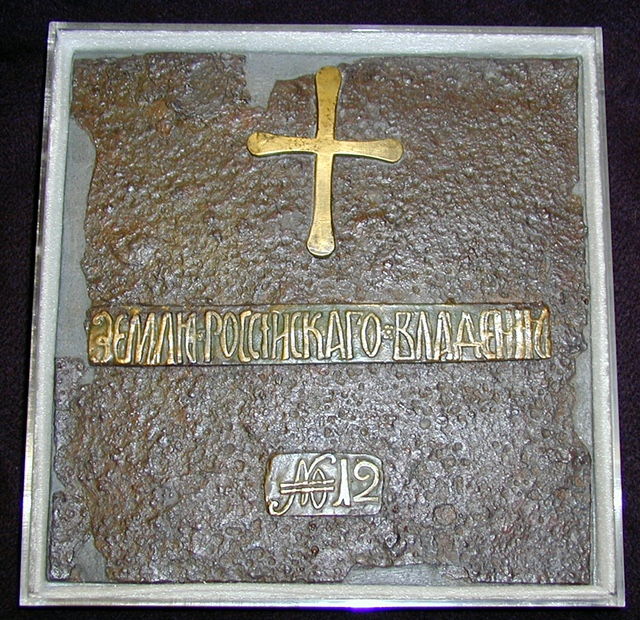
Russian Possession Plaque No. 12. Of around 20 possession plaques buried by Russian explorers, this is the only one that has been recovered. It was discovered by archaeologists near Sitka during the 1930s, and is in the collections of Sitka National Historical Park. Buried around 1799, it reads “Land of Russian Possession. Photo by Dave McMahan, courtesy of Sitka National Historical Park.
Despite recent claims by many Russian officials that Alaska was only “leased” by the U.S. government from Russia for 100 years, the historical records of the purchase are undeniable. Events leading up to the sale were influenced by the social, political, and economic undercurrents of the time.
Russia’s exploration of North Pacific, including Alaska, began with voyages in 1648, 1728, 1732, and 1741. Reports of furs brought about the formation of a number of small companies to capitalize off the newly found riches. In 1799, Russia’s first joint stock company, the Russian-American Company, was created under imperial charter.
The company, whose shareholders included Russian monarchy and nobility, monopolized the Alaska fur trade for 68 years. During that time, a maximum of about 820 Russians were ever present on Alaska soil at the same time; mostly in the southern coast of Alaska, stretching from Unalaska to Sitka. The bulk of the workforce was comprised of Natives and Creoles of Alaska.
The mid-19th century in Russia was an age of economic reforms that abolished serfdom in 1861 and embraced Laissez-faireattitudes (i.e., fewer regulations). Encouraged by the Russian press, there was a widespread belief that Alaska Natives were being mistreated through forced labor.
There were also accusations that the company violated the civil rights of Russian workers by prohibiting their importation of alcoholic beverages and sell of weapons to Natives.
The company’s charter was set to expire in 1862, and the controversy complicated negotiations for a new charter. Consequently, the company was forced to operate under extensions. Russia began to consider giving up her interests in Alaska during the 1850s, and in 1860 sent inspectors to Sitka to review (assess) company affairs and to appraise its assets to about $11.5 million in U.S. dollars. Their report suggested that the company was economically sound.
Politically, however, Russia’s ability to sustain its Alaska operations was bleak. The Crimean War (1853–1856) against Turkey and its allies Great Britain and France had hurt Russia financially and politically, and the prospect of subsidizing Alaska operations was not appealing. Tsar Alexander II and his advisors knew that Russia could not defend its remote oversea Alaska holdings against seizure by the British if war broke out again.
While Russia’s relationship with Great Britain was tense, the U.S. was a potential ally. The U.S. had provided humanitarian support to Russia during the Crimean War (1853-56), and Russia (unlike Great Britain and France) was sympathetic to the Union during the U.S. Civil War of 1861–1865. It has even been argued that the threat of Russian intervention kept Great Britain and France from providing military support to the Confederacy.
Despite a friendly and cordial relationship, Russia knew that U.S. public opinion favored a “Manifest Destiny” for expansion throughout the North American continent. It was better to transfer Alaska to the U.S. under mutually agreeable terms than to try to defend it against seizure by Great Britain or encroachment by American traders and whalers.
In the end, Russia’s decision to sell Alaska came much easier than U.S. congressional approval to buy, which was clouded by controversy and allegations of bribery.
It should also be mentioned that, from the perspective of Alaska Natives, Russia could not sell what she did not own.
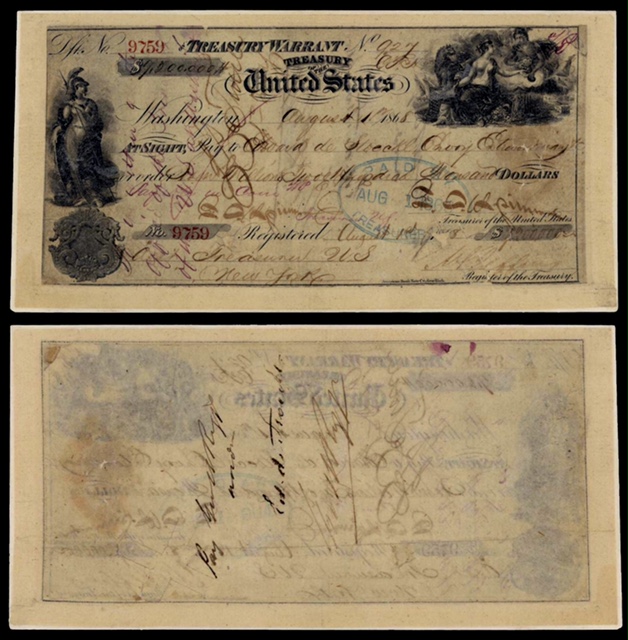
The ‘Alaska Treaty’ was signed on March 30, 1867, with a purchase price $7.2 million. Article 1 ceded “all the territory and dominion now possessed by his said Majesty on the continent of America and in adjacent islands.” Other articles addressed the status of Russian residents residing in Alaska, the disposition of private individual property, the disposition of Orthodox churches, and the details of compensation. U.S. Secretary of State, William Henry Seward, championed the opportunity to purchase Alaska.
The U.S. Senate overwhelmingly ratified (approved) the purchase on April 9, 1867, it passed the House on July 14, 1868, and, finally, became a law on July 27, 1868.
Opponents of the purchase in the press began using the term “Seward’s Folly” or “Seward’s Icebox” to describe Alaska. Some stories have attributed the $0.2 portion of the payment as compensation for the “Alaska Ice Trade”, while others have attributed it to bribes for Russian officials.
Still another story alleged that Russia’s payment, in gold bullion, was lost when the transport ship to Russia wrecked.
In the absence of primary records, these myths must for now be attributed to an unscrupulous press. Russia’s North American legacy has survived through elements of the Russian Orthodox religion, language, and cultural traditions in many Native communities of Alaska today.
Until retirement from the State of Alaska in May 2013, David McMahan served as Alaska’s State Archaeologist and a Deputy State Historic Preservation Officer. He is a board member of the Alaska-Siberian Research Center. With BA and MA degrees in anthropology from the University of Tennessee and more than 30 years in professional archaeology, his interests and skills are diverse; he has multiple training and certifications including forensic anthropology and as an adviser to the State Medical Examiner, he helped solve some of Alaska’s most gruesome crimes.
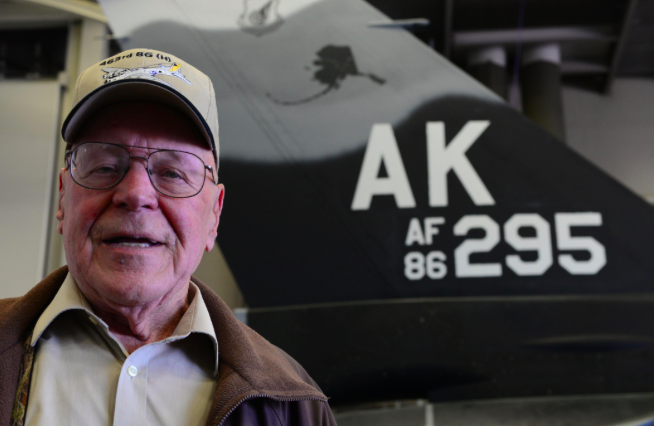
An Alaska legend has passed. Urban Rahoi of Fairbanks died on Thursday at age 102.
He was born Jan. 7, 1919. A World War II veteran, in his final years he was a resident of the Alaska Pioneers Home in Fairbanks.
“He was a one of a kind, he was a builder in this town, he fought five missions in Africa and Europe during WWII flying B-17s, and he raced snow machines at 101,” said Craig Compeau of Fairbanks, a close friend who had visited him just a few days ago. “Covid is the only thing that kept him from racing snow machines this year.”
Rahoi, to be clear, did not die of Covid, but just faded away.
Rahoi was born on Jan 7, 1919 in Iron Mountain, Mich. His interest in airplanes and flying started when he was a child. He did his first solo flight at age 15. At age 21, he met the woman who would become his lifelong love – Vienna. They married in 1940; she passed away in Urban’s arms on Jan. 3, 2010, just three days before their 70th wedding anniversary.
Rahoi joined the Army Air Corps in 1943, and he flew bombers in North Africa and Italy during World War II. “From Italy, we would fly bombing missions into southern Germany, Austria, Romania, and wherever they needed us,” he once said. He flew B-17s on dozens of bombing combat missions.
The couple moved to Alaska and homesteaded on the Tanana River close to the Richardson Highway. They had three children — Rick, Eugene, and Holly. He started his next career as a real estate developer, designing trailer parks, Ptarmigan Lake Lodge in the Wrangell-St. Elias National Park and Preserve. He became a big game guide. When Alaska became a state and guides were required to register, he was issued the state’s first big game guide license: #1.
In 1947 he started Interior Airways with Al Wright and Jim Magoffin. Over his flying career, he’s survived three crashes.
A lifelong bush pilot, he was awarded the Wright Brothers Master Pilot Award by the FAA in 2012.
Rahoi also ran as a candidate for Alaska House of Representatives a few times, most recently in 2012. He served on the Fairbanks North Star Borough Assembly.
Sen. Dan Sullivan remarked on his legendary life: “What really describes a life, when you think about your service in World War II, flying B-17s, and what you’ve done for our great state, literally it’s no exaggeration. You are part of the Greatest Generation, that saved America and built Alaska.”
Indeed, Rahoi ‘s flying career spanned over 80 years, and he has piloted his plane as recently as 2018.
For his 102nd birthday this year, friends gathered outside the Fairbanks Pioneers Home with placards wishing him a happy birthday, and they sang “Happy Birthday to You.”
He had many close friends who make up a coffee klatch group in Fairbanks known as the Laundry House Gang.
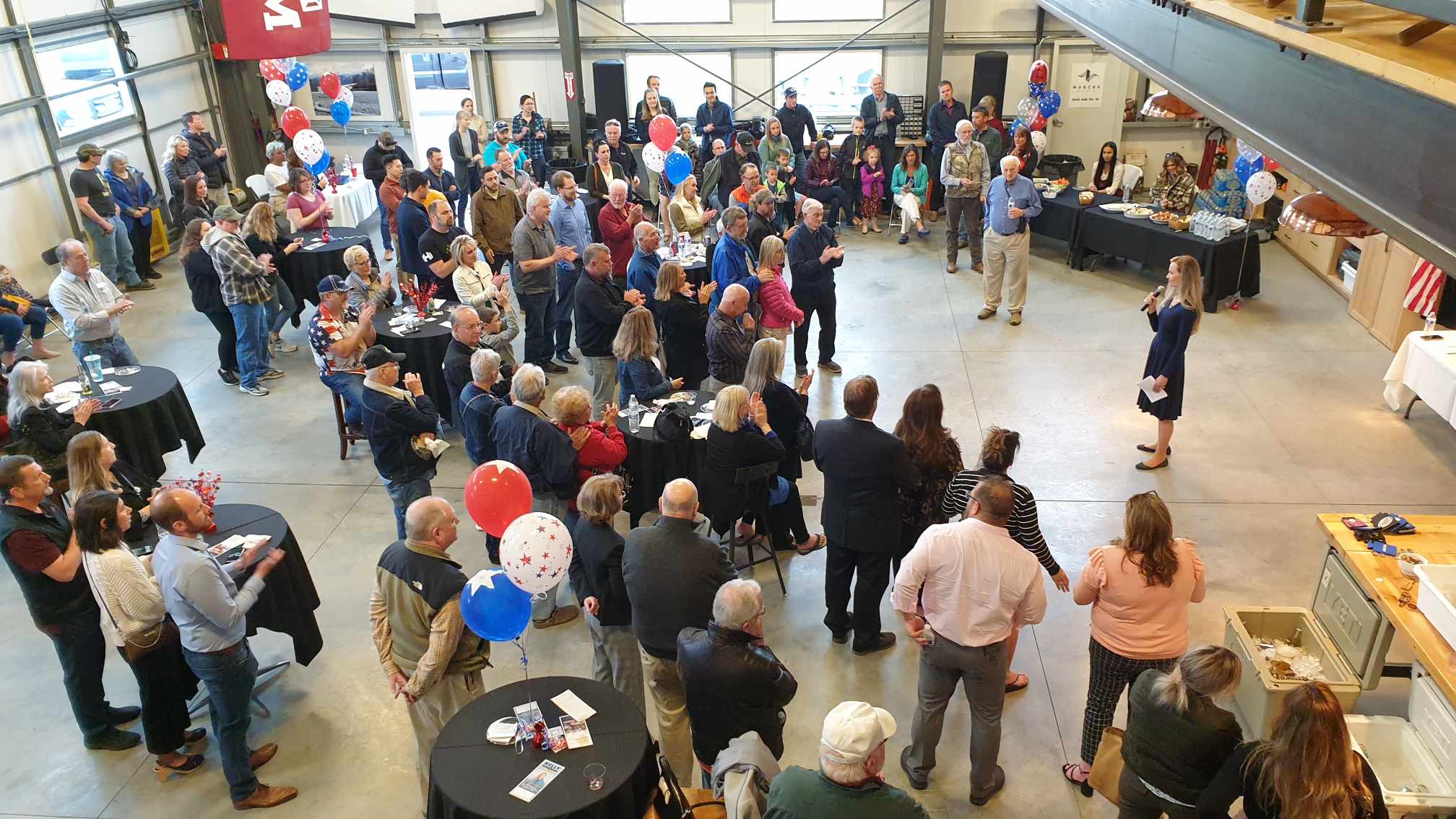
Kelly Tshibaka drew a large crowd for her first Anchorage fundraiser, held in a hangar along Lake Hood on Wednesday. Over 100 people attended the traditional meet-and-greet to learn more about the Alaska-born-and-raised mom and hockey player who is running for U.S. Senate.
Tshibaka said “Forty years is enough,” for the Murkowskis to own the seat in Congress. She was referring to the fact that Frank Murkowski was elected to the seat in 1980, and appointed his daughter Lisa to the seat in 2002.
This was Tshibaka’s first Anchorage fundraiser for her run for Senate. On Friday she heads to Fairbanks for two days, and then it’s back to the Mat-Su Valley for the Palmer Gun Show over the weekend.
The open primary is over a year away and it’s evident that three-term Republican Lisa Murkowski is seeking a fourth term. On March 16, the Alaska Republican Party voted to censure Murkowski, and formally announced that they would recruit a primary challenge to her, and also to prevent her from as running as a Republican “to the extent legally permissible.”
Ballot Measure 2 has created an open primary, and so Tshibaka, Murkowski, and others will all appear together on the August ballot, and the top-four vote getters will appear on the Nov. 8 General Election ballot in 2022.
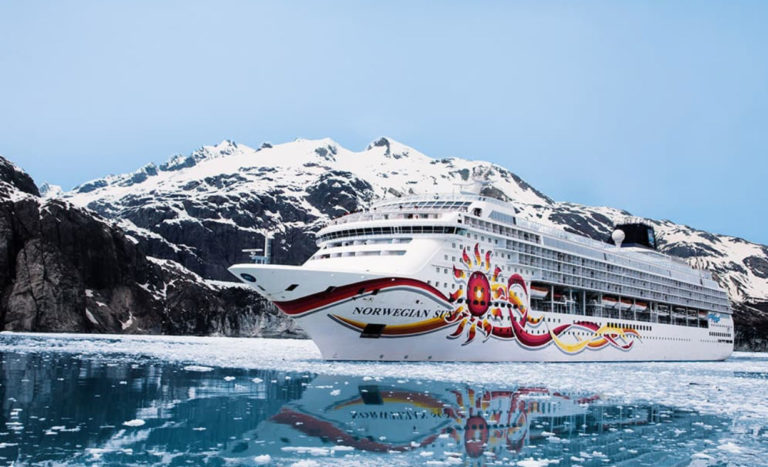
The US House of Representatives passed a bill that would allow cruise ships to sail to Alaska, bypassing Canadian ports. The congressional action exempts large Alaska-bound cruise ships that depart from Seattle for points north from the U.S. Passenger Vessel Services Act. Canada is currently closed to cruise traffic through February 2022.
HR 1318, the Alaska Tourism Restoration Act, gets around the Canadian prohibition on passenger vessels traveling through Canadian waters. Large cruise ships sailing to Alaska would not have been able to do so because the PVSA requires a stop in a foreign country. The return of large cruise ships to Alaska is critical to provide economic opportunity for communities who rely on tourism. The bill heads to the President’s desk to be signed into law.
The bill was spearheaded by Sens. Lisa Murkowski and Dan Sullivan, and Congressman Don Young.
“They counted us out, but the Alaska Delegation should never been underestimated,” Young wrote. “Today truly is a great day for the State of Alaska and our communities in Southeast. Alaska’s tourism economy depends on the summer cruise season. Today’s passage of the Alaska Tourism Restoration Act brings urgently needed good news to our mom and pop small businesses. This bill solves one-half of the puzzle for the resumption of the 2021 Alaska cruise season, and now it is the CDC’s turn to act decisively and promulgate the guidance the industry needs to set sail for Alaska.”
Gov. Mike Dunleavy thanked the Alaska congressional delegation: “Following a year of obstacles, Alaskan families, small businesses, and tourism communities are eager to welcome visitors by cruise ship this summer,” said Governor Dunleavy. “Thanks to the tireless work of our state team, local leaders, businesses, and our Congressional Delegation, the industry can resume sailings, halting a $3 billion hit to Alaska’s economy. Alaska’s well-coordinated COVID-19 response and vaccination efforts ensure this tourism season will be safe for both Alaskans and visitors alike.”
Whether there is time for this season is another matter. The cross-Gulf trip to Seward may not be back this year, because people buy those in advance. But travelers buy the Southeast cruises on shorter notice.
“Betting on that signature, Norwegian Cruise Line has already begin selling sailings on the Norwegian Bliss, roundtrip to Alaska from Seattle, beginning in August. Other cruises lines have also indicated a desire to get back to Alaska as soon as possible, which will also likely mean August,” according to Cruise Critic.
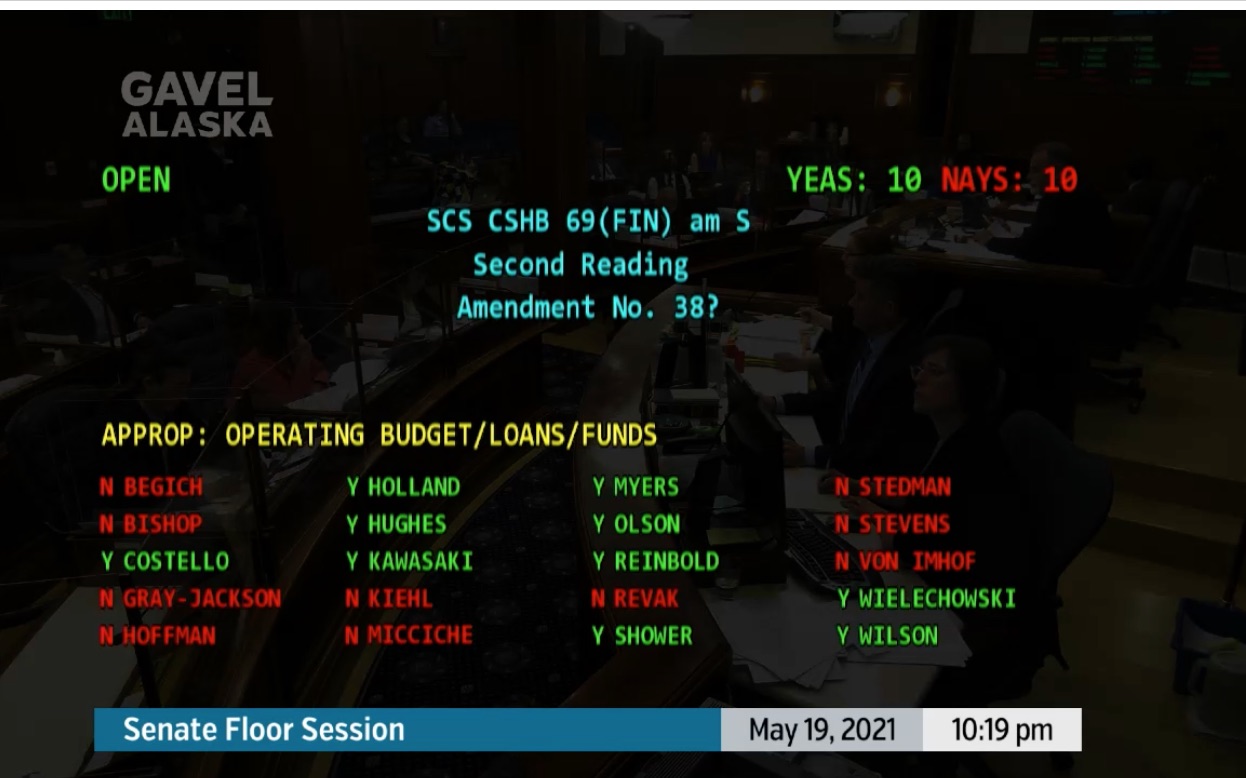
After a lengthy debate in the Alaska Senate on Wednesday night, it came down to a 10-10 vote, and thus a failure for a full Permanent Fund dividend this year. The amendment by Sen. Bill Wielechowski would have give qualifying Alaskans $3,400.
The debate lasted hours regarding various amounts and methods of funding the annual oil royalty dividend, but on this particular amendment, the debate was especially passionate.
Another amendment, giving people a $2,300 Permanent Fund dividend, passed, 12-8. An amendment to spend $1.5 billion from the Permanent Fund Earnings Reserve Account to pay for it the PFD passed, 11-9.
It is the largest Permanent Fund dividend in Alaska history.
The Permanent Fund dividend was one of the bigger bones of contention in the operating budget discussion as senators were running out the clock on the 121-day session.
House Bill 69 authorizes $4.43 billion in state unrestricted general funds for the upcoming fiscal year 2022 operating expenses and $274.6 million for next year’s capital budget, which leverages nearly $1.9 billion in federal funds for roads, bridges, and other infrastructure.
With more than $10 billion in the Permanent Fund’s spendable portion, senators voted to transfer $4 billion into the fund’s principal account, which cannot be spent without amending the state constitution.
“As we finalize the budgets, we look forward to working with the House and Governor over the summer to finally resolve Alaska’s multi-year fiscal challenge,” said Senate President Peter Micciche. “With a sustainable fiscal package, our state will attract new investment, grow our economy, and generate good paying jobs for Alaska families.”
“I think we’ve got a fine bill in front of us with a fine dividend for the people,” summarized Sen. Bert Stedman, co-chair of Finance, just prior to the final vote. “All told we did a good job. Shaved about $20 million off, all agencies. That’s the operating budget, basically been running flat.
The omnibus budget bill, including the Capital budget and $2,300 PFD, passed 17-3, with Sens. Scott Kawasaki, Donny Olson and Lora Reinbold voting against it.
The bill goes back to the House for a concurrence vote. Likely, the matter will instead be taken up in conference committee.
Special session begins Thursday to take up Senate Joint Resolution 6, which would ask Alaskans to decide on whether to put the Permanent Fund calculation into the Alaska Constitution or to allow it to continue to be a political football year after year.
Dave Bronson gained another 9 vote lead on Wednesday to increase his advantage over Forrest Dunbar. Bronson now is 1,221 votes ahead and far past the percentage threshold to trigger an automatic recount.
With an estimated 1,300 votes left to count, and with every incremental result released by the Anchorage Election Office increasing his lead, Bronson will on July 1 become the 39th mayor in Anchorage’s municipal history.
So far, 90,190 ballots have been received, according to Municipal Clerk Barbara Jones, who noted that the runoff set a new voter turnout record.
The Election Office counted just 427 votes on Wednesday in the runoff between Bronson and Dunbar, which ended May 11. Voters had whittled down a list of 15 mayoral candidates in April for the May runoff, which seems to be taking a long time to count.
Dunbar has not yet conceded, but on Friday said on Facebook he was unlikely to catch Bronson.
The current vote totals are:
Bronson: 45,639
Dunbar: 44,418
From 1981 to 1990, Bronson was an active-duty Air Force pilot and served in the USAF Reserves as a plans officer, and as an Alaska Air National Guard maintenance officer and pilot from 1993 to 2005. He was a commercial pilot from 1990 to 2020, when he retired. He and his wife Debra have been married for 35 years and have raised two children.
Bronson ran on a pro-economy, pro-public safety platform. Although he has not yet declared himself the winner, his campaign websitehas some mention of the transition process and a placeholder link, not yet live, for people to submit ideas and resumes.
A bill allowing for more business opportunities for industrial hemp, was passed by the Alaska Legislature today.
SB 27, if signed by the governor, would allow for the state to maintain a permanent industrial hemp program and allow for more broad interstate commerce of Alaska-grown and manufactured hemp products.
Hemp fibers have been used to manufacture hundreds of products that include fiber for injected/molded composite materials, twine, paper, clothing, construction materials, carpeting, clothing, and animal bedding. According to the University of Kentucky. Up until the 1950s, Kentucky was the leading state for hemp agriculture. Seeds are used in making oils, cosmetics, personal care products, and medicines. Hemp seed or oil can be found in cooking oil, salad dressings, pasta, and snacks.
In 2018, the Legislature passed a bill establishing a state Industrial Hemp Pilot Program. Congress passed the Agriculture Improvement Act of 2018, which changed the federal requirements for the industrial hemp market.
“The passage of Senate Bill 27 will not only ensure federal compliance, but will also provide agricultural and manufacturing business opportunities for hemp and help diversify our state’s economy,” said Senate Majority Leader Shelley Hughes, R-Palmer, the bill’s sponsor.
SB 27 passed the Senate 20-0 and the House 38-2, for a combined vote of 58-2. It is now on its way to Gov. Mike Dunleavy’s desk for his signature.