An effort is underway to remove Stephanie Rhoades, the executive board secretary of the Retired Public Employees of Alaska, who is accused of staging an illegal coup against the former board president.
A separate recall is being launched for the current board president, Randall Burns.
The group of retirees seeing the recall say that Rhoades, a retired judge, “knowingly, willfully, and deceitfully (a) acted in violation of RPEA Bylaws and Policies and Procedures; (b) violated provisions of the APEA-AFL Constitution under which RPEA is chartered as Local 4900R; (c) failed to acknowledge her conflict of interest and refrain from voting or participating in Executive Board decisions regarding a recall petition in which Ms. Rhoades was a subject of recall; (d) violated federal and state laws and RPEA Policies and Procedures relating to Age Discrimination; and (e) engaged in disruptive, negative, vindictive behavior toward other Executive Board members and RPEA staff thereby creating a toxic, hostile working environment that prevented RPEA from conducting business in an orderly manner. Her actions led to the mass resignation of three Executive Board members and RPEA’s administrative staff. Ms. Rhoades’ actions significantly weakened RPEA during current ongoing litigation with the State of Alaska to preserve member benefits.”
That litigation is an active court case fighting to retain medical benefits for retirees.
The group’s previous president, Sharon Hoffbeck, quit abruptly this summer under pressure, and wrote a letter that made it clear that Rhoades had created a hostile environment. Hoffbeck had worked as the volunteer president for nine years; essentially, she had been forced out by a board coup that she and others say involved illegal meetings.
Hoffbeck also filed a misconduct complaint against Rhoades in September.
The group of retirees seeing to remove Rhoades say that: “Rhoades knowingly, willfully, and deceitfully acted in violation of RPEA Bylaws and Alaska law on multiple occasions as she coordinated and participated in the ouster of RPEA leadership and administrative staff. Her covert activities include illegally assuming the “mantle” of leadership granted solely to the President and the Executive Vice-President; conducting “secret” meetings without notification to all Executive Board members and the membership at large; calendaring RPEA Executive Board meetings and setting meeting agendas without legal authority; failing to provide legal notice of such meetings to the membership in a timely manner as required by law and RPEA Bylaws, thereby depriving both general RPEA members and some Executive Board members the opportunity to participate; and executing final personnel and financial actions during such illegal meetings.”
Further, the group wrote, “Prior to July 27, Rhoades instigated and led a ‘secret’ meeting of six Executive Board members (Stephanie Rhoades, Randall Burns, Judi Slajer, Wendy Woolf, Brenda Knapp, and Cindy Spanyers). The purpose of the “secret” meeting was to plan the immediate removal of President Sharon Hoffbeck, the ouster of administrative staff and other future actions. Notice of the ‘secret’ meeting was not provided to President Hoffbeck, Executive Vice President Brad Owens, nor Communications Membership Director Bob Grove. The ‘secret’ meeting was conducted for RPEA business and required proper notice to all Executive Board and RPEA general membership as required by RPEA Bylaws Article VII, Section 5.”
Rhoades subsequently “planned, orchestrated, and set the agenda for a Special Executive Board meeting. These actions were taken without authority under RPEA Bylaws or under the applicable procedures outlined in Robert’s Rules of Order, as specified for small boards, which control actions not specifically addressed in RPEA’s Bylaws. The Special Executive Board meeting apparently was originally planned for July 20, 2021, but for unknown reasons was postponed until July 27, 2021.”
For the meeting scheduled by Rhoades, Hoffbeck wasn’t notified until late in the evening on the day before the meeting; thus she didn’t know that a meeting had been called, and did not have the ability to attend.
Hoffbeck emailed Rhoades on July 27, stating: “Stephanie, Any other meeting must be held with the knowledge of the full E-Board, scheduled in accordance with the RPEA bylaws and state laws, and noticed per the RPEA bylaws and state law. Your proposed meeting – to have begun 15 minutes ago – is 100% illegal.”
Also on July 27, Executive Vice President Owens emailed Ms. Rhoades, stating: “Stephanie, It is my understanding that you and five other E Board members met today, despite my objection, and transacted business on behalf of RPEA…Please provide to me immediately any resolutions adopted or motions passed by the six E Bd members who attended the meeting today and the votes cast by each member on each resolution or motion…I believe this conduct by the six E Board members may constitute a serious violation of RPEA Bylaws and Alaska law…”
The group claims that Rhoades illegally assumed the authority reserved to then-President Hoffbeck, and in concert with the five other attending board members (Burns, Slajer, Woolf, Knapp, and Spanyers) illegally accelerated the resignation date of Hoffbeck to be effective immediately, and stripped then-Executive Vice-President Owens of his legal authority under the bylaws to step up as interim president. The mutineers appointed Burns as president for the duration of Hoffbeck’s term, and authorized “the expenditure of $5,000 of membership dues to hire outside legal counsel, fearing legal action for violating RPEA Bylaws and/or creating a hostile work environment for the administrative staff.”
The RPEA is a watchdog and advocacy group for thousands of retirees of the State of Alaska, ensuring that the benefits they were promised are not eroded through time.
Hopefully, in reading this series, your understanding of the mining process will allow you to be aware of the predictable fear mongering of any mining project in the future.
Nothing is portrayed to be more sinister than the failure of the tailings facility. This message of doom is usually accompanied by references to historic catastrophes that did, in fact, occur. As part of your awareness, check the dates and the location of these very real events. Did they occur in the United States? Did they occur prior to commercial jet travel? If so, be a little skeptical, not if they did occur, but wonder a bit about whether current regulations would allow such a construction.
Avery powerful image is associated with the breaking of a dam. It is also very misleading. I have no concern about the use of the term “dam”, since the agency responsible for the safe construction is called “The Alaska Dam Safety Program.” I warn about the image of a dam, usually envisioned as a huge, tall concrete structure.
Yet the “dam” associated with mining is much better described as a buttress. The buttress can ultimately be very tall as well, but to us it would look like half a mountain, terraced for more stability. Another misdirection of the image of a dam is that it holds back huge amounts of water. As an extra panic excitement, the water is often described as toxic.
This invites two terrifying dreads, a massive outpouring of poisoned water. Delay reaching for the panic button. One, there is very little water held in the main tailings facility in the design put forth by Pebble Mine. The “tailings pond” that does exist is thousands of feet from the buttress, and even this pond could be drained if it became necessary. The buttress actually holds back damp sand. It’s so nearly water-free that the design calls for a sprinkler system to guard against wind carrying the dust away.
As part of the NEPA process, a simulation of the failure of the buttress was investigated. The release of huge amounts of damp sand did not even reach the Koktoli river. No water was released. Note: The simulation of failure of the tailings facility was a required part of the permitting process, not to investigate concerns about construction.
One more thought: The water in the tailings facility is not toxic. How do we know that? There is a test, written and conducted by EPA. They have done that test. If you have your awareness instinct working now, you might ask, “how can you know that, since the mine isn’t yet constructed? I am very happy that such a question occurred to you. That is exactly the kind of probe you will need to wade your way through the rhetoric you will find regarding proposed mine construction. So, let’s answer the question.
In exploring the claim, a huge number of drillings will take place to assess the deposits depth and breadth. By amassing these core samples, the developer can get a pretty accurate three-dimensional assessment of the deposit.
It is not unusual to have many hundred drillings; Pebble mine had upwards of a thousand. These drillings yield core samples; Pebble mine compiled more than a million linear feet of core samples. Throughout the process these core samples are sent to independent assayers to determine amount of minerals in the deposit. Knowing these amounts allows the developer to calculate, and with sufficient sampling (there is a required number of independent assays needed to be able to advertise, the richness of the deposit, hence, market value.)
Using these same core samples, the EPA test of the tailings ponds involves following the processes described earlier (crushing the samples to the same micron size as is planned, flotation etc) to arrive at exactly what the process will produce in terms of tailings. These pre-construction tailings are then put underwater in a tub at the laboratory to produce the best possible estimate of the resulting water in the tailings pond. Then two different types of live fish are put in the tank, sequentially, fat head minnows, then a second test with rainbow trout. The test is for acute toxicity, defined as fish die withing 3 days, and chronic toxicity, defined as fish showing some indication of stress after 7 days.
EPA wrote the test protocols; an independent lab did the experiment; and the results were that no fish died or indicated stress.
The tailings pond water is not toxic. We can’t have an opinion on this because toxicity is not an opinion; it’s chemistry.
These results came as no surprise, in Canada a mine with similar mineralization has a fishing tournament annually in their tailings pond.
The “Pebbled” series at Must Read Alaska is authored by Mark Hamilton. After 31 years of service to this nation, Hamilton retired as a Major General with the U. S. Army in July of 1998. He served for 12 years as President of University of Alaska, and is now President Emeritus.He worked for the Pebble Partnership for three years before retiring.
The Biden Administration on Friday launched a so-called “National Gender Strategy,” saying that no nation has achieved gender equality or “equity” but the administration intends to correct that.
Equity is a term for giving some people an advantage in order to help them succeed. Equality means everyone is treated the same way. The White House plan uses the terms and definitions interchangeably.
“President Biden and Vice President Harris believe that advancing gender equity and equality is fundamental to every individual’s economic security, safety, health, and ability to exercise their most basic rights,” The White House wrote that advancing gender equity and equality is essential to economic growth and development, democracy, and political stability, and the security of nations across the globe.
President Joe Biden, who abandoned the women and girls of Afghanistan to the terrors of the Taliban just eight weeks ago, says Covid-19 has amplified the challenges of women and girls, and especially women and girls of color. He said that the virus has “exacerbated a shadow pandemic of gender-based violence in the United States and around the world.”
He called repairing this condition a “moral and strategic imperative.”
The strategy from the Biden-Harris Administration reintroduces the concept of “intersectionality,” or how everything is connected to everything in terms of barriers that are faced by those experiencing discrimination. Intersectionality is a concept embraced and advanced by Marxists.
“The strategy also adopts an intersectional approach that considers the barriers and challenges faced by those who experience intersecting and compounding forms of discrimination and bias related to gender, race, and other factors, including sexual orientation, ethnicity, religion, disability, age, and socioeconomic status. This includes addressing discrimination and bias faced by Black, Latino, and Indigenous and Native American people, Asian Americans, Native Hawaiians, and Pacific Islanders, and other people of color,” the White House announced in a statement.
The plan is purported to be threaded into the Biden “Build Back Better” agenda, a $7 trillion Covid-19 relief and infrastructure package proposed by President Biden. The gender portion of the Build Back Better plan would expand Obamacare, promote abortion, and even put money into climate change agendas, all in the name of gender equity.
The plan specifically says Biden will push for the repeal of the Hyde Amendment, which prohibits taxpayer-funded abortions.
It addresses challenges faced by LGBTQ+ persons and it says the U.S. has become the world leader for women and girls.
“To advance economic security for women and girls globally, we have established a Gender Equity and Equality Action Fund, which supports efforts to address the impact that COVID-19, climate change, conflict, and crisis have on the economic security of women and their families. And we have restored America’s leadership on the rights of women and girls on the world stage,” the White House writes.
This is the 16th in a series of stories of people being fired from their jobs because they have declined to take the required Covid-19 vaccination. Send your story to [email protected].
Southcentral Foundation and Alaska Native Medical Center, having fired dozens of employees who would not succumb to the pressure of taking a Covid-19 vaccine, is now offering referral payments of $1,000 to $5,000 for finding new people to fill those jobs.
According to Southcentral, the referral bonuses are available to existing Southcentral Foundation employees who refer people who end up being hired. The terms are as follows:
Refer an applicant to a position eligible for a referral bonus.
Be listed as the referred by on the candidate’s job application upon submission.
Submit an Employee Referral Request through UKG Pro portal for approval.
If the candidate is hired and all requirements are met outlined in the Employee Referral Bonus Procedure, you will receive the corresponding bonus, once the referred employee has been employed with SCF for a minimum of 6 months.
The fourth Special Session of the Legislature sputters on. There are no discussions of the new facts, only repetitions of the hardened positions of conservatives who are advocates of a 50/50 formula like the one that served Alaska so well for 38 years vs the liberal opponents (whether they are called Democrats, Democrats disguised as Independents or RINOs (Republicans in name only).
The pollsters tell me that 80% of those who intend to vote are pro dividend.
The last time we Alaskans voted on this issue was 1999. As Permanent Fund Defenders, our job is to identify pro-dividend voters and anti-dividend legislators and prepare the troops for the upcoming battle and election to remove those who don’t work for the people.
Legislative power brokers focus the public’s attention on continuing the budget shell game. Here’s reality: The only purpose of the initial budget is to be able to tell the constituents that you cut the budget. Then you’re free to decorate the Christmas Tree supplemental budget with enough cash to meet or exceed last year’s spending. That’s how incumbents say with a straight face, “I cut the budget.” They’re hiding the money and the blood trail exposes the game.
Can we agree on facts?
1. Audited financial statements of Alaska are prepared by independent accountants.
2. Financial statements are the one true source of what was earned and what was spent.
3. The Comprehensive Annual Financial Report is federal law that requires each state to report its audited income and expense for the prior year. That’s where the rubber meets the road.
If you want reality in state spending, read and compare the budget with the CAFR. If you screw up the CAFR report, the state loses all federal funding. That’s a sledgehammer voters can use to smoke out the budget fabricators.
Can we all agree that all dollars earned should be counted? What is reported is the General Fund, a shrinking part of the overall financial income of Alaska. And not all the earnings of the Permanent Fund. Legislators’ favorite hidey hole is state agencies masquerading as dedicated funds.
Alaska’s Constitution says you can’t have dedicated funds without a majority vote of the constituents. Legislative power brokers operate on a different theory. If they’re not caught dedicating funds, they get away with it. Just ask former Gov. Bill Walker, who refused to transfer $199 million of royalty payments to the Alaska Permanent Fund Corporation.
He also refused to transfer money owed to the Constitutional Budget Reserve according to Legislative Audit Director Kris Curtis:
“State of Alaska’s General Fund rents and royalties are not reported in accordance with generally accepted accounting principles and management declined to correct the misstatements. Misstatements include an unreported General Fund prior period adjustment of $199.0 million for overstated General Fund royalty revenues of $99.8 million in (fiscal year 2018) and $99.2 million in (fiscal year 2019), and an understatement of $199.0 million due to other funds,” Curtis wrote in her Independent Auditor’s Report to committee members dated Feb. 22.
The root cause was the decision by Department of Natural Resources officials to transfer mineral royalty revenues owed to the Permanent Fund to the General Fund instead, according to the audit report. Additionally, the Constitutional Budget Reserve, the state’s primary — and dwindling — savings account “is materially misstated by $1.6 billion” and Revenue Department officials have also declined to correct the error”, she wrote.
But special interest groups continue to demand more money. I hope you caught the op-ed piece of the American Association of Retired Persons and Alaska Municipal League. The Alaska AARP Advocacy Director, Marge Stoneking and the Executive Director of the Alaska Municipal League, Nils Andreassen explained their advocacy to pour more money into the Alaska bureaucracy. In their op ed, they identified Legislative leaders who cut the dividend and agreed to tax increases.
The private briefings were exclusively for Senator Jessie Kiehl, Peter Micciche and Natasha Von Imhoff. The House briefings were for Representative Andy Josephson, Ivy Spohnholz, Bart LeBon and Adam Wool. Thank you for identifying opponents of the dividend.
The conversations were to identify the “broad based taxes as part of the broad-based revenue measures” (taxes), that would solve Alaska’s fiscal crises”. No discussion of future private sector economies or suggested cuts in Jabba the Hutt government. For contrast, let’s look at the CAFR for Alaska. Audited financials bring reality. You can read them at:doa.alaska.gov/dof/reports/resource/2020acf.pdf.
AARP and AML said they “were pleased to see the Fiscal Plan Working Group’s recommendation for adopting a broad-based revenue measure, in addition to other revenue measures, as part of a comprehensive solution. “Over the past five years, budget cuts have fallen heavily on local governments…”
According to the audited statements: “The total expenditures charged against General Fund appropriations during FY 18 amounted to $9.1 billion. There was a slight increase, $18.8 million, from FY 17.”
“The total expenditures charged against General Fund appropriations during FY 19 amounted to $9.65 billion. There was a slight increase, $564.6 million, from FY 18.”
“The total expenditures charged against General Fund appropriations during FY 20 amounted to $9.83 billion. There was a slight increase, $178.2 million, from FY 19.”
For three of the five years, state expenses exceeded the budget and increased. Only in the Legislature would increasing the budget $762 million be a slight increase.
Neither the AARP nor the AML speak for the 75,000 seniors who had their dividends traded out for budget increases. 80% of Alaskans agree that the statute on the books should be honored. Prior budget games resulted in a dividend less than half of what it should have been.
No thanks. Senior — and all Alaskans — can choose to spend our dividends without that help.
Jim Crawford is a third-generation Alaskan entrepreneur who resides in Anchorage with Terri, his editor and bride of 38 years. Jim is President of Capital Alaska LLC, a statewide commercial lender which analyses and may sponsor projects of sustained economic growth for the Alaskan economy. Mr. Crawford, known as the Permanent Fund Defender, was a member of the Investment Advisory Committee, appointed by Governor Hammond to plan and execute the Alaska Permanent Fund Corporation.
The Alaska Railroad, a State-owned corporation, has given all employees a mandate to be fully vaccinated by Dec. 8, or be terminated. Many workers are contemplating striking, sources say.
The Alaska Railroad required vaccination for all new employees hired after Sept. 15. The workforce is said to be 50 percent vaccinated, current employees told Must Read Alaska.
According to CEO Bill O’Leary, this notification will trigger union bargaining.
The letter to employees from O’Leary to Alaska Railroad employees:
From the start of the pandemic, ARRC has put a priority on maintaining a safe and healthy workplace. We’ve encouraged employees to follow guidance from public health experts regarding vaccination, but we haven’t mandated vaccination as some companies have done. Our employees have diverse and often deeply held views on this topic, and we respect those differences.
We are proud that we have stayed operational throughout the pandemic. We’ve kept trains moving and our business strong, while limiting workplace spread. Our people rose to the challenge, and we are thankful to each and every one of you. We appreciate all you do to serve our customers and communities.
Now the situation has changed. On Sept. 9th President Biden issued an Executive Order on Ensuring Adequate COVID Safety Protocols for Federal Contractors. The EO requires all employees associated with a federal contract to be vaccinated against COVID-19 in order to safeguard the health of employees and their families, customers and visitors, and the community at large.
Over the last six weeks, we’ve carefully reviewed additional EO guidelines and our interactions with federal agencies to determine if the Alaska Railroad is affected. We are. As a federal contractor, ARRC must meet this standard.
Bottom line: All Railroaders must be fully vaccinated by Dec. 8, 2021. Time is short, because full vaccination is achieved several weeks after receiving the vaccine shot(s).
We understand that for some employees this news will require a difficult decision. We don’t want anyone to leave the company because of this new mandate; yet, we do not have a choice. To disregard the EO could cause substantial legal, regulatory and financial harm to our organization, and ultimately, to our workforce.
Supervisors: Please share this notification with all employees immediately. Please print and post this notice on bulletin boards in break rooms and common areas. Please continue to share this information during your job / safety / staff meetings to ensure everyone is aware.
Meeting the Requirement
All employees must be fully vaccinated no later than Wednesday, Dec. 8, 2021.
Reference the following schedule to meet the full vaccination requirement, based on vaccine type:
Vaccine Type
1st shot no later than
2nd shot no later than
Fully vaccinated no later than
Moderna
10/27/2021
11/24/2021
12/8/2021
Pfizer
11/3/2021
11/24/2021
12/8/2021
Johnson & Johnson
11/24/2021
N/A
12/8/2021
· Employees may use paid administrative leave to get each dose. Be sure to coordinate with your supervisor to schedule time off to vaccinate by the date(s) noted above.
· Employees may use paid administrative leave to recover from any adverse reaction to the vaccine.
· If you have been vaccinated but have not yet provided proof of vaccination to Human Resources, please do so immediately. Scan or take a photo of your vaccination card, and email it to [email protected].
Who is Included?
All employees, including those working remotely, must meet the requirement.
· Represented Employees: We have notified union leadership as this triggers a union’s right to bargain regarding the effects of this requirement. Effects bargaining does not eliminate the vaccination requirement or alter the Dec. 8 deadline.
What if I don’t get vaccinated?
Exemptions. Employees can request an accommodation for a sincerely held religious belief or medical disability. To request an exemption, contact Human Resources as soon as possible, and no later than Nov. 24, 2021. Exemption requests involve an interactive process to determine if an accommodation can be granted without: A) causing undue hardship to ARRC; or B) posing a direct health-and-safety threat to others. If granted, accommodation may mean additional protocols that include, but are not limited to:
· weekly COVID-19 testing
· continued masking and social distancing even after the requirement is lifted for others
· inability to attend in-person events
· unpaid leaves of absence
Non-compliance: ARRC Employees who are not fully vaccinated on or before Dec. 8, 2021, and who do not have an approved exemption or who are not engaged in the process to seek an exemption, will no longer meet the requirements to continue employment with ARRC.
About the Vaccines
To better understand how the COVID-19 vaccines work to protect you, review this CDC Information.
Hundreds of millions of people around the globe have been vaccinated with one of the three available vaccines. The vaccines have been proven safe and effective against severe illness, hospitalization and death from COVID-19.
Find a vaccination provider or event near you here.
Finally, whether you support the mandate or have concerns about vaccination, let’s continue rising to the challenge by showing each other the mutual respect we all deserve.
Many of my friends during my upbringing in the former Soviet Union were students from various academic institutes, striving for knowledge, wisdom, academic curiosity and freedom of intellectual expression. We constantly challenged each other during our passionate discussions about new discoveries in science and creations in literature, art, music and other spheres of academic endeavors.
Many topics of our discussions — especially related to creative writing and dissident literature — were forbidden and harshly punishable by Soviet authorities. Indeed, we all realized the danger of our involvement in these freedom–spirited activities. But a desire for a democratic liberty and truth was stronger than fear and cowardliness.
Across the socialist countries in the Eastern Block, samizdat (Russian for self-publishing) was a form of forbidden literary activity in which individuals reproduced uncensored and underground publications and passed the documents from one liberal–minded reader to another. The practice of manual reproduction was done via typewriters because printing devices required official registration and permission to access. This grassroots practice to evade official Soviet censorship was dangerous and came with threats of harsh punishment, including expulsion from the universities, loss of employment and even imprisonment.
All Soviet–manufactured typewriters and printing devices were officially registered by the government. Their typographic samples were collected right at the factory and stored in the government directory for further identification, when needed.
Because every typewriter has unique micro features, which are as distinct as human fingerprints, it allowed KGB investigators to easily identify the device that was used to type the text in question and, subsequently, apprehend its user. However, the typewriters that were smuggled into the Soviet Union by rebel Soviet citizens from abroad, mostly in the nearby socialist countries (e.g., German-made Erica), skipped the sample collection procedure which made it significantly more difficult for KGB agents to trace the devices.
The smuggled typewriters typed Cyrillic text via Latin characters. To prevent capture by the authorities, the forbidden texts were often bound and concealed within ideologically approved books (e.g., Maxim Gorky, Leo Tolstoy, Alexander Pushkin, etc.).
In the Russian samizdat (self-publishing) process, writers or typists commonly typed four to eight carbon copies of uncensored and underground material at once. It was then widely multiplied, retyped and distributed among intellectuals, political activists, rebel youth and trusted friends. In absence of a typewriter, several copies were made by hand using carbon paper—a very laborious process.
Mikhail Bulgakov(1891–1940) was a Russian writer, playwright, and physician in the first half of the 20th century. His father was a professor of theology and a prominent Russian Orthodox essayist, thinker, and translator of religious texts. His mother was a teacher, and his grandparents were clergymen of the Russian Orthodox Church. Thus, Bulgakov’s writing and ideological beliefs reflected his upbringing and orthodox Judeo-Christian faith and moral values. His most renown literary work is The Master and Margarita, presumably the best masterpiece of the Soviet time (1918–1991).
Samizdat copies of Bulgakov’s satirical novel were passed around among trusted and liberal–minded friends. His novel describes a visit by the devil to the officially atheistic Soviet Union; it combines supernatural elements with a satirical dark comedy and Judeo-Christian moral values.
Unfortunately, his novel was never published during his lifetime. The publication of his work, in a censored and abridged state, happened 26 years after Bulgakov’s death. Although the censorship had removed some 60 typed pages (about 15,000 to 20,000 words), nearly 150,000 copies were sold out in a few hours in the former Soviet Union.
However, prior to its official (censored) publication in 1966–67, the complete version of the book was self–published by samizdat and secretly passed along from one avid and courageous reader to another. In fear of getting caught, rebellious readers would read it in one day (often in one night) and hurriedly rid themselves of the forbidden literature. I did not have a chance to read a samizdat version due to my secondary school age and lack of access to the source, samizdat, at that time.
Officially, the novel saw publication in its entirety (uncensored and published in full) in 1973, 33 years after Bulgakov’s death. Eventually, it was translated into many languages. In fact, my cousin Janet from Canada revealed to me, in the course of our private correspondence, that she had a chance to read Bulgakov’s uncensored novel in English in 1974. I read the uncensored Russian version several years later in the Soviet Union.
Boris Pasternak (1890–1960) was one of Russia’s foremost poets and literary translators of Goethe, Schiller, Calderón de la Barca and Shakespeare. But his novel, Doctor Zhivago, had a very unfortunate fate. The manuscript was first approved by the government publishing house, but sometime later, because of the anti-revolutionary sentiments in the book, the Soviet government reversed its decision. Fortunately, Pasternak had sent a copy of his novel to an Italian publisher who published the book in 1957; and later it was translated and widely published in many languages.
Pasternak won the Nobel Prize for Literature in 1958 for his novel, but under pressure from the Soviet government and in fear for his family and friends, he declined the prize. In 1989, however, his descendants were able to accept it posthumously.
In fact, Pasternak’s Doctor Zhivago remained unpublished in the U.S.S.R. until 1987–88, because of its implicit criticism of the Soviet socialist system and brutality of the October 1917 Socialist Revolution in Russia. I did not have a chance to read the Russian version because I left the Soviet Union in March of 1977, before the novel was published.
Interestingly, in 1977, in Vienna, Austria, three days after my departure from the U.S.S.R. as a political refugee, I happened to watch the film Doctor Zhivago, with English subtitles. It was an inspiring and eye-opening event. There I was, my third day in the West, and I had no fear of watching a classic film based on the banned book from my former country—the authoritarian socialist U.S.S.R.
Aleksandr Solzhenitsyn (1918–2008) was a Russian writer, historian and Nobel Prize Winner for Literature in 1970.He was a notorious critic of the Soviet socialist regime. The writer was accused of spreading anti-Soviet propaganda during World War II. As a result, he was imprisoned from 1945 to 1956 in the Gulag, the Soviet Union’s system of forced labor camps.
After Solzhenitsyn’s return from the Gulag, he began writing memories and accounts of the camps, including The Gulag Archipelago, his most renown anti-socialist regime novel. For a while, his stories and books, such as One Day in the Life of Ivan Denisovich, published in 1962, were studied in Soviet universities. But after the government leadership changed with the deposal of Nikita Khrushchev in October 1964, his works were no longer welcome. Eventually, he was expelled from the Union of Writers and was unable to receive the Noble Prize for Literature awarded to him in 1970.Soon after, in 1973, Solzhenitsyn was expelled from the Soviet Union along with all his works.
After deportation, he lived in Europe for several years, finally settling permanently in the United States in 1975. He visited Alaska the same year in search of permanent residency and a home state. Solzhenitsyn described his trip to Sitka as a “day of quiet spiritual joy and of simple physical rest.” He also visited several other communities in Alaska, including Juneau, where he was hosted by my close friend, the late Bill Ruddy.
I have presented several examples of how a Soviet authoritarian regime treated literary and human rights giants. Indeed, socialist governments believe that fear and rigid discipline of its members is the foundation of any social order. It uses this governing tactic, along with rigid censorship and control of natural, financial and material resources, to indoctrinate social and educational systems with notions of collective representation, collective consciousness, collective responsibility and collective justice. This effectively suppresses individual integrity, identity, freedom, liberty and factual truth.
Indeed, freedom of speech is the core of American individual and constitutional rights. As my good friend stated in our private correspondence, “If you do not have free speech, how do you know who the jerks are?”
Now, my fellow Americans, Is Soviet–style censorship rearing its head in America? Are there any parallels between the Soviet socialist regime and today’s America? Do any of these governing patterns appear familiar today?
If your answers are YES, then I, and many others, left the authoritarian socialist regime in the Soviet Union at great personal expense for the authoritarian socialist regime in America!
Alexander B. Dolitsky was born and raised in Kiev in the former Soviet Union. He received an M.A. in history from Kiev Pedagogical Institute, Ukraine, in 1976; an M.A. in anthropology and archaeology from Brown University in 1983; and was enroled in the Ph.D. program in Anthropology at Bryn Mawr College from 1983 to 1985, where he was also a lecturer in the Russian Center. In the U.S.S.R., he was a social studies teacher for three years, and an archaeologist for five years for the Ukranian Academy of Sciences. In 1978, he settled in the United States. Dolitsky visited Alaska for the first time in 1981, while conducting field research for graduate school at Brown. He lived first in Sitka in 1985 and then settled in Juneau in 1986. From 1985 to 1987, he was a U.S. Forest Service archaeologist and social scientist. He was an Adjunct Assistant Professor of Russian Studies at the University of Alaska Southeast from 1985 to 1999; Social Studies Instructor at the Alyeska Central School, Alaska Department of Education from 1988 to 2006; and has been the Director of the Alaska-Siberia Research Center (see www.aksrc.homestead.com) from 1990 to present. He has conducted about 30 field studies in various areas of the former Soviet Union (including Siberia), Central Asia, South America, Eastern Europe and the United States (including Alaska). Dolitsky has been a lecturer on the World Discoverer, Spirit of Oceanus, andClipper Odyssey vessels in the Arctic and sub-Arctic regions. He was the Project Manager for the WWII Alaska-Siberia Lend Lease Memorial, which was erected in Fairbanks in 2006. He has published extensively in the fields of anthropology, history, archaeology, and ethnography. His more recent publications include Fairy Tales and Myths of the Bering Strait Chukchi, Ancient Tales of Kamchatka; Tales and Legends of the Yupik Eskimos of Siberia; Old Russia in Modern America: Russian Old Believers in Alaska; Allies in Wartime: The Alaska-Siberia Airway During WWII; Spirit of the Siberian Tiger: Folktales of the Russian Far East; Living Wisdom of the Far North: Tales and Legends from Chukotka and Alaska; Pipeline to Russia; The Alaska-Siberia Air Route in WWII; and Old Russia in Modern America: Living Traditions of the Russian Old Believers; Ancient Tales of Chukotka, and Ancient Tales of Kamchatka.
Libby Bakalar, the city attorney for Bethel, appeared to have posted on social media a graphic of Sen. Lora Reinbold’s head on a vibrator. That post is now no longer visible, but remnants of it remain in screenshots shared on the Internet.
She was commenting on Reinbold’s method for breaking up chest congestion associated with Covid-19.
Bakalar, whose trademark on social media is audaciousness, also posted a warning that she will sue anyone who harasses her by writing to her or calling her regarding her social media posts.
She is a former assistant attorney general who was released by the Dunleavy Administration who is suing the Administration because of wrongful termination. She is represented by the ACLU.
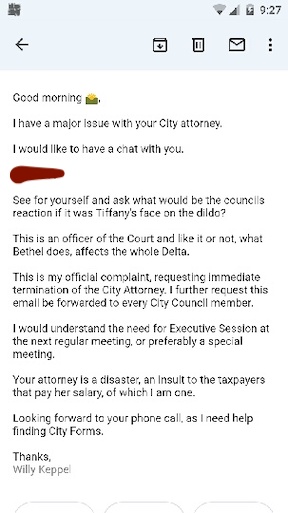
Willy Keppel, a Quinhagaklresident who often comments on political issues, took issue with the post. He asked the City Council of Bethel if it would also be acceptable to put Rep. Tiffany Zulkosky’s head on a vibrator, or it that was just ok for Republican lawmakers.
“This is an officer of the Court and like it or note, what Bethel does, affects the whole Delta,” he said, calling for her immediate dismissal.
As for Reinbold, she has aid on social media she is now better after fighting Covid-19.
The Alaska Democrats have been flirting with the idea for months, but with special session after special session of the Legislature, they haven’t been able to launch Alaska State Sen. Elvi Gray-Jackson of Anchorage as their candidate for U.S. Senate. The fourth special session of the year is still under way, even though few are paying attention to no-show legislators.
Over the course of the summer, Gray-Jackson has changed up her edgy, spiked hair style to something more … senatorial. The Alaska Democratic Party has been putting out social media surveys to lay the groundwork for her, trying to build her statewide name recognition.
Before and after the senatorial makeover.
In the latest edition of the Alaska Democrats’ official newsletter, the party makes it clear that she is their preferred candidate.
“Wonder who’s running as a Democrat for Senate and U.S. Representative? We get that question a lot, and we know it’s tough to be patient. But know that we’re working behind the scenes fitting Democrats into the best seats, waiting for redistricting maps to be finalized, and doing all the prep work behind the scenes to run successful races. But if you want to encourage things along, here’s something you can do,” the newsletter says.
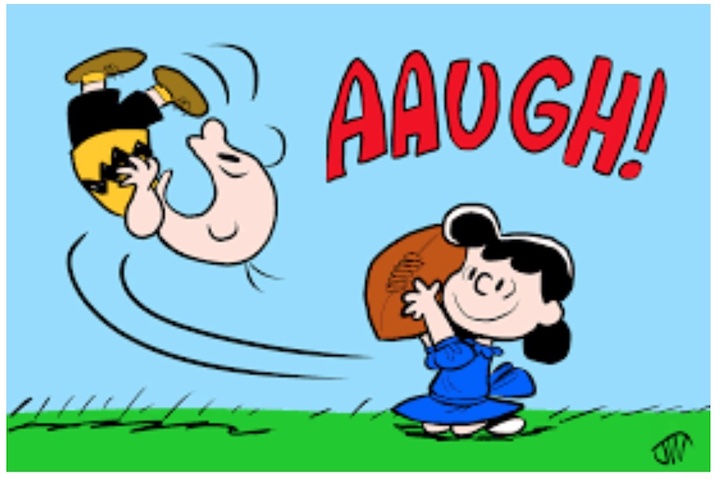
“First – does the thought of having State Sen. Elvi Gray-Jackson representing Alaska in the U.S. Senate excite you? We have reasons to believe with the right candidate, this is a winnable race for Democrats, FINALLY! Just think of it… A Senator who doesn’t bob and weave, no tiptoeing around positions, no more equivocating and backtracking, no being ‘concerned’ and then doing the wrong thing. No more being Charlie Brown while our Senator is Lucy with the football,” the party writes, describing their disillusionment with Sen. Lisa Murkowski.
The party used an old Charlie Brown cartoon to illustrate their feelings about Murkowski, who is too conservative for the party leadership:
“Elvi is solid. She’s decisive. She says what she means and means what she says. She believes in people, and that they deserve a leader not someone who licks their finger after every question to see which way the wind is blowing. She’s a rock, she’s whip smart, and she works really hard. AND, she’s thinking about running for U.S. Senate,” the Alaska Democratic Party posits. The party has been messaging for months that it is done with Murkowski, a candidate many Democrats have supported over the past two decades, due to her pro-choice position on abortion, and other stances.
This up-and-coming Senate candidate is the same Gray-Jackson who has authored legislation that some view as anti-police and anti-public safety.
She also authored legislation this year to make Juneteenth made into another official legal holiday for State of Alaska workers, shutting down government for a day and paying state workers to play. This summer Congress passed similar legislation that allows federal workersto take Juneteenth off.
Some of the legislation Gray-Jackson has authored that has not passed this year is SB 1, use of force by peace officers; SB 2, relating to how police de-escalate situations; SB 3, mandating officers must give warning before shooting a firearm; SB 4, use of force and ban of shooting from a moving police vehicle; and SB 5, the Juneteenth holiday for state workers.
Gray-Jackson represents the Anchorage midtown, Spenard, and U-Med District in the Alaska State Senate; she ran for former Sen. Berta Gardner’s seat when Gardner retired. She also anchors the far left of the Alaska Democratic Party in a state that voted for Donald Trump for president by 53 percent.
It’s unclear what Gray-Jackson will be able to do in the way of campaigning, since that is prohibited for legislators while they are in session. Will she resign in order to run for U.S. Senate?
Gray-Jackson has a long career in politics. Before joining the Alaska Senate, she was on the Anchorage Assembly for several terms, and she was an Assembly aide before that.
A Republican candidate, Kelly Tshibaka, has won the Alaska Republican Party endorsement and is already campaigning hard. She will appear on the brand-new open primary ballot on Aug. 16, 2022. Sen. Lisa Murkowski has not yet declared her candidacy, although she, like all members of Congress, keep their campaign accounts alive at the Federal Election Commission, and she has continued to raise millions of dollars.
The general election is a ranked-choice voting scenario with the top four winners from the August primary on the ballot Nov. 8, 2022.