Barry Matteson passed away from complications of a stroke on Nov. 19, 2021 at the age of 78. He was born Oct. 21, 1943 in Bismarck, N.D. to Roy Matteson and Lucy (Woehler) Matteson.
Barry served in the United States Air Force, and in 1963 was stationed at Elmendorf in Anchorage, AK. Barry was honorably discharged and remained in his beloved Alaska, the state he called home for 57 years. He started a small business, Barry’s Custom Cycle and eventually grew that business to be House of Harley-Davidson, Denali Harley-Davidson, and Kenai Peninsula Harley-Davidson. A Harley-Davidson Dealer for 37 years, he was a founding member of Alaska Bikers Advocating Training and Education, Harley Owners Group Alaska Chapters, Alaska Motorcycle Dealers Association, and a member of American Legion Riders.
He loved to ride his motorcycle, was an avid reader, enjoyed studying the U.S. Constitution, traveled the world, and never stopped learning. He put family first. Barry was generous and gave to many local and national organizations, including Must Read Alaska. He was a patriot and advocated for conservative values.
Barry is survived by the love of his life, his wife of 39 years Karen Sue Matteson, his son Joseph Matteson, daughters, Tammy Thompson, Tracy Czajkowski, Bonita James, Meggie Hoeft and Dia Matteson, his sisters Darby Matteson and Berma Matteson, and his numerous grandchildren and great grandchildren. He was predeceased by his parents Roy Matteson and Lucy Matteson and by his son Brett Matteson.
A celebration of life will be held at Unite Church (2626 Abbott Rd., Anchorage, AK) on Dec. 12 at 3 pm, with a reception to immediately follow at House of Harley-Davidson.
In lieu of flowers, the family asks that donations be made in Barry’s honor to one of his favorite charities: The Heritage Foundation (heritage.org) or Downtown Hope Center (downtownhopecenter.org).
According to several media outlets across Africa, Uganda has lost possession of the Ugandan Entebbe International Airport, along with other strategic assets, because the country has not been able to repay a loan to the Export-Import Bank of China.
The Sahara Reporters wrote that President Yoweri Museveni had sent a delegation to renegotiate with the Chinese government over “toxic clauses that exposed the East African country.” It was to no avail.
The Ugandan Entebbe International Airport is about 40 miles from Kampala, the capital, and is the country’s only international airport. It would be used by ConocoPhillips, Exxon, and Eni, all companies doing business in Alaska.
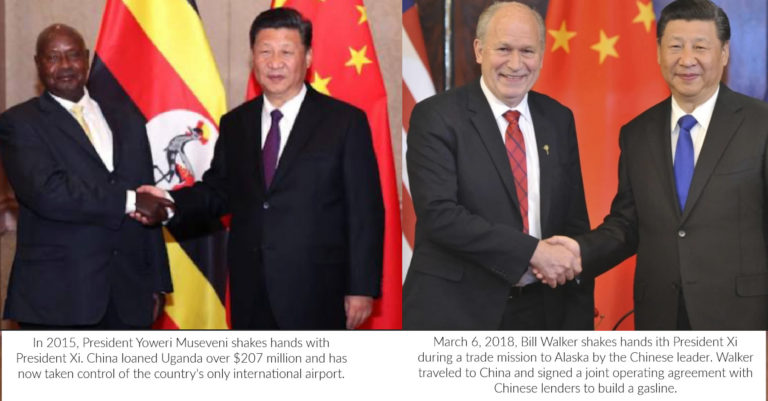
The Museveni-led Ugandan government had, on Nov. 17, 2015, signed an agreement with Exim Bank to borrow $207 million at two per cent upon disbursement, according to the Sahara Reporter. The loan was to mature in 20 years, and had a seven-year grace period. But as part of the deal, there were conditions requiring the Ugandan government to surrender the airport to the Chinese lenders, which are owned by the Communist Chinese government.
According to the Daily Monitor, the Ugandan government waived international immunity in the agreement it signed to secure the loans, exposing airport to take over without international protection.
The relinquishment of a major portion of the country’s infrastructure is reminiscent of the discomfort many Alaskans expressed after former Alaska Gov. Bill Walker signed an agreement with China to finance the design and construction of the now-mythical Alaska LNG project from the North Slope to Nikiski.
Walker and former Alaska Gasline Development Corporation President Keith Meyer signed a joint development agreement was signed with three major Chinese entities, all controlled by the communist government:
Sinopec, one of the largest oil and gas companies in the world, generates $456 billion in annual revenue.
Bank of China is one of the five largest banks, with clients in more than 50 countries and regions.
With an estimated $813.5 billion, China Investment Corporation is the world’s third largest sovereign wealth fund.
Walker smiles for the camera after signing the joint operating agreement with the Chinese.
“This is a big project with big players and big benefits,” Walker noted at the time. “There are more steps before a final investment decision is reached, but having the largest LNG buyer in the world participating in this project means the Alaska LNG project has favorable market engagement at the highest level. This project will finally allow Alaska to reach its full potential as a state. As we move from having one of the highest unemployment rates in the country to the lowest, we will build a stronger Alaska.”
That year, a cybersecurity firm said a Chinese university probed the computer networks of Alaska state departments, especially the Department of Natural Resources, and also private businesses during Walker’s trade mission “in an apparent attempt to ascertain vulnerabilities and gain illegitimate access.”
The firm, Recorded Future, published a report that said the attack originated from computer infrastructure at Tsinghua University.
The report said Alaska was not alone as the target of “cyberespionage” from Tsinghua infrastructure, called an elite Chinese university by Recorded Future, according to the publication Government Technology.
While Walker was courting China, this lending arrangement didn’t work out so well for the Ugandans, and by 2018, Walker was out of office and the new administration pulled the plug on the arrangement.
Several commentators at the time warned that Alaska should be careful about getting into bed with the People’s Republic of China, pointing to the many assets across the African continent that were already under the ownership of China.
Background: In February of 2015, South Korea, through the Korea International Cooperation Agency, gave the government of Uganda a grant of $27 billion Ugandan dollars towards modernization of the airport.
The Ugandan government began the three-phase upgrade and expansion in a project that was scheduled to stretch until 2035 and cost $586 million in U.S. dollars. With the South Korean grant and the China loan, not all of the costs were covered. Financing wasn’t secured to complete the project.
“In desperation, Uganda in March 2021 sent a delegation to Beijing hoping to renegotiate the toxic clauses of the deal but the officials came back empty-handed as China would not allow the terms of the original deal to be varied,” the Sahara Reporter wrote.
“Last week, Uganda’s Finance Minister, Matia Kasaija, apologised to parliament for the “mishandling of the $207 million loan” from the China Exim Bank to expand Entebbe International Airport,” the news agency said.
The airport, built in 1972 and used by the Uganda military, has over 1.9 million passengers per year, and the renovation is said to be 75.2 percent complete.
China controlling the airport will create a political challenge for Musenvi, “who came to power on the back of an armed uprising in 1986, and expose him to election defeat,” the news organization said.
Although Alaska escaped a fate like Uganda is suffering, in 2020, Gov. Walker and Keith Meyer put together a new corporation to try to take over the Alaska Gasline project from AGDC and move it forward, presumably with Chinese financing. By then, AGDC was under new leadership and was not interested.
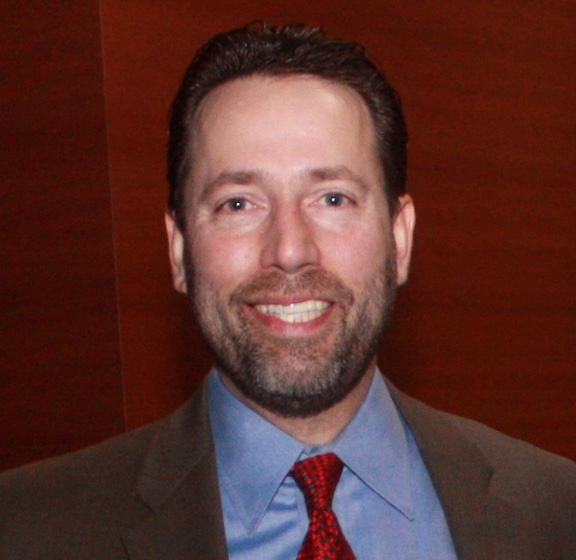
Former U.S. Senate candidate Joe Miller has hinted he is about to announce a run for governor. But then, again, maybe not.
All he is saying is he will make an announcement that will be streamed on the Joe Miller and Restoring Liberty Facebook pages at 9 am on Monday, Nov. 29.
Miller was the Republican Party nominee when he was the Tea Party candidate for U.S. Senate in 2010, winning against incumbent Sen. Lisa Murkowski. She then ran a write-in candidate and beat him and Democrat Scott McAdams in the general election.
Miller ran again for Senate in 2014, but was beat by Sen. Dan Sullivan in the primary. In 2016, he was the Libertarian candidate for Senate against Murkowski, and came in second on the general election ballot with about 30 percent of the vote. He was aligned with the Constitution Party for a while but is once again a registered Libertarian.
There are possibly two other Libertarians running for governor — Billy Toien and Roman Shevchuk. This coming election cycle, all candidates from all parties (or no party) will appear on the same primary ballot, and the top four vote getters will proceed to the general election ballot, where they will face off in a ranked-choice ballot design.
The major candidates so far are Gov. Mike Dunleavy-R, Bill Walker-no party, Billy Toien-L, Roman Shevchuk-L, and Les Gara-D.
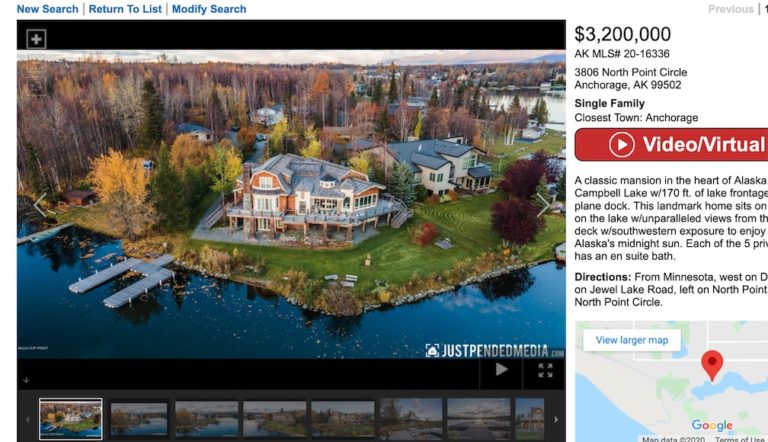
The sprawling Campbell Lake mansion where the former owner of the Anchorage Daily News once hosted President Barack Obama has been sold.
The sale price and the buyer are unknown, but the listing was for $3.2 million when Alice Rogoff put it on the market in October, 2020.
Rogoff lost the Anchorage Daily News in a bankruptcy settlement in 2017. She and her husband, David Rubenstein (whose home on Nantucket Island is being rented by President Joe and First Lady Jill Biden this weekend) divorced last December.
Rogoff relocated mostly full time to Alaska after buying the Anchorage Daily News from McClatchy in 2014 for $34 million. She already had controlling interest in the upstart online-only Alaska Dispatch and folded the two organizations together, renaming the entire publication the Alaska Dispatch. Her move to Alaska prompted friendly questions from the fawning Washington Postin a story titled “What’s this Washington insider and billionaire’s wife doing in Alaska?”
“Her rising profile in Alaska, her marriage to one of the country’s most successful private-equity managers, and the physical and metaphorical distance from her life — and husband — in Washington have made observers in both places curious about her ambitions,” the Post reported.
Her ambitions soon became clear as she helped engineer a win for Bill Walker in 2014, when he challenged former Gov. Sean Parnell and won — with the help of the media that she owned.
The Binkley Company, owned by the John Binkley family in Fairbanks, bought the paper for $1 million and saved it from extinction.
Rogoff’s home on the lake has 7,170 square feet, five bedrooms, seven bathrooms, and a dock for her floatplane, which she wrecked on July 3, 2016 in Halibut Cove. She was able to swim away from the downed Cessna.
Rogoff also has property on the East Coast and she publishes Arctic Today, an online news outlet with a global look at exclusively Arctic matters that she was allowed to take with her when the bankruptcy was settled.
One of the more disappointing reads of the season was the Oct. 27 opinion essay in The Washington Post penned by Alaska’s own Chief Medical Officer Anne Zink.
Most of it is an acceptable accounting of Alaska’s experience with Covid-19. We did pretty well in the beginning, and Gov. Mike Dunleavy’s administration, including Zink, did a phenomenal job getting test kits manufactured in-state, when it was nearly impossible to get supplies. They got protective gear shipped over from China in record time.
Alaskans followed Dr. Zink’s advice in February of 2020 to wash their hands frequently for 20 seconds and sneeze into their sleeves. She is on the record early in the pandemic for saying that surgical masks are essentially petrie dishes.
“A mask is a wet, moist environment that’s collecting viruses and bacteria … It’s not useful to protect you from other people,” she told a legislative hearing.
By June, 2020, Zink had changed her tune about why she wears a mask: “Humility: I don’t know if I have COVID as it is clear that people can spread the disease before they have symptoms. 2. Kindness: I don’t know if the person I am near has a kid battling cancer, or cares for their elderly mom. While I might be fine, they might not. 3. Community: I want my community to thrive, businesses to stay open, employees to stay healthy. Keeping a lid on COVID helps us all.”
That’s very laudable and noble, but 180-degrees from what she had said in February, 2020, and not particularly backed by science.
In The Washington Post last month, Zink took credit for Alaska’s great look on the national stage early in the pandemic, and then blamed Alaskans for the outbreak in the fall of 2021, when case loads spiked.
Alaskans fell prey to misinformation, she said.
This is a curious argument: Alaskans, evidently, have some unique quality that makes them fall for misinformation when people in Florida, with some of the lowest Covid case counts in the world, do not.
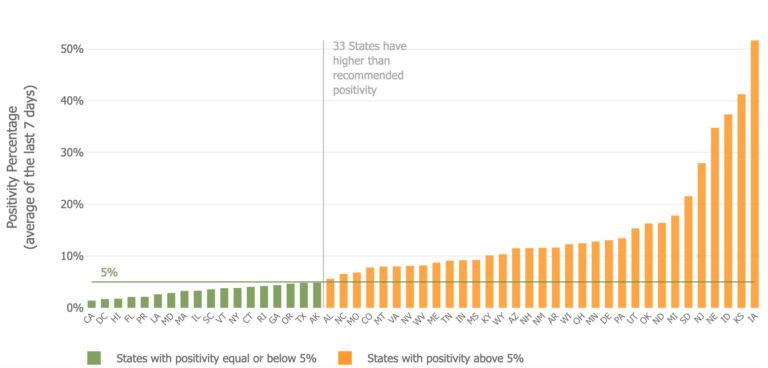
Today, the case loads are spiking in Iowa and Kansas. It must be that people are suddenly falling for misinformation in Iowa, but not in Alaska, because within weeks of spiking and causing concern in hospitals in late September, Alaska’s numbers have returned to what the World Health Organization considers the “green zone” of viral transmission — below 5% for the past two weeks. Alaskans should pat themselves on the back for not falling for misinformation.
The blame for misinformation rests on the medical community, policy makers, and on social media, but perhaps unequally. Let’s take the medical community first.
The struggle to understand what is probably a bioweapon, while filtering data through the sieve of medical experience and teachings, has led the medical profession to make imperfect recommendations to the public, and to exclude important avenues of inquiry, such as early treatment.
The medical community, led by people in charge such as Dr. Zink and Dr. Anthony Fauci, have pushed masks, distancing, and finally a leaky vaccine as the primary methods for controlling the disease. And yet, with this sneaky virus, it’s apparent that the vaccine is not going to succeed, as in less than two years the virus has evolved from its initial stage, to the more virulent Delta, and now to the even worse variant being called “omicron.” This virus, unlike viruses that come from nature, reminds us of the Greek mythological creature Hydra; every time one head is chopped off, two more grow back.
The jury is still out on whether the mass vaccination program is a good idea, but Zink’s assertion that low vaccination rates and vaccine hesitancy in Alaska is a big reason for the September surge is unsupported. 81 percent of the Juneau population is vaccinated, and yet there were 19 new cases diagnosed Wednesday. This, in what is one of the most vaccinated communities in the country — a town of 30,000 that also has instituted forced masking, six-foot distancing, and mandatory limits on gatherings. Not quite Australia, but they can see it from there.
What’s more, the breakthroughs and reinfections are on the rise in Alaska already. Through the end of September 2021, a total of 13,265 Covid-19 vaccine breakthrough cases were documented among Alaska residents, according to the Alaska Department of Health and Social Services. We must keep in mind that most Alaskans did not even have access to the vaccine until March of 2021, and yet by September, the breakthroughs were growing by leaps and bounds.
If the medical community has suffered reputation damage because of its changing and flawed advice, and if the political class has outdone itself in the scare tactics its perpetuated, the mosh pit of social media hasn’t been all that helpful either. This virus is serious, and those who diminish or dismiss its dangers do so at their own peril, and the greater community’s as well.
But the people of social media are not to blame for the misinformation. Much of what they are trading in is no more misinformed than what is being fed to them by Big Pharma and its handmaidens at the FDA, CDC, and in the mainstream media. Alaskans are reading widely; are they to dismiss the repression they see occurring around the world? Should Alaskans not make a stand so their communities don’t resemble the quarantine camps of Australia? Should they not fight for the Constitution?
Are the experiences of Israelis to be discounted? Is Ivermectin, which is a drug commonly used to treat Covid around the globe, such a danger that Alaskans can’t have access to it? What would be the harm of telling Alaskans to load up on Vitamin D, lose weight, build their immune systems with zinc and quercetin, and get plenty of exercise?
What of the stories Alaskans have told Must Read Alaska about doctors, nurses, and health practitioners discriminating against the unvaccinated or refusing to treat them altogether? Are those stories not relevant? What of the mandates on workers to get vaccinated or lose their jobs? Are these Alaskans’ experiences “misinformation”?
And importantly, what exactly is misinformation in an era in which some doctors, from Dr. Fauci to our local medical mafia at Providence, have become politicized and are telling leaders in Anchorage to enact behavioral mandates? From this perch, it appears that only because of the strong libertarian streak in Alaskans have we been able to avoid the vaccine passports now enacted in Washington, Oregon, and California.
Dr. Zink’s writing in the Wa-Po belittled Alaskans. It shifted the blame to them for a virus that is a global roller-coaster of increasing intensity and challenge. She didn’t help the case of doctors, and she insulted Alaskans by characterizing them as too stupid or hardheaded to know good information from bad in a world where the information is rapidly changing, and where much has been worthy of doubt.
Suzanne Downing is the publisher of Must Read Alaska.
An analysis by the Washington Free Beacon shows that the mainstream media, unlike its obsession with the Kyle Rittenhouse “white supremacist” narrative, has lost interest in the massacre ofsix people and the injury of 40 more at a Christmas parade in Waukesha, Wisconsin, a suburb of Milwaukee.
On Sunday, Darrell Brooks, 39, allegedly plowed his maroon SUV through the parade, running over grandmothers and children alike, and creating a horrific scene that was described by CNN, MSNBC, CBS, The Washington Post, and other outlets as an “incident” and a “crash.”
The driver of the SUV was not white, and the corporate media has quickly lost interest, barely mentioning the sixth death, that of a child, on its front pages on Wednesday.
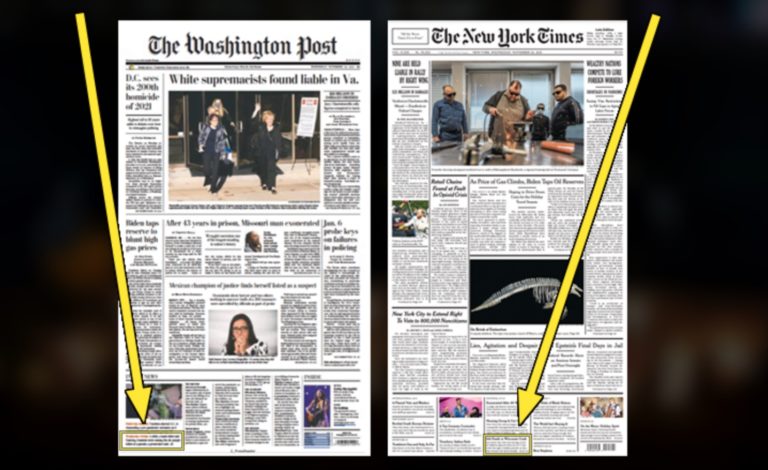
Instead, the Washington Post led with a story about white supremacists, as did the New York Times, writing about a 2017 Charlottesville, Va. rally during which James Alex Fields Jr. rammed his car into a crowd of counter-protesters, killing one and injury 35.
After Sunday’s attack, Brooks was officially charged on Tuesdaywith five counts of first-degree intentional homicide, and a sixth charge was expected after the death of the child. Waukesha Police Chief Daniel said, “This is not a terrorist event.”
Brooks, who had been released on previous charges, is the product of the progressive criminal justice reform movement, similar to what Alaska Gov. Bill Walker signed into law with Senate Bill 91 in 2016, which was repealed by the Alaska Legislature and Gov. Mike Dunleavy as one of their first acts in 2018.
Brooks was let out of jail after having two weeks earlier allegedly punching and running over his girlfriend said to be the mother of his child.
Wednesday’s edition of The Washington Post mentioned the mass slaughter at the bottom of the front page, and the Times also positioned it at the bottom of Page One, calling it a crash.
“CNN, meanwhile, was not featuring a single story about the Waukesha tragedy on its homepage as of Wednesday afternoon. The news network, however, did prominently feature an ‘analysis’ piece headlined ‘Biden spins a message of hope as an anxious nation readies for Thanksgiving,’ as well as a report that former president Donald Trump ‘now has a ninth-degree black belt in taekwondo,'” The Beacon described.
The number of positive Covid cases in Alaska on Wednesday was 138, a 31 percent decrease from last week.
There were 89 people currently hospitalized for Covid in Alaska on Wednesday, which represents 9.4 percent of all hospitalizations. Just eight people are on ventilators due to Covid effects. These numbers are a fraction of what they were in September, when Alaska saw spiking hospitalizations and when the state was making national news and being criticized for not having stricter lockdown and masking rules. For example, on Sept. 30, Alaska had 1,270 new cases and 203 hospitalizations due to Covid. On Nov. 1, there were 1,547 new cases and 202 hospitalizations.
According to Johns Hopkins University, Alaska has made the coveted list of those states with the lowest rate of positivity, at 4.84 percent.
The World Health Organization advised governments that before reopening, rates of positivity in testing (ie, out of all tests conducted, how many came back positive for Covid-19) should remain below 5% for at least 14 days. Alaska has reached that goal.
For comparison, Florida’s positivity rate is quite low at 2.2%, while Idaho, where the virus is spiking, is over 37%.
Alaska’s own data dashboard has Alaska’s positivity rate higher — at 5.7 percent. And the state dashboard still has nearly the entire state in the “red” zone of high transmissibility.
On the hospital capacity dashboard, nearly all intensive care units in the state are open, with the exception of Providence Medical Center, which is at capacity. All non-ICU units are open.
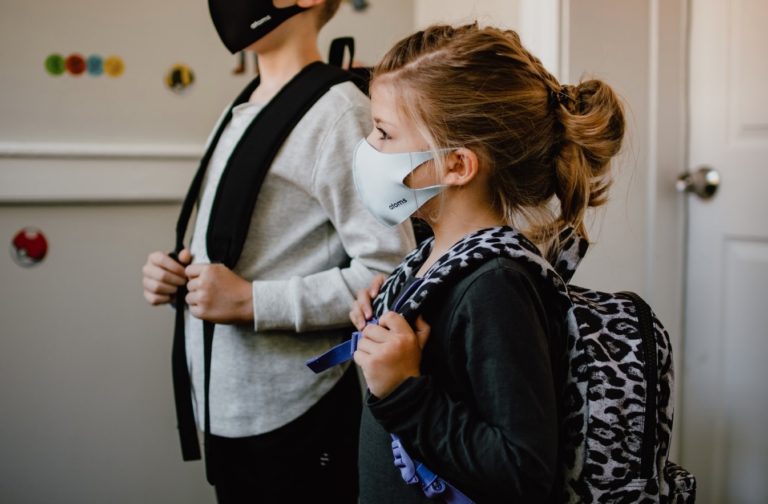
Where are the goal posts? How and when will the children of Anchorage be able to breathe freely again in school?
The Anchorage School District Board and superintendent may not be able to make this decision rationally. If asked, they will point to recommendations from the now discredited Centers for Disease Control and Prevention. They will direct your attention to a fancy colored CDC chart with indicators for risk of introduction and transmission of Covid-19 in schools.
Such indicators include number of new cases, percentage of positive PCR tests, percentage of hospital beds occupied and beds occupied by Covid patients. This decision matrix is fuzzy at best and it’s a bit hard to tell which way the wind is blowing the flags on top of the posts.
Reflecting on a few short months ago, the district conducted a Covid-free and mask-optional summer school. We thought we might be done with the mask mandate insanity.
Then Superintendent Deena Bishop huddled up and had conversations. Bishop claims she based this decision to mask up the kids for the fall of 2021 on conversations with staff and members of the community.
I am not aware of any survey asking for public or school district employee input. My opinion was never solicited. Nobody I know was asked to give their two cents. Bishop’s mask mandate e-mail announcement was issued Saturday July 31 at 7 pm. The only board meeting before the start of school was on Aug. 3, where in-person testimony was overwhelmingly against the mandate. Aug. 17 was the first day of school this year.
Make no mistake, this is Bishop’s mandate we currently enjoy. The superintendent made the recommendation to the school board and they took her advice.
The view of the end zone suddenly became blurry and undefinable at that point.
Every athlete or team that takes a beating on the field is reminded by their coach, not to hate the opposing players, instead direct your anger toward the game. It is not an easy perspective to achieve given all of the bad calls and late hits that have been made by the opponent.
This is, unfortunately, not a game. Numbers and statistics are discussed to the point of exhaustion. The failed “lockdown”, “shut out” and “mask up” plays are analyzed, but no apologies are offered. Mistakes have been made. Child development and education have suffered. The children of Anchorage will never get that lost, lockdown spring semester of 2020 back.
Suffering from the delayed academic achievements and social skill deficiencies continue as a consequence today. Look at the test scores. Look at the in-school violence.
As a constant reminder of the failure that is ASD leadership, students continue to suffer under the mask mandate. One should not dwell on the last broken play. The only thing that matters is the next play.
And here it comes. As recently as Nov. 23, a principal sent out a “Mask Wearing Reminder” notice. In that notice it stated “Correct mask wearing always means over the nose and mouth unless eating or drinking” (when Covid apparently is unable to spread or be caught). The notice goes on to say, “Students who fail to comply with wearing their mask properly will receive detention. It is important that we continue to enforce the districts universal mask wearing policy.”
One of only two possible situations can exist here. Option one: Either we have a huge outbreak of a virus which is 99.997% harmless to the 19 and under age group or, Option two: This is all about compliance, universal compliance.
I figured the numbers on the ASD web site would surely tell the story — and boy do they ever. ASD maintains a list of every ASD school, updated in real time and it reflects the number of active Covid cases involving both students and staff that are in a 10-day isolation situation with a confirmed positive Covid test.
Of the 103 ASD schools, 32 of them had zero active Covid cases on Nov. 23, 2021.
Twenty-eight additional schools had only one active Covid case. The most that any single school had was 9 Covid cases.
Translation: 58 percent of ASD schools have one Covid case or less. If one or less cases in a school is not the goal, then only zero cases must be the goal.
But no. The previously mentioned principal’s letter came from a high school with zero Covid cases. I think the Anchorage School District is running the “Option Two” play in this situation.
It’s not the players, it’s the game. There is no recognition of individual schools and their unique statistics. This is like saying, “The second place team in the Super Bowl is a bunch of losers,” even though they have nine future Hall of Fame players on their active roster.
Currently, 32 schools with zero Covid must continue to suffer the mask mandate, as they are on the losing ASD team under the rules of this game.
The rules need to be changed. Anything done in the name of universal compliance has got to be an automatic question mark in a rational mind.
There is a young generation of Anchorage students who know of no other type of school except the masked kind of school. The damages to academic achievement and social development are real, especially for the youngest students.
Are the school board and superintendent nimble enough to make changes to their own mask mandate policy? Remember, this is not a CDC policy. This is an Anchorage School District policy. They demonstrated that they have the ability to call an audible and make last minute changes like reintroduction of the mask mandate last fall. In the second half of the 21/22 season will the ASD leadership be able to move the ball the other direction?
If you could run in the next play from the sidelines, you might tell the ASD quarterback to make masking up optional when a school has one or fewer active cases of Covid-19. Or maybe 5 or fewer cases should be the threshold since we are just making up rules as we go for the last couple years. This really needs to be addressed on an individual school basis. The universal policy approach does not acknowledge the conditions on the ground or within the confines of a single school.
The Anchorage School District has a School Board Meeting on its schedule for Monday Dec. 6 at 6pm. I would hope that enough people express their concerns, and that logic and reason prevail. It is possible that we can give the kids here an early Christmas present and win the Covid Bowl. Eliminating the universal useless and harmful mask mandate could be the play that breaks the game wide open.
Dan Smith is a lifelong Alaskan and Anchorage residentand senior contributor at Must Read Alaska.
Due to a new variant of the Covid-19 virus, the Biden Administration on Monday will ban travel to the United States from South Africa and seven other countries, according to numerous news organizations, which cited unnamed Administration officials.
The ban also pertains to Botswana, Zimbabwe, Namibia, Lesotho, Eswatini, Mozambique, and Malawi. The administration’s decision was advised by Dr. Anthony Fauci, the president’s chief medical adviser, and the Centers for Disease Control and Prevention, according to Politico. The new variant of Covid, which the World Health Organization has called omicron, is also known as “B.1.1.529.”
Fauci said Friday there is no indication that the new variant is already in the United States, although other medical professionals say it’s likely already landed. It has already been detected in Belgium.
Do travel restrictions work? Early in the pandemic, President Donald Trump put travel restrictions on China, but the virus still quickly found its way to the United States.
The new variant is believe to have a greater ability to evade the vaccines in use now to combat the original Covid virus and the Delta variant. It is also believed to be more transmissible and more severe.
The stock market fell in response to the news about the new variant. The Dow Jones Industrial Average fell 900 points, or about 2.53 percent.