
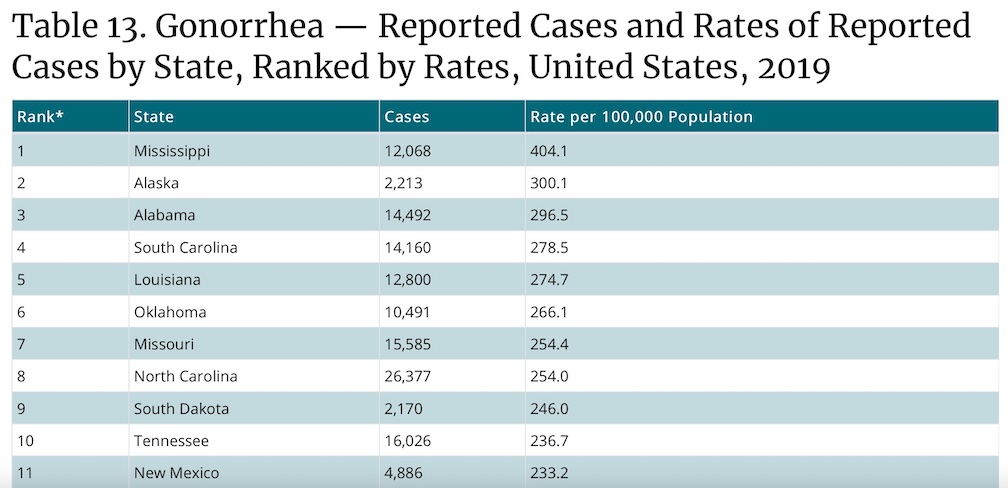
Alaska has been experiencing a significant gonorrhea outbreak since October 2017, says the Alaska Department of Health and Social Services. In 2019, Alaska ranked 2nd nationally for gonorrhea cases, second only to Mississippi.
From 2009 to 2019, the national gonorrhea rate increased by 92%, while Alaska’s rate increased by nearly 200% in the same period. While the number of Alaska cases dropped by 10% in 2020, health experts think it’s because there were fewer in-person health services due to the pandemic, and therefore cases might have gone undetected. Also, since there is a high level of syphilis in Alaska, “reduced partner services activities were conducted for GC cases.” Syphilis, more serious of the two, is often treated with medication that takes out gonorrhea at the same time.
No numbers are yet available for 2021, but if there are many undiagnosed cases due to lack of in-person healthcare services being provided in Alaska, it’s likely the number of cases is remaining high. Right now, the stats reveal that about one of every 300 Alaskans could be carrying the sexually transmitted disease.
Of the 1,982 gonorrhea cases in Alaska during 2019:
- 1,005 (51%) were in males and 977 (49%) were in females;
- the age range was 14–82 years;
- rates by age were highest in persons aged 20–24 years and 25–29 years (1,087 and 749 per 100,000 persons, respectively);
- Alaska Natives/American Indians had more than twice the rate of the disease as the overall population, with 816 cases per 100,000 persons. African Americans had 719 cases per 100,000 and Native Hawaiian/Pacific Islanders had 256 per 100,000 persons.
- rates by region were highest in the Northern, Anchorage/Mat- Su, and Southwest regions (785, 341, 223 cases per 100,000 persons, respectively).
Untreated gonorrhea can cause serious and permanent health problems in both women and men. In women, gonorrhea can spread to the uterus or fallopian tubes and cause pelvic inflammatory disease. The symptoms may be quite mild or can be very severe and can include abdominal pain and fever, according to the CDC. The infection can lead to infertility, if untreated, and can also spread to the bloodstream and affect joints, heart valves, and the brain.


