As we celebrate 250 years of American independence, this is a fitting moment to reflect honestly on the direction our country is taking. The anniversary of a nation “conceived in liberty” demands more than fireworks and festivities— it calls for an examination of conscience. At the very moment we mark this milestone, avowed Marxists are winning elected office in cities like New York, and the language of socialism is being normalized in public discourse as though it were simply another policy preference rather than an ideology with a long and devastating historical record. These are not fringe developments. They represent a direct challenge to the sovereignty, moral foundation, and spiritual identity of this Nation. Marxism, socialism, and communism fundamentally oppose the true understanding of human dignity— the human person made in God’s image— and the natural moral order. They are materialist ideologies that subordinate the soul and transcendent truth to class struggle, state power, or collective ownership, denying spiritual reality.

The Catholic Church has consistently and unwaveringly condemned all three. Pope Pius XI in Quadragesimo Anno (1931) declared: “No one can be at the same time a good Catholic and a true socialist,” because socialism’s vision of society is “utterly foreign to Christian truth.” He called communism “intrinsically wrong”— not merely imprudent or misguided, but wrong in its very nature. Popes from Pius IX through John Paul II echoed this condemnation across different eras and political climates, rejecting atheistic materialism, the abolition of private property (protected by the 7th and 10th Commandments), class warfare, and the absorption of the individual into the collective group. This is not a political position the Church arrived at reluctantly. It is a doctrinal conviction rooted in the nature of the human person and the moral order God inscribed into creation.
The Church Fathers and Doctors of the Church affirm private property as legitimate while urging stewardship and charity. St. Thomas Aquinas taught that private ownership flows from natural law and human nature, promoting responsible care more effectively than common ownership ever could. When people have genuine ownership, they steward what is theirs with diligence and generosity; when the state owns all things, no one truly cares for anything since there is no need to be a good steward. St. Ambrose stressed the universal destination of goods— property serves the common good through voluntary justice and almsgiving, not coercive state seizure. This is a crucial distinction between freedom and socialist paradigms. The Church does not oppose generosity or solidarity; it opposes the replacement of virtue with compulsion. Socialism inverts this entirely, treating persons as means to material ends rather than as ends in themselves, created and loved by God.
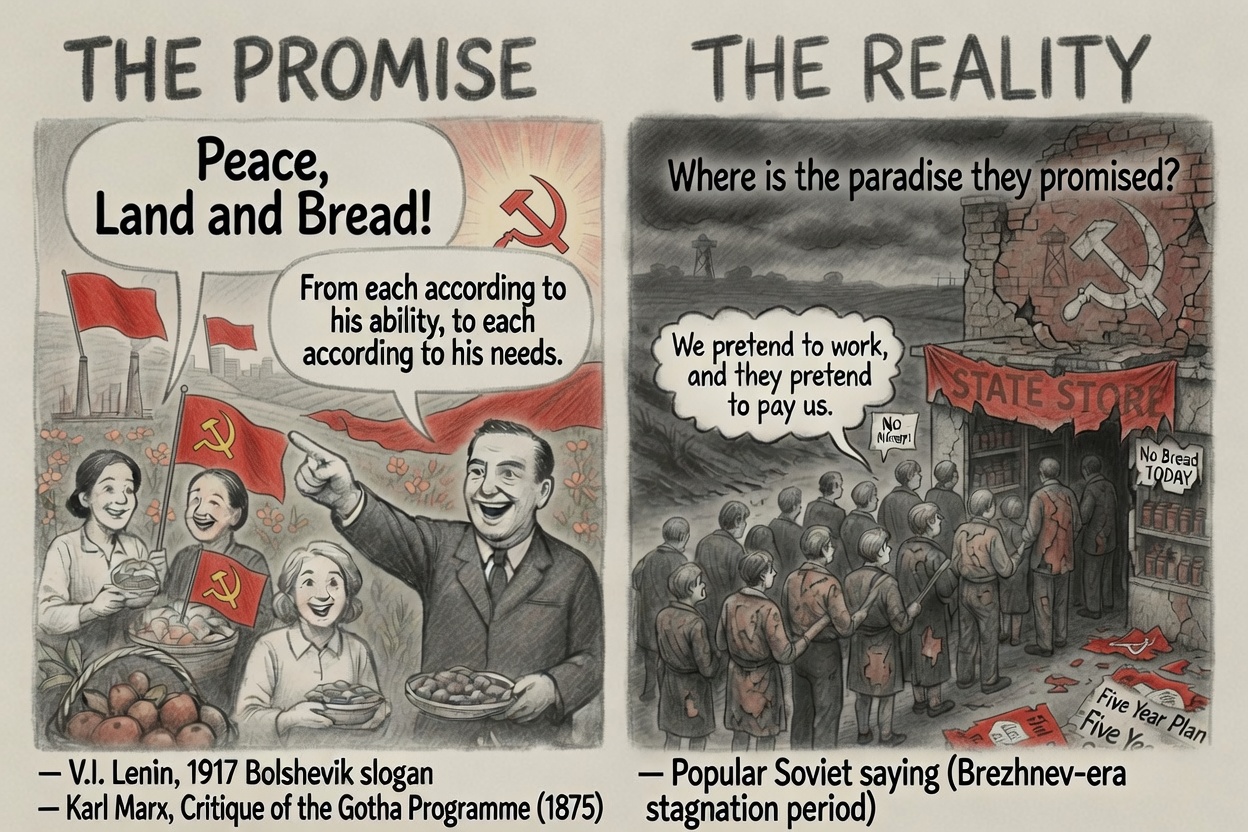
Archbishop Fulton J. Sheen was among the most prophetic voices of the twentieth century against communism. He called it “the final logic of the dehumanization of man” and warned that in denying both God and private property, communism produces authoritarian cruelty, concentration camps, and the reduction of individual worth into what he vividly described as “the wine of the state”— the person crushed and poured out for ideological consumption. Sheen understood that communism was not merely a flawed economic theory but a spiritual catastrophe. It is the logical consequence of a civilization that forgets God: a counterfeit religion built on materialism and despair, offering a false salvation through the collective while destroying the soul it cannot acknowledge. Of all the regimes that have sought communism, socialism, and marxism as their preferred form of government, only a handful remain today and only in modified form due to authoritarian one-party rule, ideological rigidity, removal of private property, internal corruption, external pressures, and structural problems in economic calculations where efficient resource allocations are impossible to meet.
Fr. Chad Ripperger has spoken soberly about the spiritual vacuum created when a nation abandons God. Secular ideologies do not merely fail economically or politically— they invite a deeper disorder; one no election or policy can remedy on its own. When a people turn away from God, they do not simply drift into neutral territory; they become vulnerable to forces that rush in to fill the void. Only a nation ordered toward God— through repentance, prayer, and fidelity to natural law— can resist such corruption from within. The battle we face is not only political. It is spiritual, and it must be engaged on spiritual terms.
This is precisely why the language of the Left deserves careful scrutiny. Jargon such as “systemic oppression,” “equity,” “decolonization,” and “democratic socialism” does not merely advance a policy agenda— it reframes reality itself. Sin becomes structural rather than personal; envy is elevated to justice; state coercion is repackaged as compassion. It promises an earthly utopia while quietly dismantling subsidiarity, personal responsibility, and ordered liberty— the very foundations that make genuine human flourishing possible. These are not new ideas dressed in modern language. They are ancient errors in fresh clothing, and history has purchased their disproof at an enormous cost in human lives.
This ideology stands in direct opposition to the vision of “one Nation under God.” The Declaration of Independence grounds rights not in the state, not in the majority, but in the Creator: “We hold these truths to be self-evident, that all men are created equal, that they are endowed by their Creator with certain unalienable Rights, that among these are Life, Liberty and the pursuit of Happiness.” The Founders appealed to “the Laws of Nature and of Nature’s God”— a phrase that echoes the very natural law tradition the Church has defended for centuries. The Constitution limits federal power, protects property, and presupposes a moral people capable of self-government under divine order. Marxism inverts all of this: rights flow from the state or the proletariat; the individual is expendable; and the transcendent is either denied or weaponized in service of ideology.
Socialism further undermines the family— the primary cell of society— along with the Church and voluntary charity, by centralizing power and fostering dependency. It rejects the doctrines of original sin and redemption, substituting class struggle for spiritual warfare and the promise of revolution for the promise of the Cross. The American experiment, by contrast, is premised on a Creator who endows every person with equal dignity, making tyranny illegitimate and self-government not only possible but morally necessary.
We owe an incalculable debt to those who gave everything in defense of this vision. The signers of the Declaration pledged their lives, their fortunes, and their sacred honor, and many paid that price in full. Revolutionary soldiers endured the frost and starvation of Valley Forge. The dead at Gettysburg and the Battle of Sharpsburg preserved the Union and ended the grave moral evil of slavery. The fallen at Normandy, Iwo Jima, and Inchon defended liberty against the totalitarian regimes that Marxist ideology, in its various expressions, produced and inspired. Countless graves marked “Known but to God” bear witness to the cost of liberty. Generations of immigrants, pioneers, and ordinary citizens built their lives under the conviction that rights come from God and not from government, and that moral responsibility is inseparable from freedom. To normalize the ideology those men and women died opposing is not progress. It is ingratitude of the gravest kind.
A nation that forgets God does not remain neutral. It knowingly opens the door to the chaos that follows. We have a responsibility to quiet the noise around us and genuinely seek the Truth. The world promotes a subjective truth— the truth we want to hear, the affirmation we find comfortable— because it appears to cause less internal conflict. But this false comfort is a placebo, and the soul knows it. Unease does not diminish when we suppress the truth; it deepens, because the soul cannot affirm lies and will not find rest in disorder. No ideology, no political movement, and no amount of affirmation from the culture will bring the peace we are searching for. Only the Truth of Jesus Christ, who is unambiguous about sin and redemption alike, who does not flatter us but sets us free, can quiet the turmoil we carry, whatever our particular struggle may be.
If we return to Him through truth, virtue, subsidiarity, and ordered liberty, we can preserve “one Nation under God” against ideologies that war on the soul and on authentic freedom. The founding of America remains a rampart: rights from the Creator, government limited, citizens accountable to both divine and natural law. As we mark 250 years, fidelity to this vision, not materialist experiments with a failing track record, is what honors the fallen and secures the future for those who come after us.