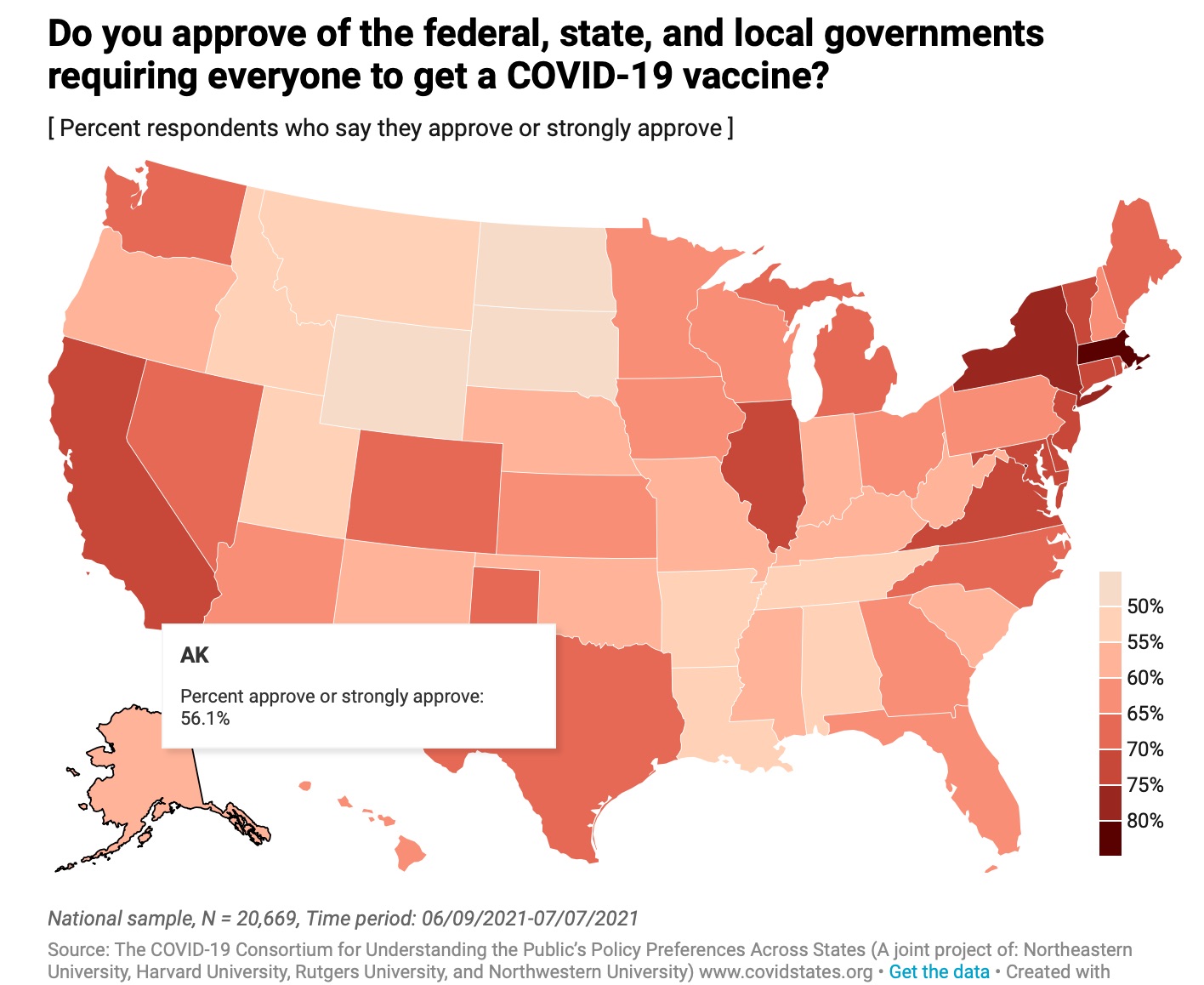
A poll conducted by Harvard University and other major research universities says that Alaskans, while not the most supportive in the “mandate” department among the 50 states, still has a significant majority of people who support mandatory Covid-19 vaccinations.
According to the survey results, 56.1 percent of Alaskans support mandatory Covid-19 vaccines. The highest state for supporting a vaccine mandate was Massachusetts, at 81.1 percent, followed by New York at 76.8, while the lowest support for a mandatory vaccine was Wyoming, at 45.7 percent.
The study took place between June 9 and July 7, 2021, when the universities surveyed 20,669 individuals across all 50 states plus the District of Columbia.
The survey was conducted by PureSpectrum via an online, nonprobability sample, with state-level representative quotas for race/ethnicity, age, and gender (for methodological details, see covidstates.org).
The results for Alaska seem unlikely, even when this data is backed by the nation’s most prestigious university, Harvard.

In Alaska, Donald Trump won 53 percent of the votes for president, and another 3 percent of the vote went for the Constitution Party and Libertarian Party candidates, for a total of about 56 percent.
Republicans in general have opposed vaccine mandates, and Libertarians and Constitution Party members are likely to feel even more strongly against mandates. In a survey done in Australia, even Green Party members were reluctant to support the “Jab or No Job” mandates, due to their skepticism of “Big Pharma.” Yet Harvard says Alaskans largely support mandates.
Must Read Alaska polled readers on Facebook with the question last month: Do you support vaccine passports to travel. Over 1,000 people answered the question — and the result was a resounding 100 percent “No.”
Harvard’s poll was the latest in a series of surveys the universities have been conducting since April 2020, examining attitudes and behaviors regarding COVID-19 in the United States. The repeat poll appears to have the intent of discovering pockets of resistance to help policymakers find ways to overcome them.
The survey work is supported by the National Science Foundation grants, and funds from the Knight Foundation, Russell Sage Foundation, and the Peter G. Peterson Foundation. Data collection was supported in part by Amazon.
About 70 percent of all U.S. adults are fully vaccinated against the coronavirus, but many of those who have not agreed to the vaccine have dug in their heels, as government and business mandates now are showing up repeatedly.
“The more worrisome news is that a persistent 20% – 30% of the public, depending on the poll, say they are either uncertain or will not get the vaccine. In our most recent surveywave (fielded from June 9 to July 7, 2021), 14.9% of respondents who claim to currently be eligible for a COVID-19 vaccine and say they are not already vaccinated indicate that they are extremely unlikely to get it. Another 4.5% are “somewhat” unlikely to seek the vaccine,” the Harvard report said.
“As the remaining unvaccinated population becomes increasingly difficult to reach, persistent questions emerge regarding whether vaccines should be mandatory in some or all circumstances. In our April/May survey wave, six in ten respondents approved of the government mandating vaccines for everyone.”
In the July report, the participating universities came away with a few bold conclusions:
- Overall, public support for federal, state, and local governments requiring that everyone be vaccinated remains very strong, ranging from 61% to 70%, depending on the specific type of mandate.
- Public support for such mandates has increased since April/May, both overall and in specific circumstances, like for getting on an airplane and returning to school or a university.
- These over-time increases in support emerge across nearly all partisan and demographic subgroups the study investigated.
Majorities of respondents in nearly all (45+) or all states and the District of Columbia approve of all four types of vaccine mandates the researchers suggested.
There remains a persistent gender gap in support for requiring Americans to get vaccinated, researchers noted, with men 9 percentage points more supportive than women (69% vs. 60%). This is about the same gender gap as the researchers found in April/May, when men were 8 points more likely than women to support mandatory vaccines for everyone (66% to 58%). That said, both genders are more supportive in June/July than they were in April/May (by 3 points for men and 2 points for women), the researchers said.
Asian Americans were the most likely to agree to vaccine mandates, while white Americans were the least likely. Whites were 18 points less likely to agree to mandates than Asian Americans.
“The partisan gap in support for vaccine mandates remains vast, with Democrats nearly twice as likely as Republicans to approve (84% vs. 45%). Interestingly, both Democrats and Republicans increased their support for vaccine mandates by 3 points from April/May, when we observed an identical 39 point gap. Independents, however, did not change their support level (57% in both survey waves),” the researchers said.
The Biden Administration said it will not impose national mandates, but has given the nod to private employers to create jab-for-job mandates for workers.
| National | Approval |
| AK | 56.1 |
| AL | 53.4 |
| AR | 50.8 |
| AZ | 60.1 |
| CA | 70.4 |
| CO | 66.5 |
| CT | 73.4 |
| DC | 80.5 |
| DE | 70.7 |
| FL | 64 |
| GA | 63.6 |
| HI | 64.1 |
| IA | 62.1 |
| ID | 50.7 |
| IL | 70.8 |
| IN | 55.7 |
| KS | 60.9 |
| KY | 56.9 |
| LA | 52.5 |
| MA | 81.1 |
| MD | 73.6 |
| ME | 65.9 |
| MI | 66.3 |
| MN | 62.1 |
| MO | 56.1 |
| MS | 55 |
| MT | 54.3 |
| NC | 65.3 |
| ND | 49.8 |
| NE | 57.5 |
| NH | 62.5 |
| NJ | 72.7 |
| NM | 57.3 |
| NV | 66.2 |
| NY | 76.8 |
| OH | 62.1 |
| OK | 55.8 |
| OR | 59.3 |
| PA | 61.2 |
| RI | 73.9 |
| SC | 57.4 |
| SD | 49.5 |
| TN | 53.2 |
| TX | 65.8 |
| UT | 51.8 |
| VA | 71.3 |
| VT | 71.8 |
| WA | 69.8 |
| WI | 61.2 |
| WV | 57.4 |
| WY | 45.7 |
What are your thoughts about this poll? Add them in the comment section below.