

Cryptocurrency’s fallen king Sam Bankman-Fried, who ran FTX into bankruptcy and now may be criminally charged for scamming money from investors, not only funded the campaigns of Alaska Sen. Lisa Murkowski, Alaska Congresswoman Mary Peltola, and the Alaska Democratic Party through his direct donations and funneled donations, he was indirectly funding left-leaning news organizations in Alaska, most notably the Anchorage Daily News. And he was funding a news group that defines what “misinformation” is.
“SBF [Sam Bankman-Fried] was heavily involved in Democratic Party politics: In the 2022 election cycle, he was the second most prolific funder of Democratic candidates after George Soros. But he wasn’t just a funder of electoral efforts. He funded both progressive and mainstream media organizations,” writes Robby Soave Reason Magazine.
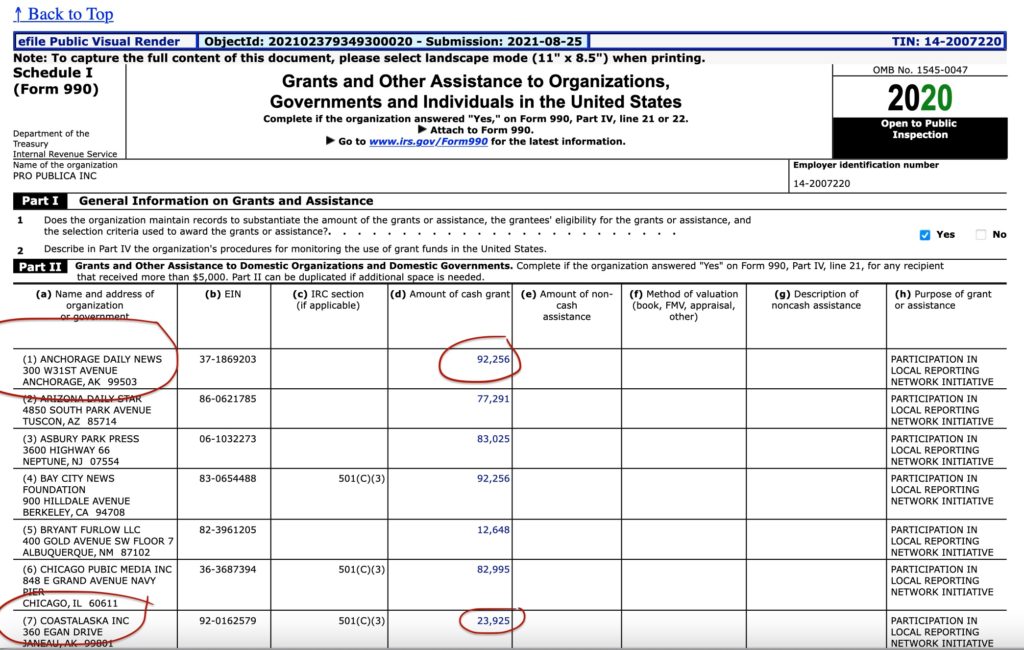
ProPublica, a nonprofit that pays for reporters to do investigative journalism, paid the salary of reporter Kyle Hopkins at the Anchorage Daily News in 2019, for participation in “local reporting network initiative.” The amount was $92,256.
This year, the FTX Foundation promised ProPublica $5 million, but has only made good on a third of the grant, leaving the news organization looking to other funders to make up the shortfall in what it has promised to media companies.
“One has to wonder how newsrooms will respond to S.B.F. [Sam Bankman-Fried] going forward. The then-billionaire hired a team of advisers who have been making investments in nonprofit and for-profit newsrooms over the last year, including in Vox, The Intercept, ProPublica, The Law and Justice Journalism Project, an international affairs podcast, and most prominently, Semafor,” wrote at Puck.news, which has been documenting the links between Bankman-Fried, FTX, and various non-profit and for-profit news ventures.
Some of ProPublica’s funding comes from George Soros’ Foundation to Promote an Open Society or other Soros-related charitable foundations. One of the biggest funders of ProPublica is a foundation called Crankstart, which is the family foundation of Sequoia Capital partner Michael Moritz.
Sequoia Capital is the fund that invested Alaska Permanent Fund Corporation money into FTX.
In 2019, the Anchorage Daily News received a grant from ProPublica as one of 14 newsrooms in the Local Reporting Network grant cycle, which was to support “investigative and accountability reporting at the local and regional levels.” CoastAlaska, a nonprofit that runs seven public radio stations in Southeast Alaska, also received a grant of nearly $24,000 from ProPublica that year.
The Anchorage Daily News used the funds to cook up a series of reports on how Gov. Mike Dunleavy had failed the people of rural Alaska by not providing enough law enforcement. Headlines such as “Citizens hide from active shooters as Alaska is slow to deliver on 2019 promise of village Troopers” and other headlines and sub-heads blaming Gov. Dunleavy for the lawlessness in village Alaska were the norm during a two-year timeframe when activists were also trying to recall the governor for other unfounded claims, such as so-called “loyalty pledges” that he supposedly required from executive branch appointees.
The newspaper and ProPublica won a Pulitzer Prize for the series.
Winning Pulitzers for projects that attack conservatives is just the kind of winning endeavor that someone like Sam Bankman-Fried would be interested in funding.

Other news organizations that FTX Foundation was funding included Vox, The Intercept, Semafor, the ProPublica Law and Justice Journalism Project, and a podcast.
One of the grants made by the FTX Foundation’s Future Fund was $500,000 for the Public Editor Project to “use a combination of human feedback and Machine Learning to label misinformation and reasoning errors in popular news articles.”
In other words, Bankman-Fried was funding the shaping of the narrative in the news by funding liberal news organizations and by deciding what was reasonable and what was misinformation.
Teddy Schleifer, a reporter for Puck, reports that Vox is a “progressive news web site created by liberal bloggers Ezra Klein and Matt Yglesias.” Vox Media owns New York magazine. The Intercept received a $3.25 million grant. Semafor, a new journalism site started by Ben Smith, formerly of the New York Times and Buzz Feed, was another liberal news site seeded with Bankman-Fried’s ill-gotten gains.
Robby Soave in Reason speculates that Bankman-Fried was also buying favorable coverage from the media. The link is not direct, but major news organizations have used a light touch in their coverage of FTX and Bankman-Fried’s intentions to reshape the world through his “Effective Altruism” project. After all, Bankman-Fried was also funding Democrats and scammy nonprofits, including one run by his brother that was influencing Covid policy in Washington, D.C.
The FTX charitable endeavor is octopus-like, with many arms and tentacles that supported Sam Bankman-Fried’s interest in climate change, pandemics, predictive technologies, and Democrats. In fact, Bankman-Fried was a major funder of Democratic Party politics; in 2022 he was the second only to George Soros.
“The FTX contagion now appears to be spreading to some of the nonprofits, academics, institutes and think tanks that allied themselves with or received money from the FTX Foundation, which was funded by profits from Bankman-Fried’s crypto exchange. The foundation claims to have donated $190 million,” wrote Forbes magazine.
Much of the foundation activities are not traceable or transparent. Bankman-Fried also had foundations that were sloppily run and whose activities are not clear. Some have no websites. Others are not listed with the IRS.
“It’s unclear how much of that money came from the foundation’s main giving vehicle, the Future Fund, which as of September had committed $160 million towards dozens of nonprofits and researchers; some of that money also was invested in companies whose profits would be redistributed to philanthropic causes. Recipients fell under the organization’s ‘areas of interests,’ which spanned artificial intelligence, space governance, combatting biohazards and climate change, but all under the banner of Effective Altruism: a philosophical movement that advocates doing the most good possible,” Forbes wrote.
“Individuals and organizations promised funds from the FTX Foundation are now grappling with the fallout, according to several that spoke with Forbes. One group says that it didn’t receive any funds at all from Future Fund, while another received only part of what had been promised. At least two that did receive money admit to feeling guilty–or even looking to rid themselves of the capital,” the magazine reported.
“Some of the Fund’s largest grantees were Effective Altruist groups with ties to MacAskill and Oxford. MacAskill mentored SBF for years and “nudged” him to take his first trading job at Jane Street Capital back in 2017, according to Sequoia Capital’s now-deleted 14,000-word fluff piece,” according to Forbes. Sequoia Capital, as mentioned much earlier in this story, is the group that invested Alaska Permanent Fund Corp. millions in FTX.
“To date, the Future Fund has given $30 million in grants to organizations that are part of Effective Ventures, a U.K.-based charitable entity chaired by MacAskill, according to the Future Fund’s June update. That includes Longview Philanthropy, a nonprofit started by two Oxford grads that ‘design and execute bespoke giving strategies for major donors,’ which was given $15 million; the Center for Effective Altruism, MacAskill’s main group, which received $13.94 million; and Non-trivial Pursuits, which received $1 million,” Forbes explained in this story.
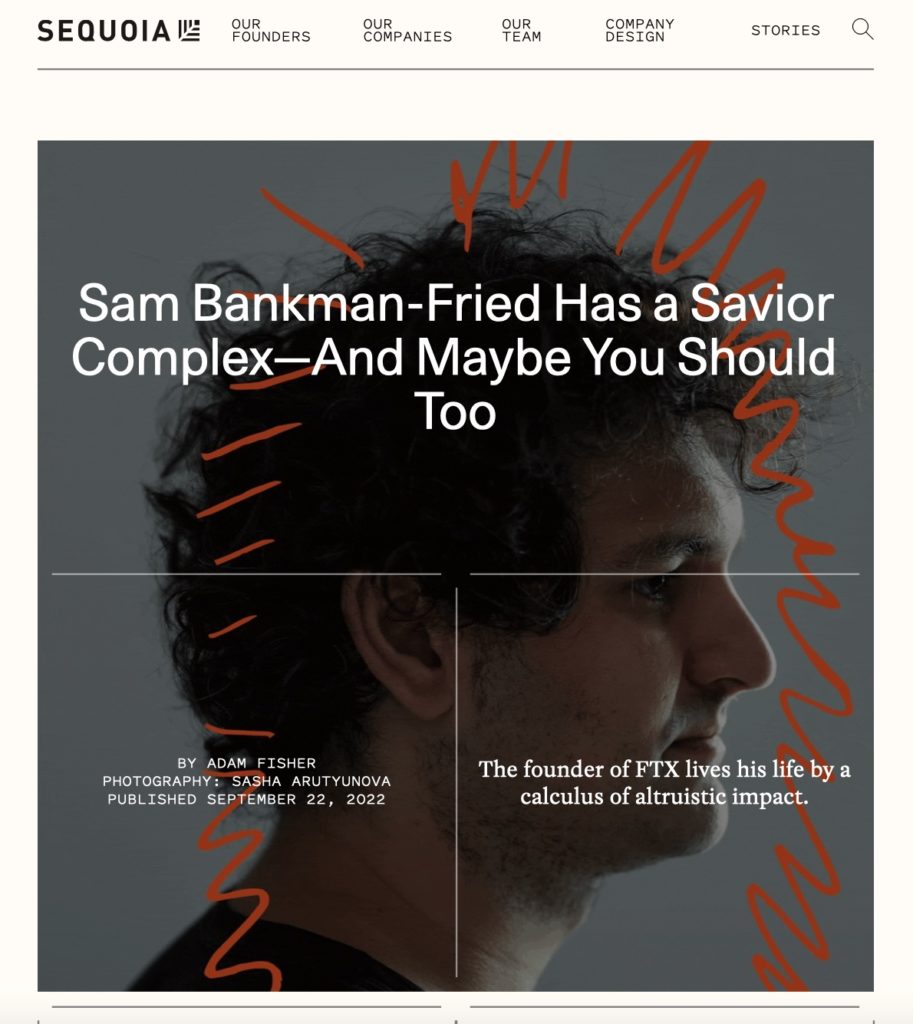
Read the fluff piece by Sequoia that the company doesn’t want you to see.



