I recently had the distinct honor of attending the ribbon-cutting ceremony for Holy Rosary Academy’s new campus on East 64th Avenue, and I left thoroughly enthralled by the beautiful, modern building this once-modest community has become.
Standing amid families, students, faculty, advisory board members, community leaders, and longtime supporters, it was impossible not to feel the weight of nearly four decades of faith, perseverance, and quiet determination that brought this independent classical school rooted in Catholic tradition to this moment.
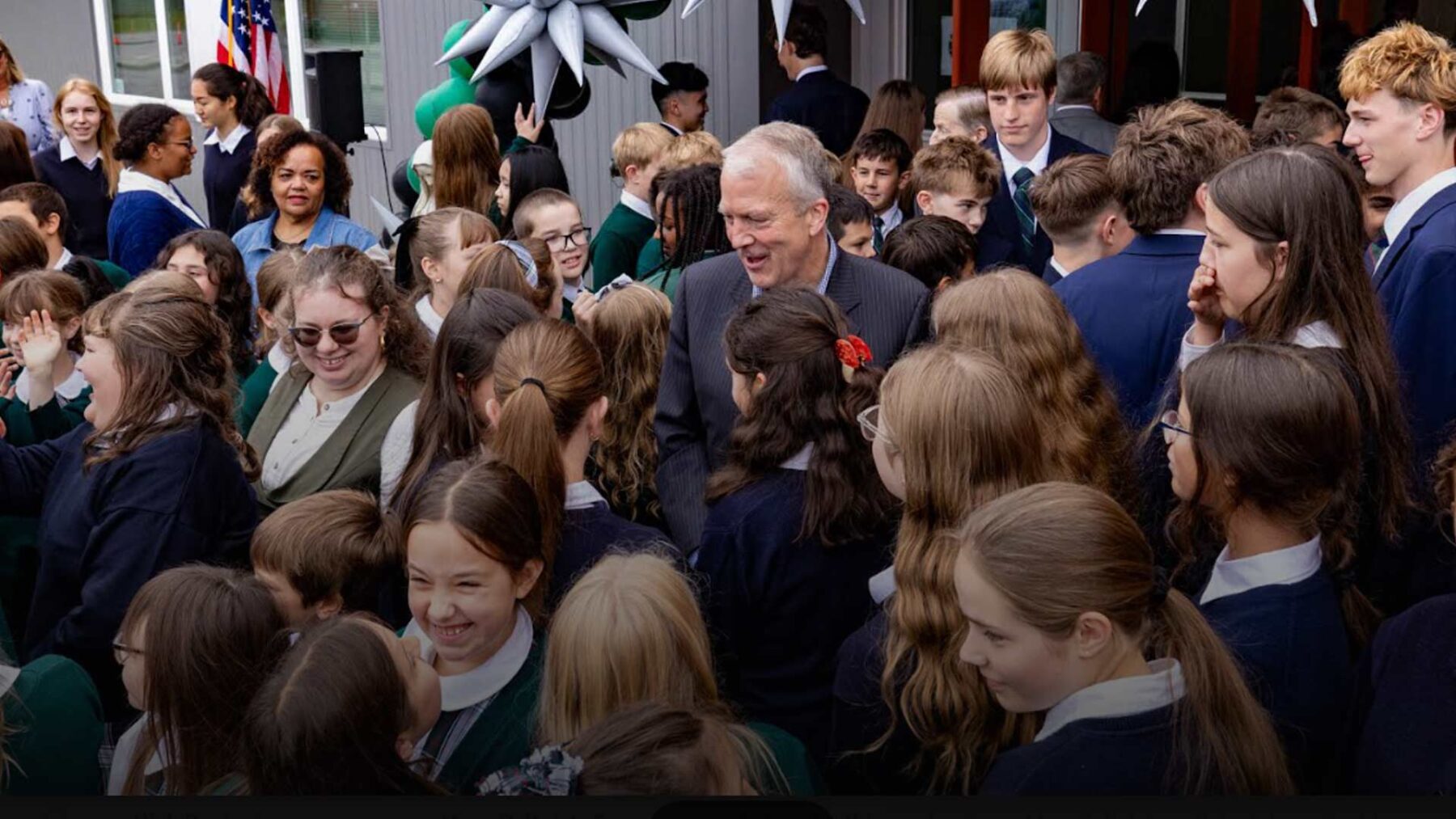
The air carried a palpable sense of shared accomplishment as the ribbon was cut and the doors formally opened. Children in uniform pressed close to the front of the crowd for a photo op, while parents and grandparents traded quiet smiles over decades of memories now folded into a single afternoon.
The new facility—a ten-year-old, two-story, state-of-the-art building formerly home to the Rilke Schule—feels both spacious and purposeful. Bright hallways and thoughtfully designed classrooms buzzed with the excitement of students and parents exploring their new home.
The move marks a significant chapter for a school long ranked among Alaska’s top private institutions. Its classical curriculum emphasizes the Trivium of grammar, logic, and rhetoric, paired with formation in faith, reason, and virtue—an approach that has drawn families seeking something more substantial than the standard educational fare, and that has only grown in demand as the school’s reputation has spread by word of mouth across Anchorage and surrounding communities.
Students will now learn, pray, and grow in spaces designed for the 21st century, yet the heart of the academy remains unchanged: an education that forms the whole person—mind, heart, and soul.
Opening remarks were given by Principal Mary Louise Schirda and current School Board President Jim Dixon, who were followed by Senator Dan Sullivan, whose remarks resonated deeply with the school’s foundational principle of forming the whole person in partnership with parents.
Drawing on his own experience as a Catholic-school student, and noting that all three of his daughters attended Catholic school, he underscored the value of institutions like Holy Rosary, which partner with parents to form young people academically, in character, and in faith.
Representatives from the Anchorage Chamber of Commerce were present, along with representatives from both the current and former mayor’s offices. Their collective presence signaled that the school’s contribution to Anchorage’s educational landscape is recognized well beyond its own walls, a recognition earned not through publicity but through decades of steady, faithful work.
At the center of the academy’s story stands the family of the late Vernon and Madeleine Hickel of Anchorage. I spoke with several members of the Hickel family in attendance, who shared their memories of Holy Rosary’s early, humble beginnings.
In 1987, Vernon Hickel opened the entire lower level of the family’s Westwood Drive home—where the family had lived since moving there after the 1964 earthquake from their first residence on 25th Avenue—to a small group of Catholic parents seeking a rigorous, faith-grounded education.
What began as a homeschool co-op, originally called Our Lady of the Rosary and using curriculum from Bardstown, Kentucky (operating under the DBA Holy Rosary Academy), quickly grew under the conviction that this formation belonged to every family who desired it, not merely an elite few.
Inspired by the post-Vatican II call to the laity, Vernon and his sons renovated a property on Lakeshore Drive donated by a man named Bob Betz, building classrooms and a playground; enrollment rose from about 11 to 50 students, and the property was later willed to the school.
When space ran short, the family renovated their original 25th Avenue home into a chapel that would soon be incorporated into the campus on Fireweed, which later acquired an adjacent high-school building.
Over four decades, the combined construction talents of the Hickel family have maintained and improved every facility. Most recently, Pete and Vern of Hickel Construction and Engineering once again brought their expertise to the school, working on the new campus’s lunchroom and upstairs chapel.
Several of Vernon Hickel’s adult children and other extended family members have served on the school board. Many of the family’s children and grandchildren have attended, continuing the family’s multi-generational commitment.
That same spirit of partnership and openness still defines the school. Students from many different backgrounds come because they love what Holy Rosary is and what it teaches.
The mission has always been solidly Catholic, offering truth, beauty, and a classical education so that every child can become whatever God calls them to be. It is not a prep school for the gifted or affluent, but a community that assists parents as the primary educators of their children.
What struck me most was the seamless continuity between humble beginnings and present reality. The same commitment to the great books, Latin, Greek, and the pursuit of truth, goodness, and beauty continues to shape every classroom.
As the new doors opened, gratitude and hope filled the afternoon. In an era when many institutions struggle to maintain a clear identity, Holy Rosary Academy stands as a quiet testament to what faith, family, and steady hard work can achieve.
The impressive new building is only the latest chapter; the true achievement is the living community—parents, alumni, grandparents, civic leaders, and students—whose lives have been shaped by an enduring vision.
Last week’s ribbon cutting was not merely the opening of a facility; it was the public affirmation of a tradition that continues to bear fruit in Anchorage’s Catholic and classical educational landscape.
For a community that began with eleven students in the lower level of a family’s home, the new campus is a striking measure of how far faithfulness to Christ can carry an idea—and a reminder that the schools shaping our children’s souls are often built not by institutions, but by families willing to give everything they have.