

By DAVID BOYLE
The Anchorage School District has put itself in a real financial bind. Over the years, the district has lost students while maintaining the same infrastructure.
Now, the school board must make the difficult decisions on how to close a $68 million budget gap. Some solutions put forth include school closures/consolidations, eliminating language immersion classes, and elimination of the gifted Ignite program.
Each of these programs has its own vocal supporters. At its Oct. 4 meeting the board room overflowed with parents and students who were strong supporters of the several language immersion programs. They testified to the value of the programs.
Although these language programs are of value to a small group of students, the question to the board should be, “Can students learn languages just as well without immersion programs?” It is important to look at the greater good; however, expect a huge push back from the supporters.
The most obvious area to target in reducing expenses is the closing/consolidation of excess schools.
The Fairbanks North Star Borough School District did just that when it decided to close three elementary schools for the current school year. It estimated a cost savings of about $1 million per school.
On the other hand, the Anchorage School District estimates only about half a million dollars to close one elementary school.
The district states that today it has 18 schools operating at less than 65% capacity. According to the latest Capital Improvement Plan, 16 of these are elementary schools.
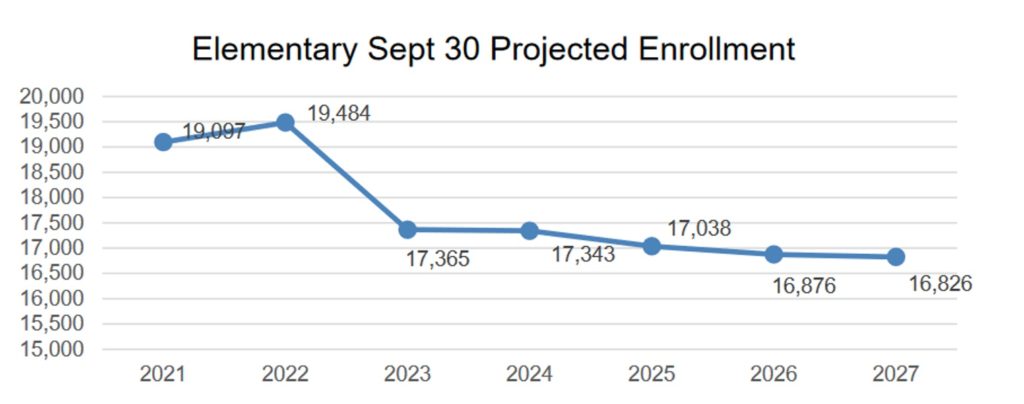
And the number of elementary students is projected to decrease more than 2,500 by the 2027/28 school year.
Add to this a bigger issue—are these the only schools with less than 65% capacity? And how does the district compute school capacity?
One thing for sure, the district does not use the State’s specification of 114 square feet/student for calculating elementary school capacity. Instead, it uses its own specification called “Program Capacity.”
Through this Program Capacity, the district has changed the school capacity metric at least twice during the past 12 years.
As an example, using the State’s specification for Kincaid, Russian Jack and Lake Hood Elementary Schools, each would have a capacity of 536 students. Using the ASD “Program Capacity,” Kincaid would have room for 484 students, Russian Jack would accommodate 399 students, and Lake Hood would hold 515 students.
The total difference is 210 fewer students using the district’s specifications versus the state’s specifications.
By using its own specification, the district has manipulated the data to show that schools are at higher student occupancy rates when there is really excess capacity.
Using Inlet View Elementary School as an example, here is how the district changed its specification over the years. All these data are from the ASD Capital Improvement Program documents. Note there were no substantial changes to the building itself to increase square footage. The building did not shrink.
Inlet View Elementary School Capacity
Year Student Capacity
2011 235
2013 243
2014 271
2015 271
2016 233
2017 170
2022 170
However, even the district’s data show that there is extra space, i.e., buildings, that either need to be closed or repurposed. In the case of Inlet View ES, there are several nearby schools with unused capacity. Here is a map showing how the Inlet View students could be transferred to nearby schools (the percentages are the district’s capacities):
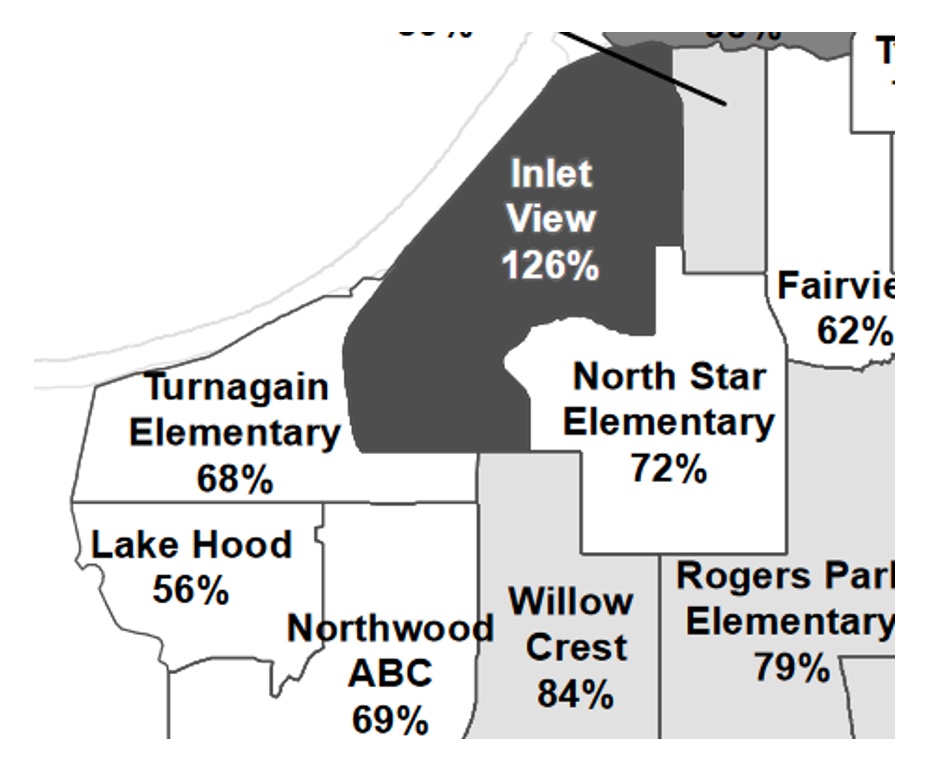
The school district could save monies and at the same time increase the teachers in other schools to meet those students’ needs. If this is true for Inlet View ES, then the significant change in student capacity may be true for other elementary schools.
But the school board, in defiance of Anchorage voters, is unnecessarily considering building a new Inlet View school. Anchorage voters said “no” to this on last year’s ASD bond issue.
Here is a list of the 16 elementary schools with ASD Program Capacity (2022 Capital Improvement Plan) and the State Capacity (114 sq ft/student):
| SCHOOL | ASD CAPACITY (%) | STATE CAPACITY (%) |
| Abbott Loop | 65 | 49 |
| Aurora | 58 | 49 |
| Baxter | 49 | 39 |
| Birchwood ABC | 51 | 48 |
| Eagle River | 55 | 51 |
| Fairview | 62 | 51 |
| Fire Lake | 57 | 54 |
| Homestead | 55 | 60 |
| Kasuun | 61 | 53 |
| Lake Hood | 56 | 53 |
| Mirror Lake | 58 | —– |
| Mt View | 65 | 60 |
| Nunaka Valley | 58 | 49 |
| Orion | 49 | 34 |
| Russian Jack | 59 | 51 |
| Wonder Park | 55 | 58 |
The above State capacities do not make allowances for supplemental capacities but only show the State’s basic square foot allowance per elementary student.
It gets worse.
The total “Program Capacity” for elementary schools today would hold 26,432 students. The actual number of students in 2022 was 19,484, a nearly 7,000 student excess capacity.
There is even a further downward trend in the future until the projected number of elementary students is 16,826 in 2027, nearly 10,000 students fewer than the district’s capacity.
Language immersion, ABC curriculum (Birchwood Elementary School), and the Ignite programs are much more important than the building infrastructure.
It will be difficult for the board to withstand the pressures of the various community interests. But the excess infrastructure needs to be closed/repurposed so revenue can be focused on the classroom—where education happens.
This would benefit the community, especially the students.
David Boyle is an education writer for Must Read Alaska. He is former executive director of the Alaska Policy Forum.
Schools vs. parents: Anchorage public schools secretly affirmed a student’s transgender leanings



