
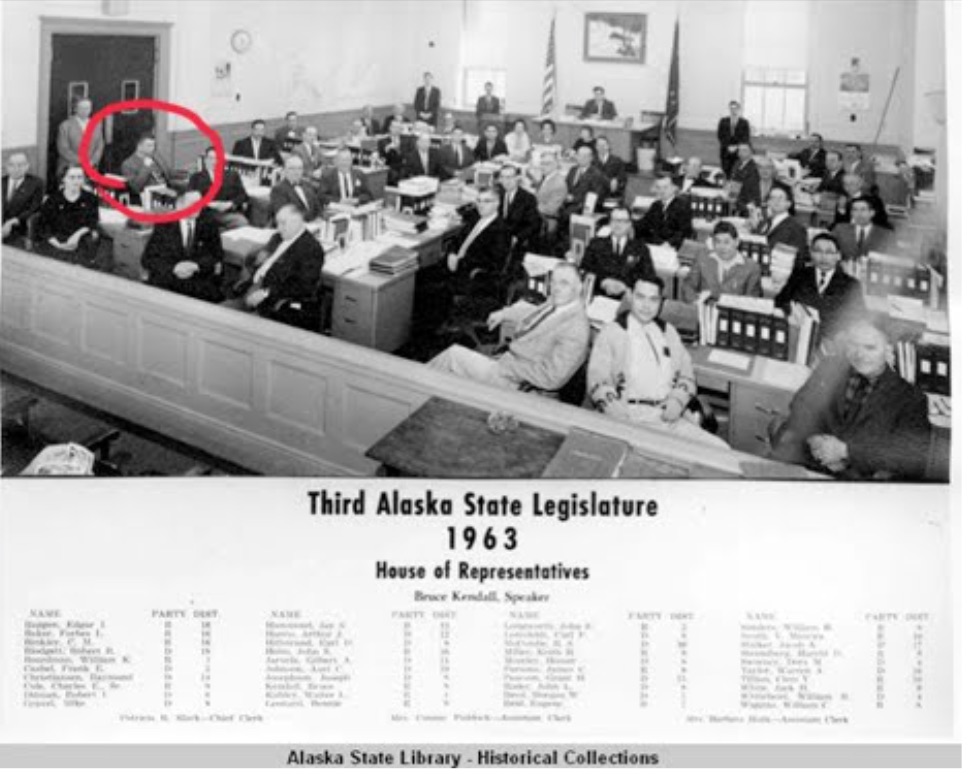
2021 year is not the only year when the Alaska House of Representatives is split 20-20 between caucuses.
In 1963, the House had the same trouble organizing, and could not even elect a Speaker Pro Tem for a few days.
Notable members of that session included Warren Taylor, for whom the Taylor Gallery is named; Jay Hammond, who became governor; Joe Josephson, father of Rep. Andy Josephson; John Holm, father of former Rep. Jim Holm; and Carl Lottsfeldt, the grandfather of current lobbyist/political operative and MidnightSunAK blog publisher, Portland resident Jim Lottsfeldt.
SUMMARY OF ACTIONS – Convening/Organizing
- Secretary of State Hugh Wade swore in the membership of the new House.
- Warren Taylor-D and Jay Hammond-R were nominated as Pro Tem by their respective sides. Taylor, born in 1891 in Chehalis, Wash., had served as the first Speaker of the 1st Alaska Legislature. They were voted on by the body three times, failing each time 20/20.
- Following the three failures, a motion was made to propose a 3-member committee in an attempt to resolve the impasse. That failed 20/20.
- Taylor and Hammond were voted down two more times for Pro Tem, 20/20
- Taylor nominated an alternate, Dora Sweeney for Democrats, but that vote failed, 20/20.
That was just Day 1. The House adjourned with no progress toward even getting a Speaker Pro Tem.
On Day 2, both sides nominated the same two candidates — Sweeney and Hammond, and that vote failed 20/20. The sides reverted to their original nominees, Taylor and Hammond, and that failed 20/20.
Taylor once again nominated Dora Sweeney. Along with Hammond, they both failed 20/20.
Over the next few days, the motions kept being made and failing, until Day 4, when an eight-member committee was appointed, with four members from each caucus. The committee was to propose a way to end the impasse. The committee was approved 21/19.
The joint/bipartisan committee met in the chambers, with staff, the press, and the public in attendance. The vote to allow the committee to use the chambers passed 38-2 with only Josephson and Lottsfeldt voting no.
The group came up with the following method for electing a Pro Tem, and then a Speaker:
- Each caucus was to nominate two members for Pro Tem and Speaker.
- Members were called up one at a time to the Clerk’s desk to cast a secret ballot.
- After the first round of voting, the lowest vote getter was eliminated from future rounds of voting.
- On the second round of voting, the top vote-getter was elected Pro Tem.
- Then the process was repeated to elect a Speaker.
- The eight-member committee proposed that whoever was elected Speaker, their party would be the majority.
- On Day 8 of the legislative session, Bruce Kendall of Anchorage, was elected Speaker. Kendall later changed his party registration to Democrat.
Read the House Journal from 1963 at this excerpt:


