When I came to Alaska in the mid-1960s, the words “North to Alaska” still carried a special energy. John Wayne’s 1960 film had helped project an image of Alaska as a place where people went toward something: toward work, adventure, independence, risk, opportunity, and a chance to build a life that might not have been possible somewhere else.1
That picture was romanticized, of course. Real Alaska was colder, harder, more complicated, and far more diverse than Hollywood could capture. But the feeling was real. Alaska drew people who were willing to work, improvise, endure distance, help a neighbor, and take responsibility for what came next. We did not come north expecting someone else to build everything for us.
“North to Alaska” once meant going toward possibility. The question for us now is: What are Alaskans going toward today?
That is where the Spirit of Alaska begins. It is not nostalgia for one movie, one generation, one industry, one political party, or one famous Alaskan. It is a civic character — a way of seeing this place and our responsibility to it.
A spirit bigger than any one person
Harold Heinze represents one expression of that spirit. He was an engineer, an industry leader, a former president of ARCO Alaska, and in 1991 Alaska’s Commissioner of Natural Resources.2 In public testimony he argued that Alaska should look beyond bitterness and confrontation and seek an “enhanced future” for North Slope development — a future tied to the interests of Alaska’s people.3
Alaskans can disagree with Heinze on particular policies and still recognize the deeper instinct: Alaska should not be merely a place from which wealth is extracted, nor a place that waits helplessly for decisions made elsewhere. We should understand what we have, protect what must be protected, develop what can be responsibly developed, and insist that the result makes Alaska stronger.
That same spirit can be seen in many different Alaskans: the pipeline worker, the commercial fisherman, the village elder, the miner, the teacher, the homesteader, the bush pilot, the small-business owner, the engineer, the nurse, the young family trying to stay here, and the person who simply refuses to accept that Alaska’s best days must be behind us.
The Spirit of Alaska belongs to no party, no corporation, no governor, and no institution. It belongs to the people who are willing to carry Alaska forward.
The promise was written down
What makes this more than sentiment is that Alaska’s founders placed the same idea into our Constitution. Its Preamble speaks of being “grateful to God” and to those who founded the nation and pioneered this land, and declares a purpose to “secure and transmit to succeeding generations” our heritage of political, civil, and religious liberty.4
Article I, Section 2 then places political authority where it belongs: “All political power is inherent in the people.” Government originates with the people and exists for the good of the people as a whole.
And Article VIII gives Alaska an unusually direct resource promise. The State is to encourage development and maximum use consistent with the public interest, while the Legislature must provide for Alaska’s natural resources to be used, developed, and conserved “for the maximum benefit of its people.”
Liberty. The people. Responsible development. Maximum benefit. An inheritance passed to the next generation.
Those are not disconnected phrases. Together they form something close to a constitutional definition of the Spirit of Alaska.
How do we awaken it again?
We will not restore that spirit by telling Alaskans only what is wrong. Anger can awaken attention, but it cannot by itself build a state. People need something worth moving toward. The answer is to reconnect Alaskans with their own story and then give them meaningful work to do together.
1. Tell the Alaska story again. Record short, honest stories from every part of the state. Ask elders, workers, Native leaders, fishermen, builders, teachers, veterans, young entrepreneurs, and families one simple question: “What does the Spirit of Alaska mean to you, and what do we owe the generation that comes after us?” Put the people before the politicians.
2. Recover the builder’s mindset. Celebrate people who solved hard problems instead of merely describing them. TAPS, rural aviation, ports, roads, fisheries, telecommunications, energy systems, schools, and local enterprises all required courage, engineering, compromise, and persistence. The lesson is not that every old decision was right. The lesson is that Alaskans once expected to build.
3. Put the Constitution back in ordinary hands. The Alaska Constitution should not be treated as a document that belongs only to lawyers, judges, agencies, or legislators. Make its central promises understandable: political power belongs to the people; liberty is an inheritance; resources are a public trust; and government exists for the good of the people as a whole.
4. Give young Alaskans a reason to stay. A movement about Alaska’s past will fail unless it opens a door to Alaska’s future. Young Alaskans need to see pathways to skilled work, ownership, housing, energy security, resource careers, technology, entrepreneurship, and public service. The Spirit of Alaska must mean that a young person can build a future here — not merely remember what earlier generations built.
5. Replace permanent division with constructive argument. Alaskans have always argued. We should. But disagreement need not become contempt. The test should be: Does this proposal preserve liberty, respect the public interest, strengthen Alaska’s productive capacity, and leave the next generation better off? That gives people with different politics a common measuring stick.
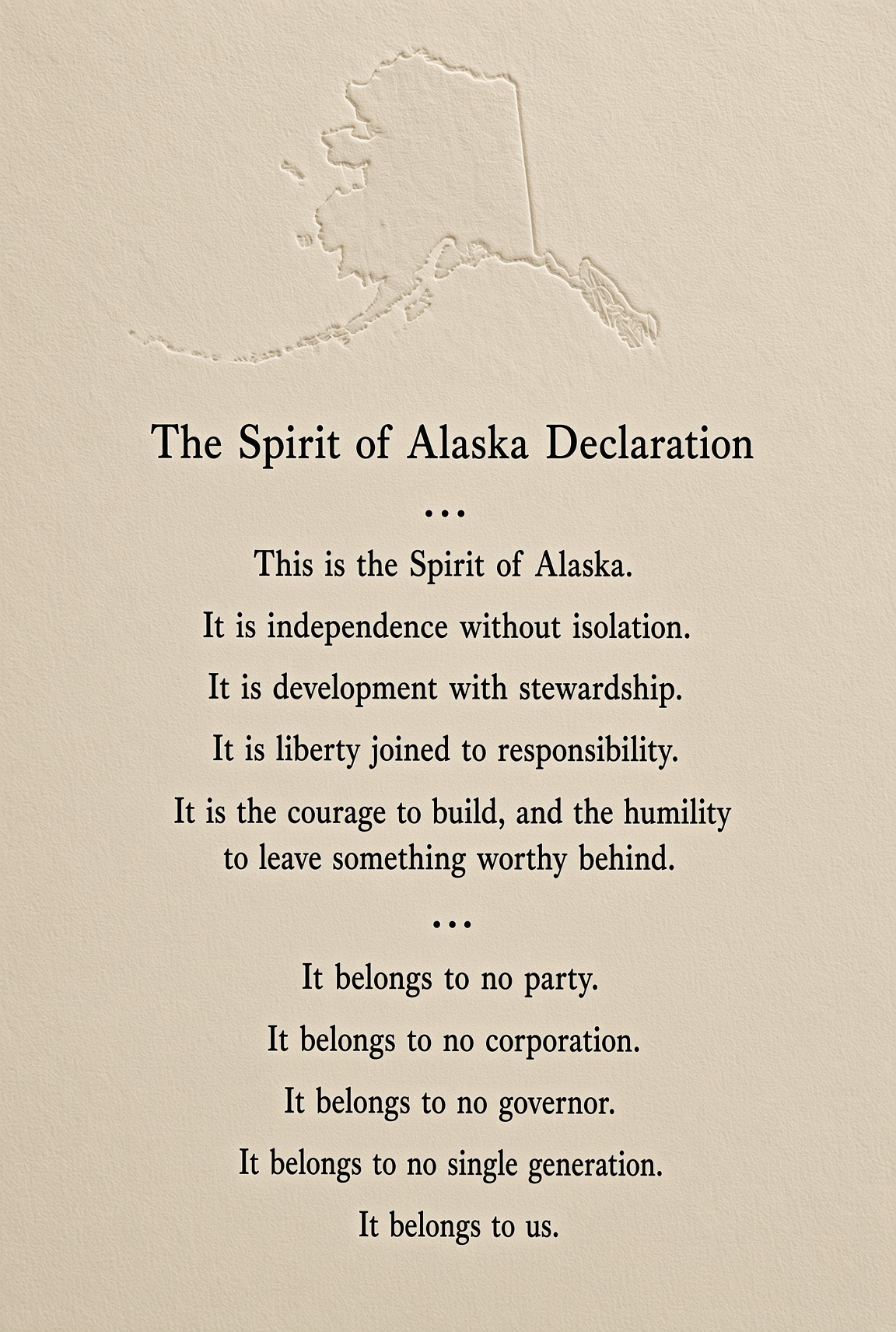
6. Create a Spirit of Alaska Declaration. Invite Alaskans from every region and background to sign a short civic declaration — not a party platform — committing to liberty, stewardship, honest government, responsible resource development, local initiative, and the duty to leave Alaska stronger than we found it.
The Spirt of Alaska Declaration
We are Alaskans.
We inherited a place unlike anywhere else on Earth — not merely land and resources, but an obligation.
Those before us crossed mountains, worked frozen ground, fished dangerous waters, built communities, raised families, defended this country, constructed great projects, and believed that tomorrow in Alaska could be greater than today.
Our Constitution gave that inheritance a promise: liberty is to be transmitted to succeeding generations; political power belongs to the people; and Alaska’s resources are to be managed for the maximum benefit of Alaska’s people.
This is the Spirit of Alaska.
It is independence without isolation.
It is development with stewardship.
It is liberty joined to responsibility.
It is the courage to build, and the humility to leave something worthy behind.
It belongs to no party.
It belongs to no corporation.
It belongs to no governor.
It belongs to no single generation.
It belongs to us.
Once, “North to Alaska” called people toward a frontier. Today our call should be just as clear: North to Alaska — not to retreat into the past, but to recover the courage that built this state and use it to build the next Alaska.
Let us remember who we are.
Let us pull together where we can.
Let us argue honestly where we must.
And let us leave Alaska freer, stronger, more productive, and more hopeful than we found it.
A Simple Measure
Whenever Alaska faces a major decision — about resources, energy, government, education, infrastructure, public money, or the Permanent Fund — perhaps we should ask a question simple enough for every citizen to understand: Will this decision preserve our liberty, honor the public trust, and leave a stronger Alaska to the generation that follows us?
If we can make that question part of Alaska’s civic life again, the Spirit of Alaska will not need to be manufactured. It will already be there — waiting to be remembered.
Historical note: The phrase “North to Alaska” is used here as a cultural reference to the 1960 film and to the sense of possibility associated with Alaska during the era. The personal recollection of arriving in Alaska in the mid-1960s is the author’s own.
- American Film Institute Catalog, “North to Alaska” (1960), listing John Wayne in the cast and a November 1960 release. https://catalog.afi.com/Film/53235-NORTH-TO-ALASKA ↩︎
- Alaska Department of Natural Resources, historical list of DNR commissioners, identifying Harold Heinze as the 1991 commissioner, a Hickel appointee and petroleum engineer. https://dnr.alaska.gov/commis/dnrcommissioners.htm ↩︎
- Harold Heinze, testimony before the Alaska Legislature Joint Committee on Mergers, July 28, 1999. Heinze identified himself as a former president of ARCO Alaska and former DNR commissioner and argued for an “enhanced future for North Slope oil development.” https://www.akleg.gov/pdf/billfiles/Committee%20Bill%20Files/1999-2000%20-%2021st%20Legislature/SCOMM%20117%20HMER/HMER21%2007-28-1999%20Meeting.pdf ↩︎
- Constitution of the State of Alaska, Preamble; Article I, Section 2; Article VIII, Sections 1-2. Office of the Lieutenant Governor. https://ltgov.alaska.gov/information/alaskas-constitution/ ↩︎