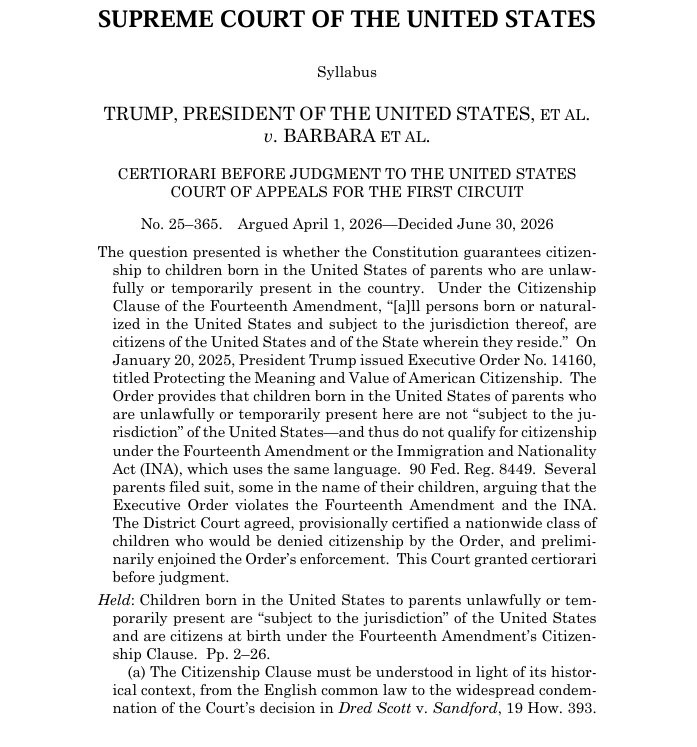
The Supreme Court on June 30, 2026, ruled that children born in the United States to parents who are unlawfully present or temporarily visiting the country are citizens at birth under the Fourteenth Amendment’s Citizenship Clause. In a 5-4 decision in Trump v. Barbara (No. 25-365), the Court invalidated key provisions of Trump’s Executive Order titled “Protecting the Meaning and Value of American Citizenship.”
Chief Justice John Roberts authored the majority opinion, joined by Justices Sonia Sotomayor, Elena Kagan, Amy Coney Barrett, and Ketanji Brown Jackson. The Court held that children born on American soil to illegal immigrants or temporary visitors are “subject to the jurisdiction” of the United States and therefore citizens under the Clause. The decision affirmed a district court’s nationwide preliminary injunction blocking the Order.
The majority grounded its ruling in English common law principles of jus soli— citizenship by birth within the sovereign’s territory— as reflected in Calvin’s Case and Blackstone’s Commentaries. Under this tradition, children born within a sovereign’s dominions owed natural allegiance in exchange for protection, subject only to narrow exceptions such as children of foreign ministers. The Court explained that the Citizenship Clause was enacted to overrule Dred Scott v. Sandford and to constitutionalize the principle already expressed in the Civil Rights Act of 1866, which granted citizenship to “all persons born in the United States and not subject to any foreign power, excluding Indians not taxed.”

The Court concluded that the phrase “subject to the jurisdiction thereof” refers to the U.S. government’s governing power within its territory rather than a requirement of permanent parental domicile or complete severance from foreign allegiance. Temporary visitors and even those present unlawfully remain amenable to U.S. law while on American soil. Relying on United States v. Wong Kim Ark (1898), the Court reaffirmed that children of aliens temporarily sojourning in the United States are citizens. It rejected arguments for a domicile requirement as lacking support in the historical record from the Founding through Reconstruction.
Justice Ketanji Brown Jackson filed a concurring opinion, joined in part by Justice Sotomayor. She emphasized the Fourteenth Amendment’s universalist and anti-subordination purposes. Jackson argued that the Clause reflects a broad commitment to equality and the eradication of caste systems, extending beyond the specific circumstances of freed slaves to all persons born on U.S. soil. She argued that attempts to limit citizenship based on parental immigration status would distort the Amendment’s remedial aims.
Three Justices dissented in whole or in part. Justice Clarence Thomas, joined by Justice Neil Gorsuch, authored the principal dissent. He contended that the majority adopted an overly broad, feudal notion of allegiance based solely on territorial birth. In Thomas’s view, post-Revolution American law increasingly required domicile (a permanent home with intent to remain) for full citizenship and complete jurisdiction. The Citizenship Clause, he argued, primarily secured citizenship for freed Black Americans who were domiciled here and owed no foreign allegiance. Children of temporary visitors or unlawful immigrants, according to the dissent, historically remained subject to their parents’ home countries and were not understood to be U.S. citizens.
Justice Samuel Alito filed a separate dissent, joined in part by Justice Gorsuch. He focused on the text of the Civil Rights Act of 1866, which the Fourteenth Amendment constitutionalized. Alito interpreted “not subject to any foreign power” to exclude children who would automatically acquire the nationality of their parents’ native country at birth. He argued that the majority’s rule creates problematic dual nationality and departs from the original public meaning of the Clause.
Justice Brett Kavanaugh concurred in the judgment but dissented in part from the majority’s constitutional analysis. He agreed that the Executive Order could not stand under 8 U.S.C. §1401(a), the statutory provision codifying the Citizenship Clause and long interpreted in line with Wong Kim Ark’s limited exceptions. However, Kavanaugh suggested that constitutional principles might accommodate additional exceptions in light of modern immigration realities and emphasized that Congress retains authority to address the scope of citizenship through legislation consistent with the Fourteenth Amendment.