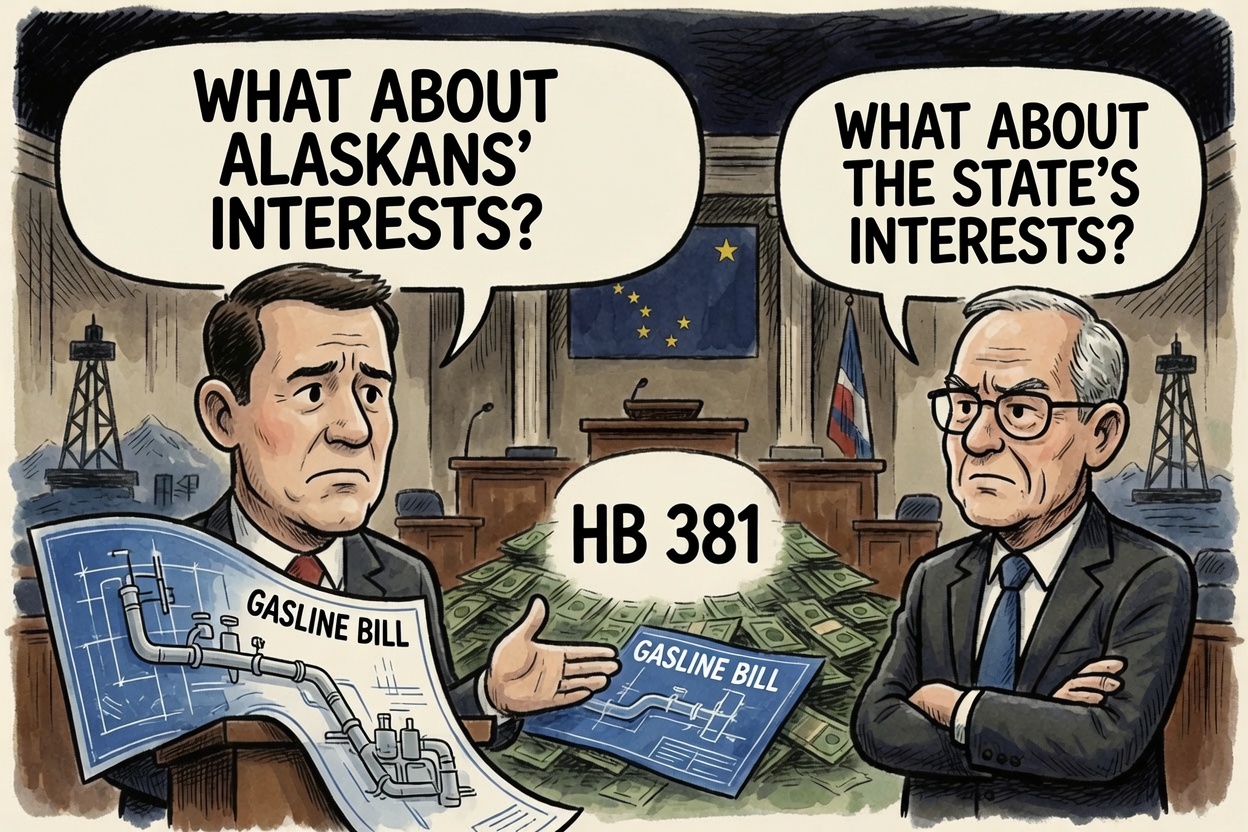
Today, July 2, 2026, legislators held a conference committee meeting to continue work on HB 381, a bill to provide a workable tax structure for the Alaska LNG project. At the end of the meeting, Representative Justin Ruffridge (R-Soldotna) and Senator Bert Stedman (R-Sitka) summed up their positions on the bill: Rep. Ruffridge expressed concern that the bill attempts to prioritize the State above Alaskans by seeking “maximum government take;” Senator Stedman counterargued that the bill may provide “too aggressive” a tax cut.
Rep. Ruffridge asks the conference committee to start asking how to structure the bill to best solve Alaskans’ energy needs rather than structuring the bill around the question, “How much can we extract from this project?”
On the other hand, Senator Stedman posits that even “if you take the tax rate to zero, it still doesn’t get this project over the line financially.” Rather than arguing for legislation that helps the economics of the project, Senator Stedman places the financial viability of the project firmly on the developer’s shoulders and argues that HB 381 gives a “significant reduction in the tax burden on this gasline” that may be “a little too aggressive.”
Below are transcripts of Rep. Ruffridge’s and Senator Stedman’s remarks at the end of today’s conference committee meeting. The transcripts were produced using AI and then checked and edited by Must Read Alaska for accuracy and readability.
Rep. Ruffridge: But What Is In the Best Interest of Alaskans?
“I believe that there are some items with this conference committee document that are potentially problematic. I understand that the will of the committee is to adopt it as a work draft and a work draft only. But I think we’re headed down a path where— if you think, Mr. Chair, of just a molecule of gas for example, a molecule of gas in this state, if we are to produce a project, it’s going to go through royalty payment. That’s step number one. It’s going to be taxed for its production.
“It’s going to be taxed for its gas treatment, taxed for its transport, taxed for its export, and then also pay sales tax on its use in the state. And, this working document I think proposes that the company or companies or entities developer attempting to make profit, or, you know, a business opportunity off of the sale or transport or export of that gas are then taxed again by our state and then taxed again by the federal government. And I think Mr. Chair, from my perspective, I think our we should ask ourselves on this committee: Is the working document right now headed in the best interest of Alaskans? Maybe it is. I certainly still have some concerns.
“I think that we’ve been hearing from this committee level that time is critical. We have an open window. I know Alaska’s geographically diverse, and maybe some of that critical element isn’t as pertinent to each of the committee members. The gas line project potentially doesn’t affect each of us the same. But I believe we really don’t have the luxury of waiting to deal with some of these issues further, and I believe we need a plan to utilize our stranded natural gas.
“Cook Inlet production— we’ve heard that over and over and over again is not keeping up. Potentially by 2029, our utilities are going to have to make a decision: Do we burn diesel? (And there’s people at this committee table that know a lot about burning diesel. It’s not ideal.) Or we import natural gas. And these are both negative options. Or we have before us a document that I think, Maybe could help us get down the road, a pace where we can have another option. So I think we have a duty at this table. And I think that duty is something that we’ve all taken seriously to help solve that problem. I worry about a few provisions in this bill right now that maybe go a step too far.
“I think that we’re worried about solving a provision that we’ve been worried about for longer than I’ve served in the Legislature— that’s the S-Corp provision. And we’ve known for decades that our property tax system is unworkable for a project of this magnitude. And we’ve had a chance to do that before; we didn’t take it. We have a chance in front of us to do that now, And I think we don’t need to put additional barriers in front of this thing.
“And I see in this bill additional barriers, and maybe that’s the intention. Is to try to find a fine line that we can draw that brings people together on this, but Mr. Chair, I think we’ve heard over and over that we have to protect the state’s interest. That’s what we’ve heard from the table, And I want to ask the question: What about protecting the interest of our constituents who I think have been worried for quite some time about what the answer is going to be to their energy solutions? And we are seeking maximum government take. I think in here, we have asked the question: How much can we extract from this project?
“And I think we’ve missed the fact that we are asking potentially to put on the line jobs, cheap energy, and potentially a boon to Alaska’s economy in the form of revenue. This project brings forward a significant amount of revenue if it’s built. And I think we might be putting some of those things at risk while we’re asking for reports, while we’re asking to meddle in required local contribution as well as talk about S-corp taxes.”
Senator Stedman: Economic Viability is Developer’s Problem; HB 381 Gives Aggressive Tax Reduction
“I have a little different view. We have a property tax established in 1974 for twenty mills of our oil and gas, and that is a significant tax. And it hasn’t been updated, and it particularly deals with the North Slope. We had eliminated that twenty mill rate for the construction of the gasline during the construction phase several years ago. So, there is no property tax. Now, we’re looking at relinquishing most of that tax on a gasline, but the economics of putting the project forward do not work at twenty mils. You cannot get it over the line. We’re talking about a couple hundred million dollars a year more in debt service.
“So, they need some relief through construction and then after first gas to make their economics work, and that’s what we are talking about here. And then we’re scaling down the old twenty mil rate. We’re scaling that down substantially for the first several years, and then we ratchet it back up as their economics become more favorable.
“We are not changing the severance tax. We’re not changing the corporate income tax. We’re not changing the royalty rates. The gas is taxed at the point of production before it goes into the treatment plant. We’re looking at the treatment plant through tidewater. We’re not looking at upstream.
“So, there is a portion in this bill dealing with a pass-through entity tax that we will be working on the next few weeks. But this is a significant reduction in the tax burden on this gasline— any way you cut it. And some of us are concerned maybe we are a little too aggressive in that direction. But if you take the tax rate to zero, it still doesn’t get this project over the line financially. So, there’s more work to be done by the developer to get this project economic.”
Full Meeting Audio
Listen to the full July 2 conference committee meeting here: