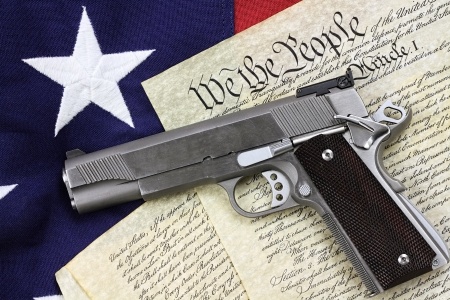
A military panel studying how to slow down the rate of service members who kill themselves is recommending, among dozens of other offerings, that firearms not be sold by military exchanges to any service member under the age of 25. The committee also recommends waiting periods on both firearms and ammunitions sales at military stores, and some warnings about energy drinks.
The Suicide Prevention and Response Independent Review Committee released its report on Friday. It focuses on four main area, including restructuring suicide prevention training, providing more resources to help service members access existing support services, promoting lethal means safety, and emphasizing leader stewardship in addressing service member needs, according to the Pentagon’s summary.
The report acknowledges that a large percentage of suicides among service members are by those members who are under investigation for something.
“In 2021, 23% of service members who died by suicide were experiencing or had experienced legal or administrative challenges during the preceding year. Over half of these service members were under investigation (DSPO, 2021). Being the focus of an ongoing investigation creates a combination of individual and occupational stressors that can increase risk for suicide compounded by poor handling by investigators or command,” the report noted.

The recommendation to stop selling private firearms at base exchanges to young warriors is given the highest urgency rating by the committee. The committee also is recommending severely curtailing the Second Amendment rights of troops, such as universal gun registration and a database of firearms purchased on Department of Defense property. Recommendations include:
“Repeal Public Law 112-239 Section 1057 and replace with procedural due process regarding the collection and recording of information relating to the lawful acquisition, possession, ownership, carrying, or other use of a privately owned firearm or weapon by military personnel and civilian employees of the DoD.”
That public law was created to prevent the unconstitutional infringement of service members’ rights to acquire, possess, and use firearms when not on Defense property.
“Implement a 7-day waiting period for any firearm purchased on DoD property.”
“Require DoD-approved firearm safety training, including refresher and sustainment training every five years.”
“Develop a national database for recording serial numbers of firearms purchased on DoD property.”
“Implement a 4-day waiting period for ammunition purchases on DoD property to follow purchases and receipt of firearms purchased on DoD property.”
“On DoD property, raise the minimum age for purchasing firearms and ammunition to 25 years.”
“Incentivize the acquisition and use of firearm locking devices by providing discounts for firearm locking devices purchased at a Military Exchange.”
“Establish command notification procedures when a service member or family member who lives on DoD property purchases a firearm on DoD property.”
“Require anyone living on DoD property in military housing to register all privately owned firearms with the installation’s arming authority and to securely store all privately owned firearms in a locked safe or with another locking device.”
“Establish DoD policy restricting the possession and storage of privately owned firearms in military barracks and dormitories.”
“Prohibit the possession of privately owned firearms that are not related to the performance of official duties on DoD property by anyone who does not live on DoD property.”
Explaining why firearms need to be curtailed, the committee said Defense data indicate approximately 66% of active-duty suicides, 72% of Reserve suicides, and 78% of National Guard suicides involve firearms.
“Several lines of evidence suggest that limiting or reducing firearm availability could dramatically reduce the military’s suicide rate. For example, a simple policy change requiring Israeli military personnel to store their military-issued weapons in armories over the weekend led to a 40% reduction in the Israeli military’s suicide rate,” the report said on Page 57.
The recommendations also take on other aspects of military quality of life, such as sleep cycles, pay scales, promotions, the management of millennials, ensuring that air conditioning is working inside of barracks, and even a limit on energy drinks and alcohol:
“Raise the minimum purchase price and ban price discounting of energy drinks sold on DoD property.”
“Ban the promotion of energy drinks on DoD property.”
“Display signs on vending machines and retail outlets where energy drinks are sold about responsible energy drink consumptions.”
“Ban the promotion of alcohol on DoD property.”
“Increase the purchase price of alcohol sold on DoD property”
“Limit when alcohol is sold on DoD property.”
The report tackles many other aspects of military life, and recommends that pay scales be reviewed to be more competitive with non-military jobs.