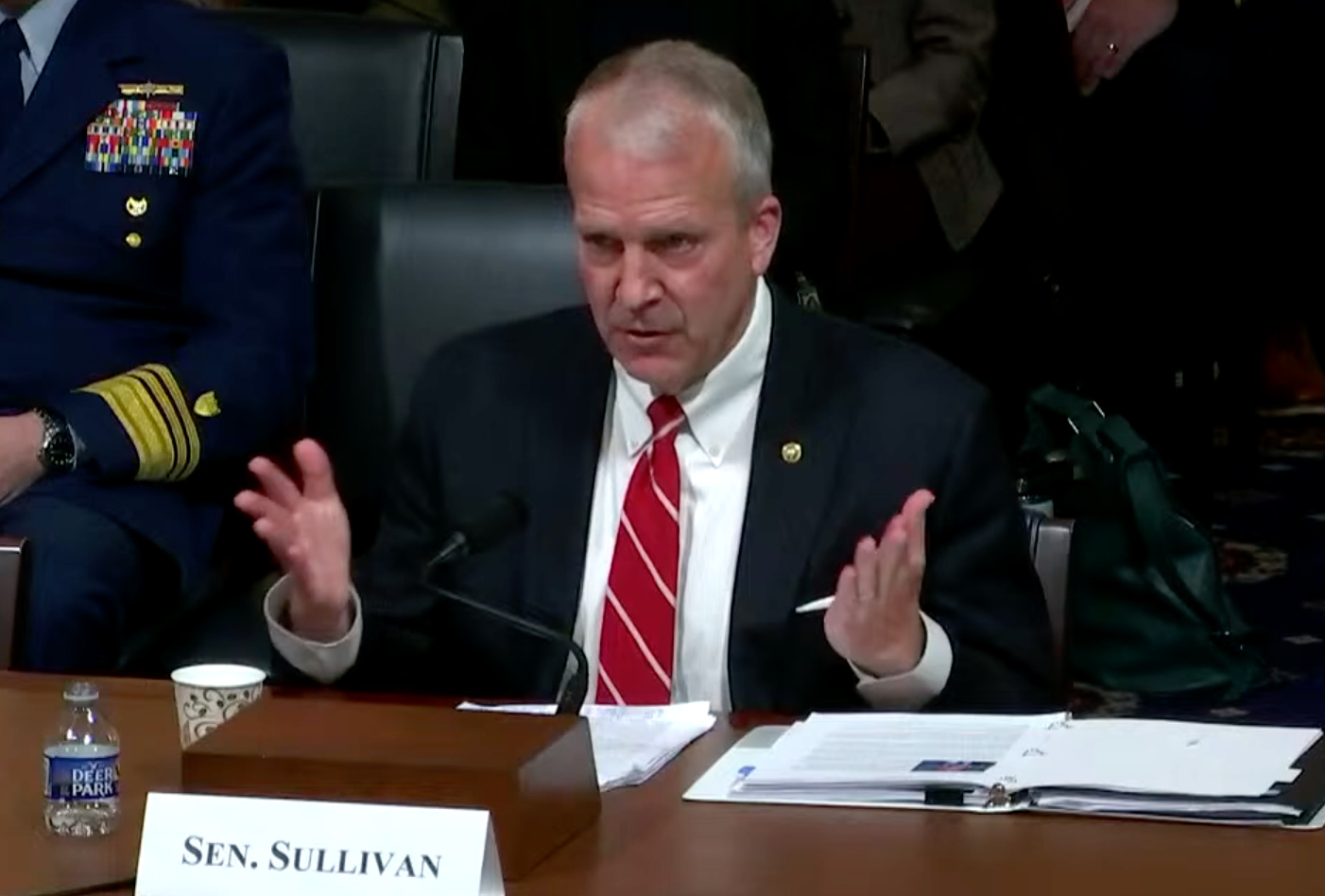
Alaska and national security in the Arctic were the topics of a House Committee on Homeland Security hearing on Wednesday, during which Sen. Dan Sullivan delivered remarks on the present and future challenges of the Arctic, and the U.S. Coast Guard’s role in protecting America’s national interests.
Alaska’s only U.S. Representative Mary Peltola was invited to testify but declined and was not present at the hearing. Her staff was busy on X/Twitter fighting the free-market merger of Kroger and Safeway. Sen. Lisa Murkowski, who describes herself as “the leading expert in Congress on Arctic policy and polar affairs,” was also invited but did not attend the hearing.
Sen. Sullivan, who was first to testify in the hearing, emphasized the growing significance of Arctic security for the United States and its national interests.
“The Arctic is undergoing monumental changes,” Sen. Sullivan began. “Sea ice is receding, opening an entire ocean that was previously unreachable. This allows access to a wealth of natural resources and makes available maritime trade routes that are thousands of nautical miles shorter than transits using the Suez Canal or Panama Canal. The strategic importance of this region, the Arctic, is unquestionable. Arctic security is American security.”

Highlighting Alaska’s pivotal role in Arctic competition, Senator Sullivan underscored the importance of the 49th state in guarding the United States against threats from competitors, particularly Russia and China. He noted that Alaska’s proximity to both nations necessitates its active involvement in securing American interests in the Arctic.
“Alaska constitutes three pillars of America’s military might,” Sullivan explained. “We are the cornerstone of missile defense for the entire country, the hub of air combat power for the Arctic and Indo-Pacific region, and a platform for expeditionary forces.”
Sullivan, who takes a keen interest in national security as a member of the U.S. Marine Corps Reserve, called for Alaska to become the logistical hub for power projection in the Arctic, emphasizing the need to respond swiftly to incursions. He highlighted recent incidents where Russian naval exercises near Alaska and joint Russian-Chinese naval task forces operating in the region raised concerns about the United States’ ability to protect its interests.
He expressed his disappointment with the Department of Defense’s past inaction regarding Arctic security but praised the House and Senate for pressing for provisions in the National Defense Authorization Act and Coast Guard bills to prioritize the Arctic.
As for infrastructure and assets in the Arctic, Sullivan stressed the need for more icebreakers, citing the significant gap between the United States and its competitors in this regard. He pointed out that even China, which is not an Arctic nation, is set to surpass the U.S. in icebreaking capacity by 2025.
Green’s opening remarks mentioned Alaska’s proximity to Russia and China. He quoted Billy Mitchell, who is known as the father of the U.S. Air Force, saying, “I believe that in the future, whoever controls Alaska, controls the world.” And he reminded attendees at the hearing that it was just this year that a spy balloon from China crossed the entire state of Alaska before entering the 48 contiguous states.
“To make matters worse, the People’s Republic of China has absurdly claimed itself to be a ‘near Arctic state,’ and is attempting to impose its will through diplomatic pressure and increasing maritime transits by PRC vessels in Arctic waters. The PRC is also actively building out its own icebreaker fleet, and its two existing icebreakers have operated in both the Arctic and Antarctic regions,” Green said.
“Russia, which has the most territory and largest Arctic population, maintains a robust military presence in the region. Russia has 51 icebreakers whereas the U.S. currently has two. Russia’s proximity to Alaska makes its concentration of forces appear even more menacing. The Russian mainland lies less than 60 miles away from the west coast of Alaska. Additionally, just 2.4 miles separate the Russian island of Big Diomede and the American island of Little Diomede in the Bering Strait,” Green said.
Watch the full hearing at this link.
Subcommittee on the right to produce act in an energy subcommittee, with many Alaskans from. John Boyle, DNR, Dorene Levitt.