Friday, May 8, 2026
Home Blog Page 939

F-22s at Ted Stevens — weather-related or sign of global tensions?

The appearance of a dozen F-22s at the Ted Stevens Anchorage International Airport tarmac could be due to snow removal at Joint Base Elmendorf Richardson. Or it could be a sign that tensions between Russia and the United States are ramping up, with the impending invasion of Ukraine by Russia.

The F-22s were parked overnight at the Anchorage airport, spotted after 1 am by several passengers on commercial flights.

Earlier this week, Biden spoke with Ukraine President Volodymyr Zelenskyy, and reaffirmed the commitment of the United States to Ukraine’s sovereignty and territorial integrity.  

“President Biden made clear that the United States would respond swiftly and decisively, together with its Allies and partners, to any further Russian aggression against Ukraine.  The two leaders agreed on the importance of continuing to pursue diplomacy and deterrence in response to Russia’s military build-up on Ukraine’s borders,” the White House said.

On Friday, President Joe Biden said that he believes an invasion of Ukraine will come soon.

“We have reason to believe the Russian forces are planning and intend to attack Ukraine in the coming week, the coming days,” Biden said.

Several of the fighter jets departed one at a time from Ted Steven midday on Friday, and were heard widely around West Anchorage.

Also in Anchorage, C-17s were spotted leaving the Anchorage airspace.

While military planes are commonly seen in Southcentral Alaska, observers say it’s rare to see F-22s at TSIA at any time, especially the middle of winter.

Dinner with Trump: Tshibaka spills the details

At the close of last weekend’s fundraiser for U.S. Sen. candidate Kelly Tshibaka in Mar-a-Lago, former President Donald Trump invited Tshibaka and her husband, Niki Tshibaka, to join him for a private dinner in the dining room upstairs at the six-star resort in Florida. It was just the three of them, with Donald Trump Jr. and his fiancé Kimberly Guilfoyle joining them briefly. And the dinner was somewhat of a strategy meeting.

Kelly said they talked extensively about the new ranked choice voting system that Alaskans will use this November, and she was struck by not only how familiar Trump is with the novel voting scheme, but how it may work strategically for candidates. Trump was pleased to learn that other Republicans had not jumped into the race, which now features main candidate Tshibaka, a Republican, going up against Sen. Lisa Murkowski, and Democrat Elvi Gray-Jackson.

This was Tshibaka’s second time meeting with Trump, whom she describes as keenly interested in business, in outcomes, and in strategy.

“Whenever you talk to Trump, you’ve got to be on your toes. You’ve got to know your facts. He’s very astute. He is a corporate businessman, and he is interested in results. You have to be ready,” Tshibaka said. “My background involves a lot of strategic planning, and I’m target driven.” In other words, Tshibaka can speak Trump’s business language, even over prime rib at his fancy resort.

As they dined on the massive outdoor balcony with its iconic tropical plants and polished pebble floors, Trump agreed that Republicans can be their own worst enemies, and that he hoped Alaska Republicans would commit to a winning strategy, even with ranked choice voting.

Tshibaka ran through the data, the past turnout numbers, and the details of ranked choice voting with Trump, and the two of them noodled through the various potential scenarios that will have Tshibaka, Murkowski, Gray-Jackson, and likely a fourth name on the November ballot. Voters in Alaska will rank candidates from their first to last preference. The person with the least amount of votes drops off and the second-place votes are distributed to the remaining candidates. The redistributing of votes continues until a candidate reaches 51 percent.

Trump was fascinated with the math of it all. He has a burning desire to get Murkowski out of office due to many reasons, including her trying to get a Jan. 6 investigation going in the Senate against him, and her rubber stamping Biden’s plan to withdraw from Afghanistan. Murkowski has always been in opposition to Trump, and during his presidency, her dislike for him was more than obvious to Alaskans, 53.5 percent of whom voted for his re-election. He blames Murkowski for ruining Alaska’s economic recovery because she secretly supported Joe Biden, and she confirmed Biden’s nominee to the Department of Interior, which has since shut down Alaska’s oil potential.

Tshibaka said opening up the Arctic National Wildlife Refuge’s coastal plain was important to Trump from the beginning of his presidency, when he realized that no one had been able to accomplish it over decades. The Biden-Murkowski outcome has disappointed him, because he cares about Alaskans.

“When I heard nobody else could do it, I said we have to get this done,” Tshibaka recalled Trump saying over dinner. Then, when Murkowski enabled Biden and Sec. of Interior Deb Haaland, ANWR’s “10-02” development area went back into the vault, a blow to America’s energy security.

Tshibaka also told Trump about her plan to focus on rural Alaska during her campaign. She has spent time in over 40 rural communities, sometimes sleeping on floors, because “nothing replaces that eye-to-eye contact,” she said. Rural Alaskans told her that Murkowski only visits them once every six years. Tshibaka said the people of King Cove understand that the reason they don’t have a road is because of Murkowski — she voted to confirm Judge Sharon Gleason, voted to confirm former Interior Secretary Sally Jewell, and voted to confirm current Interior Secretary Haaland. She is not willing to give up on votes in rural Alaska, just because those votes historically go for the Democrat or Murkowski.

Trump recommitted to traveling to Alaska this summer to rally for Tshibaka’s campaign, and the two talked about timing — should he visit before the primary or after? They left it undecided — again, looking at it as a strategic decision.

“I also remember that he also said he always made it a point to stop in Alaska when he was flying because he loves our state and loves Alaskans,” Tshibaka said.

Trump was also very impressed with Niki Tshibaka, and as he shook his hand at the end of the dinner, he told Niki that he now understood why Niki is “so popular.”

“He really likes Niki,” Kelly Tshibaka said.

Hers was one of the biggest fundraisers held at Mar-a-Lago that didn’t involve the super-wealthy donors of Florida. The attendees were mostly Alaskans and she thinks the fundraiser brought in about $450,000 for her campaign, give or take a few.

“One of the biggest fundraisers was for Hershel Walker, but that was a Palm Beach crowd,” she said. “For our fundraiser, it was Alaskans who made it happen.”

The unseen puppeteer in Alaska Redistricting Board was Sen. Tom Begich, controlling two from behind the scenes

At the most critical juncture of Alaska’s redistricting process in November, an unknown, non-appointed shadow on the Alaska Redistricting Board was working from behind the curtains. It turns out it was Anchorage Democrat Sen. Tom Begich.

Tom Begich was texting in real time with board member Nicole Borromeo for several days as the board approached its Nov. 10 decision deadline. Her drawings of the House districts in Anchorage were ultimately the ones chosen by the board.

The texts between the two show that Tom Begich greatly helped her draw those maps.

The board has five appointed members — Budd Simpson and Bethany Marcum, appointed by Gov. Mike Dunleavy; John Binkley, appointed by former Sen. President Cathy Giessel; Nicole Borromeo, appointed by former House Speaker Bryce Edgmon; and Melanie Bahnke, appointed by former Alaska Supreme Court Chief Justice Joel Bolger.

Borromeo and Behnke, who align with Democrats, were taking direction from Tom Begich, who was watching the proceedings online and telling Borromeo what to do, how to try to manipulate the other members of the board, and especially how to defeat Republican Bethany Marcum.

The text messages, shown below, were obtained in a public records request after they came to light during last week’s Superior Court trial over the final maps approved by the board.

Tom Begich also testified multiple times over several months before the board, and he even had proposed one of the plans, called the Senate Minority Plan, which was one of four third-party draft maps adopted by the board and taken around the state to be shown to the public in the 20 public hearings that took place before final political boundaries were drawn.

At one point, Tom Begich wrote to Borromeo, “Try agreeing with Bud,” to see if Borromeo could manipulate Budd Simpson, the Juneau member of the board appointed by Gov. Mike Dunleavy.

At another point he sent her a map, and he directed her and Bahnke to ask the board, “what do you object to in Nicole’s Anchorage map” referring to a map he just sent. The purple lines on the map are the House district pairings for Senate district he apparently wanted.

Using his advice, that is exactly what Borromeo and Bahnke did that day, repeatedly asking the other board members what they objected to in Borromeo’s Anchorage map.

Begich wrote to Borromeo of the Eagle River pairings, “It’s a disaster.” He was meaning that it was a political disaster, since he went on to say that there appear to be no grounds for a lawsuit.

Borromeo responded, “How long will it take DOJ to sue? Are the[y] fast?”

“No,” Tom Begich replied. “And they may not. VRA [Voting Rights Act] is weak. Others might not have grounds.”

Then he said he would work on a map and get it to her the next day, “But it’s hard. Senate pairings always political.”

At another point, he encouraged her to use a racial argument, just to get it on the record.

In fact, there were several lawsuits and the Eagle River House pairings into a Senate district is one of the two parts of the redistricting map that the judge wanted the board to reconsider.

“Please don’t put Muldoon in Eagle River, as Bethany is suggesting,” he wrote.

“You should see her new version,” Borromeo responded, while in the middle of the meeting.

“I did. That’s why I texted,” Tom Begich wrote back.

Then Borromeo asked him for help on the Mat-Su and Valdez pairings, and he provided her with case law to support that grouping. Although that particular part of the map was also challenged by a lawsuit by the city of Valdez and from the Mat-Su Borough, Anchorage Superior Court Judge Thomas Matthews ignored the conservative lawsuits regarding the new political boundaries, and only ruled in favor of the liberal litigants who didn’t like the Muldoon-Eagle River and the Skagway-Juneau lines.

Read: Judge says redistricting map needs do-over for Eagle River area and Skagway-Juneau

While Judge Matthews said in his ruling on the new political maps that there were too many executive sessions during the proceedings, he made no mention of the secretive side conversations between Tom and Nicole, even though he knew about them, since they were entered into the record. View some of the text messages in the slide show below:

Bill Walker names a campaign manager and guess what? He was the deputy director of 2021 redistricting board

With a significant pile of cash in his campaign account, Bill Walker has announced his campaign team. T.J. Presley left his job as the deputy director of the Alaska Redistricting Board, the group overseeing the new political boundaries in Alaska.

Presley will be campaign manager. Austin Mahan will handle compliance with campaign laws as the Walker campaign treasurer. Moira Gallagher is finance director. Austin Baird is a senior advisor focused on external communications, outreach, and public engagement. Paxson Woelber will be the graphic and web designer, and Carolyn Hall will manage campaign operations.

Mahan runs a compliance business and does campaign compliance for Anchorage Assemblyman Chris Constant, who just announced his campaign for U.S. House.

Gallagher ran Anchorage Economic Development Corporation’s grassroots effort for its “Live. Work. Play.” initiative to make Anchorage the No. 1 city in America in which to live, work, and play. She was deputy treasurer for Anchorage Assemblyman Constant’s effort to add a second Assembly district to downtown Anchorage.

Baird was in the news business before becoming press secretary for former Gov. Walker, who left office in disgrace. He then became the communications director for the Democrat-led House majority in the Legislature.

Woelber is part owner of the Alaska Landmine blog, and has worked on numerous campaigns. He designed the iconic look for the Mike Dunleavy political action committee in 2020. Woelber is writing and photographing for the blog.

Hall is co-founder of Jensen Hall Creative, an Anchorage-based media production company that partners with liberal causes. She was the communications director for Anchorage Mayor Ethan Berkowitz, and was communications manager for Walker during his one term in office. She also led the Municipality of Anchorage’s Vote by Mail public relations campaign.

Chris Constant makes it official: Running for Congress

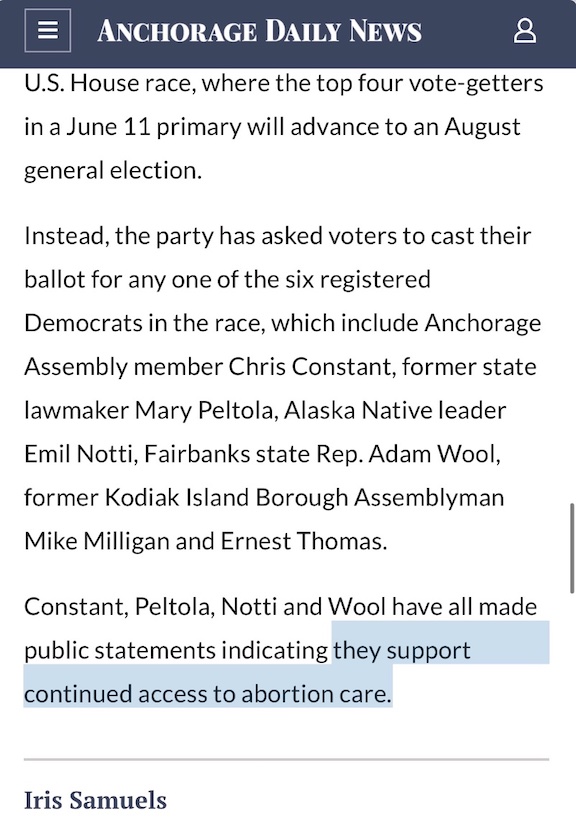
As rumored for weeks, Anchorage Assemblyman Chris Constant says he is a candidate for United States Congress. He will run as a Democrat in a race that already has big names — 25-term U.S. Congressman Don Young and Republican challenger Nick Begich III.

Constant, who represents downtown Anchorage, revealed his plans on social media and scrubbed his past, somewhat problematic social media accounts of some of their more unpleasant content.

The last Democrat who ran against Young was Alyse Galvin, who ran in 2018 and again in 2020. She is now running for an Anchorage seat in the Alaska House of Representatives.

Although he announced he would do a Facebook live event of his announcement, no one seemed to see it, and it appeared that the livestream either failed or was ditched by his campaign. However, moments after he made his Facebook announcement, he posted on Facebook a story about his announcement from the Anchorage Daily News.

Anchorage school resource officers appear to be done with masks in schools; what will leftist school board do now?

In a post on social media, the Anchorage School District has shown its appreciation for school resource officers — and none of them are wearing face masks in a school district where masks are the law.

Surely it was intentional. Maybe the school district leadership is trying to telegraph to the greater community that it’s done with mandatory masking. But will the Anchorage School Board keep forcing masks on kids in schools, or allow children to see each other’s faces — and the faces of their teachers and safety personnel?

The school board extended the mandatory masking of the kids into 2022, in an action that some parents view as the crime of the century. A growing body of evidence shows the pandemic policies of the past two years had led to a mental health crisis among the young. Superintendent Deena Bishop, who turned in her resignation due the board’s anti-child policies, is going to make another attempt at moving to a “mask choice” policy in the coming days, Must Read Alaska has learned. At this point, only school board member Dave Donley seems to support a lifting of the mask mandate.

Former ADN editor wants you to join ‘Fight the Fascists’ at rally for Dunbar, Zaletel, Weddleton, Perez-Verdia

34

Newspaper reporters and editors wonder why people don’t trust the media. In Alaska, it’s fairly easy to see the reason for the mistrust.

Exhibit A: The former Anchorage Daily News editor Pat Dougherty wants you to join him and “fight the fascists” running for Assembly. He invites you to an event in support of his candidates — the sitting Anchorage Assembly incumbents who brought the city to an economic standstill over the past three years, with their allegiance to former Mayors Ethan Berkowitz and Austin Quinn-Davidson.

The “Fight the Fascists” event is at Cuddy Park in support of incumbent Assembly members Forrest Dunbar, Meg Zaletel, Kameron Perez-Verdia, and John Weddleton, all who will be making an appearance at the Fight the Fascists event.

According to Dougherty, Save Anchorage is a fascist organization and is also an “insurrectionist” group. Save Anchorage is a Facebook page for centrists in Anchorage who object to the city being taken over by leftists on the Assembly and School Board.

Dougherty’s invitation to a campaign event to “Fight the Fascists”

In Dougherty’s thinking, opponents of the current Assembly members are fascists to be fought.

A look at Dougherty’s “fascists”

Democrat Forrest Dunbar, representing East Anchorage, is challenged by Stephanie Taylor, an African-American mother and volunteer who came to Alaska as a child, when her father transferred in the military. She is a traditional, conservative, church-going and community-volunteering resident of East Anchorage who has taught many classes in youth leadership. Dougherty would classify this as “fascism” that needs to be fought.

Stephanie Taylor is running for Anchorage Assembly District 5 – Seat H – East Anchorage

Democrat Meg Zaletel, in midtown-south, is being challenged by Kathy Henslee, a mother and grandmother who works as a real estate agent and tries to not be the first in the room to whip out photos of her grandchildren. “As I have watched the public servants in my beloved city ignore the citizen’s needs and make everyday life more and more difficult with restrictive regulations, out of control spending, and harmful social ideas I felt the need to act,” Henslee says on her campaign site. Her core principles are “Respect very person, Protection for our personal freedom, Humbly serving my neighbors, Upholding the rule of law for every citizen, the same way, every time, and A smaller government that encourages its citizens to pursue life, however, they want to live it, and then purposefully tries to stay out of the way,” she says on her campaign site.

In Pat Dougherty’s mind, this represents “fascism.”

Kathy Henslee is running for District 4 – Seat F – Midtown Anchorage

Democrat Kameron Perez-Verdia, who serves on the Assembly for West Anchorage, has a challenger in Liz Vazquez, who served in the Alaska House of Representatives. Vazquez was born in poverty in Puerto Rico, and pulled herself up by her bootstraps, graduated from law school.

Vazquez says, “I am an American of Puerto Rican heritage and an example of the American dream. I started school in Puerto Rico and learned English as a second language. My parents never finished high school and I was the first in my family to graduate from college. After eating a lot of macaroni and cheese, I obtained my law degree and later, my two master’s degrees.”

She is a former assistant attorney general for the State of Alaska, and a former criminal prosecutor, administrative law judge, who served four years on the Anchorage Equal Rights Commission.

In Pat Dougherty’s mind, this represents “fascism.”

Liz Vazquez is running for District 3 – Seat D – West Anchorage

“The road hasn’t always been easy, but it has been worth it, and it has taught me to see challenges as opportunities. The great reward has been serving Alaskans,” Vazquez said.

Democrat-associated John Weddleton, the Assemblyman for South Anchorage who is running for reelection, is being challenged by Randy Sulte.

He moved to Anchorage in 2004 with his wife and children. An Eagle Scout, Sulte attended the Colorado School of Mines and Seattle University Albers School of Business, where he earned a MBA. He is an engineer and a pilot. He is also chief operating officer of Kakivik Asset Management and CCI Industrial. Sulte has served for 16 years on the board of Youth Exploring Adventure (Hill Top Ski Area), where the board brought back ski racing, made significant site improvements, and in 2021 opened a new lift served bike park.

In Pat Dougherty’s mind, this represents “fascism.”

Randy Sulte is running for District 6 – Seat J – South Anchorage

Dougherty, who boasts a Pulitzer Prize during his long career at the Anchorage Daily News, is still a now-and-then contributor to the newspaper’s opinion pages and spends his days holed up in his south Anchorage home, retweeting savage messages from the Anchorage Press, the Blue Alaskan blog, Anchorage Action, and Dermot Cole, all extremists propaganda machines of the Left that are out of step with everyday Anchorage residents who voted for a conservative mayor who will fight the hard-leftists on the Assembly.

Dougherty hid his extreme views well when he was the editor of the Anchorage Daily News, but in retirement has let loose his true nature, liberally pouring on the “fascism” label as the next next municipal election approaches.

Dougherty may be doing more to undermine journalism in Alaska than the leftist crowd that currently runs the ADN.

A Gallup poll released in October found that just 36% have a “great deal” or “fair amount” of faith in what they see and hear in the news media. Pew Research also released results last summer, showing that conservatives don’t trust the media, while liberals do:

“Nearly eight-in-ten Democrats and Democratic-leaning independents (78%) say they have “a lot” or “some” trust in the information that comes from national news organizations – 43 percentage points higher than Republicans and Republican leaners (35%) – according to a new Pew Research Center survey conducted June 14-27, 2021. This partisan gap is the largest of any time that this question has been asked since 2016. And it grows even wider – to 53 points – between liberal Democrats (83%) and conservative Republicans (30%).”

Video shows Donald Trump backing away from support for Gov. Mike Dunleavy

In a short video posted by an anonymous account on Twitter, former President Donald Trump can be seen at Mar-a-Lago saying he’s “not happy” with Gov. Mike Dunleavy of Alaska, because he hasn’t seen Dunleavy supporting candidate Kelly Tshibaka, who is running against Sen. Lisa Murkowski.

Trump said he was displeased about Dunleavy’s neutral stand in the Tshibaka-Murkowski race for Senate. Trump opposes Murkowski, supports Tshibaka, and was hosting a fundraiser for the Alaska Republican challenger at his six-star resort in Florida last week, where someone in the crowd took the video.

Gov. Mike Dunleavy is running for reelection and has taken pains to not involve himself in the Senate race between the senior senator for Alaska and Tshibaka, who is his former commissioner of the Department of Administration. He finds himself in a tricky spot because Trump also endorsed Dunleavy and had a fundraiser for Dunleavy’s recall fight at the Trump National Golf Club Bedminster in New Jersey last year. Now, he thinks Dunleavy should support Tshibaka.

Dunleavy is challenged by former Gov. Bill Walker, former State Rep. Les Gara, Kenai Borough Mayor Charlie Pierce, and Rep. Chris Kurka, as well as a small crowd of other candidates, as he runs for his second term.

Dunleavy has been a big supporter of Trump, due to Trump’s pro-Alaska policies, and Trump has been a fan of Dunleavy’s, but the feelings may have cooled at the moment, according to the video. See the video here.

Alaska Redistricting Board will appeal a judge’s ruling that favors mob rule

The Alaska Redistricting Board will appeal a decision by Anchorage Superior Court Judge Thomas Matthews, who on Tuesday rejected two parts of the new political boundaries set by the board for Alaska’s Senate and House districts.

The board deliberated in executive session and then voted 3-2 to challenge Matthews’ ruling, which ordered the panel to “take a hard look” at a Senate district that has a piece of Anchorage’s Muldoon neighborhood in the same Senate seat as Eagle River. Matthews also said the board had not given enough weight to the public testimony in Skagway and downtown Juneau — those two neighborhoods want to be paired together and exclude the apparently unhip Mendenhall Valley, a Juneau residential community. Skagway’s mayor said the people in the Valley could not possibly understand the tourism concerns that they share with downtown Juneau. Ironically, most who live in downtown Juneau work in government jobs, and the alignment of Skagway with north Juneau is geographically more compact.

The board’s lawyer, Matt Singer will challenge the rulings on key points of argument.

  1. The judge gave more weight to public testimony than to the informed decision-making by the Redistricting Board, and in doing so sets a huge precedent. If it stands, whichever group can pack a public hearing room will win, under this logic.
  2. The ruling by the judge was overly political, because he ignored the political boundary challenges of conservatives in the Mat-Su and Valdez, and ruled in favor of liberal challenges in East Anchorage and Skagway/Downtown Juneau.
  3. The judge also placed more emphasis on in-person testimony, to the disadvantage of working members of the pubic who cannot attend the public hearings, but send in their written comments.
  4. The board was not given due process during the court challenge. The judge set the rules of procedure, which only allowed the board to respond to the accusations of the challenging attorneys, and did not afford them the opportunity to explain why they made the decisions.

The board’s challenge to the Alaska Supreme Court must be filed by Thursday, Feb. 17.

Voting against the legal challenge were the two leftists on the board, Nicole Borromeo and Melanie Bahnke. Borromeo was appointed to the board by then-House Speaker Bryce Edgmon, and Bahnke was appointed by then-Supreme Court Justice Joel Bolger. The two women align with Democrats and favor Matthews’ ruling because it gives more power to Democrats.

More information about the redistricting process can be found at this link.