Nearly 75,000 ballots have been cast in the special primary election for Alaska’s lone seat in Congress. This primary, which ends June 11, is mail-in, is for the temporary seat to finish out Congressman Don Young’s term, and has 48 names on the ballot.
Petersburg sighting: Spotted at the Little Norway Festival in Petersburg, Nick Begich for Congress, the man himself, riding in the back of a truck during the parade, along with the mayor of Petersburg, tossing candy to folks during the festivities, including none other than Alan Gross, who was not in the parade but is among the candidates running for Congress.
China Bill: Noticed in Petersburg, there are a lot of Walker-Dryas signs in the community that is commercial-fishing oriented. Heidi Drygas, the other half of the Walker-Drygas for governor-lt.gov campaign, was in the parade pulling. child’s wagon.
Gross report: Alan Gross continues to campaign on abortion-for-all.
Mark Anthony Cox endorses Kelly Tshibaka for Senate.
Endorsements: Alan Gross says he is “Honored to have the endorsement of the National Organization for Women Political Action Committee. As Alaska’s congressman, fighting for reproductive rights and constitutional equality for all people will be at the center of my work.” Chris Constant for Congress for the endorsement of Debra Call, the former running mate of Mark Begich when he ran for governor. Mark Anthony Cox of Anchorage, running for State Senate (Taku/Campbell/Bayshore/Klatt/Old Seward/Oceanview), has endorsed Kelly Tshibaka for U.S. Senate.
Revak’s war on Santa mash-up: Someone sent MRAK this cutting mash-up that asks the question: Is congressional candidate Josh Revak seething at Santa because he got coal in his stocking at Christmas?
Ask Sweeney anything: Tara Sweeney, running for Congress, will have a live Facebook event on Monday, May 23, at 4 pm, when people can ask her questions. Here is he link. http://facebook.com/taraforalaska.
Mary Peltola at Alaska Federation of Natives.
Peltola courts AFN: Mary Peltola, running for Congress, met with a group from Alaska Federation of Natives “to talk with leaders in our state helping to grow our economy and uphold our Native rights. We had a long talk about Alaska’s future.”
Santa Claus at 75: Running for Congress, Santa Claus of North Pole turned 75 this week and said “I am thankful for everyone who is independently being very creative supporting my campaign for the Special Election via Twitter, Facebook, TikTok, Reddit, etc., making signs, canvassing, calling, etc. Thank you :-)}.” On Twitter, he’s known as @RadicalSanta, but his campaign handle is @SantaClausforAK. Here’s his video thanking people:
Constant Comment: Things have been quiet over at the Constant for Congress campaign, but we note that after we asked the question about who was writing his articles on his campaign web page (Who is “DOM Team, we asked), the byline has been suddenly changed to Christopher Constant, but it’s still being written in the third person voice. On Twitter, he writes in first person, “I am a firm believer that housing is the solution to homelessness, and that no one should lose their housing based on addiction or behavioral health issues.” A guaranteed right to housing is part of his platform.
Sign-waving season: An impromptu group in Delta Junction was out waving Nick for Congress signs this week, even though the candidate was in Homer and then in Petersburg. We’re bound to see more sign-waving as we head into the final 20 days of campaigning for the special primary election for replacing Alaska’s congressional representative.
Tiffany Zulkosky is out: Rep. Tiffany Zulkosky is done with the Legislature for now. She will not be running for reelection. The seat representing Bethel and surrounding area is hard Democrat.
Ivy Spohnholz is out: Likely back to the nonprofit sector is the next thing for Rep. Ivy Spohnholz of East Anchorage. Hers is a lean-left seat, and will be a tough one for a conservative to win.A walk down memory lane with Spohnholz.
Democrat Rep. Ivy Spohnholz announced today that she will not run for office after six years in the Alaska House of Representatives.
“After a lot of thought and discussion with my family, I have decided that I am not going to run for office in 2022,” she said. “I am really proud of what I have accomplished over the last six years in the legislature. I have worked with Democrats, Republicans, and nonpartisans in coalition majorities that have prioritized public education, the University of Alaska, public safety, protecting our most vulnerable, and economic and fiscal responsibility.”
Spohnholz represents District 16 (old number); her new District is 18 under the new redistricting plan. In that new district, Clinton and Trump were even in 2016. It’s a swing to lean-Democrat district. She has favored an income tax and a smaller Permanent Fund dividend for Alaskans, and has repeatedly attacked Republican lawmakers and appointees, such as her unfounded accusations against former Judge Karl Johnstone, when he was appointed to the Alaska Board of Fisheries.
“When I reflect on my legislative accomplishments I am particularly proud of passing health care price transparency in 2018 (originally HB 123, but passed in SB 105) and HB 265 expanding access to telehealth care for Alaskans this year. Alaska’s health care costs are the highest in the entire country and reducing them is a sure-fire way to put more money in Alaskans’ pockets. Each of these policies passed into law through bipartisan collaboration that put Alaskans ahead of special interests,” she said.
“I am proud of the passage of SB 26 in 2018, which protected the Permanent Fund and created a new stable mechanism for funding essential government services in addition to Permanent Fund dividends. I remain passionate about the need for a comprehensive and sustainable fiscal plan. Although this work is not yet done, I am confident it will continue,” she said.
SB 26 is the bill that restructured the draw from the Permanent Fund Earnings Reserve Account to allow for stable use of earnings from the Permanent Fund to pay for government services. Because it was an incomplete bill that did not make a plan for the Permanent Fund dividend, the Legislature has continued to fight over the amount of the dividend year after year since SB 26’s passage. Many critics consider SB 26 to be highly flawed because it took care of government, but not the people of Alaska who are shareholders in the state’s oil.
“In my years of service in the Alaska State legislature, I’ve learned that there are an infinite number of ways to serve Alaskans. For decades prior to coming to the legislature, I worked to make Alaskans’ lives better in the nonprofit, business, and public sectors. The Alaskans I’ve met and worked with over the past six years have inspired me and demonstrated the countless ways we can improve our communities. While I don’t know what is next for me, I look forward to my next chapter in service to our great state,” she said.
Former Alaska legislator Glenn Hackney has died at the age of 97. Hackney had been in a car accident that left him with numerous injuries earlier this week. His family had rushed to Fairbanks to be with him and Art Hackney, his Anchorage son who is a well-known political consultant, was at his side when he passed on Friday morning.
Hackney was a much beloved figure in Fairbanks, where he was known as a volunteer for the food bank. He was also a regular volunteer each Spring in cleaning up the roads of Anchorage in preparation for summer. In fact, he was one of the founders of the annual cleanup.
Art Hackney told the story of when the United States entered World War II, young Americans rushed to enlist, and his father was among them.
“Dad, like so many, was raised on a farm (upstate New York). Their high school let them graduate early so they could enlist. Dad’s brothers entered various services, and like his brother Howard he went for the Marines, and was completely shocked to be rejected because he had ‘an enlarged heart.'”
Glenn tried to enlist in other branches of the service, but received the same rejection.
“This is a young man who had rigged up a rope across the barn so he could train going hand-over-hand. He was fighting fit. Determined to serve, he ended up going into the Merchant Marine (which lost more people than any other service). He delivered munitions across both the Pacific and the Atlantic and watched ships in his convoys taken out by submarines. For so many farm boys, memories of service in WWII were the most vivid of their lifetimes, Dad was no different,” Art remembered. “He received a commendation from Ted and Don and Lisa at a Republican Women’s convention in Anchorage which I wrote that started with the enlarged heart story, then recounted his life of service and ended with, ‘It turns out they were right – Glenn Hackney does have a big heart.'”
Hackney served as a legislator for eight years and volunteered countless hours over the decades, serving as founding member of community organizations and on numerous boards. He was in demand at Republican conventions and meetings, where he was frequently asked to recite the Gettysburg Address, first delivered by President Abraham Lincoln during the Civil War.
Hackney worked as a city purchasing agent in Fairbanks, was a special assistant to Gov. Keith Miller, a sales manager for television advertising, and was a longtime plant manager for Concrete Products of Alaska. Born in 1924, he was educated at Cornell University before moving to the Territory of Alaska in 1948.
More details will be added to this story as they become available.
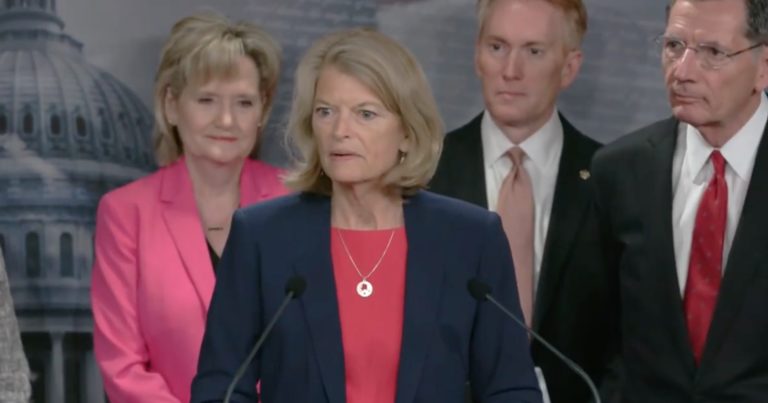
Sen. Lisa Murkowski may have been happy to usher President Donald Trump out of office in 2021, but today she’s also not happy today with his replacement, President Joe Biden.
Murkowski appeared with other lawmakers at a press event slamming the Biden Administration’s policies of locking up energy in America, specifically in Alaska.
“I come from a state where we are an energy producer. But we pay some of the highest energy costs in the country, and right now our gas prices are the sixth highest in the country. Statewide, regular gas has increased by more than 52 percent over last year. As of yesterday, Alaska’s statewide average was $5 a gallon. This is the highest ever average in our state,” Murkowski said. “We’re used to somewhat high prices but when it’s on average, over $5 dollars in places like Anchorage and Fairbanks, think about what that means to our rural communities. Over 80 percent of our communities are not connected by road, so fuel comes in by barge and fuel comes in by air. At Fort Yukon, the Yukon River, gas is $7.25 a gallon. Up in Noatak, just above the Arctic Circle, it’s a stunning $11 a gallon. And so think about what that means—it’s not just what you’re paying when you fill up your car, it’s everything else that’s associated with it.”
Murkowski was the first Republican senator who called on President Donald Trump to resign immediately in January, 2021, over her perceptions about the Jan. 6, 2021 incident in the U.S. Capitol, when rioters came through the doors. She said if the Republican Party cannot separate itself from Trump, she wasn’t sure she has future with the party.
“I want him to resign. I want him out. He has caused enough damage,” Murkowski told reporters on Jan. 8, 2021. She has stayed with the Republican Party, however, even while the Republican Party has continued to remain inclusive to Trump, a president that Murkowski was diametrically opposed to during his four years in office.
Today, she’s stuck with something worst: the Biden Administration’s war on Alaska.
“Right now, we have an administration whose plan is to blame anybody but them and their policies. They are quick to put it all on Putin. Yes, there is a war. Yes, we recognize that, but this price increases started long before Putin crossed into Ukraine. This is not something where you can just blame big oil and go after price gouging. This is not something where you can attack others when it is failed policies that this administration has put in place. It really comes down to basic supply and demand and we know that supply matters and domestic supply matters. If we’re not learning anything from Ukraine and Russia and what we’re seeing in Eastern Europe, domestic supply matters,” Murkowski said.
“So, the Biden administration needs to reverse its anti-supply actions, it needs to take its bad ideas off the table, it needs to restart approving crucial projects that deliver greater supply,” she said.
Murkowski’s remarks were made during a press conference that included Sens. John Barrasso, John Kennedy, Ted Cruz, Joni Ernst, Steve Daines, James Lankford, John Hoeven, Shelley Moore Capito, John Boozman, and Cindy Hyde-Smith.
“Lisa Murkowski’s vote for Deb Haaland was not simply a one-time mistake, rather, it was a colossal error in judgment that is hammering Alaska over and over again. Murkowski admitted publicly that it was likely that Haaland would be harmful to Alaska as secretary, but she cast that vote anyway. Haaland’s sustained assault on Alaska’s resource industries proves that Murkowski showed gross disregard for the jobs of Alaska workers and our entire state economy,” said Kelly Tshibaka, who is challenging Murkowski for Senate.
“Haaland and Biden have targeted Alaska like no other state. The Biden Administration has launched 24 executive actions directed against the people of Alaska, many of them coming from Haaland. The fact that Haaland even refuses to admit that gas prices are too high shows that this has been her plan all along. Lisa Murkowski knew all of this, just like anyone with a pulse knew it, yet she still cast the vote that continues to crush Alaska workers and families to this day. When I’m the next senator from Alaska, I will always vote for the best interests of Alaskans, and not for the Washington, D.C. insiders who write fat campaign checks.”
Casey Sixkiller, who served as deputy mayor of Seattle and chief operating officer of King County, Wash., has been appointed the new EPA administrator for Region 10, the area that covers Washington, Idaho, Oregon, and Alaska.
Sixkiller is a longtime government staffer and lobbyist and ran for mayor of Seattle in 2021. In his new role, he succeeds Michelle Pirzadeh, who had been the acting regional administrator for the agency that oversees and implements federal environmental statues, rules and regulations. Pirzadeh had been in place since the departure of Alaskan Chris Hladick, who left when the Biden Administration took over in 2020. Hladick is the interim city manager for Unalaska, where he served in the same from from 2001 to 2015.
Sixkiller has focused his work in equity and social justice issues of BIPOC (black, indigenous, people of color) citizens, and is the founding and managing partner of Sixkiller Consulting. He worked for U.S. Sen. Patty Murray and former U.S. Rep. Jim McDermott, both Washington Democrats. Sixkiller is an enrolled member of the Cherokee Nation who was born and raised in Seattle. The EE/Greenwire blognotes that his appointment continues a trend by the Biden administration of selecting tribal citizens for leadership positions.
The White House reported today that the Department of Defense is responding to the U.S. Department of Agriculture’s request for “Operation Fly Formula” to transport Nestlé S.A. formula from Zurich, Switzerland to Plainfield, Indiana.
The Defense Department is now looking for qualified commercial aircraft to complete the mission.
The Operation Fly Formula shipments will transport the equivalent of up to 1.5 million 8-ounce bottles of three formulas of Alfamino® Infant, Alfamino® Junior, and Gerber Good Start® Extensive HA brands. All are hypoallergenic formulas for children with cow’s milk protein allergy. These formulas have been prioritized because they serve a critical medical purpose and are in short supply in the United States because of the Abbott Sturgis plant closure, the White House said. These shipments will include approximately 246 pallets.
President Biden launched Operation Fly Formula to speed up the import of infant formula and start getting more formula to stores as soon as possible. Under Operation Fly Formula, USDA and the Department of Health and Human Services are authorized to use DOD-contracted commercial aircraft to pick up overseas infant formula that meets U.S. health and safety standards, so it can get to store shelves faster.
In addition, President Joe Biden directed his Administration to ensure there is enough safe infant formula for families, including invoking the Defense Production Act, entering into a consent agreement between the Food and Drug Administration to reopen Abbott Nutrition’s Sturgis facility, and issuing FDA guidance to allow major formula manufacturers to safely import formula that is not currently being produced for the U.S. market.
Alaska’s Constitution mandates a “merit system of employment.” At its essence that means that to get a State job you get hired based on your qualifications rather than your connections. Merit system employees are the majority of Executive Branch employees, but they are not a majority of State employees by any means.
The State workforce is composed of three services: the classified service, the partially exempt service, and the exempt service. The classified service are true “merit system” employees who have to be hired into a specified job classification which establishes minimum qualifications for the job and the candidate must be competitively selected. The 14 departments of State government have about 17,000 employees, about 15,000 of which are in the classified service.
These employees are subject to the provisions of the State Personnel Act (AS 39.25 et seq.) and may appeal discipline or dismissal or actions that violate the State Personnel Act to the State Personnel Board, though this appeal process is almost never used, since almost all classified employees are unionized and their conditions of employment are established by collective bargaining.
The partially exempt service is the smallest group of State employees, a couple of thousand, are about as close to true “serve at the pleasure” or “at will” political appointees as the State has. These employees are division directors, some deputy directors and other specialized employees who know how to work the system, all of the assistant attorneys general, and those in the assistant commissioner classification. Deputy commissioner is a statutory designation in the exempt service with a statutorily set salary and depending on the size of the department and horsepower of the commissioner a department has one or two.
Sometime in the late 1980s or early 1990s, ambitious division directors prevailed upon the director of personnel to create the classification of “assistant commissioner” in the partially exempt service. This allows an assistant commissioner to keep his/her merit/longevity steps earned in the classified and partially exempt service rather than accept the deputy commissioner salary set by the Legislature. That’s called working the system.
Partially exempt employees must have a job classification set out in the State Classification Plan and must meet the minimum qualifications of that classification and must be paid from the statutory State Pay Plan at the range set out in the Classification Plan. They do not have to be hired competitively and rarely are, none are unionized, though they could be, and they cannot appeal discipline or dismissal to the State Personnel Board. They can and often do sue the State for wrongful discharge if they get fired, especially if they’re Democrats being fired by a new Republican governor or commissioner. Alaska’s leftist judiciary is more than happy to order them put back to work and paid a lot of money.
The rest of the people who draw a State paycheck, almost half the total workforce are in the exempt service. Nominally, a position is placed in the exempt service because it isn’t susceptible to the State’s ordinary pay and selection processes. One of the first drivers of the exempt designation was the ferry system. Alaska basically imported the Washington ferry system and its unions to operate the aborning State ferry system.
The Washington unions wanted nothing to do with merit system hiring and bureaucratic pay plans so ferry system employees were made exempt from the State Personnel act and its accoutrement. Teachers also thought they were special, so they were made exempt. At that time the State operated the state-operated school system, which was composed of the old BIA schools the State had taken over.
Subsequently, various job classifications were placed in the exempt service since their wage and benefit structure couldn’t be accommodated under the statutory scheme. And, of course, Alaska being as it is, people with friends in high places managed to get the job they coveted placed in the exempt service so they could slip the surly bonds of the State Pay Plan and union contracts.
Then the State created all sorts of quasi-governmental entities that didn’t want to be burdened by the strictures of the State Personnel Act and certainly didn’t want to be limited by the State Pay Plan. If you work for a quasi or a board or commission, you get paid what the Board wants to give you. I think some of the Alaska Housing Authority is still union, but other than that none of the quasis are union, so they pretty much do as they please as long as they don’t have to beg the Legislature for much money.
So, that is the way the State is supposed to work, and the way it kinda’, sorta’ works, though how and why things are done are somewhere between a vague memory and a suggestion. The State Personnel Rules, the regulations implementing the State Personnel Act, were rescinded pending revision back in the 1990s and have never been re-issued. The State runs on the “this is what we’ve always done” system and as often as not what we’ve always done is wrong.
I spent most of my career as either a non-union classified employee or as a partially exempt political appointee. The Knowles Administration threatened to fire us all and replace us with people acceptable to the unions, so we unionized and told them to let us know how that turned out. That lasted two or three years for me but after I became an appointee, I was never able to get my subordinates out of the union even though they wanted to be out.
So, that is a lot of background about how the State workforce is organized; probably more than you wanted but you need to know at least the broad strokes and bright colors.
Non-union employees in the classified and partially-exempt services of State government didn’t have a union rep or lobbyist picking up the tab at the Bubble Room and making sure the State Pay Plan kept up with the union contracts. We carried the spear for the State on a lot of issues and our reward was that we got paid the equivalent of a State range or more less than a union employee in the same range. A State range is about 7.5%. I could take comfort in the knowledge that when I walked into a room to represent the Administration, I was likely the lowest paid person in the room.
The Legislature just passed a bill (HB 226) giving all exempt and partially exempt employees paid from the State Pay Plan a 5% general increase. They haven’t had a general increase since 2015 but most of them have been getting either merit or longevity steps of around 3% every year or two, so don’t feel too sorry for them.
That said, I’m not really much troubled by it because the Legislature finds non-union employees easy to ignore; they’ll whore for the unions and decide to save money by not giving the same increase to the non-union employees. It can make you cranky.
They’re also giving a 15% general increase to all the State attorneys. I’m a little troubled with that. Now, true confessions for those who don’t know me well, I’m not much on State lawyers and the Department of Law. There are basically three kinds of State lawyers: those who would starve to death in private practice, those who are decent lawyers but are more political activist than lawyer, and decent lawyers who will accept less money than they could make in private practice for the more regular hours and workload that the State offers. If you’re hiring you look for the latter group.
Membership in the attorney club starts at State Range 17, and that is essentially a paraprofessional job. I got that sort of work done at range 13 or 14 and I didn’t require a law degree. I also had my higher level advocates do a lot of that sort of work themselves and carry their own briefcases. So I don’t know if Law is looking to develop higher level lawyers or just are being snobby and want their briefcase toters to have law degrees.
My journeyman level position was a labor relations specialist II at SR 20, the same range as an attorney II and with similar duties. I didn’t require bar admission but neither does Law, though an attorney II would have to be a member of the Bar Association to appear in court. It took a lot of on the job training because they don’t come out of law school with much in the way of advocacy skills.
I lost a couple of new ones because they simply couldn’t handle the stress of advocacy. I knew I wouldn’t be able to keep any of the attorneys long because Law could pay more. I got the work out of them that I could and let them go to Law for a raise. I topped out at SR 21 and Law could go to SR 25.
I don’t think that Law needs that 15% general increase because the money isn’t the root issue. The root issue is living and working in Juneau, Fairbanks, or one of the regional hubs. Maybe money will make that more attractive, but not for long. These employees are going to be young, looking for an active social life, and they are deeply in debt.
We used to have end of the day “after action analysis” meetings at local watering holes, and I knew who was going to pick up the tab because most of my staff was eating top ramen so they could pay their student loans. Some sort of student loan repayment scheme might be more effective than a general increase. That said, whether you’re talking State Troopers or young lawyers, Bethel, Nome, Kotzebue, Dillingham, Barrow et al. are not desirable duty stations except for a very special sort of employee.
I think if I were trying to solve a recruitment and retention problem with lawyers, I’d be looking at the same sort of things we looked at with Troopers back in the 1980s: Make sure they knew they were going to get experience that they couldn’t get anywhere else, were going to be paid very well, and weren’t going to have to do it very long.
Art Chance is a retired Director of Labor Relations for the State of Alaska, formerly of Juneau and now living in Anchorage. He is the author of the book, “Red on Blue, Establishing a Republican Governance,” available at Amazon.
The Alaska Supreme Court has stayed the Superior Court order by Judge Thomas Matthews that directed the Alaska Redistricting Board to adopt Map 2 for Senate pairings for East Anchorage, Eagle River, and Girdwood. Judge Matthews earlier this week ordered the board to adopt the map, after he said he did not like the second map the board drew for Senate districts in East and South Anchorage. Matthews had ordered the Democrats’ preferred map be used for the 2022 election cycle, rather than the one the redistricting board had decided on.
The Alaska Redistricting Board has petitioned the Supreme Court for review of the Superior Court decision. The Supreme Court is reviewing petitions over the next few days. A date for oral arguments, if any, has not been set.
The litigation page at the Alaska Redistricting Board’s website has been updated with the Board’s Petition to Review filed with the Alaska Supreme Court last night. More about the ongoing litigation over the Anchorage Senate districts can be found at the Alaska Redistricting Board’s homepage.
President Joe Biden’s Department of Homeland Security “Disinformation Governance Board” has been put on hold after quickly falling into controversy, according to media reports. Critics have dubbed it the “Ministry of Truth,” and described it as Orwellian and communist.
The Washington Post on Wednesday reported a pause for the board, which DHS head Alejandro Mayorkas announced at a Congressional hearing last month.
Mayorkas told lawmakers the board would use federal law enforcement power to address disinformation. He gave the examples of bad information given to migrants as well as Russian disinformation.
“The goal is to bring the resources of (DHS) together to address this threat,” he said before Congress in April.
Soon after, videos emerged online showing the woman tapped to lead the board, Nina Jankowicz, making a series of controversial comments. News outlets reported her resignation Wednesday.
Critics also raised concerns about how such a board could be used to silence free speech. Several lawmakers took issue with the board.
U.S. Sen. Marco Rubio, R-Fla., posted a video on Twitter saying the “Soviet-style censorship agency” is evidence “the Marxist left are coming after your most basic constitutional rights.
“A lot of people don’t know this, but the Department of Homeland Security just set up a new office that’s going to be a speech police,” Rubio said after the board was announced. “They’re basically going to be focused on misinformation … so instead of the Department of Homeland Security focused on stopping drugs from coming into America or securing the border, stopping illegal immigration, they’re not going to be focused on that. They’re focused on policing speech, on making sure that people cannot share information or say things that they decide is misinformation.”