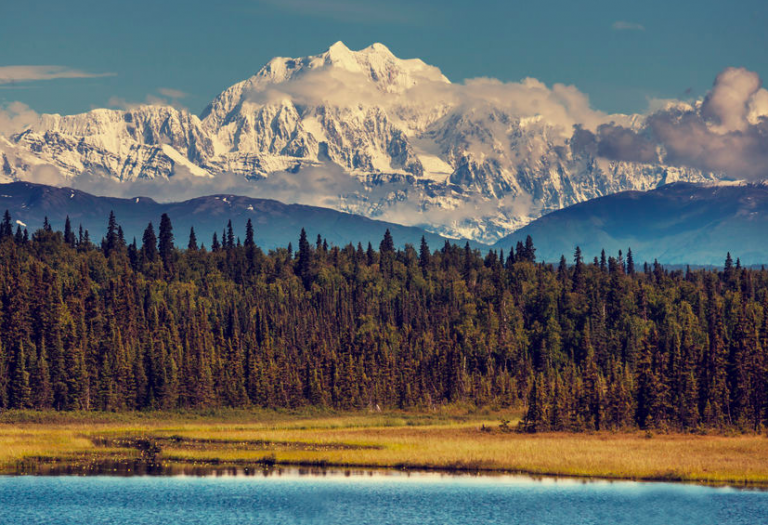
You can hike in the fresh air, but if you’re on one of the buses inside Denali National Park, or using the facilities, you’ll be required to don a face mask again. So says the National Park Service, which reinstitute a mask mandate for Alaska’s most famous national park.
That mask mandate applies to anyone 2 years of age and older, regardless of vaccination status.
The mask mandate takes effect Friday.
The park mandate is following U.S. Interior Department guidelines, which require masks when Covid-19 community levels reach a high status in the surrounding area.
Mask requirements are based on the CDC COVID-19 Community Levels for the Denali Borough and the Matanuska-Susitna Borough.
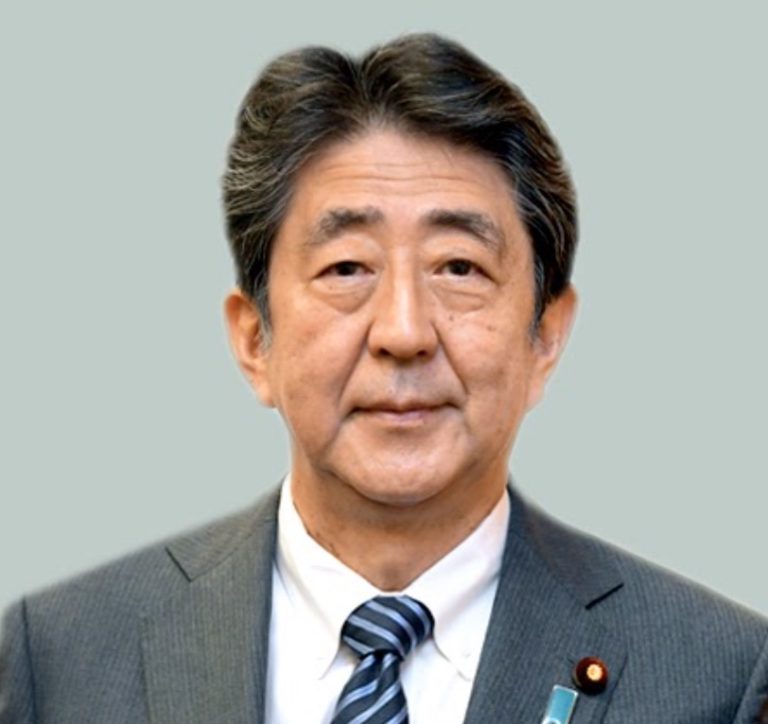
Shinzo Abe, Japan’s most storied former prime minister, was assassinated on Friday in Japan’s old capital city of Nara. He had been speaking on behalf of one of the members of his political party, when a man from the crowd shot him in the neck with a homemade gun. He was rushed to a hospital and died six hours later at the age of 67.
Police apprehended 41-year-old Tetsuya Yamagami at the scene; he is charged with murder. Officials said he made the gun and that he has confessed to intending to kill Abe because the former prime minister had political views he disagreed with. Several more homemade weapons were said to be found in the man’s apartment.
President Trump, on Truth Social, wrote it’s “really BAD NEWS FOR THE WORLD! His killer was captured and will hopefully be dealt with swiftly and harshly.” Trump, who will be visiting Anchorage, Alaska on Saturday, described Abe as “a unifier like no other” who loved his “magnificent country.”
“Shinzo Abe will be greatly missed. There will never be another like him,” Trump said.
Abe was the longest serving prime minister in Japan since World War II and had met with President Donald Trump on many occasions. In fact, he was the first world leader to meet with Trump after the Republican president was elected in 2016. It was at a time when many world leaders were reluctant to meet with the new president. Abe visited Mar-A-Lago on several occasions.
Mainstream media had its own take, calling him “divisive”: “Former Japanese Prime Minister Shinzo Abe, a divisive arch-conservative and one of his nation’s most powerful and influential figures, has died after being shot during a campaign speech Friday in western Japan, hospital officials said,” NPR wrote on Twitter, later deleting the characterization.
Gun violence is rare in Japan. Other than police and the military, no one in Japan may buy any type of firearm. Hunters and target shooters may own shotguns and airguns under strictly enforced conditions, including extensive background checks, required safety checks, and police surprise visits.
“The police check gun licensees’ ammunition inventory to make sure there are no shells or pellets unaccounted for. A prospective gun owner must take an official safety course and then pass a test that covers maintenance and inspection of the gun, methods of loading and unloading, shooting from various positions, and target practice for stationary and moving objects. The license is valid for 3 years. When not in actual use, all guns must be in a locked space. So comprehensive are the gun laws that even possession of a starter’s pistol is allowed only under carefully prescribed conditions. The Japanese crime rate is low. Handguns were used in 209 crimes in 1985. About two-thirds of all gun crimes are committed by organized crime groups. The citizens apparently voluntarily comply with the gun law; accordingly, there is no mandatory minimum penalty for unlicensed firearm possession. Pressure to conform and internalized willingness to do so are much stronger in Japan than in America. The spirit of conformity provides the best explanation for Japan’s low crime rate. It also explains why the Japanese people accept strict gun control. A gun ban in America similar to that in Japan would be alien to our society, which for over 300 years has had the world’s strongest gun culture. Japan’s gun laws are part of an authoritarian philosophy of government that is fundamentally at odds with America’s traditions of liberty,” according to a report from the U.S. Department of Justice, published in 1992.
There will be a community meeting in Anderson on Thursday night to share information on the Clear Fire. The meeting starts at 7:30 pm at the Anderson Fire Hall, 911 D Street in Anderson and will be broadcast live on the Alaska DNR Division of Forestry and Fire Protection’s Facebook page.
If you are evacuated and in need of shelter, contact the Denali Borough at (907) 683-1330.
Weather: Yesterday’s conditions were hot, dry, and windy; today is predicted to be the same. There are isolated showers and thunderstorms in the forecast. Relative humidity may be as low as 26% on the south side of the fire. Winds are forecasted from the northeast at the north end of the fire. Winds on the south end of the fire will be from the south-southeast early in the day and then shifting to the come from the southwest by the afternoon at 6-10mph with gusts to 18.
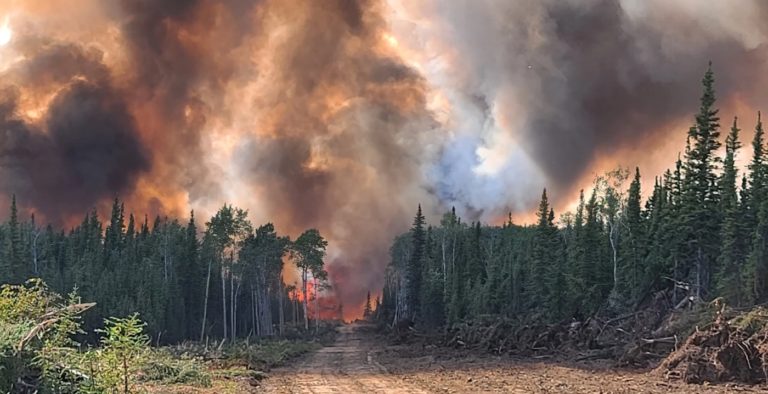
Fire Activity: There was extensive fire in the south side of Kobe Ag in Div K yesterday afternoon and into the evening. Winds came in from the southwest, prompting a severe increase in fire activity on the southeastern-most finger. The fire pushed about three miles north from the finger, breeching the east-west dozer line at the end of Diane Ave. as well as the north-south dozer line on the west side of Kobe Ag. Firefighters working to protect structures on the west side of Kobe Ag had to evacuate due to extreme fire behavior and life-threatening conditions. They remained near Rochester Way, working to protect structures where possible. Several aircraft were ordered, and they staged an aggressive water and retardant attack from the air. Firefighters worked overnight to attack spot fires and to keep the fire west of the Nenana River. The fire has not reached the river as of last report. Fire was active within the lower half of the subdivision reaching east to Rochester Way and north toward Bush Rd. The exact extent of fire reach and damage is being assessed by fire managers today. More resources will be moved into Div K today to continue fighting the fire and assessing the status of structures. Elsewhere in Div K, firefighters are still working to access structures on the southern-most edge, and the southwest edge remains checked by natural barriers.
North of Div K in Div G, there was minimal fire activity yesterday on the western-most dozer line. The east-west dozer line on the north side of Kobe Ag had some active fire that threw some spots, but firefighters were able to corral them. Thursday, crews will continue working directly at the edge of the fire to complete the dozer line that is wrapping north and west around the finger of fire in Div G, with a plan to connect this line into the marshy area near the Div G and Div B break.
In Div B on the northeast, crews constructed saw line yesterday and will work Thursday to tie this into the marshy area at the Div B and Div G break. They will continue laying hose for mop-up or suppression needs.
In Div A in the north, fire behavior is mainly creeping and smoldering. Firefighters will mop-up, protect structures, and improve fire line along the edge of Div A today.
Fire behavior in Div O on the northwest side is mainly smoldering with limited activity. Firefighters are allowing the river to work as a natural barrier and will keep monitoring some hot spots. There is no immediate threat to structures in Div O.
The River Group, also in the northwest, helped to transport crews yesterday morning and then assisted crews in Div A. Today, they will be assessing structures on the northern portion of the fire and making plans for any fuel reduction needs around the structures.
Div F firefighters worked on community protection lines around Anderson Wednesday morning. The area is well prepared in the case of any fire movement toward the city. Later in the day, most crews were relocated to Div K to assist with efforts there. Several Div F resources will keep assisting in Div K today.
Ready (Prepare your property): All areas WEST of the Nenana River between Parks Highway MP 264 – 269, including Bear Creek and June Creek areas.
Set (Prepare your “go bag”): All areas WEST of the Nenana River between Parks Highway MP 269 – 274.
This includes the city of Anderson, Clear and Clear Space Force Station. All areas EAST of the Nenana River between Parks Highway MP 275 – 302. All cabins along the Teklanika River between two and five miles of the current fire perimeter.
GO (Evacuate now): All areas accessed by Kobe Road. All cabins along the Teklanika River within two miles of the current fire perimeter.
Sheltering or evacuation-related information: Contact the Denali Borough at (907) 683-1330, see the Borough’s Facebook page or visit denaliborough.org
All other fire information: Clear Fire Information, (907) 290-2921; Alaska Fire Information, (907) 356-5511; akfireinfo.com, inciweb.nwcg.gov/incident/8178, and on the Alaska Division of Forestry and BLM Alaska Fire Service Facebook pages.
Photo: Fire burns in the Kobe Ag subdivision on the afternoon of 7/6/2022. Photo credit: Eric Kiehn, Task Force Leader with Northwest Team 1
One might think with local outcries over the steep increase in commercial and residential property taxes this past two years, coupled with Juneau’s struggling economy, the City and Borough of Juneau (CBJ) Assembly would be looking for ways to ease the burden on local taxpayers. Instead, they seem to be doing just the opposite, funding pet projects in a variety of ways that will only serve to increase taxes.
On June 27, the Assembly met in a work session with two main items on the agenda, (1) selection of items to fund from the “temporary” 1% sales tax extension, and (2) whether to add a sales tax exemption for food.
During the first three hours of the meeting, assembly members debated dozens of priorities that would be funded with approximately $60 million expected to be collected during the five-year life of the 1% sales tax measure – should it be approved by Juneau voters in October.
To Mayor Beth Weldon’s credit, she led an effort to reduce or eliminate items that had other funding sources or didn’t target specific projects.
One of the items of contention was childcare funding. Mayor Weldon made it clear that she preferred choosing capital projects and specific deferred maintenance items qualifying as one-time expenditures. While she was able to get childcare reduced by half from the original $5 million request, what remained is a significant departure from past CBJ sales tax measures. It effectively “locks-in” the operating expense of childcare in perpetuity so that it must be included in subsequent sales tax measures. Sneaking an operating expense into the budget in this way diverts taxes from more pressing needs and kicks the can down the road because it eventually must be funded from other sources.
The Assembly then moved on to the question of exempting sales tax on food.
This modification would create a $7 million hole in the budget. Without a long-term strategy for replacing the missing revenue, it’s doubtful that a majority of Juneau voters would approve it. Nor would they likely accept general tax increases without a rigorous review of on-going CBJ operating expenditures, which the Assembly seems unwilling to discuss.
Previously, assemblymembers decided to put an advisory vote on the ballot to determine the public’s views on the matter. But when faced with how to word the advisory vote, they waffled and decided instead to spend $30,000 on a survey or poll.
So the Assembly kicked the can down the road once again.
This is problematic. Questions on a survey can be asked a number of different ways to get the preferred answers. Indeed, one of the options presented to the Assembly was to ask the question this way:
The Assembly intends on exempting food from sales tax. Would you prefer to replace the lost revenue by: (vote for not more than one) 1. Increasing the sales tax rate year-round? Yes [ ] 2. Increasing the sales tax rate seasonally? Yes [ ] 3. Increasing the property tax mill rate? Yes [ ]
Obviously, this doesn’t even give the person polled the option to object to the exemption. And it only allows three possible funding options. What about a combination? What about canning the idea of a new city hall instead? What about reducing or eliminating other sales tax exemptions to help offset the revenue lost?
This last suggestion seems particularly appropriate and there are plenty of alternatives from which to choose. One of the most glaring and obvious options is the exemption for non-profits from collecting sales taxes from customers on their retail sales. Why would we tax visitors and residents at most local stores but provide a competitive advantage to “non-profit” retailers like the downtown Sealaska Heritage store or the Discovery Southeast store at the Mendenhall Glacier Visitors Center by not charging any sales tax at all ?
Where is the equity in that?
The CBJ Assembly is again dodging the thorny issue of non-profit tax exemptions and kicking the can down the road with a survey that cannot provide the kind of context that is needed when weighing so many different options.
Assemblymembers have been elected to make difficult decisions – not procrastinate or hide behind a poll.
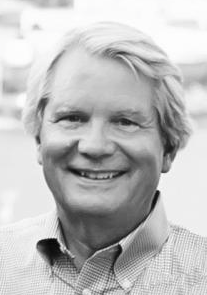
After retiring as the senior vice president in charge of business banking for Key Bank in Alaska, Win Gruening became a regular opinion page columnist for the Juneau Empire. He was born and raised in Juneau and graduated from the U.S. Air Force Academy in 1970. He is involved in various local and statewide organizations.
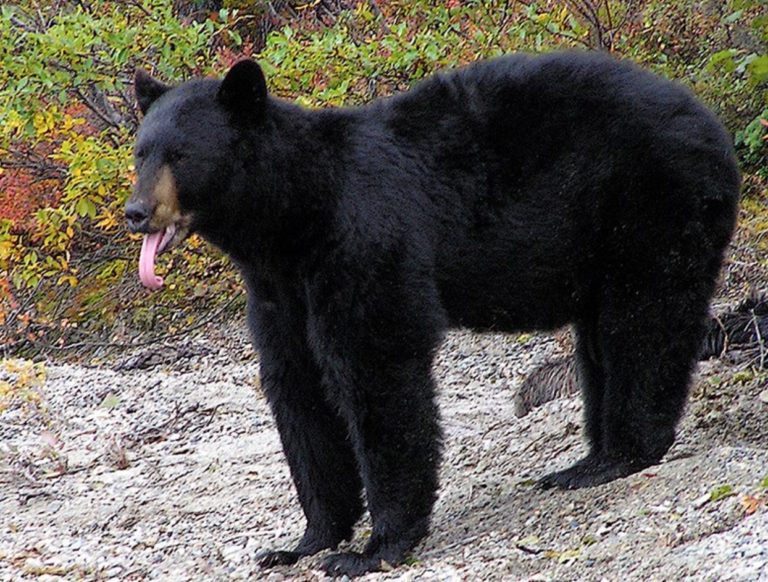
Thousands of bears are harvested every year in Alaska, but if Alaska Fish and Game kills a pack of dangerous bears in urban Anchorage, there are going to be those who will complain, and the mainstream media is there to service the complainers.
That is how it came to pass that the New York Times wrote a story about four garbage bears who had put their hungry snouts inside the tents of campers at Centennial Park Campground one time too many and ended up dead. For the world, it’s the stuff of legends, but for Alaskans, it’s called summer.
There are few who think that destroying the garbage bears was unfair to ursus americanus. But they are the few who have the ear of the mainstream media.
“The killing of the bears raised questions in the community about the safety of the hundreds of homeless people living at the campground,” the New York Times wrote.
“Raised questions” is a reference to the left-wing resistance to clearing dozens of homeless people from the Sullivan Arena and setting them up in tents in the Centennial Park Campground, no fee required.
Corey Allen Young, communications director for the mayor’s office, said bears are all over in Anchorage, not just at the campground. It’s not uncommon for bears to be destroyed when they become dangerous in the city limits. It happens routinely, in fact.
Alaska is bear country. An estimated 100,000 black bears roam the state — one for every seven Alaskans. The annual harvest of them is about 3,250 bears.
“As many longtime Alaskans can attest to, bears do not go to just campgrounds,” Young told a reporter. “During the summer, it is common to see them throughout the city in many neighborhoods. The priority will always be to protect humans and mitigate risks to bears.”
Young said that officials “continue to inspect camps and educate campers about bear-safe practices” and that private security personnel were already at the site but that they would now be working around the clock,” according to the Times.
During the reign of Gov. Bill Walker, state government tried to play nice with urban garbage bears, and it didn’t work out.
In 2015, a sow black bear and her four year-old cubs were relocated from Government Hill in North Anchorage to a remote corner of the Kenai National Wildlife Refuge, south of Anchorage. The bears were fitted with radio tracking collars to allow the Department of Fish and Game to monitor their movements. The sow also was fitted with a GPS collar.
Those bears had been picked up and flown out of Anchorage on May 1 of that year after becoming a hazard in the neighborhood. By May 4, they were within 1.5 miles of the town of Hope, and the people of Hope started securing their trash. Then the bears moved in. They became regulars.
The U.S. Forest Service restricted camping outside of Hope the following year after the bears tore up an unattended tent with food inside at the Porcupine Campground. Finally, the bears were euthanized after one of them climbed into a parked van, while the driver was relaxing inside.
In 2021, 12 bears had to be killed in Sitka. They were brown bears; Chichagof Island is full of brown bears. Every year some get destroyed because they take up residence in a neighborhood.
In May of 2022, a soldier from St. Augustine, Florida was killed by a brown bear on Joint Base Elmendorf-Richardson, while he was on a training assignment.
It often makes more sense to destroy a bear, rather than hope that it can be reformed, once it gets a taste of easy-to-harvest human food, wildlife managers say.
“Efforts to relocate bears often fail because the animals may travel long distances to return to their location of origin. In one case recorded by the department, a brown bear relocated from Cordova to remote Montague Island in Prince William Sound was killed in Cordova less than a month later within 100 yards of its original capture site. The bear’s return entailed a 50-mile-long straight-line journey, which required a minimum 7-mile-long open saltwater crossing of Hinchinbrook Entrance from Montague Island,” the Alaska Department of Fish and Game reported.
“Even when relocation results are permanent, the solution is often only short term as new bears will move into the area. Within a day of Friday’s relocation of the Government Hill black bear sow and four cubs, the department began receiving reports of new black bears in the neighborhood.”
The quality of public discourse has been in decline for years. But it is seldom that a person who works in media — especially public broadcasting — is caught putting crude and sexually disrespectful language into the public record. But it happens.
Case in point: A [edited July 8] former employee of Alaska Public Media had some unkind words for the Bronson Administration on Wednesday. After four dangerous, garbage-munching black bears were put down near the Centennial Park Campground, out an abundance of caution for the campers there, some Anchorage residents were unhappy. Some were clearly distraught.
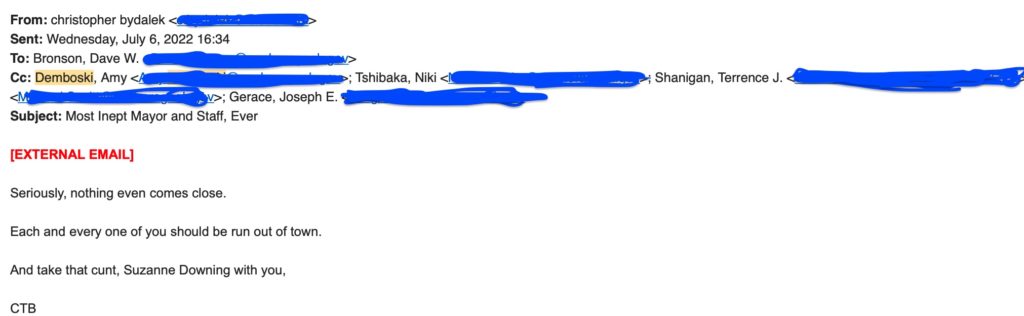
Chris Bydalek was one of them. He wrote an email to Mayor Dave Bronson, City Manager Amy Demboski, and several other members of the executive branch.
Must Read Alaska did a public records request concerning any public complaints about the bears on Wednesday, and among the documents retrieved was a curt note from Bydalek, which made it clear he thinks the Bronson Administration should be run out of town and “take that cunt Suzanne Downing with you.”
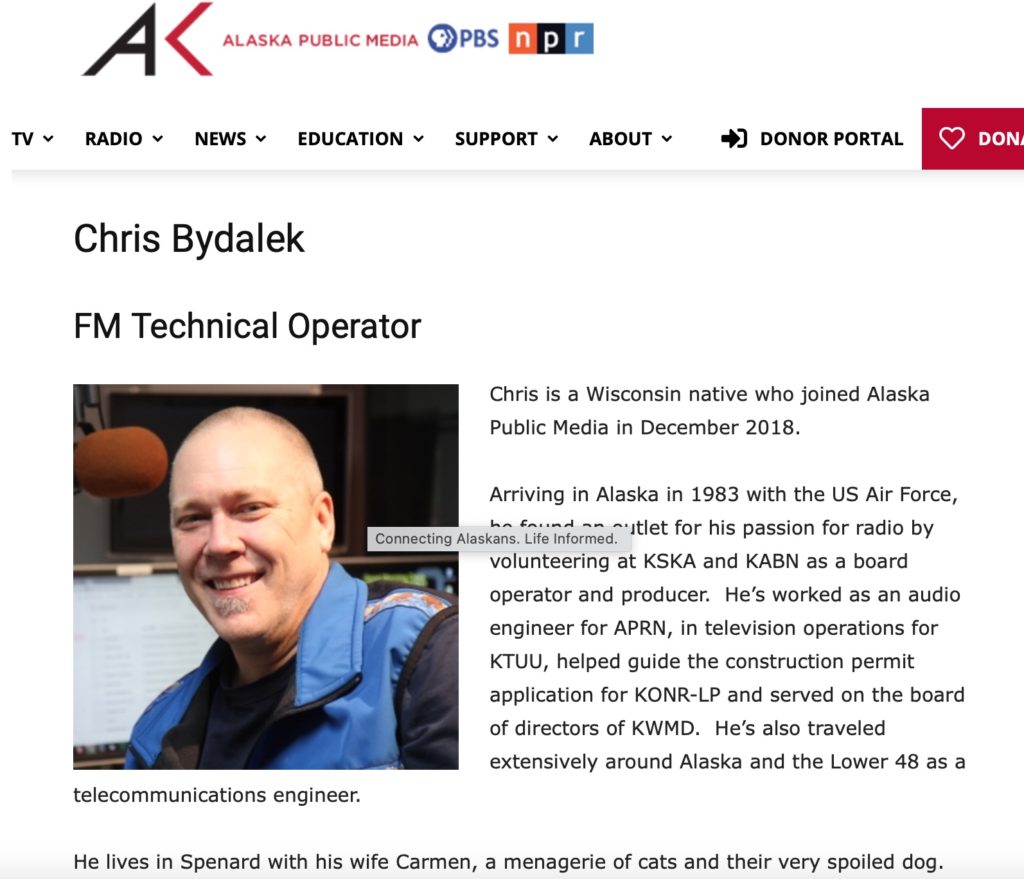
Bydalek is former contractor with the Alaska National Guard who joined Alaska Public Media in 2018, after volunteering at KSKA and KABN as a board operator and producer.
He worked as an audio engineer for APRN, and in television operations for KTUU. He apparently only lasted a year, according to Wesley Early, a reporter at Alaska Public Media, who took exception to this story but who could not provide evidence as to when Bydelek left the company.
(Within days of this story being published, Alaska Public Media had corrected its website:)
Before – Alaska Public Media staff box on Thursday.After – Alaska Public Media staff box on Friday.
Sources at City Hall said Bydalek has a history of abusive emails.
Suzanne Downing is the publisher of Must Read Alaska.
Trigger warning: Jerry Ward, senior adviser to the Sarah Palin campaign for Congress, told KENI talk show host Dan Fagan on Wednesday that Palin never quits, that she only does what’s best for America and Alaska.
Ward insisted that Palin never quit her term as governor, with 18 months to go.
Fagan was incredulous. He has been a vocal critic of Palin for quitting, for signing off on high oil taxes, and for helping to install a Democrat Party-backed governor by endorsing Bill Walker and Byron Mallott in 2014, instead of her own former lieutenant governor, Republican Sean Parnell.
Fagan asked Ward to explain several times. But Ward would not budge. He continued to repeat that Palin never quits.
“What would you say to those people who are maybe thinking ‘I can’t vote for Sarah Palin because she quit on us once, she may quit on us again.’ What would you say to them?” Fagan asked Ward.
“Sarah Palin is a fighter. She never quits. She does what’s best interest for America and the state of Alaska.”
“When you say she ‘never quits,’ I know you don’t mean that,” Fagan replied. After all, it is a fact that she resigned from office in July of 2009.
“Dan, Dan, she is not a quitter. She is a fighter. She always does what she thinks is in the best interest of Alaska and America,” Ward repeated.
It went on this way for over two minutes, with Ward never off message from the “she never quits” answer. Fagan finally thanked Ward for joining the show. Listen to the clip:
In 2009, the Guardian newspaper wrote: “The customary political calm of the celebratory 4 July weekend was shattered by frenzied commentary over the surprise decision by Sarah Palin to stand down as governor of Alaska, which has left pundits intrigued, baffled and amazed.
“Palin added to the speculation over the weekend, dropping a few further tantalising hints but falling far short of a definitive explanation. The most suggestive of those hints were made in an Independence Day post on Facebook where she alluded to a “higher calling” and said she was “now looking ahead and how we can advance this country together”.
“Those words will strengthen the camp that believes the resignation amounts to a first step in a bid for the White House, as opposed to those who interpret it as the beginning of the end of her political career. But, this being Palin, nothing is clear,” the newspaper wrote.
Randy Ruaro, chief of staff to Gov. Mike Dunleavy, is taking a leave of absence to manage health-related family issues out of state, Must Read Alaska has learned.
Ruaro has been chief of staff to Dunleavy since the departure of Ben Stevens, who left to take a job with ConocoPhillips in 2021. Ruaro served as chief of staff for Sen. Bert Stedman and was deputy chief of staff for Gov. Sean Parnell.
In his place, Tyson Gallagher will serve as acting chief of staff. Gallagher, the deputy chief of staff, has been on leave and working on the Dunleavy reelection campaign as the campaign co-manager.
Gallagher served in the Parnell Administration, as a budget analyst the Office of Management and Budget, was a GCI executive, and then was offered a position in the senior management of the Dunleavy Administration.
U.S. Sens. Lisa Murkowski and Dan Sullivan released the following statement after the Diane Kaplan, President and CEO of the Rasmuson Foundation, was nominated by President Joe Biden to serve as a member of the board of directors for the Corporation for Public Broadcasting.
Kaplan announced earlier this year that she is retiring from the foundation in 2023, which she has led since 2001. She will face congressional confirmation for this appointment, but with two Alaska Republican senators supporting her, that seems a mere speed bump.
“Diane Kaplan’s work in Alaska has touched all sectors – business, government, nonprofit, philanthropy and so much more. Diane has been a particularly strong advocate and leader in the world of radio, having previously served as the CEO of our state’s 28-station public radio network. I am pleased that an Alaskan will be stepping into a role on the CPB Board,” said Murkowski. “Diane understands the importance of telecommunication and broadcasting—the opportunities and challenges we face and the type of innovation and collaboration it takes to solve them – and I have every confidence she will serve as an incredible representative for our great state as well as the country. I am pleased that Diane’s talent and knowledge has been recognized in this important and meaningful way and I’m proud to have supported her through the process.”
“I want to congratulate Diane on this prestigious appointment to the CPB Board, a fitting capstone to an already impressive career and a life of service to others. Public media offers an invaluable service in a state like Alaska, particularly for our rural communities, which Diane understands well given her deep roots and many years leading Alaska’s public radio network. Diane’s tenacity and vision at the helm of the Rasmuson Foundation has likewise grown Alaska’s nonprofit sector exponentially, enriching the life of our state and better serving the needs of the most vulnerable in our communities. We look forward to all that Diane will contribute and accomplish for her fellow Americans at the Corporation for Public Broadcasting,” said Sullivan.
The Corporation of Public Broadcasting was created by Congress in the Public Broadcasting Act of 1967 to help advise the federal government’s investment in public broadcasting.
The nomination comes after a letter sent a year ago by Senators Murkowski and Sullivan recommending Kaplan for the prestigious positioin.
The White House wrote: “Diane Kaplan is President and Chief Executive Officer (CEO) of the Rasmuson Foundation, based in Anchorage, Alaska. As President and CEO, Kaplan’s approach to philanthropy raised the bar for funder partnership with business, government, and other nonprofits. Before joining the Foundation, Kaplan provided consulting services for philanthropic organizations, Native corporations and tribes, and nonprofit organizations. Prior to that, she served as Chief Executive Officer of Alaska’s 28-station public radio network. She serves on the board of United States Artists, and is a member of the Anchorage Homelessness Leadership Council, Anchorage Rotary Club, the Federal Reserve Bank of San Francisco community advisory council, and Recover Alaska’s governance council. In 2019, Kaplan received the Anchorage ATHENA Society’s Leadership Award, the group’s highest honor. Kaplan earned a degree in Communications and Women’s Studies from the University of Pennsylvania, graduating summa cum laude.”