On December 24, Governor Dunleavy appointed Steve St. Clair, of Wasilla, and Garret Nelson, of Sutton to serve as House Representatives for Districts 26 and 29. Next week, House Republican leaders will meet to confirm the appointments.
Steve St. Clair is a retired Military Police First Sergeant who has spent 7 years in Juneau as a legislative staffer. He ran for Senate in 2016 but was defeated by Shelley Hughes. His values include returning to “God, family, and country,” seeking protections for disables veterans, protecting life from conception, promoting limited government, and honoring the State and National Constitutions.
Garret Nelson is the chair of the Sutton Community Council.
The two House seats were vacated after Cathy Tilton and George Rauscher were confirmed to the Senate to fill vacancies left by Candidate for Governor Shelley Hughes and Candidate for Lieutenant Governor Mike Shower.
Republican leaders seek to seat the new members quickly as the 34th Legislature prepares for their second session, beginning Jan 20.
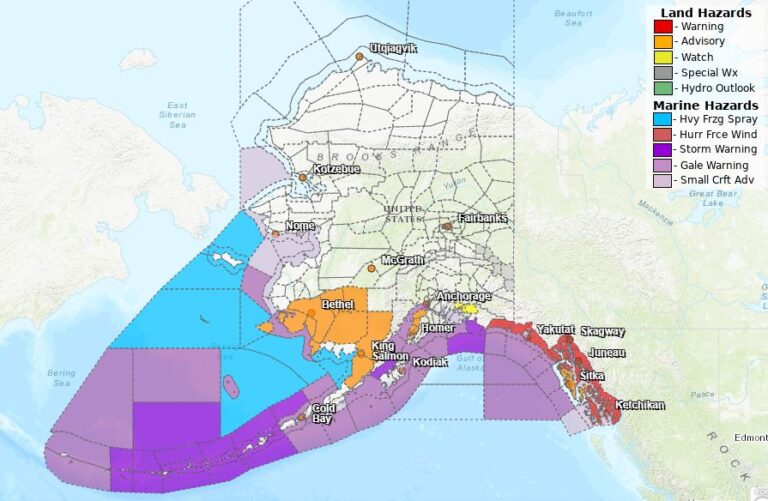
As Alaskans dig out from a brutal spell of record-breaking wind and cold, a powerful winter storm is unleashing heavy snowfall across the Panhandle, threatening travel and daily life after Christmas. The National Weather Service has issued Winter Storm Warnings for much of Southeast Alaska, forecasting more than a foot of snow in areas like Juneau from late Friday into Saturday evening, driven by an atmospheric river that will push temperatures into the high 20s. This comes on the heels of extreme lows, including a new record of -10 degrees at Juneau International Airport earlier this week, marking the fifth sub-zero day in December.
The storm’s impacts are expected to be severe, with hazardous road conditions and potential power outages. City officials in Juneau are urging residents to stock up on essentials and monitor heating systems, citing recent fires linked to equipment failures in the frigid weather. Harbor operations may also face disruptions, as boats contend with accumulating snow and shifting conditions.
Meanwhile, the storm’s reach extends westward, with Blizzard Warnings and Winter Weather Advisories in effect across Southwest Alaska and the Bering Sea, where high winds and blowing snow could reduce visibility to near zero. In the Kenai Peninsula, a Winter Weather Advisory warns of 2 to 4 inches of snow and gusty winds, complicating travel along highways and coastal areas. Moderate to heavy snow is anticipated to persist into Sunday across the Panhandle, exacerbating recovery efforts from the ongoing cold snap.
Emergency shelters remain open in Juneau, providing warmth and transportation for vulnerable residents. With the Alaska Region Headquarters monitoring the system, forecasters advise checking local updates for evolving conditions. As the state braces for this latest wintry assault, communities are reminded of Alaska’s unforgiving climate, where preparation can mean the difference between safety and peril.
An update for resource development in northern Alaska: the Alaska Industrial Development and Export Authority (AIDEA) released findings from a new scientific review asserting that the proposed 211-mile Ambler Road would pose minimal threats to the Western Arctic Caribou Herd (WAH). The announcement, made on December 23, 2025, highlights the road’s potential to access rich mineral deposits while safeguarding wildlife, amid ongoing debates over environmental and subsistence concerns.
The report, authored by biologist Matthew A. Cronin, Ph.D., and completed on October 28, 2025, analyzes caribou data in relation to the Ambler Road project. It estimates the road’s footprint at less than 0.005% of the WAH’s 92.2-million-acre range, with only 3-4.8% of collared caribou crossing the alignment in fall and winter from 2010-2022. The study emphasizes that primary migration routes lie west and north of the route, over 150 miles from calving grounds.
The last major caribou assessment related to the Ambler Road prior to this was in the U.S. Bureau of Land Management’s (BLM) 2020 Final Environmental Impact Statement (EIS), which incorporated data up to 2018-2019. That EIS projected potential migration delays and habitat fragmentation affecting 0.0005% of the WAH range, drawing from surveys dating back to 1982-2017. A 2023 Draft Supplemental EIS updated some analyses with data to 2022, but the 2020 version remains the core federal reference.
Key differences include the current report’s use of fresher data showing a sharper WAH decline—to 152,000 animals in 2023 from 259,000 in 2017—and reduced road crossings in recent years, attributing declines more to predation and weather than infrastructure. Earlier reports, like the 2020 EIS, focused broader on subsistence impacts, estimating high reliance (20-45% of harvests) in affected communities.
Predation and winter weather are primary threats to the WAH, without the road in existence, Cronin wrote in the report.
AIDEA’s release underscores mitigation measures, such as no public access and predator control requests.
If built, the road could generate over $1.1 billion in state revenues from taxes and royalties, while creating 2,730 construction jobs and boosting rural economies.
Despite Alaskan Republicans outnumbering Alaskan Democrats 2:1, liberal ideology appears rampant in Alaska’s public schools, government decisions, and non-profit industry. Time after time, Alaskans see ballot measures, lawsuits, and media campaigns pushing policies resembling those drafted in Portland. At the heart of the issue, like every political issue, is money.
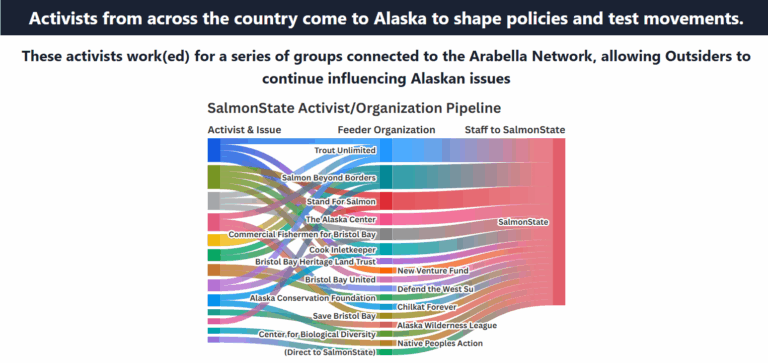
On Nov. 12, the American Accountability Foundation (AAF) launched the Alaska Influence Pipeline. This online hub traces how wealthy, out-of-state advocacy networks fund a liberal agenda in Alaska. Disguised behind seemingly benign nonprofits and nonpartisan brands, out-of-state plutocrats are pushing progressive politics into Alaska.
The Arabella Machine: Billions in Liberal Money, Now Flowing North
The Sixteen Thirty Fund, the New Venture fund, the Hopewell Fund, and the Windward Fund are few of the progressive nonprofits showing their way into Alaska. At the center of all of them is the for-profit consulting firm Arabella Advisors, a powerful D.C.-based firm that manages these nonprofits.
According to public filings highlighted by AAF, the Arabella-managed network has spent approximately $9 billion since 2006, shaping policies around the country through ballot measures, ad campaigns, “popup” groups, and media projects.
Between 2020 and 2024, entities backed by Arabella spent more than $9 million on opposing or delaying Alaskan resource development and infrastructure projects, pushing progressive ballot initiatives, and building “local” organizations that echo national talking points.
In a small population state like Alaska, $9 million targeted over a few years can overwhelm genuine local activism and drown out voices that do not have access to large amounts of money or D.C.-backed management resources.
“Alaskan” in Name Only
The Alaska Influence Pipeline flags several entities that brand themselves as Alaskan organizations but rely heavily on out-of-state funding.
For example, the Sixteen Thirty Fund and other liberal sources support the Alaska Center. This group pressures candidates to endorse an agenda seeking 100% renewable energy by 2050, higher oil and gas taxes, and changes to Alaska’s voting system. These policy positions reflect nationwide liberal demands, not the desires of the average Alaskan.
Progress Alaska is another example. Arabella-managed organizations infused Progress Alaska with $3 million to aid a campaign against energy development, mining prospects, and projects such as the West Susitna Access Road.
Although these organizations appear homegrown, with websites featuring local scenery and familiar rhetoric, their funding and strategy point back to national campaigns that treat Alaska as another battlefield, not as a unique state with unique needs.
Ballot Measures and Faux “Grassroots” Campaigns
Non-profits are not the only political devices manipulated by dark money. The Alaska Influence Pipeline also shows heavy out-of-state involvement in Alaska’s ballot initiatives. For example, the New Venture Fund played a key role in funding 2016’s Ballot Measure 1, which linked automatic voter registration to the Permanent Fund Dividend. In 2024, the Sixteen Thirty Fund poured approximately $930,000 into an initiative pushing higher minimum wages and mandated paid sick leave.
Additionally, campaigns like the 907 Initiative and “Alaskans for Posterity” launched an extensive advertising and political campaign in Alaska, but they did not openly disclose the out-of-state funding, such as funding from the New Venture Fund, that propped up their campaign.
Whose State Is It Anyway?
The reality of out-of-state money pouring into Alaska to fuel the liberal agenda raises the question of whether self-government means anything if the messaging, lawsuits, and ballot language are all being drafted somewhere between K Street and Silicon Valley.
Alaskans deserve to know who is paying for the ads and mailers they see, who underwrites the “nonpartisan” or “local” group knocking on their door, and which national networks are experimenting on Alaska’s political system.
The Alaska Influence Pipeline offers transparency to Alaskans wanting to know who is meddling with their resources, elections, and communities.
More to Come
COMING SOON: Let’s go deeper! This column outlines just the tip of the iceberg of the dark money problem. Keep watch for more articles diving deeper into the problem and what can be done about it. In the meantime, read our previous coverage below:
Alaska did not enter the Union by accident. It entered under a specific design.
When Congress admitted Alaska as a state, it understood something fundamental: Alaska had no private land base, no established property tax system, and no realistic way to support self-government using the same tools as other states. Therefore, Congress chose a different model: instead of funding Alaska through ongoing federal support, statehood was structured around land.
Alaska was given the right to select vast amounts of federal land over time— land meant to support communities, enable local government, and form the economic foundation of a self-governing state. This land was not symbolic. It was intended to function as Alaska’s substitute for the internal improvement grants and revenue mechanisms earlier states had relied upon.
Land was how Alaska was expected to grow up. That design matters because it explains many conflicts Alaskans argue about today.
The Statehood Act does not require the federal government to give up all the land nor does it prohibit federal withdrawals. However, it does repeatedly tie Alaska’s land selections to communitydevelopment, expansion, and practical use. The Act anticipates towns that did not yet exist. It requires land to be selected in workable, connected areas. It treats land access as a continuing responsibility of state government, not as a one-time gift.
In plain terms, statehood promised that enough land would remain available, accessible, and usable for Alaska to build local authority and long-term fiscal capacity. That promise never fully materialized.
Over time, large portions of land became unavailable or difficult to use. Development clustered unevenly. Local governments formed slowly or not at all. Yet the responsibilities of statehood never changed. Alaska was still expected to educate its children, maintain infrastructure, and govern a vast territory.
Rather than insisting on land access, Alaska adapted to land restrictions. Centralized revenue replaced local tax bases. Bureaucracy substituted for settlement. The Permanent Fund became a stabilizer for the volatility that land was once expected to absorb. Dividends became a stand-in for equity that ownership and local development were supposed to provide.
Although the Alaska Native Claims Settlement Act resolved Native (ANCSA) land claims and was both historic and necessary, it did not replace the broader land-based framework statehood promised. Neither ANCSA nor the Permanent Fund was intended to substitute for local self-government. Both became part of a system that managed around an unfinished design instead of completing it.
This issue is a result of policy choices planting certain seeds— the seeds of federal overreach mixed with state avoidance— and over time those seeds produced predictable results: dependency, division, and endless conflict over money instead of responsibility.
Common sense tells us this: a durable self-government cannot be built without a functioning land system. Local responsibility cannot be expected without local authority. And symptoms cannot be managed forever without addressing the root cause.
Alaska was not meant to beg. It was meant to build. Until we realign modern policy with the land-based design embedded in statehood, we will keep arguing over the weeds rather than restoring the ground they grew from.
Edward Martin, Jr. is a retired 50+ year IUOE, General Contractor and long-time Alaskan with a strong belief in the National and State Constitutions and the inherent rights of citizens. He devotes his retirement to investigating Constitutional violation(s) in hopes of protecting the eternal rights of liberty.
COMING SOON: keep an eye out for the coming-soon column addressing what Alaskans and the Legislature can do to begin restoring land-based self-government.
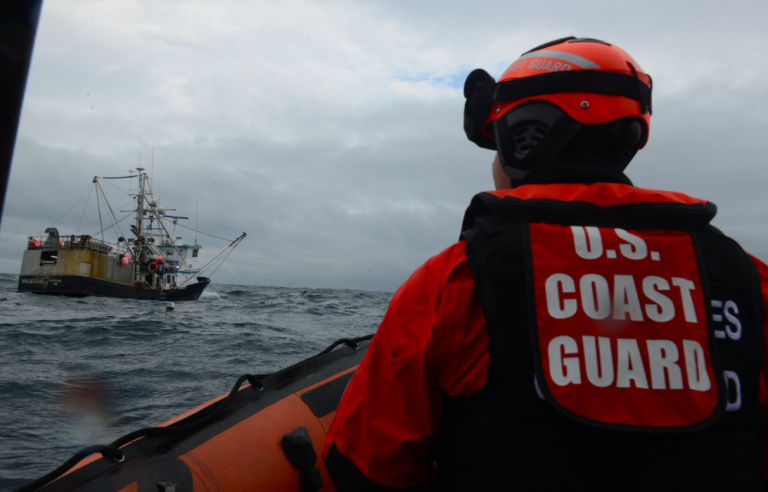
The Coast Guard Authorization Act of 2025, included in the NDAA, authorizes $15.5 billion for FY 2026 and $17.2 billion for FY 2027 to support and expand the U.S. Coast Guard. Combined with the $25 billion Coast Guard investment provided by the One Big Beautiful Bill Act, this year marks America’s largest investment in the Coast Guard to date.
Senator Sullivan, chairman of the Senate Commerce Coast Guard, Maritime and Fisheries Subcommittee, explains the importance of this investment for Alaska: “As America’s only state with Arctic territory and with more coastline than the entire Lower 48 combined, Alaska is critical to the Coast Guard’s missions in defense of our nation. The Coast Guard serves an indispensable role in our state, defending our waters and ensuring the safety of Alaskans, a fact we were all reminded of witnessing the numerous search-and-rescue missions conducted and lives saved in Western Alaska in the aftermath of Typhoon Halong. From bolstering oil spill and emergency response, to providing greater support and quality of life improvements for our Coast Guardsmen, this Coast Guard authorization builds upon the strong relationship between Alaska’s communities and our Alaska-based Coast Guard and will help our service members support their families and fulfill their many critical missions in the Last Frontier.”
A press release from Sullivan’s office details how the money will be spent:
In the quiet sanctity of Nazareth, the Holy Family exemplifies beauty through humility and devotion, with Mary shining as the epitome of grace and purity. Her life with Joseph, marked by a simple home and mutual reverence reveals a divine harmony that inspires Christians worldwide. This familial splendor links directly to Advent, a season rooted in ancient traditions of preparation for Christ’s birth.
Advent, from the Latin “adventus” meaning “coming,” traces its history to early Christian practices in the West, evolving from a rigorous “second Lent” of fasting—spanning 40 days with three weekly fasts decreed by figures like St. Perpetuus in the fifth century—to the modern four-week observance by the ninth century. For Christians, this time is vital for spiritual renewal, fostering gratitude for Jesus’ sufferings—as St. Alphonsus would describe began in Mary’s womb—and binding souls to divine love amid worldly distractions.
The fourth Sunday of Advent, known as “Rorate,” intensifies this anticipation as the final call to devotion, echoing John the Baptist’s cry in the desert: “Prepare ye the way of the Lord: make straight his paths.”
St. Bernard eloquently stated, “In the first coming, He comes in the flesh and in weakness; in the second, He comes in spirit and in power; in the third, He comes in glory and in majesty,” encapsulating Advent’s profound call to preparation for the coming of the Savior. As Christmas nears, Advent invites believers to emulate Mary’s humility, transforming waiting into wondrous union with the divine.
At the December 9, 2025 Georgia State Election Board hearing, Fulton County admitted to certifying approximately 315,000 early ballots in the 2020 presidential election without required signatures on tabulator tapes, violating state law and breaking the chain of custody. This admission stemmed from a complaint filed by election integrity activist David Cross in March 2022, alleging that the county failed to provide signed tapes for these votes despite open records requests. The board voted to refer the matter to the Attorney General, imposing a $740,000 fine—calculated at $5,000 per violation for 148 unsigned tapes. These 315,000 uncertified votes, far exceeding President Trump’s 11,779-vote loss margin in Georgia, have placed a spotlight on potential fraud, though no direct evidence of altered outcomes was presented.
Cross’s original complaint, detailed in a demand letter to the board, accused Fulton County of statutory violations in handling advanced voting, demanding accountability for the unsigned tapes that legally certify vote totals. During his testimony at the December 9, 2025, hearing, Cross urged, “We should have an asterisk by the results for Georgia in 2020… trust in our elections will remain broken.” Another revelation came from county attorney Ann Brumbaugh, who acknowledged that poll pads were remotely wiped, stating, “KNOWiNK was able to remotely wipe them.” Cross countered that this implied unauthorized internet access, a critical vulnerability.
This issue underscores broader 2020 election integrity. Allegations of remote access and wiping capabilities fueled lawsuits and claims of hackability, suggesting potential manipulation without detection—echoing national debates over machine security that questioned results in battleground states. The Georgia case highlights ongoing calls for paper-based reforms to restore voter confidence amid persistent technological doubts.
The Mat Su Assembly meeting on Dec 16, 2025, had an apparent theme of deciphering information presented in order to make effective decisions. Whether the topic was libraries, gravel pits, or Annex Now to Mat-Su, the Assembly members used the truth litmus test to determine what is fitting for the benefit of Mat-Su.
Resolution 25–120 called for the Mat-Su Assembly to “initiate discussions and considerations regarding the proposal to annex the Chugiak Eagle River area into the Matanuska-Susitna Borough.” The Resolution has no intention to make a formal commitment to annexation, but rather to begin the discussion and consideration of it. According to the rules of engagement by the Borough, any lengthy discussion involving the time and resources of Borough personnel first necessitates Assembly acceptance of the process.
Eaglexit supporters came out in great force to oppose RS 25–120. They argued that the resolution should be tabled and Eaglexit should be acknowledged for their 8 years of effort towards the process. Eaglexit is currently waiting for a technical review by the land boundary commission to be released by Jan 5, 2026. Although Eaglexit presenters acknowledged interest in the annex to Mat-Su solution if Eaglexit proves unattainable, they requested more time to complete the process before introducing another solution.
In the end, the Mat-Su Assembly voted “No” on Resolution 25–120. The Assembly also led discussions regarding a timeframe to renew resolution considerations. Options spanned from several weeks, six months, or a year. Legal counsel informed the Assembly that the denial of RS 25–1 20 does not preclude another resolution to be submitted in the future for the same topic of “intent to discuss.”
Annex Now 2 Mat-Su will not disband due to the recent Mat-Su Assembly action but rather is on hold to see the “proof in the pudding” of Eaglexit’s claims. Is Eaglexit really a viable consideration? Or is Eaglexit a hypothetical utopia that is manipulating the people of Chugiak Eagle River while the Muni of Anchorage disregards and blatantly disrupts the people of CER? Eaglexit should demonstrate itself promptly or CER should explore other options, like Annex Now.
Disclaimer: Opinions expressed in this story are of the writer only. Must Read Alaska supports local self-government and will continue to cover Eaglexit’s efforts.