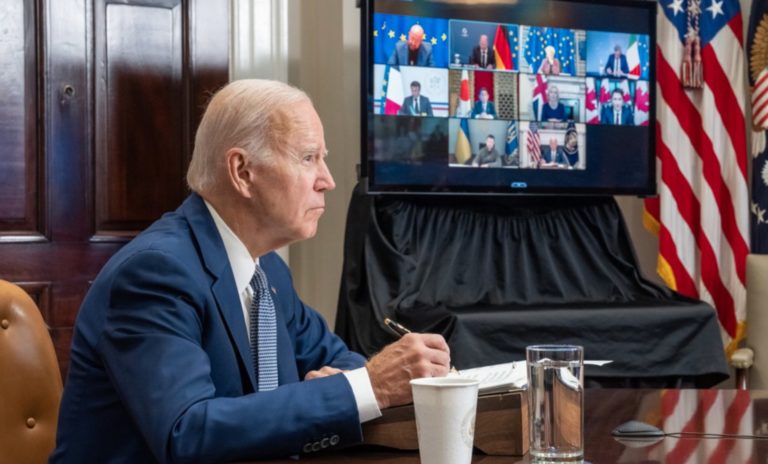
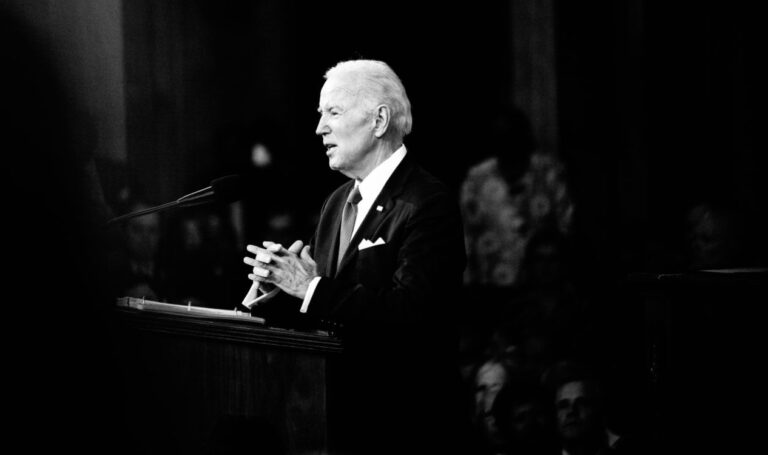
Must Read Alaska readers have had a lot of harsh words over the years for outgoing President Joe Biden. But reader/commenter “Whidbey TheDog” (pseudonym) asks if people could say even one nice word about the president.
So here’s your chance, Must Read Alaska readers. We’ll publish your comments below, but only the ones that are “nice” about Biden. For instance, your MRAK editor offers that Biden said once how children love to touch his hairy legs in the pool. That’s . . . nice.
But there’s so much more than his hairy legs and children.
Here’s your chance to give Biden your best. (Please don’t misspell his name Bidum or Bribem when you comment; it creates a lot of work for the editor.)
The comment section is now open for your pleasure. Go!
The campaign season has apparently begun for the 2026 congressional election cycle. The Democratic House Majority PAC’s sub-PAC is already going after Congressman Nick Begich of Alaska, who has been in office for two weeks.
The group called House Majority Forward is the same one that tried to keep Alaska’s one congressional seat in Democrat hands in 2024. It has purchased an ad buy to attack the Republican candidate who won, along with nine other Republicans in the U.S. House.
House Majority Forward will specifically attack:
GOP Reps. Mariannette Miller-Meeks (ad here) of Iowa and Ryan Mackenzie(ad here) of Pennsylvania. The ads tie the Republicans to Robert F. Kennedy Jr.’snomination to lead the Department of Health and Human Services.
“Marianette Miller-Meeks is supporting Robert Kennedy Jr., who plans to restrict safe products farmers rely on based on conspiracy theories,” the narrator says the ad. “That will drive up the cost of meat and produce.”
Other ads will shred Zach Nunn of Iowa, Tom Kean of New Jersey, Nick LaLota of New York, Mike Lawler of New York, Rob Bresnahan of Pennsylvania and Scott Perry of Pennsylvania.
Of those targets, only Begich, MacKenzie, and Breshnahan are freshmen who just took the oath of office two weeks ago.
“Over the coming weeks, HMF will launch television and digital ads in order to hold Republicans accountable for refusing to lower costs, and conduct extensive quantitative and qualitative research and polling in order to develop a deeper understanding of how Republican policies are hurting American wallets,” House Majority Forward said.
Alaskans may be polled to find out what is important to them so the group can craft its message around the issues of the day.
A Chinese national sentenced this week for illegal guide-outfitter operation he ran in Alaska will serve his time on supervised release for two years. Jun “Harry” Liang also agreed to turn over $73,000 and a luxury vehicle he owns.
According to court documents, beginning in August 2021, Liang, 41, and his co-conspirator Brian Phelan, 53, of Fairbanks, conspired to provide guide-outfitter services for caribou and brown bear hunts out of Fairbanks.
Neither defendant was licensed by the state of Alaska as a big game guide-outfitter.
During the 2022 hunting season, Liang collected $60,000 in advance payments from two undercover agents posing as non-resident hunters in exchange for guide-outfitter services for a brown bear hunt. The money was transferred to Liang’s account through wire transfer and deposited checks.
In August 2022, Liang and Phelan falsely informed the Alaska Department of Fish and Game that Phelan was the brother-in-law of the two undercover agents, which led the department to issue a non-resident brown bear permit and tag, not knowing the information was a lie.
On Sept. 20, 2024, Liang pleaded guilty to one count of Lacey Act false labeling, and additional violations for failing to obtain a special recreation permit and engaging in business in park areas without a permit in Denali National Park. As part of his sentence for the Lacey Action violation, Liang is also required to pay a $10,000 fine. For guiding without a license on Federal Land, he will pay over $9,000 in restitution to the Bureau of Land Management.
On Dec. 30, 2024, Phelan was sentenced to two and a half years’ probation and fined $2,000 after pleading guilty to two counts of violating a regulation for management, use and protection of BLM land, and one count of Lacey Act false labeling.
The U.S. Fish and Wildlife Service, Office of Law Enforcement, Alaska Region, U.S. Homeland Security Investigations, and IRS Criminal Investigation Service, Seattle Field Office, investigated the case.
President-elect Donald Trump recently snapped the gaze of the national security establishment to an often-overlooked geographical feature — Greenland.
Trump’s comments have been enough to start a long-overdue conversation about the semi-autonomous territory owned by Denmark, a landmass that retired Admiral James Stavridis, who served as the Supreme Allied Commander for NATO, has called “a strategic goldmine for the United States.” Stavridis was speaking both literally and figuratively.
Trump has likely done something that many of the so-called national security experts have never considered: He has looked down on a globe from the top. The traditional U.S.-centric view does not tell the full story nor provide the proper perspective. A top-down glance unveils key observations that reveal the wisdom of focusing on a geographic feature that has been brushed aside for far too long.
Greenland and the entire Arctic region are typically considered simply rugged and quaint. Yet, their significance must be
properly elevated as a fundamental component of U.S. national security and economic interests. Trump has done just that.
A North-Pole-centered perspective reveals that Greenland is the largest geographical feature in the Arctic region. As a result, it holds oversized strategic significance in controlling land, sea, air, undersea and space domains for a substantial part of the planet. Proper utilization of the Greenland landmass creates opportunities for multi-faceted dominance of the entire region.
This same perspective reveals a massive trade route, given the right climatic conditions and ice-breaking capabilities. It provides a maritime shortcut between the East Coast and the West Coast of the United States, and similarly for trade between Europe and Asia.
The Houthis in Yemen have reminded the world of an important economic truth — the ability to shut down transit through a key trade route can have ripple effects on the global economy. Suffocating transit through the Red Sea has tripled the cost of shipping from Asia to the East Coast of the United States, enacting huge global inflationary pressures. These negative impacts would be dwarfed by a nation that could control and restrict transit through the Arctic Ocean.
The view from the North Pole also enlightens the viewer about the closer-than-expected proximity between Russia and North America. The protective buffer of the Atlantic Ocean does not tell the full story, and the distances between the United States and Canada and their Russian adversary are much shorter than would otherwise be understood.
Through this literal worldview, Greenland looms large in its significance. This is especially true when it is properly viewed as the primary barrier between Russia and the east coast of the United States. Such positioning provides the rationale for the United States Space Force’s posture on the island with its early warning radars and space control systems – situated to protect against strategic surprise.
Trump’s strong statements about proper economic and strategic utilization of Greenland have been informed by such strategic orientation. These statements are also a natural extension of his rightful insistence that European NATO members pay their fair share to meet collective defense requirements.
While the United States has a commendable 75-year history of supporting European and collective security, fair share also means that America’s European allies must support North American security. That starts with Greenland and continues with a robust strategic focus on the Arctic region.
None of this addresses the largely untapped and abundant natural resources in the Arctic region, from oil and natural gas to precious metals and rare earth minerals, which are desperately needed to sustain a thriving modern global economy. Calling it a goldmine is not hyperbole.
Not only have Trump’s comments gained our attention, but they have also captured the attention of Greenland’s Prime Minister Múte Egede. Egede has eagerly proclaimed that his territory is poised to enhance its collaboration with the United States regarding natural resources and security efforts.
Thus, with just a few words informed by a properly oriented security perspective, Trump has already motivated and cultivated a collaboration that could strike gold for American interests.
United States Air Force Brigadier General John Teichert (ret) is a prolific author and leading expert on foreign affairs and military strategy. He served as commander of Joint Base Andrews and Edwards Air Force Base, was the U.S. senior defense official to Iraq, and recently retired as the assistant deputy undersecretary of the Air Force, international affairs. General Teichert maintains a robust schedule of media engagements, and his activities can best be followed at johnteichert.com and on LinkedIn. General Teichert can be reached at [email protected].
On Friday, three days before the end of his presidency, President Joe Biden set a new record for the most pardons, clemencies, and commuted sentences ever granted by a president.
He commuted the sentences of nearly 2,500 non-violent drug offenders, whose sentences were more harsh than the sentences given today for similar offenses.
“Today’s clemency action provides relief for individuals who received lengthy sentences based on discredited distinctions between crack and powder cocaine, as well as outdated sentencing enhancements for drug crimes,” Biden said in a statement. “This action is an important step toward righting historic wrongs, correcting sentencing disparities, and providing deserving individuals the opportunity to return to their families and communities after spending far too much time behind bars.”
The White House didn’t release the names of the offenders whose sentences he has commuted.
Biden has long has a lax view of illegal drugs, and seems unconcerned that the drug trade is fueled by his open border policies and involves layers of other violent crimes by criminal gangs. The Secret Service and F.B.I. still have not released a report on the packet of cocaine found in the White House near the Oval Office in July of 2023. The agencies closed the investigation a few weeks later, saying they could find no evidence, although the DNA on the package provided a “partial hit.” Critics like Sen. Ted Cruz have raised concerns about a coverup.
The U.S. Supreme Court has upheld a lower court ruling that says Congress acted within the law when it passed a “sell-or-ban” law targeting TikTok, the Chinese social media app that has grave national security concerns.
TikTok has problems that other social media companies don’t: For one, it’s owned by the Chinese, and that means the Chinese communist government has control of it. In China, the content is aimed at educating China’s young people, but in America, the content is aimed at destroying them and making them stupider.
The justices, in an unusual unanimous decision, said that Congress did not violate the First Amendment when it passed the law due to national security concerns.
“As of January 19, the Protecting Americans from Foreign Adversary Controlled Applications Act will make it unlawful for companies in the United States to provide services to distribute, maintain, or update the social media platform TikTok, unless U. S. operation of the platform is severed from Chinese control. Petitioners are two TikTok operating entities and a group of U. S. TikTok users. We consider whether the Act, as applied to petitioners, violates the First Amendment. In doing so, we are conscious that the cases before us involve new technologies with transformative capabilities,” the court wrote in its summary.
This challenging new context counsels caution on our part. As Justice Frankfurter advised 80 years ago in considering the application of established legal rules to the “totally new problems” raised by the airplane and radio, we should take care not to “embarrass the future.”
One of the functions of TikTok is that the app has access to your phone and can get access to your photos, videos and contacts. It also tracks where you are. The terms in the conditions also apply to the ability of TikTok to monitor any device on the same network. So if you use wifi to monitor your home or office, TikTok may have a backdoor to those other devices. It’s a form of spyware, critics say.
The court ruling gives TikTok until Sunday, a challenging deadline for any company to meet.
President Donald Trump will announce Sean Curran as the head of Secret Service, according to several media sources that all cite CNN as the source.
Curran is pictured above helping Trump leave the stage in Butler, Penn. after the president was shot during a rally last summer. As presumed incoming director of the Secret Service, he is someone who Trump trusts.
Curran has led Trump’s security detail for the past four years and has supervised about 85 people in that detail.
Acting Director Ronald Rowe replaced Director Kim Cheatle, who resigned after the first major assassination attempt on Trump’s life in July of 2024. He has lobbied for the job, according to reports.
A second known attempt on Trump’s life was made in September, when an assassin snuck into position outside of Trump International Golf Club.
For two years prior to the two assassination attempts, the Secret Service denied the requests of Trump for added security. When confronted with that allegation, the Secret Service then lied about it, but later sources inside the service admitted it was factual to the New York Times.
The Secret Service is one of the nation’s oldest federal investigative law enforcement agencies.
Founded in 1865 as a branch of the U.S. Treasury Department, it was created to combat the counterfeiting of U.S. currency. It’s estimated that following the Civil War, between a third and half of all currency in the U.S. was counterfeit.
In 1901, following the assassination of President William McKinley in Buffalo, N.Y., the Secret Service was tasked an additional mission, and the one it is now known for: Protecting the president.
Critics will pounce on Curran’s lack of experience managing an agency the size of the Secret Service, which employs some 3,200 special agents, 1,300 uniformed division officers, and more than 2,000 other technical, professional and administrative support personnel.
But Trump is probably more interested in having someone at the agency who he trusts, especially after the assassination attempts he has lived through under the Biden era, when the Secret Service started emphasizing D.E.I. — Diversity, Equity, and Inclusion — and took criticism for not putting enough appropriate resources in place to protect presidents and presidential candidates. Under the Biden Administration, Robert F. Kennedy, Jr. was denied service protection while he was a presidential candidate even though his father, Sen. Robert F. Kennedy, and uncle, President John F. Kennedy, had both been assassinated.
The Biden Administration is now locking up another three million acres of land in the National Petroleum Reserve-Alaska.
With just three days left in his administration, his Department of Interior is calling the area set aside for oil and gas a “special area” that must be saved for subsistence, and the ruling takes effect immediately through an interim ruling, for an area near where ConocoPhillips is developing the Willow project and Nuna oil and gas project.
The NPR-A was set aside by the federal government for oil and gas development in 1923. Management of the area was later transferred from the Navy to the Department of Interior-Bureau of Land Management. Now, 13% of it is being taken away from that original mission by Biden.
The Interior Department claimed that the ruling is based on 80,000 comments received from people who live on the North Slope.
The problem with that is that fewer than 11,500 people live in the entire North Slope Borough.
Congressman Nick Begich didn’t mince words:
“The Biden administration’s Alaskan assault team, led by Deb Haaland, continues to celebrate their all-out dismantling of Alaska’s economic future,” Begich said. “They are obstructionist, anti-Alaskan, anti-progress, anti-development, Rule us from Washington radicals. Today Joe Biden put forward New and Expanded “Special Areas” that make new development in the National Petroleum Reserve impossible should they be allowed to stand. Biden did end up building a wall after all. Unfortunately it was one that separates American families from the abundant prosperity they deserve. Thankfully, Biden’s war on American families is about to come to a close, and commonsense conservatives in the Congress and the incoming White House are already working to dismantle Biden’s legacy of failure.”
Congressman Nick Begich announced he has joined the Congressional Department of Government Efficiency (DOGE) Caucus. The DOGE Caucus seeks to create a more responsive, effective, and transparent federal government, rooted in accountability and fiscal responsibility.
Congressman Begich, a longtime advocate for reducing government waste and supporting Alaska communities, expressed enthusiasm for the opportunity to contribute to these goals.
“It is time for the American people to have an efficient government that serves them and not the bureaucracy. We can no longer afford to sit by as taxpayers fund an ever-expanding bureaucracy that fails to deliver results,” he said. “By joining the Congressional DOGE Caucus, I am reaffirming my commitment to cutting waste, eliminating unnecessary regulations, and ensuring that funds spent by the federal government work for the people it serves. I look forward to collaborating with my colleagues to bring about demonstrable reform.”
The group has newly formed and is inspired by the efforts of Trump’s DOGE team, Vivek Ramaswamy and Elon Musk. They held their first meeting on Dec. 17. Begich was accepted into the caucus just two weeks after being sworn in as Alaska’s member of Congress.
In joining the caucus, Begich will work alongside a bipartisan group of colleagues to enact policies that prioritize taxpayer interests, eliminate wasteful spending, and rein in bureaucratic overreach.
The Congressional DOGE Caucus Platform:
• The federal government must serve the interests of taxpayers, and taxpayers are best served by a lean, efficient, transparent, and accountable bureaucracy.
• No amount of waste, fraud, abuse, duplication, or administrative bloat is too small or too large to fix.
• The national debt is a threat to our nation’s economic strength. Members of the Congressional DOGE Caucus are dedicated to finding ways to cut spending, not increase it.
• There are too many federal agencies, programs, rules, and regulations that hinder economic growth for the future.
• Government agencies, programs, rules, regulations, and employees must demonstrate effectiveness for and responsiveness to taxpayers while also not creating unnecessary costs or burdens.
• Existing federal agencies, programs, rules, regulations, or functions that do not provide value to taxpayers must be reformed or eliminated.
• All rules and regulations should be grounded in statute. Congress enacts public policy, not unelected bureaucrats.
• Engaging with the American people is necessary to ensure our success.










Interactive: Say something nice about Biden? Please.
Must Read Alaska readers have had a lot of harsh words over the years for outgoing President Joe Biden. But reader/commenter “Whidbey TheDog” (pseudonym) asks if people could say even one nice word about the president.
So here’s your chance, Must Read Alaska readers. We’ll publish your comments below, but only the ones that are “nice” about Biden. For instance, your MRAK editor offers that Biden said once how children love to touch his hairy legs in the pool. That’s . . . nice.
But there’s so much more than his hairy legs and children.
Here’s your chance to give Biden your best. (Please don’t misspell his name Bidum or Bribem when you comment; it creates a lot of work for the editor.)
The comment section is now open for your pleasure. Go!
Share this:
Like this: