Wednesday, June 3, 2026
Home Blog Page 28

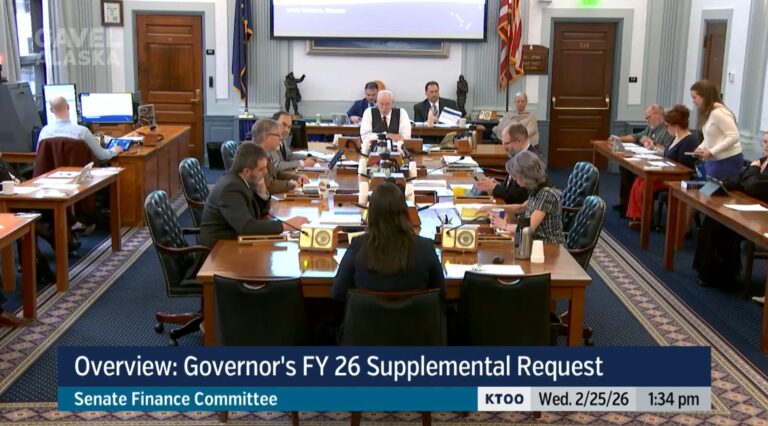
Senate Finance Committee Scrutinizes $467M FY2026 Supplemental Amid Revenue Volatility and Disaster Needs

0

Alaska Senate Finance Committee, reviewed the Governor’s proposed FY2026 supplemental budget, addressing a projected $467.7 million shortfall driven by declining oil revenues, escalating disaster costs, and operational necessities. Office of Management and Budget (OMB) Director Lacey Sanders presented the package, emphasizing the need for swift action to avoid payment defaults, program interruptions, and construction delays. The hearing highlighted fiscal prudence amid oil price fluctuations, with a mid-March revenue forecast from the Department of Revenue poised to potentially alter the deficit outlook.

Sanders framed the discussion around unrestricted general funds, noting the supplemental’s scale: “$467.7 million is a substantial amount for a supplemental.” This figure stems from a $52 million revenue shortfall, down from a $68 per barrel oil price assumption last spring to $65.48 in the fall forecast. She stressed volatility: recent prices have climbed to around $70, but dips to near $60 remain possible, underscoring the need for “headroom” in appropriations to buffer against further declines.

Key components include $35.6 million for formula programs. The Department of Health requested $1.125 million for the Senior Benefits Program due to increased utilization, warning that without it, payments to eligible seniors would cease. More significantly, Medicaid needs $34.4 million in state funds plus $361 million in federal authority, based on mid-February projections. Sanders explained: without this, the state would halt $14 million bi-weekly check runs to providers, leading to defaults and compounding arrears into FY2027.

Fund capitalizations total $138.7 million, with $40 million for the Disaster Relief Fund to cover the October Ha Long storm (estimated at $150 million total, assuming a 90/10 FEMA match) and repay $10 million borrowed from a Department of Environmental Conservation project. An appeal for the 90/10 split is pending; denial would revert to 75/25, increasing state exposure. Sanders noted Alaska faces “about a disaster a month,” projecting $4-6 million remaining if no more occur by June. Fire Suppression requires $98.7 million, including $55 million from interim declarations and $43.7 million for prior obligations and spring preparedness, leaving $7-8 million cushion.

Statewide items amount to $127 million, featuring $2.5 million in debt service savings from bond refunding by the Department of Revenue. A $70.2 million capital supplemental recapitalizes the Alaska Higher Education Investment Fund from the Constitutional Budget Reserve (CBR), reversing last year’s drawdown. Operational needs total $44 million, including $3.3 million (multi-year) for Public Defender Agency contractors to clear backlogs, $4.7 million for Department of Corrections health care, and $1.25 million for Village Public Safety Officers (VPSOs) to fill vacancies.

A $70.2 million capital item for Department of Transportation (DOT) federal matching drew urgency. Senator James Kaufman (R – Anchorage) pressed: “I honestly don’t want to see projects delayed another year,” citing three years of instability. Sanders confirmed executive support, with Chair Stedman (R – Sitka) affirming timeliness to stabilize the industry. Without July 1 funding, projects risk deferral.

Comparing to House Bill 289 ($489.9 million), Sanders noted differences: a $2 million Medicaid reduction, $43 million more for fire suppression, and House inclusions like $30 million headroom and $35 million disaster contingency. Headroom, she explained, preauthorizes CBR draws via three-quarter vote, providing flexibility without repeated supermajorities. Stedman clarified legislative control: “We can still turn it down.”

Recent amendments (February 18) include Medicaid tweaks, VPSO funds, Economic Research Group retention adjustments to combat turnover, and bond savings. These post-date HB 289’s cutoff, so the Senate will incorporate them upon receipt.

Concerns arose over $1 million for “statehood defense” in the Department of Law, with Senator Jesse Kiehl (D – Juneau) questioning its use for cases potentially misaligned with Alaska sovereignty. Stedman noted planned scrutiny in the operating budget.

Sanders projected 98% confidence in stabilizing funds like fire suppression via reimbursements. The committee intends swift action on HB 289, prioritizing essentials while monitoring FEMA and revenue updates.

This supplemental addresses immediate gaps but underscores Alaska’s fiscal challenges: oil dependency, rising disasters, and program demands. Public testimony is slated for upcoming sessions, with regional access. As Sanders concluded, “Always happy to help answer questions,” signaling ongoing collaboration.
Senate Resources Grills AGDC on 8 Star Amid Transparency Concerns

1

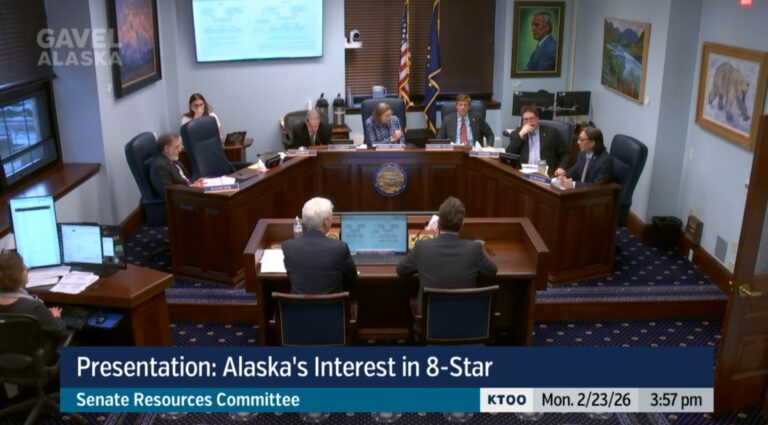
In a tense and probing session yesterday afternoon in Juneau, the Alaska Senate Resources Committee scrutinized the state’s evolving role in the 8 Star Alaska LLC for the Alaska Gasline and LNG project, a multi-billion-dollar endeavor aimed at monetizing North Slope natural gas. Chaired by Senator Cathy Giessel (R – Anchorage), the meeting highlighted lawmakers’ frustrations over limited access to governance documents and the project’s shift from public-led to private-developer control. Presenters from the Alaska Gasline Development Corporation (AGDC), including President Frank Richards and Commercial Director Matt Kissinger, defended the structure as a strategic pivot to attract private investment while preserving state benefits, but faced sharp questions on control, valuation, and timelines.

The hearing focused solely on Alaska’s interest in 8 Star Alaska LLC, reflecting the project’s significance amid Alaska’s energy challenges. AGDC, established in 2010 and bolstered by legislation in 2013 and 2014, was tasked with maximizing North Slope gas for local and global markets. Richards traced the project’s history: from an equity partnership with major producers like Exxon, BP, and ConocoPhillips, which faltered, to a 2016 restructuring recommended by consultants Wood Mackenzie. This led to a tolling model and project finance approach, culminating in federal approvals from FERC and other agencies.

A pivotal change occurred in March 2025 when AGDC transferred 75% of 8 Star LLC—a subsidiary holding permits, engineering, and rights-of-way—to Glenfarne Group, LLC, for an in-kind commitment to advance the project to Final Investment Decision (FID), valued at around $150 million. AGDC retains a 25% stake, with transition completed by July 1, 2025. Kissinger detailed the series LLC structure: a “TopCo” (8 Star Alaska LLC) oversees three subprojects—Arctic Carbon Capture (8 Star ACC, LLC), the 800-mile pipeline (8 Star Pipeline, LLC), and the LNG terminal (8 Star LNG, LLC) in Nikiski—allowing specialized investor participation while centralizing authorizations.

Lawmakers pressed on governance and control. Senator Bill Wielechowski (D – Anchorage) questioned the state’s diminished influence, noting Glenfarne’s majority board seats. Kissinger countered that minority protections, including unanimous consent on key matters, provide influence beyond voting. However, when Giessel demanded redacted operating agreements to verify these safeguards—citing over $1 billion in public investment since 2014—Kissinger cited confidentiality, requiring Glenfarne’s approval. “We’re unable to share those agreements… they are confidential,” he said. Giessel insisted on disclosure, emphasizing fiduciary duties under statute to deliver “maximum benefit” to Alaskans.

The discussion delved into the integrated project’s scope: removing CO2 via ACC for liquefaction, transporting gas south, and enabling exports of up to 20 million tonnes per year (MTPA). Senator Scott Kawasaki (D – Fairbanks) clarified ACC’s necessity, while Wielechowski probed ownership flows. AGDC owns 25% of the parent LLC, receiving distributions from retained subproject equity post-sell-down, with an optional “back-in” right for 5-25% direct investment within six months of FID—no obligation to fund to maintain the parent stake.

Phasing emerged as a flashpoint. Phase 1 prioritizes the pipeline for in-state gas delivery, estimated at $10.8 billion, with full build-out adding $33 billion for ACC and LNG. Richards expressed high optimism for Railbelt utilities facing supply shortages: “I put my confidence level at 98 percent” that the line will be built, alleviating needs for LNG imports. This confidence stems from milestones like gas supply agreements with Exxon, Hilcorp, ConocoPhillips (in principle), and Pantheon; letters of intent with Enstar and Donlin Gold; FEED completion by Worley; and two-thirds of pipe supply contracted.

Pricing projections varied: $16 per MMBtu for Phase 1, dropping to $5 at full volume due to economies of scale. Senator Myers (R – North Pole) noted Fairbanks’ current $24 rates would benefit, while Anchorage might see increases from $10, though Kissinger warned Cook Inlet contracts are rising to $16-20 anyway.

Transparency dominated closing remarks. Vice Chair Senator Matt Claman (D – Anchorage) lamented limited state access compared to private investors under NDAs. Giessel challenged the project’s alignment with Senate Bill 138 (2014), arguing it “morphed into something materially different.” She reiterated demands for documents, noting a similar request to Glenfarne’s Adam Prestidge.

The session adjourned with clear action items: AGDC to seek redacted disclosures and justify refusals.

This hearing underscores Alaska’s push for energy independence amid global LNG demand, but highlights tensions between commercial sensitivity and public accountability. With FID and pipe-laying possibly by December 2026, the project could transform the state’s economy—creating jobs, securing supplies, and generating revenue—yet lawmakers demand proof it serves Alaskans first.

Bolstering North American Trade – SJR 25 Set Aside for Refinement

0

The committee heard SJR 25, a resolution sponsored by Senator Scott Kawasaki (D – Fairbanks) urging the continuation and modernization of the United States-Mexico-Canada Agreement (USMCA). Enacted in 2020 with bipartisan backing, the agreement faces a pivotal review in 2026, and the resolution aims to preserve its benefits while removing trade obstacles. Kawasaki framed it as essential for Alaska, given its close ties to Canada—its primary trading partner and land-border neighbor—supporting supply chains, jobs, and economic stability.

The presentation began lightheartedly with hockey banter, celebrating the UAF Nanooks’ Governor’s Cup win, before delving into the topic at hand. Staffer Samuel Marquardt detailed USMCA’s role in predictable trade, noting Alaska’s reliance on Canadian transit for goods like construction materials and fuel. He warned that missing the 2026 review could delay updates until 2032, injecting uncertainty. Senator Gray-Jackson (D – Anchorage) questioned Mexico’s role, prompting Kawasaki to affirm the tri-national scope, though Canada dominates Alaska’s trade volumes.

Chair Bjorkman (R – Nikiski) raised dynamic risks, referencing recent violence in Mexico trapping Alaskans and a Supreme Court decision on tariffs potentially enabling unilateral presidential changes. Kawasaki preferred keeping the resolution focused on trade architecture, avoiding geopolitical entanglements. He noted tariffs as consumer cost drivers and praised the Trump-era renegotiation.

Invited testimony from Steven Myers of the Pacific Northwest Economic Region (PNWER) reinforced the case, citing post-2020 trade growth of 56% and $343 billion in Canadian investment, supporting over 20,000 Alaska jobs. Myers emphasized stability for energy, minerals, and Arctic logistics, with the July 2026 joint review as a critical juncture.

Myers highlighted economic interdependence: “Canadian trade supports more than twenty thousand Alaska jobs, with nearly six thousand additional jobs provided by Canadian-owned businesses operating in the state.” The committee set SJR 25 aside for further consideration, potentially incorporating amendments on barriers or tariff implications. Rationale centers on sustaining investment and supply chains, especially Alaska-Canada corridors, without delving into crises. This resolution underscores Alaska’s strategic position in North American trade, where USMCA has driven growth amid global uncertainties. Unresolved elements include integrating Mexico-specific language and addressing tariff jurisprudence, as per legislative tracking. If advanced, it could influence federal negotiations, benefiting sectors like tourism and defense.

Understanding House Bill 280: Impact on Digitized Business Taxes

0

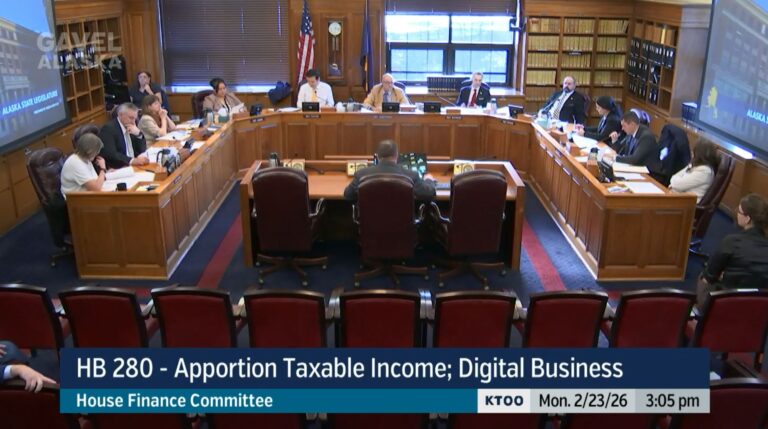
The House Finance committee turned to House Bill 280, the “highly digitized tax” measure, which amends the Multistate Tax Compact to adopt market-based sourcing and shifts highly digitized businesses to single-factor apportionment for corporate taxes. Staffer Brody Anderson recapped: the bill targets online firms selling to Alaskans without physical presence, with a retroactive clause to January 1, 2026. Recent testimony from industries like motion pictures, banking, and telecom prompted amendment suggestions mirroring a vetoed prior bill.

Anderson walked through the fiscal note: $321,700 initial operating costs, dropping to $313,700 annually, funding two new auditors (Tax Auditor IV and II) for enforcement. While no revenue shown upfront, internal estimates project $25-65 million yearly gains, midpoint $30 million. Department of Revenue (DOR) officials Brandon Spanos and Michael Williams fielded queries remotely from Anchorage.

Implementation timing sparked questions. A member inquired on notifying taxpayers for 2026 filings due in 2027; Spanos affirmed hiring post-enactment in FY 2027, with outreach via existing staff. On vacancies, he reported none in corporate tax but some in other groups, noting a 30% division shrinkage over a decade from legislative and executive cuts.

Rep. Will Stapp (R – Fairbanks) followed up: “You said you had a big downsizing in auditor positions. Was there a specific reason for that?” Spanos attributed it to defunding, including four positions cut last year by the Senate Finance Subcommittee.

Rep. Jeremy Bynum (R – Ketchikan) explored shifting the effective date to January 1, 2027, to avoid retroactivity. Spanos clarified no system overhaul needed, as factors are built-in, confirming “no fiscal impact by moving the effective date.” Co-Chair Andy Josephson (D – Anchorage) requested formal documentation on auditor cuts, recalling a veto override on oil/gas auditors; Spanos committed to emailing details, citing Walker-era executive cuts and recent legislative ones.

No further questions arose; the bill was set aside for DOR analysis of industry amendments at the next meeting. Decisions: March 2 amendment deadline, with submissions to staff. Action items: DOR’s amendment review, auditor history email, and taxpayer outreach plan. Unresolved: retroactivity policy, amendment scopes, and precise cut attributions.

The bill echoes a 2025 vetoed measure expanding taxes on digitized firms to fund education, amid ongoing fiscal debates. Supporters see revenue potential; critics eye administrative burdens.

House Bill 271: Debates Over Natural Gas Royalty Reductions in Alaska

0

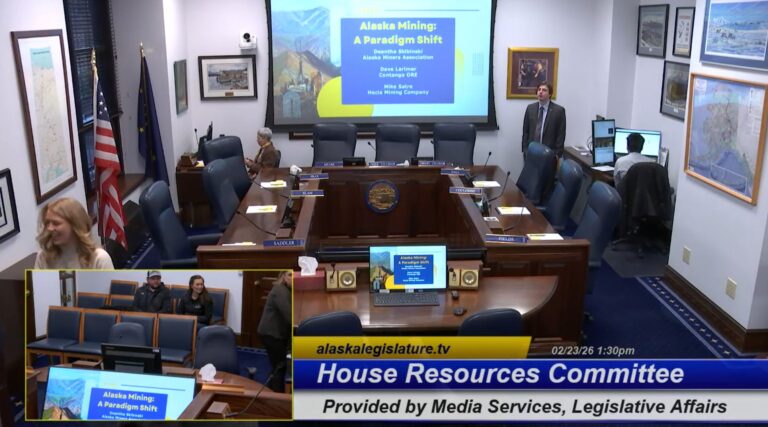
Alaska House Resources Committee voted to advance House Bill 271, a measure that would permanently reduce the royalty rate to 3% for natural gas production in the Kitchen Lights unit of Cook Inlet. Sponsored by Rep. Zach Fields (D- Anchorage), the bill aims to incentivize further investment and production in the aging basin, which supplies much of Southcentral Alaska’s energy needs. Critics, however, decried it as a targeted giveaway to a single operator, HEX/Furie, amid the state’s ongoing fiscal woes.

After a brief recess, public testimony opened, revealing sharp divisions.

Jeff Landfield, operator of the Alaska Landmine news website, delivered a scathing critique, framing the bill as the latest in a series of “political handouts” to HEX/Furie owner John Hendrix. Landfield recounted Hendrix’s acquisition of Furie out of bankruptcy in 2019 for $15 million, partly financed by a state loan, and his subsequent battles over property taxes. He noted that the Department of Natural Resources (DNR) had already granted a 75% royalty reduction in September 2024, resulting in a $2 million credit and slashing monthly payments from $400,000 to $100,000. “The royalty relief he’s already obtained does nothing for ratepayers, it just enriches his pockets,” Landfield said. “I urge this committee to put this bill where it belongs: in the trash.”

Carrie Harris, testifying online, echoed the opposition, arguing that the bill creates a “permanent three percent royalty carve out for a single operator” without geological justification. “Alaskans are being told there isn’t enough money for a permanent fund. Essential services are strained,” she said, warning of a “really big bad precedent” that could prompt other producers to seek similar deals.

With public comment closed, the committee deliberated on three amendments. Rep. Donna Mears (D – Anchorage) moved Amendment G.1, proposing a sunset date of January 1, 2030, to limit the relief while allowing time for the operator to refine plans through DNR processes. “I fundamentally believe that this work should be done through DNR’s thorough process rather than legislative action,” Mears explained. Fields opposed, arguing four years was insufficient to attract major investments like jack-up rigs, suggesting 2035 instead. Rep. Dan Saddler (R – Eagle River) called the shorter timeline “counterproductive,” potentially harming financing. The amendment failed 2-7.

Mears’s second amendment, G.2, sought to remove intent language justifying the bill’s focus on one unit, citing drafting guidelines. Fields defended it as essential to address constitutional concerns over special legislation, emphasizing the unit’s role in boosting competition and supply. Rep. Mike Prax (R – North Pole) supported removal, viewing the bill as “special treatment for a particular company.” It also failed 2-7.

A conceptual amendment from Sadler, changing “avoid reliance on imported fuels” to “reduce reliance” for realism, passed without objection.

Debate intensified on the bill’s merits. Mears opposed, trusting DNR’s existing robust process. Prax argued it overreaches legislative expertise, setting a bad precedent by overriding DNR. Saddler countered that statutes provide enduring certainty executive actions cannot: “What the executive giveth, the executive can taketh away. Uncertainty is the enemy of fiscal certainty.” Fields clarified, “This bill definitely does not override what DNR did. It actually takes DNR’s decision and gives us some multi-year predictability and stability to encourage investment and production.”

Rep. Julie Coulombe (R – Anchorage) supported, noting it endorses DNR’s research showing relief yields more gas: “This is not overriding DNR. This is actually supporting what DNR did.” Mears reiterated that DNR relief is a durable contract across administrations.

Co-Chair Maxine Dibert (D – Fairbanks) moved the amended bill, granting Legislative Legal leeway for technical changes. After objection, a roll call passed it 7-2, with Mears and Prax dissenting.

The bill now heads to further committees amid broader debates on Cook Inlet’s declining output and high gas prices. Supporters see it bolstering supply; opponents fear favoritism eroding state revenues.

Saddler, in a key remark during debate, underscored the pragmatic stakes: “We’d rather have fifty percent of loaf or one hundred percent of no loaf at all, and that’s the situation we are faced up against. My constituents do have a need for natural gas in the inlet.”

This decision comes as Alaska grapples with energy security, with Hilcorp’s production update slated for February 25. Critics like Landfield vow continued scrutiny, alleging Hendricks’s influence. Proponents argue it’s vital for competition in a basin not “what it was.”

Editors Note: Corrected spelling of John Hendrix and HEX/Furie.

For Alaska School Districts: A $1.5 Million Settlement Serves as a Wake-up Call

2

In a landmark ruling last summer (Mahmoud v Taylor), the U.S. Supreme Court ruled that parents must be informed of classroom instruction involving certain gender and sexually explicit subject matter; and moreover, must be afforded an opportunity to “opt out” of such programs.  

A Massachusetts court recently affirmed in Alan L. v. Lexington Public Schools that no public school can force a parent to choose between giving up the benefit of a public education and exposing their child to material that burdens the parent’s right to the free exercise of religion.

Alaska’s Attorney General affirmed the intent of the law. (See a memo from the former Alaska Attorney General).

Last week, in what is widely viewed as a wake-up call over municipal liability for non-compliance, the Montgomery County, Maryland Board of Education agreed to pay a $1.5 million award to families whose religious rights were violated when their opt-out opportunity was denied to them. The case affirms that school districts nationwide have financial liability for failing to protect the constitutional rights of parents whose children attend public school.

Notably, the Maryland board was directed to issue advance notice to parents before introducing certain sexuality explicit materials.  

READ: Liberal County Took On Religious Parents — Now They’re Paying For It

Here in Alaska, some believe our state courts have misconstrued privacy protections to the degree that Alaska legal precedent undermines the rights of parents.

Jim Minnery, Director at the Alaska Family Council, observes:

Today, Alaska caselaw with respect to parental consent appears increasingly out-of-sync with Federal law and with public opinion. Historically, Alaska’s legislature has avoided statutory reforms that would strengthen parental rights.  

Increasingly, these conflicts center on our public schools.  Senate Bill 90, sponsored by Senator Cathy Giessel, is the latest example of what Minnery describes as a “dangerous overreach that undermines the fundamental rights of parents to guide their children’s healthcare decisions.”

According to Minnery,  Alaska Senate Bill 90 claims to help teens access needed mental health services, but instead “creates a system where minors can receive ongoing treatment behind their parents’ backs—with potentially devastating consequences.”

“SB 90 gets [the goal] exactly backward”, states Minnery.  “Instead of supporting families, it enables providers to exclude them. Instead of protecting children, it exposes them to potentially harmful decisions made without the guidance of those who know and love them best…Alaska’s parents have both a constitutional right and a moral responsibility to direct their children’s healthcare.”

In Alaska, outreach is underway. In a press release, the Alliance Defending Freedom seeks to connect with Alaskans concerned about transparency and compliance in our public schools. The release stated:  

“Alliance Defending Freedom’s Center for Parental Rights seeks to identify public-school parents who are struggling to access curriculum and public schools that refuse to honor parents’ requests to opt their children out of the curriculum and programs that undermine their rights as parents. We want to help parents access curriculum, request notice, and make informed choices about what their children are taught and exposed to during the school day.”

Letters are being sent to District Superintendents across Alaska reminding them of their duty to enforce the law, and that failure to enforce the law is not “neutral”. Rural Alaskan tribes, elders and councils especially are being encouraged to understand the rights of parents seeking to retain traditional family structures within their communities and places of public learning.

Alaska House Education Committee Tackles Cyberbullying and Funding Issues

0

The Alaska House Education Committee delved into pressing issues facing the state’s schools, from innovative student engagement programs to legislative proposals aimed at combating modern bullying and stabilizing funding. The meeting, chaired by Co-Chair Rep. Andi Story (D – Juneau) and Rep. Rebecca Himschoot (NA – Sitka), blended celebration with policy deliberation, highlighting both successes in local education and the challenges posed by technology, declining enrollment, and special needs services.

Addressing the Digital Battlefield – HB 240 Targets Cyberbullying and AI Impersonation

The committee’s legislative agenda kicked off with House Bill 240, sponsored by Rep. David Nelson (R – Anchorage), which seeks to mandate school districts to adopt policies against digital harassment and non-consensual digital impersonation. This bill arrives at a critical juncture, as advancements in artificial intelligence (AI) and social media have amplified bullying tactics, particularly among youth. Nelson opened by painting a stark picture of the evolving threats: “As technological advances in artificial intelligence and the proliferation of social media have made clear, school children are now susceptible to new methods of bullying and harassment.” He emphasized how deepfakes and impersonations disproportionately affect women and children, urging the need for updated frameworks to empower schools.

Staffer Donna Fox Page provided a detailed sectional breakdown, explaining how the bill amends existing statutes under AS 14.33 to require policy adoption, integrate training, enhance reporting, protect against false accusations, and define key terms. The effective date is set for January 1, 2027, allowing districts time to prepare. A poignant moment came from student testimony by Alexandra (last name withheld due to her minor status), an Anchorage high schooler who shared her experiences with online torment. “Bullying doesn’t happen in the hallways or in the cafeteria anymore. It happens on many social media platforms like Instagram, Snapchat, or TikTok,” she testified, describing how fabricated images and accounts erode mental health and classroom focus. “It impacts how you walk into school the next day, how you focus in class, and how you see yourself.” Alexandra’s plea was straightforward: “We’re not asking for anything extreme. We’re asking for rules that reflect the world we actually live in.”

Committee members engaged deeply, raising concerns about scope, constitutionality, and implementation. Rep. Schwanke (R – Glennallen) highlighted the rapid evolution of synthetic media, sharing a personal anecdote about AI-generated faces and voices, and questioned whether the policy should extend statewide. Nelson agreed on the need for broader AI legislation in the coming years. Representative Underwood brought emotional weight, referencing recent tragedies: “Just in the last seventy-two hours, I have read and heard two different mothers’ testimonies about their children no longer being with us because of AI bullying.” She advocated for action at state and federal levels to save lives.

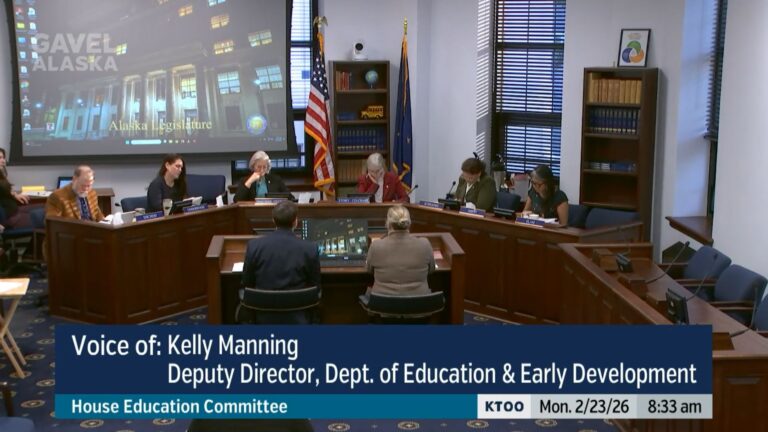
Co-Chair Story inquired about outreach to districts like Anchorage and the Alaska Association of School Boards (AASB), noting potential overlaps with existing model policies. Deputy Director Kelly Manning from the Department of Education and Early Development (DEED) clarified that while statewide bullying guidelines exist and are being updated for online elements, AI-specific harassment like deepfakes isn’t explicitly covered yet. “We do have statewide policy around bullying and harassment and our e-learning materials… are being updated to include information regarding online bullying and harassment,” Manning said, but admitted the “fast-changing landscape” demands more.

Rep. Dibert (D – Fairbanks) flagged First Amendment issues: “Have you looked into freedom of speech when it’s online—if that’s going to affect this?” Nelson acknowledged this hadn’t been fully explored, signaling a need for legal review. Rep. Eischeid (D – Anchorage) sought clarity on definitions, asking if something as innocuous as an emoji could qualify as harassment. Page distinguished intentional impersonation from symbolic expression, noting emojis likely wouldn’t meet the threshold.

The discussion underscored a balance between urgency and caution. With no public testimony, the bill was set aside for refinements, including definitional tweaks and constitutional safeguards. Unresolved issues include statutory cross-references for digital harassment, district adoption rates, and off-campus jurisdiction. This part of the meeting revealed a committee committed to protecting students in an increasingly digital world, where virtual harms spill into real-life trauma.

Stabilizing the Fiscal Foundation – HB 261: Reforms Average Daily Membership and Funding Formulas

Shifting gears after a brief recess, the committee examined House Bill 261, sponsored by Co-Chair Story, which proposes reforms to Average Daily Membership (ADM) calculations, school size adjustments, and intensive needs funding to provide stability amid declining enrollment. Story framed the bill as essential for predictable budgeting, especially in rural areas: “In a school district with around eighty kids, losing four students is about $300,000… Small schools are delicate… losing that in the first year is significant.” She highlighted nationwide trends of fewer children, urging Alaska to prioritize stability to boost retention and planning.

DEED School Finance Manager Lori Weed dissected the updated fiscal note, projecting a $147 million impact. She explained the methodology: “We did have to generate new ADM numbers… taking the previous three-year average as defined in the bill and comparing those to this year’s preliminary count for SY26.” The bill replaces hold-harmless provisions with a three-year ADM average, selecting the greater of the average or current count per school. Weed estimated the alternative high schools component at about $5.8 million, due to removing minimum ADM thresholds and interactions with host schools. For intensive needs, she isolated roughly $43 million to use the greater of prior averages or current counts.

Co-Chair Story sought confirmation: “With the exchange of hold harmless for the three-year average… you looked at each of the 53 districts… result is a net addition of funding—is that correct?” Weed nuanced it as school-level dependent, noting some districts might lose absent hold-harmless, while others gain. Current hold-harmless costs about $12 million in state aid, potentially offsetting part of the new note.

Rep. Schwanke requested walkthroughs for districts with large increases and decreases to demystify the “cascading” formula effects. Story floated ideas like grandfathering hold-harmless districts or a rural stabilization fund, criticizing “chaotic backwards funding.” Data sources were clarified: preliminary FY26 OASIS data for current counts, with SY23-25 for averages.

The bill addresses broader challenges, including alternative programs and intensives, amid enrollment drops. Story anticipated the fiscal note could rise if declines accelerate, as averaging cushions losses. With time short, the bill was set aside for further analysis, including DEED scenarios and policy explorations for rural schools.

Overall, it reflected a proactive stance on evolving educational demands, with follow-ups slated for Wednesday’s session. As Alaska grapples with these issues, the committee’s work underscores the delicate balance between innovation, protection, and fiscal responsibility in serving the state’s diverse student population.

FY27 Budget Insights: Scrutinizing Alaska’s Revenue Strategies

0

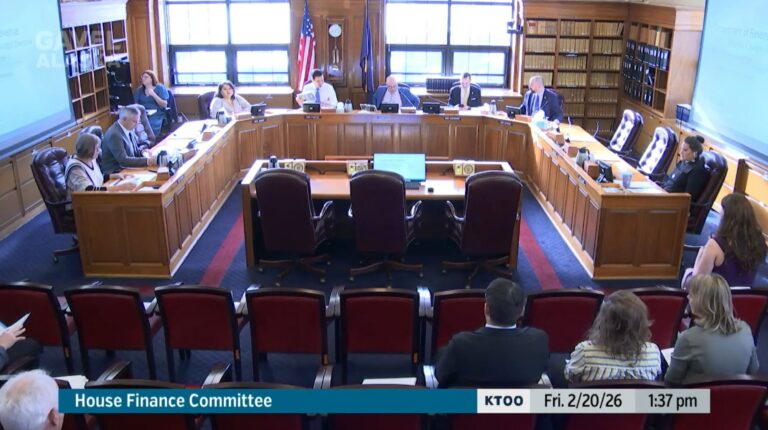
The House Finance Committee convened on February 20 to scrutinize the Alaska Permanent Fund Corporation (APFC) and the Department of Revenue’s (DOR) proposed FY27 budget. The meeting, chaired by Co-Chair Andy Josephson (D – Anchorage), highlighted the fund’s role in generating two-thirds of the state’s unrestricted revenue, while addressing investment strategies, governance, and fiscal discipline amid economic uncertainties. Marking the 50th anniversary of the Permanent Fund’s creation, discussions balanced historical gratitude with forward-looking challenges, including inflation proofing, active management debates, and budget adjustments.

Part 1: APFC Overview – Celebrating Legacy While Navigating Investment Realities

The APFC presentation, led by Executive Director and CEO Devin Mitchell alongside Chief Investment Officer Marcus Frampton, began with a nod to the fund’s origins. Mitchell emphasized the visionary decision by Alaskans in 1976 to establish the fund through a constitutional amendment. “The fact that we have this resource is because the people that lived in Alaska in 1976 elected to save money for us rather than spending it on themselves,” Mitchell said, noting that 75,588 voters—67% of the electorate—approved the measure in a “landslide.” This amendment mandated saving at least 25% of certain revenues, investing them, and making earnings available to the general fund unless otherwise specified.

Mitchell illustrated the fund’s growth through a counterfactual: without reinvestment and statutory frameworks, the fund would hold just $20 billion today, compared to its actual $86 billion as of the latest financial statements. Breaking it down, principal stands at $59.1 billion (constitutionally protected), with the Earnings Reserve Account (ERA) and unrealized gains adding layers of complexity. He highlighted $17 billion in unrealized gains, explaining the distinction between total return (more volatile but higher on average) and statutory net income (realized returns available for spending).

Governance drew scrutiny, with Rep. Allard (R – Eagle River) seeking confirmation on board appointments. Mitchell reiterated: “We have six trustees, two of which are members of the cabinet, and four of which are appointed by the governor on four-year staggered terms… all of them… are appointed by the governor at this point.” Representative Hannon inquired about Acting Commissioner Janelle Earle’s role, which Mitchell affirmed as standard practice.

Investment strategy discussions revealed a shift from conservative fixed income in 1976 to a diversified portfolio targeting risk equivalent to 80% equities and 20% fixed income. Frampton addressed a recurring public question posed by Co-Chair Schrage (NA – Anchorage): why not simply index to the S&P 500? “Index and passive investing is a very sound investment approach,” Frampton acknowledged, but warned of recency bias. He cited Nevada’s passive model as “valid,” but stressed diversification’s necessity, noting three decades where the S&P 500 returned near zero. “If you did a back test with a 5% POMV, it would be fairly devastating to be only S&P 500,” he said.

Performance metrics showed the fund beating its benchmark by 30 basis points over 10 years and 16 over five, net of fees. Frampton was transparent about recent underperformance: a deliberate underweight in mega-cap tech stocks amid high valuations hurt short-term results, but he anticipated recovery as cycles shift. On fees, he noted APFC’s inclusive reporting makes it appear “expensive” compared to peers, yet it’s “on the extreme efficient side.” Private equity, comprising 17% of the portfolio, drew focus for its 20% carried interest, but Frampton highlighted outsized returns, like 60% in 2021 versus the S&P’s 30%.

The CPI + 5% target was framed as probabilistic—achievable about half the time with fiscal discipline. Mitchell reported $114 billion in total earnings generated, with $97 billion realized, funding dividends and services. Under the Percent of Market Value (POMV) draw—5% of the five-year average balance—the FY27 draw is $4 billion, keeping the effective rate below 5% due to growth.

ERA sufficiency sparked debate. With $6.6 billion spendable after segregating the FY27 draw, Mitchell credited foregoing inflation proofing in FY25 and FY26. “We’re either $500 million behind… if you include the $4 billion as inflation proofing or $4.5 billion behind if you did not,” he said, disagreeing with prior legislative labeling of a transfer. He advocated rules-based inflation proofing to balance generations.

Other highlights included discontinuing the underperforming Alaska-focused private equity program (residual $100 million exposure), economically driven proxy voting, and modest AI adoption for efficiency, not core investing. Mitchell welcomed oversight: “Having as many eyes looking at the corporation and the permanent fund as possible is always going to be for the betterment of our state.”

Part 2: DOR’s FY27 Budget – Technical Tweaks Amid Broader Fiscal Pressures

In the FY27 budget overview, Acting Commissioner Janelle Earls, supported by Division Operations Manager Adam Bryan and agency leaders, outlined DOR’s mission to “collect, distribute, and invest funds for public purposes.” Organized into four divisions, four corporations/authorities, and oversight of items like shared taxes (revenues redistributed to municipalities), the budget emphasizes restricted “other state funds” from entities like APFC and the Alaska Housing Finance Corporation (AHFC).

Key adjustments included Treasury Division’s reduction of a vacant position and salary tweaks. For the Alaska Retirement Management (ARM) Board, Earls noted $150,000 for external legal counsel on private investments, passed through from the Department of Law. A significant discrepancy emerged: the ARM Board requested $34-37 million more in service fees than the governor’s budget, tied to amortization assumptions for unfunded liabilities targeting full funding by 2039. Treasury Director Pam Leary explained: “The one that was adopted by the ARM Board was partially adopted in the Governor’s budget… I believe the difference… is about $37 million.” The chair favored the ARM Board’s cautious approach but deferred to actuaries.

ARM Board incentives rose $13.6 million for external manager profit-sharing, contingent on $54 million outperformance. “Fees would only be paid from the retirement funds if external managers outperformed market benchmarks,” Earls clarified.

The Permanent Fund Dividend (PFD) Division sought $611.6 million for cloud hosting a new application system, plus postage increases—a figure flagged for scope clarification. The Alaska Mental Health Trust Authority added $298,500 for merits and inflation.

AHFC achieved UGF savings: $685,000 via debt service from dividends and $490,000 from vacant positions. For APFC, Earls highlighted restoring a single appropriation structure (split last year), fully funding incentives (previously at 75%), and minor IT/subscription increases. Fee authority saw a net $8 million reduction based on historical spend, with facilities adjustments including $66,000 for non-state-owned spaces and $32,000 for Juneau’s Michael J. Burns building—owned by the fund, not the state. Representative Hannon questioned the setup: “We’re just shuffling money between ourselves… this must be something that we do every year.” Earls confirmed the appropriation mechanics.

Child support inquiries revealed no agency fees for enforcement under Title IV-D, though courts may impose civil fees. Anchorage office costs for APFC were detailed at $71,100 last year, aiding recruitment.

The session adjourned without votes, but action items included reports on inflation proofing, fees, performance, and clarifications on budget items like the PFD hosting increment.

Overall, the meeting reinforced the Permanent Fund’s centrality—generating 66% of unrestricted revenue—while stressing disciplined management. As Mitchell reflected, the fund transforms “one-time resource revenue into… a renewable resource generating revenue from the world’s economy.” With FY27 draws and budget tweaks in focus, Alaska’s fiscal stewards aim to sustain this legacy amid volatility.

Defending Parental Rights: South Carolina vs. Alaska   

2

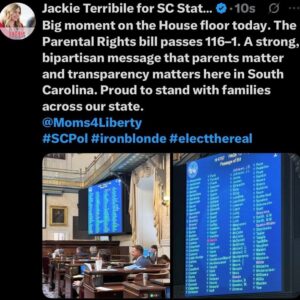
While South Carolina is passing common-sense bi-partisan legislation protecting parental rights, Alaska’s legislature appears to be doing the opposite. Rather than support Alaska families, some critics argue, Alaska’s Senate Bill 90 moves Alaska in the wrong direction.  

By a vote of 116-1, this week South Carolina’s Parental Rights bill passed the House reinforcing a principle most Americans agree with:  parents are the best protectors of their children and must be entrusted to nurture their education and well-being.

House Bill 4757, known as the Parental Rights Act, passed with 100% support from Democrats and only a single Republican “Nay” vote.   

In a press release by “Moms for Liberty” the organization praised the legislation, stating, “For many families, this bill represents more than policy. It represents partnership. It strengthens communication between schools and parents and ensures families remain informed and engaged in decisions impacting their children.”

While opinion polls show strong nation-wide majority support for the 2025 U.S.  Supreme Court decision regarding parental consent in Mahmoud v Taylor, Alaska seems strangely out-of-step.

Senate Bill 90, sponsored by Senator Cathy Giessel, does not serve Alaska’s youth or the parents of kids enrolled in public schools, many believe.  Rather, by making it easier for school health officials to withhold information from parents, the bill expands school district control and replaces parental care with that of health administrators. Jim Minnery, of Alaska Family Council, summarized the concerns of Alaskan parents this way:   

“Many teachers, principals, counselors and school board members are abusing their positions of authority by actively undermining the inherent right of families and faith leaders to direct the upbringing of their children. Instruction, from people we tell our children to honor, that implicitly endorses specific ideologies regarding gender or sexuality is not a neutral educational matter. It is a subject of core spiritual significance”.

Key provisions of the South Carolina Bill include:

  • Affirm and enumerate the fundamental rights of parents to direct the upbringing, education, healthcare, and general welfare of their children.
  • Require schools to implement these rights through written policies.
  • Provide parents greater access to educational records, curriculum, lesson plans, and guidance evaluations.
  • Require schools to provide at least five days’ notice and obtain affirmative parental consent before students participate in certain activities (e.g., those related to gender, sexuality, or sensitive topics).
  • Raise the age for minors to consent to non-emergency medical treatment from 16 to 18, strengthening requirements for parental consent.
  • Repeal or amend sections allowing certain health services to minors without parental consent.
  • Establish administrative procedures to investigate and resolve alleged violations of parental rights.
  • Address protections around children’s biometric data and other areas of parental authority.

For the full official text and status, check the South Carolina Legislature’s site: H.4757.

Read Senate Bill 90 here: Alaska Senate Bill 90.

Related Story: SC House advances bill giving parents more control over children’s health care and education

Related Story: GOP-pushed parental rights bill passes SC House with every Democrat voting for it