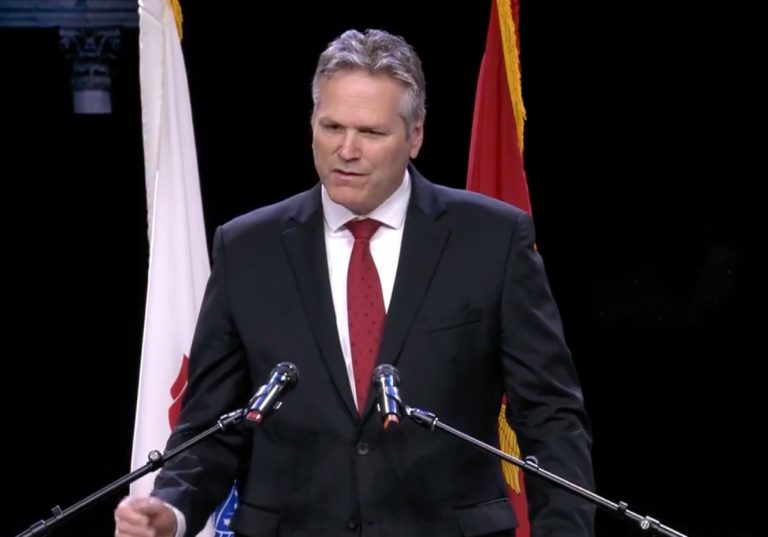
As he has in the past, Gov. Mike Dunleavy is an invited speaker at CERA Week in Houston, Texas, where he will be joining the stage with Daniel Yergin, the chairman of the conference that is part of S&P Global.
Dunleavy appears on stage on the conference’s final day, Friday, 14 March at 8:40 am Alaska time in a session titled, “Leadership Dialogue: Alaska and the world.”
Last year during the conference, Dunleavy urged the Biden administration to update and streamline the US mine permitting process. This year, he is likely to focus on the Alaska LNG gasline that President Donald Trump is eager to get built and that has long been a priority for Alaska.
This year’s conference themes include energy transition strategies, technological advancements, and geopolitical factors influencing energy markets. Discussions have naturally been influenced by President Donald Trump’s energy policies, the integration of artificial intelligence in energy consumption, and the evolving dynamics of global energy strategies. The conference is considered to be the cutting edge for thought leaders from the different sectors of the energy industry.
Gov. Mike Dunleavy has added a surprise twist in his effort to create a new state agency.
Dunleavy said in a promotional video that a tax on farming will “hopefully sooner rather than later” pay for his plan to create a new state Department of Agriculture in Alaska.
In the 9-minute state-produced video advocating for the creation of the new department, the governor acknowledged the plan is to tax farmers.
The state already has a Division of Agriculture, which falls under the Department of Natural Resources. Separating it out from under DNR would require a new commissioner and quite possibly some additional state bureaucrats.
“For those that fear this is going to cost an extraordinary amount of money, we’re basically going to move the division into its own department stand it up and then put the focus on what is needed to make sure the department works well for farmers,” said Dunleavy. “And then be able to grow that sector where eventually, hopefully sooner rather than later, some of the proceeds from what the farmers are growing begins to help to pay for that department.”
Gov. Dunleavy issued a response to clarify his statement: “The ‘Proceeds’ that I was referencing in my video had to do with agricultural land sales to help underwrite aspects of the ag department. not new taxes. If anyone understands me, they will know that taxes, especially on a small and growing business, is not something I was alluding to. This is to clarify that so that there is no future misunderstanding.”
However, originally he said “proceeds from what the famers are growing.”
Here’s the video:
Taking some of the “proceeds from what the farmers are growing” sounds like a tax on their income and would require additional bureaucrats to collect and account for the taxes.
Former President Ronald Reagan once warned when government gets involved in “helping” the private sector, it often taxes the very industry it purports to help.
“If it moves tax it, if it keeps moving regulate it, and if stops moving subsidize it,” said Reagan of government’s approach to helping industry.
Dunleavy has been short on specifics on how newly created government bureaucrats will help grow Alaska agriculture. He has provided no particular plan or called for new regulations or farm subsides. But his inference that he’ll tax farmers if his plan works was new information in this department rollout.
Department of Natural Resources Commissioner John Boyle testified to the Senate Finance Committee that there would be no cost to create the department of Agriculture because existing staff would be transferred and reclassified. The start-up cost would be minimal, he said.
That contradicts the earlier statement from the Governor’s Office that it would cost $2.7 million.
Critics of the plan say Alaska has a poor record of using government to prop up industry, especially agriculture.
History is littered with stories of politicians promising to grow the private sector by hiring more bureaucrats only to see government over regulate, pick winners and losers among competitors, and raise taxes on the very industry it was supposed to help.
“I think you all know that I’ve always felt the nine most terrifying words in the English language are: I’m from the government and I’m here to help,” said Reagan.
Dunleavy appears to have little support from legislators for his Department of Agriculture expansion plan. Only Republican State Sen. Shelley Hughes, whose district has a heavy farm presence, has openly supported the governor on this issue.
This may be why Dunleavy is selling his plan so hard. Last week, his office posted a short video on Facebook asking Alaskans to help him lobby the Legislature to approve his executive order. This week, he produced the long video of himself explaining his hopes for food security through creation of a department dedicated to farming.
The state faces a $536 million deficit for spending, and legislators appear to favor massive increases to the state Department of Education, which may mean new taxes on Alaskans in the form of a drastically reduced Permanent Fund dividend.
Alaska leads the nation in the number of state government employees per capita by a large margin. The state has five times as many as some states and double the number of state employees of most states. And the governor has already created one additional department in his six years in office, when he split the Department of Health and Social Services into two separate agencies.
The Legislature may vote to reject the executive order; that vote is done in a joint session of the House and Senate, which may occur on March 18.
Unless rejected by a majority of lawmakers by March 22, 60 days after the order was signed by the governor, the Department of Agriculture would become official on July 1.
Dan Fagan reports and writes columns for Must Read Alaska. He’s covered Alaska politics for close to 30-years. He currently hosts a morning drive radio talk show on 1020 am 92.5 and 104.5 fm on KVNT. For news tips, email Dan at [email protected].
Sen. Donny Olson, representing the far northwest part of Alaska, is back at the Alaska State Legislature after having been in Chicago for a month of rehabilitation for what appears to have been a type of stroke.
He spent 30 days at the Shirley Ryan AbilityLab, which specializes in helping people recover their ability to speak after strokes.
Olson, a longtime District T Democrat, did not attend the Senate Finance meeting on Wednesday. He did attend the floor session of the Senate. He plans to be absent for the rest of the week, however. It’s unclear if he is able to speak yet, but he said he is ready to serve.
Olson issued a statement through the Democrat majority press office: “I want to express my heartfelt gratitude to everyone who has sent or wrote messages of support and encouragement over the past several weeks. Your kindness has meant a great deal to me and my family.
“My time in Chicago was incredibly beneficial, and I am grateful for the therapy I received. While I will continue participating in speech therapy as part of my recovery, I am feeling strong and energized to be back at work.
“I am excited to return to the Capitol and join my colleagues in advancing the important work we have before us this session. Alaskans deserve dedicated leadership, and I am committed to serving my constituents with the same focus and determination as always.
“Again, thank you to everyone who offered their support during this time. I look forward to reconnecting with friends, colleagues, and community members in the days ahead.”
Olson, of Gloving, has been in the Legislature since winning in 2000. Age 71, he lists his occupations as doctor, pilot, and reindeer herder.
Elections were held in Greenland on Tuesday and the party that is most pro-USA doubled its seats in the legislature/parliament.
The Naleraq party gains are notable, with 24.5% of the vote, worth eight seats, rather than the four it had.
Greenland’s Demokraatit party, a center-right group, tripled its gains and won the parliamentary elections with nearly 30% of the vote, securing 10 of the 31 seats in the parliament, a big increase from the 9% share that it had in 2021.
The Demokraatit party will start coalition talks to form a new government, focusing on domestic priorities such as healthcare, education, and economic development, while maintaining a go-slow approach to achieving full independence from Denmark.
Although Greenland is a long ways from voting to join the United States, the election is definitely showing a change in sentiment. The center-right Demokraatits agrees with Naleraq on strengthening US ties and holding an independence-from-Denmark vote, but the two parties have different timelines on how that should occur.
The incumbent Inuit Ataqatigiit and Siumut parties declined, getting 21.4% and 14.7% of the vote respectively, both taking big losses from the previous election.
President Donald Trump has welcomed Greenland as another US state. It has been a Danish territory since 1953 and was a colony of Denmark before that.
Alaska Sen. Lisa Murkowski panned the idea, saying Greenland is “not for sale.” Full statement here.
“As legislators representing Greenland in Denmark and the United States, we see a better path forward. The United States, like Denmark, should recognize that the future will be defined by partnership, not ownership. To ensure our alliance reaches its full potential, Americans must view Greenland as an ally, not an asset. Open for business, but not for sale,” Murkowski said in a joint statement with Aaja Chemnitz, a member of the Greenland parliament, back in January.
As a retired teacher of 25 years and current State senator, I am writing to the Alaska homeschooling community today with a matter of great urgency and importance concerning the future of homeschooling in Alaska.
Recent legislative actions and public discourse have put your homeschooling rights and the choices you make for your children’s education under threat.
With HB 69, the House Majority, strongly supported by the National Education Association (NEA), recently blocked several critical amendments that would have supported correspondence students more equitably. This decision significantly impacts the ability of the state’s highly effective correspondence programs to provide services to families. Services that some families across the state are yearning for, and which best support the individual needs of many of students. (These limitations appear to be the intentional goal of the Majority and NEA).
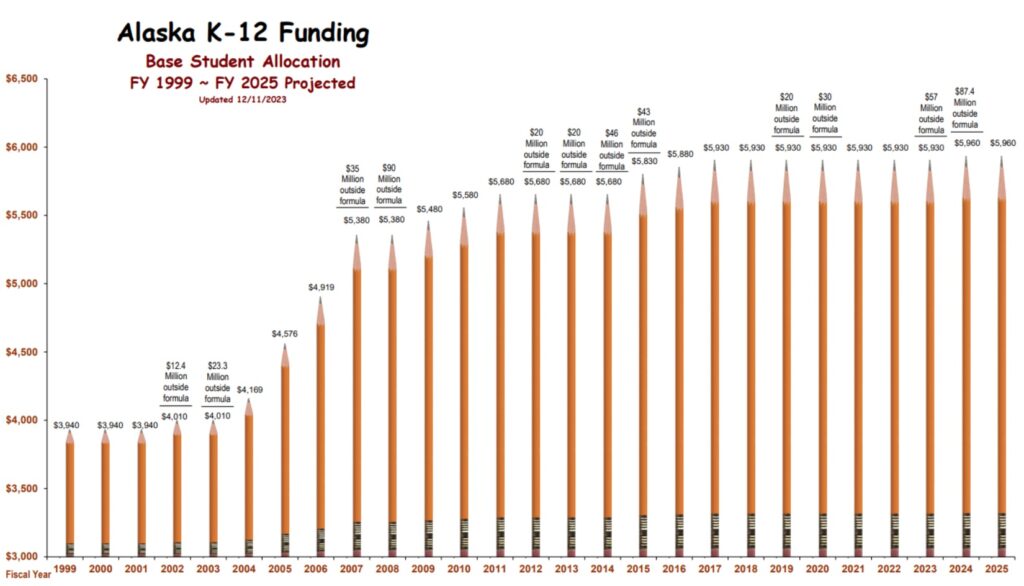
The amendments sought to rectify the major funding shortfalls these programs experience, as they do not receive the full Base Student Allocation (BSA) or the additional funding allocated for students who need special education services. According to estimates provided by State officials, the funding received by correspondence programs is less than one half of the average funding provided for students in Alaska and often significantly less.
The failure to pass these amendments shows a disconcerting disregard for parental rights and the varied educational needs across our state, affecting both the current families who rely on these programs and the future landscape of homeschooling in Alaska.
It is no coincidence that the votes landed this way if you compare who the NEA supported during the election cycle: Yes, they are much the same. Parents, do you see who is trying to gain control of your child’s education?
Furthermore, the NEA’s 2024-2025 resolutions specifically target homeschooling.
Their Resolution B-88 bluntly states, “The National Education Association believes that home schooling programs based on parental choice cannot provide the student with a comprehensive education experience” and also states that “The Association also believes that home-schooled students should not participate in any extracurricular activities in the public schools.”
Such statements hurt children and not only challenge your decisions but also undermine the vibrant, diverse, and powerful educational journeys many of you are successfully creating for our children while facing significant barriers. For Alaska’s NEA leadership to tell our state that they support homeschooling is a farce. Let me reiterate that, it’s a farce beyond measure and demeaning to our educators.
Contrary to the portrayal of homeschooling in some public narratives, such as a recent short-sighted Alaska Beacon article, Alaska’s homeschooling community is not a fallback option, but a thoughtful choice on the front end, as well as a safety net for children needing a different educational setting.
Homeschooling in Alaska represents a rich history of successes, made evident by the vast achievements of correspondence students who consistently demonstrate academic excellence, placing and earning accolades at state and national scholastic and athletic events on a regular basis. Imagine what they could do if they received even a grain of the same fiscal support?
As Alaskans, we must question the motivations behind these legislative moves, public criticisms and why outside entities like the NEA are trying to tell us what is best for our children and Alaska’s future. Is it truly about educational outcomes, or is it something else? We owe it to our children to fight for their right to the education that best suits their needs, free from undue governmental restrictions, propaganda or opinions.
Let us stand together to challenge these unjust perceptions and policies. Let’s advocate for the recognition of homeschooling as a valid, effective, and vital part of our educational system. Our efforts are not just about safeguarding our rights; they are about ensuring that all educational paths are valued and supported equally.
I want to be very clear about this writing: This is not about “us” vs. “them” with regards to traditional programs, correspondence programs, charter schools and/or residential schools. This is not a win/lose proposition. This is about finding the win for all students.
Every student in Alaska is “OUR” student and deserve to be treated as such. We do not need to listen to those (NEA) who want to divide, who want to pit programs and schools against each other and we should not be a part of that discourse. All of Alaska’s children deserve the opportunity for an exceptional education – not just those they select.
I have always stated that I support every student in how they are educated. My daughters attended public schools, public charter schools, and public residential schools and flourished in all those settings.
Whether it be public brick and mortar schools, public correspondence schools, public charter schools, or public residential schools.
I urge each of you to speak out, engage with your legislators, and make your voices heard. Together, we can protect and enhance not only home school students in Alaska, but all students and how their parents choose (parental choice) to educate their children. It’s imperative that we ensure that homeschool remains a robust and respected choice for many families and another option for serving our children.
Sen. Mike Cronk serves Alaska from the Interior Senate Seat R.
On a vote of 24-16, the Alaska House passed House Bill 69, boosting the per-student funding for the education establishment by $1,000, the largest increase to the base student allocation in Alaska history. There is no funding source but the low-hanging fruit of the people’s Permanent Fund dividends, or possible oil taxes that are being proposed by Democrats.
Voting in favor of the bill were all the Democrats and those who joined the Democrat-led majority: Robyn Burke, Ashley Carrick, Maxine Dibert, Bryce Edmon, Ted Eischeid, Zack Fields, Neal Foster, Alyse Galvin, Andrew Gray, Carolyn Hall, Sara Hannan, Ky Holland, Nellie Jimmie, Andy Josephson, Chuck Kopp, Donna Mears, Genevieve Mina, Cal Schrage, Andi Story and Louise Stutes.
Three members of the Republican minority voted for it: Rep. Justin Ruffridge of Soldotna, Rep. Julie Coulombe of south Anchorage and Jeremy Bynum of Ketchikan.
The bill introduces a permanent $1,000 increase to the Base Student Allocation (BSA), ensuring greater financial stability for school districts across the state. Alongside the funding increase, HB 69 implements targeted education reforms aimed at enhancing school choice, accountability, and operational efficiency.
“HB 69 is not just about funding—it’s about strengthening Alaska’s public education system for the long term,”said Speaker Bryce Edgmon. “This bill is the product of good-faith negotiations, reflecting input from legislators, the administration, and stakeholders across the state.”
Except there is no funding source, which calls into question the “good-faith” aspect mentioned by Edgmon.
Key Provisions of HB 69:
Base Student Allocation Increase – Permanently raises the BSA by $1,000, providing a crucial financial boost to public schools.
Open Enrollment Policy – Says it expands school choice but actually reduces choice. It actually dials back parental choice, by putting kids who live outside a district behind military kids and siblings of kids who are enrolled in a school. Destination school districts have subjective control over whether outside-district students can enroll.
Charter School Burdens Increased – Increases administrative costs for charter schools from 4% to 8%, by allowing a district to double the amount of charter school budget they can retain for administrative overhead.
Education Task Force – Establishes a legislative task force to assess school funding and policy improvements on an ongoing basis; task forces such as this always push for more funding. Adds to bureaucracy. The only members of the task force are the education committee members who are already responsible for this. The membership of the task force is tilted toward Democrat-led majority.
Correspondence Study Program Oversight – Introduces annual reporting requirements on parents about enrollment, spending, and academic performance. It makes the parents file numerous reports with the state, which could drive people away from homeschooling.
Wireless Device Policy – Requires school districts to implement policies regulating student cell phone use during school hours.
There is no funding support for this measure, which ties the hands of future legislatures. The estimated cost is an additional:
$326.3 million in fiscal year 2026,
$501.3 million in FY27,
$647.7 million in FY28.
The total cost is currently at $1.47 billion in additional funding over three years, on top of the existing BSA funding level of about $1.2 billion each year. These numbers are from the original bill, but have probably changed; there is no fiscal note with the current bill, so no way to know at this time what the cost is.
The amounts could change as the Senate considers the legislation, which has been fast-walked by the House.
Education and knowledge translate into power. Education does not parallel economics or politics, but is the soul of the society, and more fundamental than these others. Education determines people’s moral values, appearance, eating habits, the role of citizens; it shapes behavioral and subsistence strategies.
Today, unfortunately, there are several weak areas in the primary and secondary education system in the United States and in Alaska in particular: the absence of a unified methodology for teaching, a lack of consistency in school policies, a weak academic curriculum (compared to other technologically advanced countries), and an often-unsavory school environment.
In addition, some researchers suggest that the U.S. educational crisis is more social than academic, including a remarkable indoctrination of our youth in the divisive “white privilege” and “critical race” doctrines, “systemic racism” nonsense, the anti-American 1619 Project, and controversial “gender identity” theory.
While some educational experts recommend American schools adopt aspects of our Asian and West European counterparts—longer school year and more rigorous requirements—to raise the scholastic level of U.S. students, other researchers indicate that recently immigrated children of Asian, European and Russian origin can excel in the American school system as it exists.
In fact, despite hardships and limited knowledge of English and western cultural values, these children quickly adapt to their new school environments and rapidly excel within the first few years of schooling.
In the late 1990s, the California Achievement Test (CAT), for example, demonstrated that the performance of newly arrived students was exceptional. Their mean overall score on the CAT was in the 54th percentile, placing them just above the national average. Evidently, the lowest scores were found in the language and reading test, not surprising as English was their second language. In this case, the mean score was slightly below the national average.
How can we explain the remarkable performance of newly arrived immigrants in a foreign social and economic environment? What social stimulus forces newly arrived immigrants to perform better in school than those who have lived in this country for three or four generations?
It appears some factors were parental encouragement, dedication to learning, family pride in educational excellence, a clear realization that education is the most important “instrument” for success in the highly competitive American society, collective consciousness among members of the nuclear family and most importantly, sustaining conservative moral values in the family.
Studies showed that conservative moral values play an important role in the educational achievement of children. In my 18 years of teaching at the Alyeska Central School (a former correspondence school affiliated with the Alaska Department of Education and Early Development), my best and most outstanding students were from conservative, religious, and traditional families.
In my brief teaching in Thailand in 2017 and 2020, I observed that on the national level, among Southeast Asians, for example, the Confucian and Buddhist code of behavior (i.e., harmonious relationships between parents and children, subjects and rulers, men and women, rich and poor) is a main source of motivation and direction in their life. The family is the central institution in these ethnic groups, where achievement and knowledge are admired and encouraged.
Nowhere is the family’s commitment to education more evident than in time spent on homework. For example, during high school, Indochinese students spend an average of three hours per day; in junior high, an average of 2.5 hours; and in grade school, an average of two hours per day.
Research in the US shows that American students study at home about 1.5 hours per day at the junior and senior high school levels. Studies also found that parents who attributed greater importance to fun and excitement than to education had children who achieved lower grade point averages: 2.90 as opposed to 3.14. The results for children of parents who valued material possessions more highly than education were similar: GPAs were 2.66 versus 3.19.
It is essential to remember that school is not an entertainment center, but an institution where teachers share their knowledge with students in the most harmonious, professional and effective way. A teacher is the fundamental “instrument” of education. No brilliant policy, effective administration or sophisticated technology will ever replace the harmony of teacher–student relationships.
If we want to deal effectively with the crises in America and Alaska education, we must address the problem of those educators who serve as frontline social activists for radical political groups that seek to indoctrinate and brainwash our youth in neo-Marxist far-left ideology—such as today’s popular and divisive “white privilege” and “critical race” doctrines and gender identity.
Social engineering to create a new identity by imploring radical socialist ideology in our school system does not work, as well as meaningless concepts in education, such as “gender identity,” “white privilege” and “critical race” doctrines or “critical thinking”— if thinking is not critical, then it is not thinking.
My mother was an outstanding primary/elementary school teacher for 32 years in Kiev, former Soviet Union. She taught basic and fundamental skills to her students; and none of these bumper–stickers nonsense. If our teachers just do that instead of far-left social activism, we would be in a much better place in our education system today.
For American schools to succeed, parents, families and communities must become more committed to the basic education of their children. Families, especially, must create within the home an environment conducive to learning by participating in the process so that their children feel comfortable learning, and then go to school willing and prepared to study.
On the other side, schools must reach out to the families and engage them meaningfully in the education of their children—identifying cultural and moral values and educational methods for success that might enhance students’ scholastic achievement. Schools must empower families by directly involving them in the educational process, providing support and training to parents when necessary.
Unconventional means of schooling such as correspondence studies with emphasis on home schooling should continue to be applied effectively in Alaska as a viable and family–controlled educational system that provides students with excellent instruction, a safe study environment and parental involvement that is critical to children’s educational success.
Here is the bottom line: Place a student from a home that values education in a class with an impartial, well-trained and professional teacher who loves and is proficient in his/her subject and enjoys teaching, and learning takes place. Everything else is “window dressing.”
Parents, especially rational and conservative parents, get out of your closets, be courageous and make your voice heard. These “gender identity,” “systemic racism,” “critical race” and “white privilege” madness is not going away by itself. Teachers, or so called “social activists” who advocate neo-Marxist ideology in the classrooms must be challenged by YOU!
Alexander B. Dolitsky was born and raised in Kiev in the former Soviet Union. He received an M.A. in history from Kiev Pedagogical Institute, Ukraine, in 1976; an M.A. in anthropology and archaeology from Brown University in 1983; and was enroled in the Ph.D. program in Anthropology at Bryn Mawr College from 1983 to 1985, where he was also a lecturer in the Russian Center. In the U.S.S.R., he was a social studies teacher for three years, and an archaeologist for five years for the Ukranian Academy of Sciences. In 1978, he settled in the United States. Dolitsky visited Alaska for the first time in 1981, while conducting field research for graduate school at Brown. He lived first in Sitka in 1985 and then settled in Juneau in 1986. From 1985 to 1987, he was a U.S. Forest Service archaeologist and social scientist. He was an Adjunct Assistant Professor of Russian Studies at the University of Alaska Southeast from 1985 to 1999; Social Studies Instructor at the Alyeska Central School, Alaska Department of Education from 1988 to 2006; and has been the Director of the Alaska-Siberia Research Center (see www.aksrc.homestead.com) from 1990 to present. He has conducted about 30 field studies in various areas of the former Soviet Union (including Siberia), Central Asia, South America, Eastern Europe and the United States (including Alaska). Dolitsky has been a lecturer on the World Discoverer, Spirit of Oceanus, and Clipper Odyssey vessels in the Arctic and sub-Arctic regions. He was the Project Manager for the WWII Alaska-Siberia Lend Lease Memorial, which was erected in Fairbanks in 2006. He has published extensively in the fields of anthropology, history, archaeology, and ethnography. His more recent publications include Fairy Tales and Myths of the Bering Strait Chukchi, Ancient Tales of Kamchatka; Tales and Legends of the Yupik Eskimos of Siberia; Old Russia in Modern America: Russian Old Believers in Alaska; Allies in Wartime: The Alaska-Siberia Airway During WWII; Spirit of the Siberian Tiger: Folktales of the Russian Far East; Living Wisdom of the Far North: Tales and Legends from Chukotka and Alaska; Pipeline to Russia; The Alaska-Siberia Air Route in WWII; and Old Russia in Modern America: Living Traditions of the Russian Old Believers; Ancient Tales of Chukotka, and Ancient Tales of Kamchatka.
The Alaska Department of Revenue released its Spring 2025 Revenue Forecast, providing updated projections for oil prices, oil production, and state revenues.
Unrestricted General Fund revenue, prior to the transfer of revenue from the Permanent Fund Earnings Reserve Account, is forecasted at $2.6 billion for Fiscal Year 2025 and $2.3 billion for FY 2026. These figures indicate a relatively stable financial outlook despite fluctuations in oil prices.
The Alaska Permanent Fund is expected to transfer $3.7 billion to the General Fund in FY 2025 and $3.8 billion in FY 2026. These transfers remain the largest source of funding for government operations and the annual dividends paid to Alaskan residents. Permanent Fund revenue makes up 59% of the Unrestricted General Fund in Fiscal Year 2025. Over the next decade, the Permanent Fund’s contribution is anticipated to range from 62% to 65% of total UGF revenues.
Oil Prices In FY 2024, Alaska North Slope oil prices averaged $85.24 per barrel. The Spring 2025 forecast projects a drop to an annual average price of $74.48 per barrel for FY 2025 and $68 per barrel for FY 2026. Future projections suggest oil prices will remain within a nominal range of $66 to $72 per barrel over the coming years.
Oil Production North Slope oil production in FY 2024 averaged 461,000 barrels per day. The updated forecast pops it up to 466,800 barrels per day in FY 2025, followed by a slight decline to 464,000 barrels per day in FY 2026.
Long-term projections indicate a production peak of 663,500 barrels per day in FY 2034.
The Spring 2025 forecast reflects modest adjustments from the Fall 2024 Revenue Forecast, released in December 2024:
ANS oil price estimates increases by $0.62 per barrel for FY 2025 but decreases by $2 per barrel for FY 2026.
ANS oil production forecasts saw a minor increase of 200 barrels per day for FY 2025 but a reduction of 5,400 barrels per day for FY 2026.
The UGF revenue projection for FY 2025 remains largely unchanged, while FY 2026’s forecast saw a $70 million reduction due to lower expected oil revenues.
The Democrat-controlled Alaska State Legislature appears to be prepared to send a budget to the governor that explodes spending on state worker pensions and the state Department of Education, at a time when revenue will be flat and then somewhat reduced. The only fund that would be able to patch the hole created by the budget’s current trajectory is Alaskans’ Permanent Fund dividends, which appear to be on the list for hospice.
The full report is available on the Alaska Department of Revenue’s website at https://tax.alaska.gov.
The Koloa Rum Company is known for producing popular spirits using pure cane sugar and water from Mount Waialeale, a volcano whose summit is one of the rainiest places on the planet. Business is booming in Hawaii, where the distiller is based, and beyond. Its offerings can be found on the shelves of more than three dozen US states and nine countries.
However, the owners say that a century-old federal law known as the Jones Ac, or the Merchant Marine Act of 1920. has undermined growth.
In a complaint filed in February, the company claimed businesses and consumers in Hawaii pay an “estimated $1.2 billion annually in excess costs—a hidden tax on all goods transported to and from the state” due to the Jones Act.
The original intent of the law when it was introduced was to ensure the development of a competitive merchant marine. To that end, it stipulated that all maritime goods transported between US ports must be carried aboard ships that have been built in America and are both owned and crewed by Americans.
Critics say it’s bad for business. Supporters of the Jones Act argue that it is imperative to both national and homeland security.
Koloa falls squarely in the former camp, pointing to higher prices for goods, fewer shipping options, and “increased operational expenses that reduce their competitiveness compared to mainland businesses.”
The complaint claims that shipping freight from Los Angeles to Hawaii can cost two to three times more than it does to move it from the West Coast of the U.S. to Asia. That’s because there aren’t many ships that meet the requirements of the Jones Act.
As of January 2023, there are fewer than a hundred vessels worldwide that are considered compliant with the law,according to Statista. In contrast, the Danish shipping giant Maersk has a fleet of 735 ships alone.
Imports and exports are a unique challenge for Hawaii.
In 2019, the Cato Institute reported there are just two ships that are compliant with the Jones Act and capable of transporting liquefied natural gas, but both are mainly used for refueling other vessels.
“What they are not used for, nor even capable of, is transporting bulk quantities of LNG for use in large-scale electricity generation,” the institute concluded. For Hawaiians, that translates into increased reliance on foreign energy imports.
Alaska has had its own notable issues with the Jones Act.
Last year, two seafood shipping companies challenged penalties and fines brought on by U.S. Customs and Border Protection. The firms pointed to an exemption of the US-flagged vessel requirement that allows for products to be moved from Alaska to mainland America if they travel by Canadian rail.
In the end, the companies settled and agreed to pay$9.5 million to the federal government in what was the second-largest settlement of a case brought under the Jones Act to date.
Now, the Koloa Rum Company is arguing that the maritime law violates a clause within Article 1, Section 9, Clause 6 of the US Constitution. It is called the Port Preference Clause, and it “prohibits Congress from enacting laws that favor certain ports over others through regulation of commerce or revenue.”
The complaint states that the Jones Act is almost exclusively applied to the ports of Hawaii and Alaska and that it was adopted before either became a state, in part to force them “into subsidizing the American shipping industry.”
The Pacific Legal Foundation, which is representing Koloa Rum at no charge, argues that it is plainly illegal.
“The Constitution’s Port Preference Clause prohibits Congress from favoring ports of one state over those of another to ensure equal treatment in interstate commerce,” the foundation said in a statement.
“The Jones Act, however, was specifically designed to disadvantage Hawaii and Alaska, then territories, despite strong opposition to the law’s discriminatory effects from Hawaiian and Alaskan officials.”
Some legal experts believe that should a case make its way up, the current composition of the Supreme Court could spell the demise of the Jones Act.