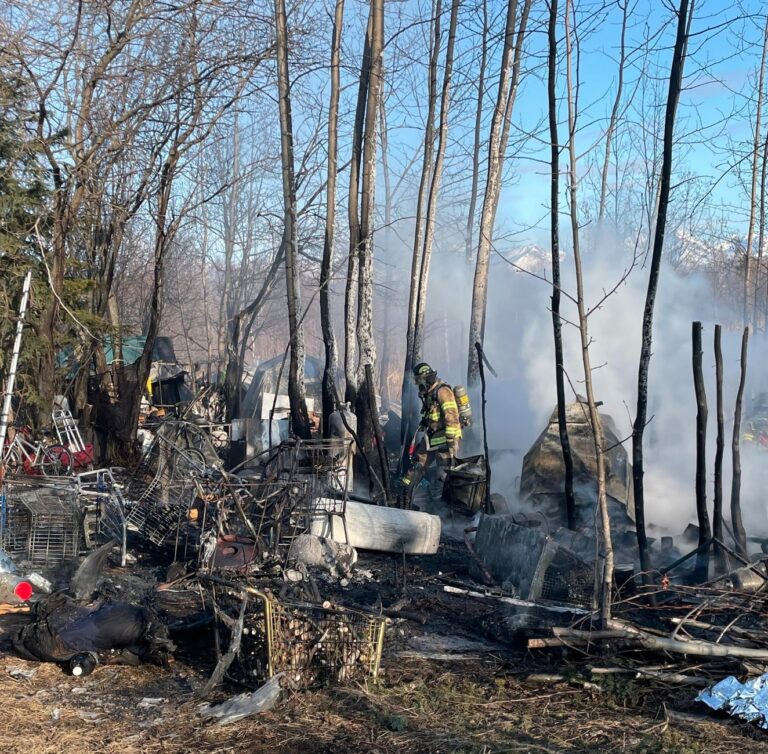
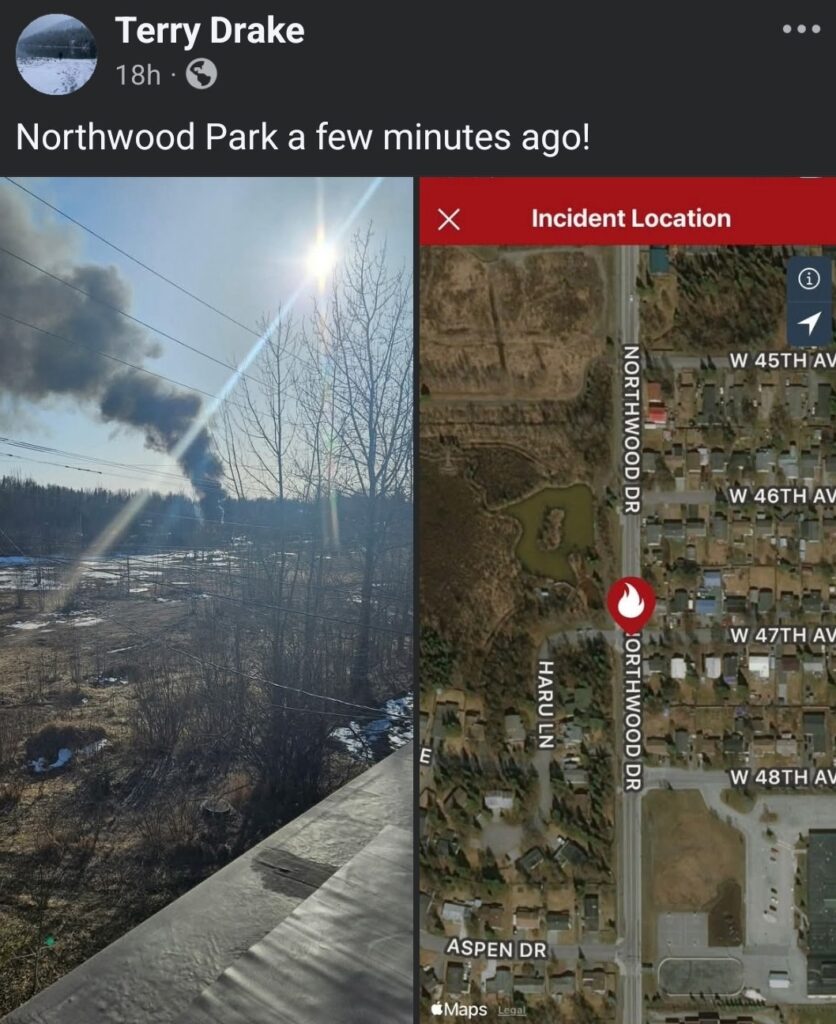
On Saturday afternoon, a significant fire broke out in a homeless encampment on Norwood Dr. in Spenard. There were multiple calls to 911, with the smoke reportedly seen as far away as Merrill Field. Propane tanks were exploding in the neighborhood, people were screaming, and flames were visible when firefighters from stations 5 and 1 pulled up.
Four homeless people in the area were given advice on where to get shelter from the city services, and the fire fighters were able to clear the scene at about 7:10 pm.
It’s become a regular occurrence in Anchorage, with homeless encampments setting the greenbelts and forests on fire, and this is just March, with fire season ahead.
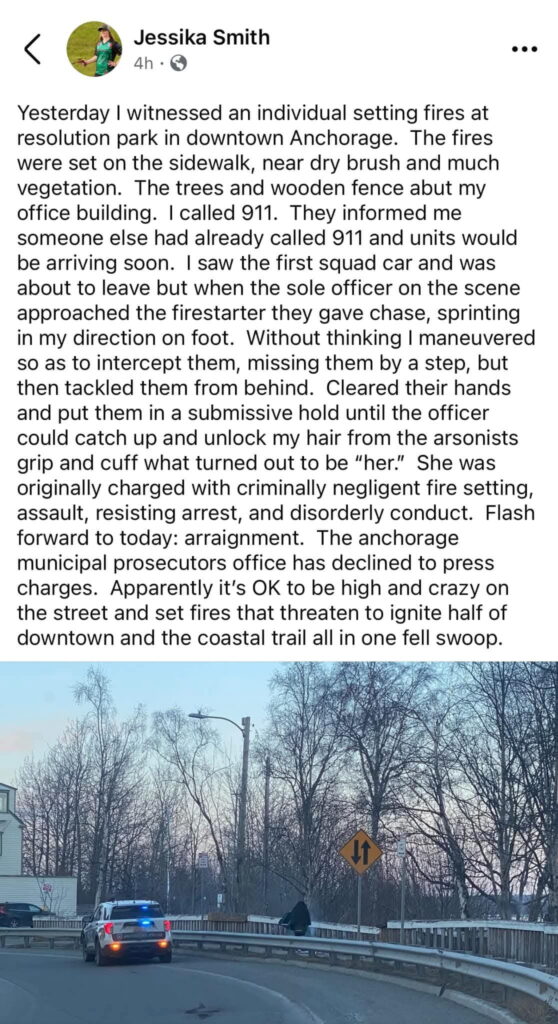
Days before, a citizen reported someone who appeared to be on drugs setting fire to brush and trees at Resolution Park near downtown.
Political writer Jeff Landfield reported on March 26 a major homeless fire on the Campbell Creek Trail near the Foxridge condominiums. There were six foot flames and explosions from propane tanks in the encampment.
The increasing number of vagrant-set fires raises questions about whether Mayor Suzanne LaFrance has been up to the task of tamping down the homelessness in Anchorage, which appears to be spreading, literally, like wildfire.
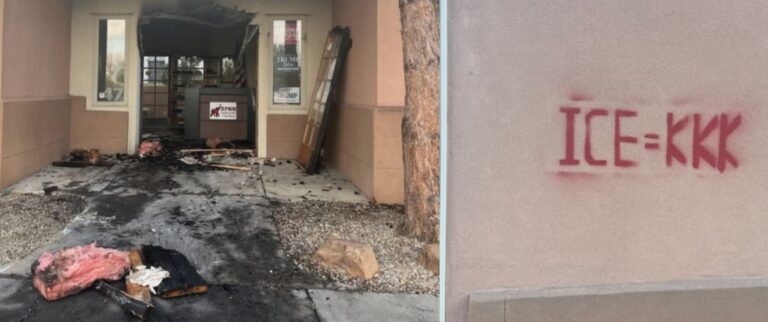
The Republican Party of New Mexico was hit by what appears to be a terrorist attack at its headquarters in Albuquerque on Sunday. A fire broke out in the building after an unknown person or persons threw a Molotov cocktail (a crude homemade bomb) at the building, causing a fire, and vandalized it with spray paint.
The attack comes on the heels of numerous other terrorist attacks on Republicans and supporters of Donald Trump, particularly those who own Tesla electric automobiles or those who have American flags outside their homes.
Tesla is a car brand developed by Elon Musk, who President Trump has put in charge of downsizing the government through the Department of Government Efficiency.
Trump, himself, was the subject of at least two assassination attempts last year.
Sunday’s assault occurred just before 6 am. Albuquerque Fire Rescue responded to a structure fire at the building on San Francisco Road NE. It took only about five minutes for firefighters to extinguish the blaze, but significant damage was done to the entryway and smoke damage was found throughout the building, which was not occupied at the time. The letters “ICE=KKK” were sprayed on the building, indicating the attack was politically motivated.
Republican Party Chairwoman Amy Barela condemned the attack as “a blatant attack not just on our party, but on the values of freedom and democracy we stand for.”
Barela said in a statement: “This is not an isolated incident. It is part of a disturbing pattern of politically motivated violence that has plagued our country—fueled in part by the silence and implicit encouragement from progressive leaders who refuse to condemn these acts. Their failure to stand against political violence has created an environment where attacks like this are not only possible but increasingly frequent.
“We are deeply relieved that no one was harmed in what could have been a tragic and deadly attack. Those who resort to violence to undermine our state and nation must be held accountable, and our state leaders must reinforce through decisive action that these cowardly attacks will not be tolerated. We are working closely with the Bureau of Alcohol, Tobacco, Firearms and Explosives (ATF), local law enforcement, and federal investigators. We are committed to providing every piece of evidence necessary to bring those responsible to justice and ensure they are prosecuted to the fullest extent of the law. We will not allow New Mexico’s broken criminal justice system to dilute the seriousness of this attack,” she said.
The Republican Party of New Mexico will not be silenced, Barela said.
“We will emerge from this stronger, more united, and more determined to fight for the people of New Mexico and the future of our country. Let us not forget: it was the Democrat Party that once supported the formation of the KKK, pushed Jim Crow laws, and defended slavery. Today, we see the same dangerous tendencies play out in new forms—attempts to suppress free speech, silence dissent, and use fear to control the political narrative. Our fight is not just for our party—it’s for every New Mexican who wants a safer, freer, and more accountable state. We will never back down,” Barela said.
The investigation into the attack includes local fire and police, as well as the FBI and the Bureau of Alcohol, Tobacco, Firearms, and Explosives.
National GOP Chairman Michael Whatley issued a statement about the attack: “I’m grateful no one was hurt and look forward to the perpetrators being held accountable to the fullest extent of the law. Whether it’s vandalizing Tesla dealerships or burning GOP HQs, the Left is completely out of control. Every Democrat who doesn’t condemn violence like this is responsible for it.”
But the Democrats are, in fact, following the directions of Rep. Hakeem Jeffries, who said that after Trump was elected, they would fight Trump “in the streets.”
According to SmartAsset, an Alaskan needs to make at least $58,000 a year to live comfortably in the 49th State. That’s less than Massachusetts but nearly double what it costs to live comfortably in Mississippi.
Of course, the definition of “comfortably” is elastic.
In Massachusetts, the top end of the national scale, a Bay Stater needs between $67,000 and $200,000 to be considered middle class, the financial advisor company says. That state’s high cost of living comes from high taxes, expensive housing, and generous social welfare payments.
In Alaska, the income needed is between $58,000 and $173,000 to be considered middle class, SmartAsset says in its latest report.
Although prices are high, taxes in Alaska are generally lower, with the exception of property taxes in organized cities and boroughs. Anchorage homeowners, for instance, pay over $3,500 a year for a lower-end home or condo valued at $269,900. The average Anchorage home is now assessed between $460,000 and $490,000, which means much higher property tax bills, likely over $7,000 annually to the Municipality.
The US Census Bureau puts Alaska’s median household income at $89,000, higher than the median household income for the whole country, which is $75,000 (half of Americans earn les than $75,000).
For a homeowner in Anchorage making $70,000, that could mean easily 10% of his income is going to pay property taxes to the municipality.
Meanwhile, in Mississippi, the minimum household income that is considered middle class is $36,162. Mississippi is a cheap place to live in due to low housing costs and relatively low tax burdens. Food and sundry are also cheaper in Mississippi, in part because wages are lower and are not driving up prices. There are, of course, also alligators and water moccasins, but the cost of ammunition is going to be low.
See the graphic that breaks down every state by what is needed to be middle class in 2025 at this VisualCapitalist link.
At least two Walmart locations in Anchorage — the Dimond Walmart and DeBarr Walmart — are now keeping Spam and other staples, such as canned corned beef hash, in a locked display. Shoppers must press a button and ask for a store employee to help them if they want to buy the canned meat product, which is popular in rural Alaska and in homeless encampments around Anchorage. Culturally, the spice ham in a can is very popular among Hawaiians and Pacific Islanders.
TikTok video user @akwildrose_beadwork documented the Anchorage display, as she was planning on buying Spam for her breakfast menu.
The employee explained that certain cans are kept at designated registers, such as register six, rather than allowing customers to place them directly in their carts.
This practice of locking up high-theft target items is part of a broader trend among retailers like Walmart to combat the shoplifting. It’s not just guns that are behind locked cabinets anymore. It’s now becoming more common to lock up every-day staples.
Sen. Kelly Merrick of Eagle River has publicly blasted the Dunleavy Administration and the Alaska Gasline Development Corporation for signing an agreement with the Glenfarne Group.
In a Senate Finance Committee she made it clear that she is a “no” vote on state support for the Alaska LNG project with the private developer signed on to take over ownership of it. The state, through its independent development agency the Alaska Industrial Gasline and Export Authority, has a $50 million stake to get the $44 billion project going.
“Looking for answers? So am I! AGDC President, Frank Richards, has inked a deal with Glenfarne for the AKLNG project BEFORE examining all proposals on the table. This is a complete abdication of his duty to Alaska. Mr. Richards is the highest paid state employee at nearly $500k/year and refuses to answer questions posed by legislators. The only real answer I could get was from Co-Chair Hoffman! (Watch the final 10 seconds). Alaskans should be outraged and demand answers!” Merrick wrote on her official Facebook page.
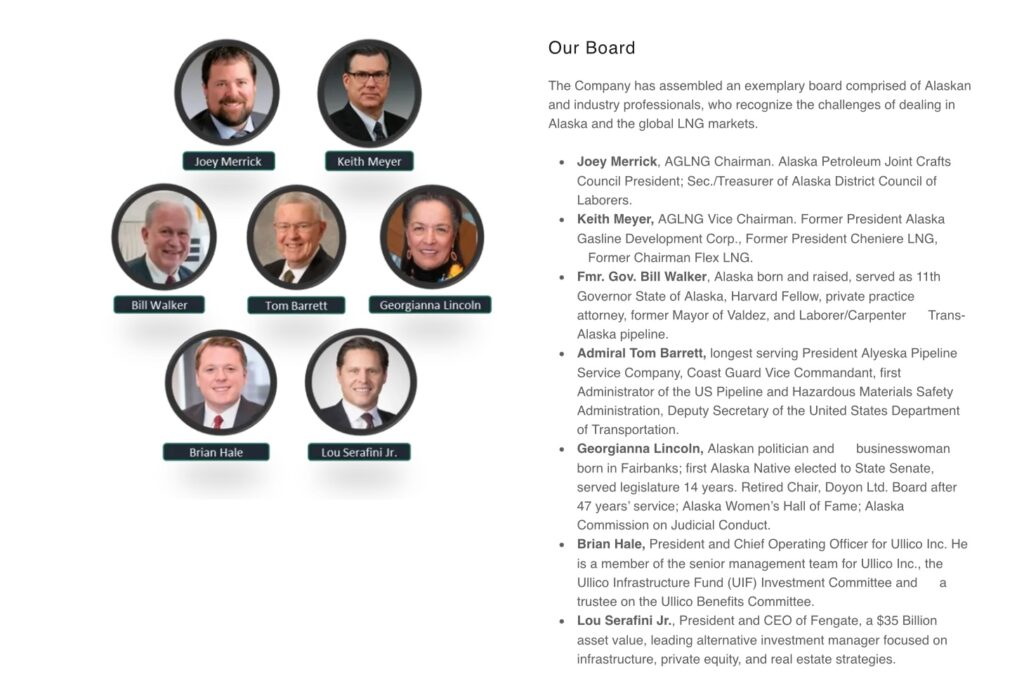
Merrick did not disclose that her husband Joey Merrick, along with former Gov. Bill Walker, and former AGDC President Keith Meyer launched a private company to take over the project in 2020.
This, after Walker and Meyer had signed deals with the communist Chinese to take over the project in 2017.
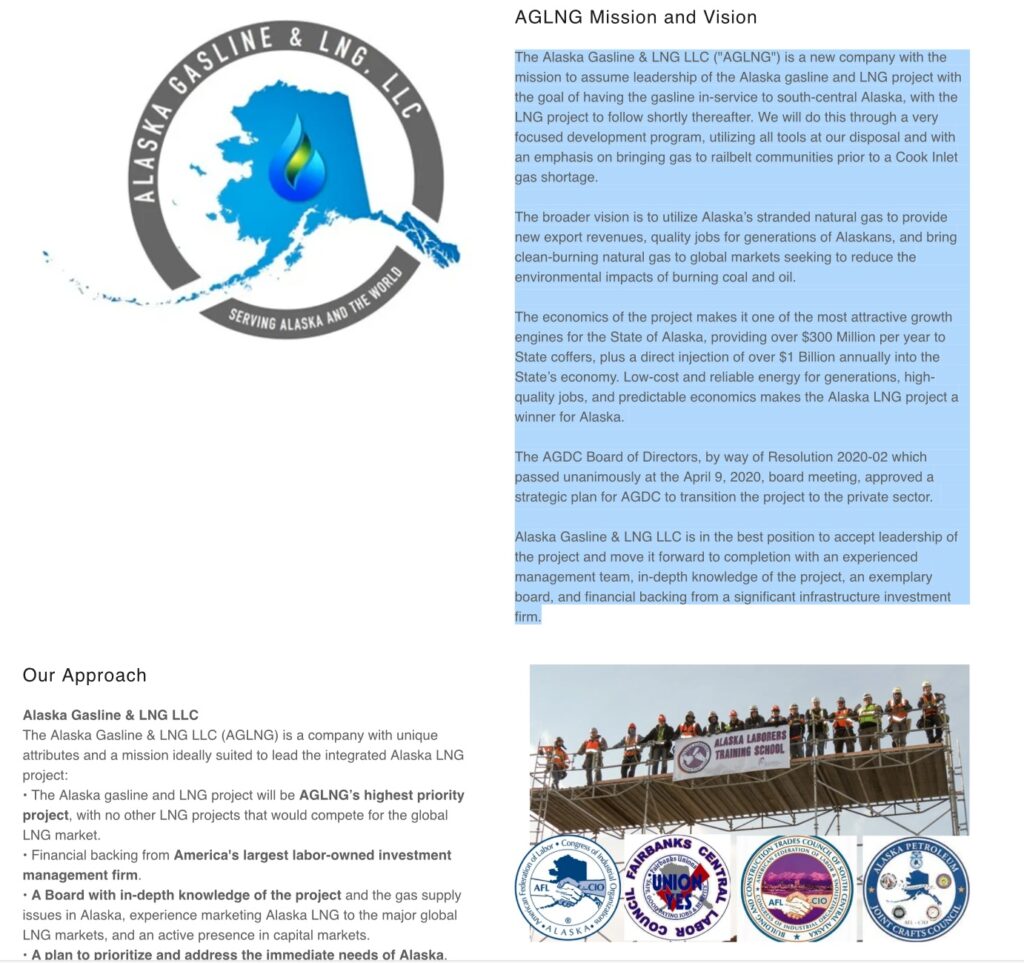
When the new company Alaska Gasline & LNG LLC was formed, the new management at AGDC, led by Frank Richards, had no appetite for dealing with the prior Walker Administration and Joey Merrick, the thuggish head of Laborers 341. The company dissolved in 2021, but the company website is still standing, showing Merrick as the president of the company.
ScreenshotScreenshot
Sen. Kelly Merrick, in her current outrage, cut off AGDC President Richards during a Senate briefing last week, and then accused him of not answering questions.
Since Gov. Mike Dunleavy cancelled Walker’s deal with the communist Chinese in 2019, AGDC has conducted a public, multi-year market search for an experienced lead developer with the financial, technical, and operational resources necessary to successfully advance an energy infrastructure project as large and complex as Alaska LNG on a timeline that best serves the needs of Alaskans, AGDC said in a statement.
“We engaged with numerous parties and evaluated every written and documented proposal submitted during that time, independently and in consultation with advisors such as Goldman Sachs, in a thorough due diligence process,” AGDC reported to Must Read Alaska.
Must Read Alaska raised concerns in January about Glenfarne’s financial strength and whether it would have Chinese investors, but since then, AGDC hired a third party to do the “due diligence” investigation of the Houston and Australia-based company, and came away satisfied that the company has the wherewithal to build the Alaska gasline, and no communist Chinese skeletons in its closet.
“Glenfarne presented a comprehensive project development plan and engaged with AGDC in hundreds of hours of information sharing which culminated in an exclusive development negotiation and term sheet agreement. Once the AGDC-Glenfarne agreement was finalized, numerous other parties stepped forward with new or renewed interest in Alaska LNG. A project of Alaska LNG’s scale will offer numerous opportunities for additional investors and developers to participate,” AGDC’s statement to Must Read Alaska said.
In other words, after Glenfarne expressed interest and the negotiations were well under way, other parties wanted to see if they could play too.
But they were companies that were Johnny-come-lately entrants, and AGDC moved ahead with Glenfarne, rather than starting over.
Sen. Merrick may have just signaled that she will lead the charge to kill the Alaska Gasline project that is now moving toward the “final investment decision” phase. She is parroting the words of her husband, who has also trashed the AGDC project in public.
For Merrick, it may be a case of “If my husband can’t own it, no one can.”
Sen. Merrick may also be mad at Gov. Dunleavy for backing her opponent, Jared Goecker, in her 2024 run for reelection. She could be out for revenge.
Alaskans have waited for generations for the gasline to be built. The promises started with Alaska Gov. Frank Murkowski and time and again, the project has ended in disappointment.
So it’s a fair question to raise: Is Kelly Merrick this year’s “Lucy,” the one who is going to pull the football out from under the gasline project?
It has been seven years since Alaska Gov. Bill Walker and entities owned by the communist Chinese government signed a preliminary agreement granting extraordinary control over the planned Alaska LNG project to Chinese firms, including Sinopec, the Bank of China, and the China Investment Corporation, all owned by the communist government.
Under the agreement, Sinopec, a state-owned oil and gas company, would serve as the primary buyer, committing to purchase up to 75% of Alaska’s natural gas from the AKLNG project. The company would also be responsible for the engineering and construction of the gasline.
The Bank of China, also government-owned, would act as the primary lender, putting Alaska in financial dependency on China.
Additionally, the China Investment Corporation would take an equity stake in the project, giving China a direct ownership interest in Alaska’s natural gas infrastructure. This was all part of China’s international effort to buy up and control infrastructure. It is called the “Belt and Road Initiative.”
A widely circulated photo of Gov. Walker shaking hands with Chinese President Xi Jinping highlights the relationship Walker cultivated with China. This courtship began in April 2017, when President Xi made a stopover in Anchorage. Walker and then-AGDC head Keith Meyer later traveled to China to further negotiate details.
Gov. Bill Walker signs a deal with China in November, 2017, to build the Alaska LNG Project.
After Mike Dunleavy was elected governor in 2018 — his victory due in part to public opposition to Walker’s deals with China — he promptly canceled the agreement.
On July 19, 2019, Joe Dubler, interim president of the Alaska Gasline Development Corporation after Keith Meyer’s departure, testified before the Alaska House Resources Committee that the joint development agreement had effectively collapsed. The Dunleavy administration had informed the Chinese via teleconference that Alaska would instead pursue partnerships with North Slope producers and other potential buyers.
Then, in 2022, Sinopec was delisted from the New York Stock Exchange.
Six years into his administration, Dunleavy embarked on a trade mission to Asia to secure non-communist buyers for Alaska’s gas, notably avoiding China. He returned with at least one letter of intent from Taiwan’s President Lai Ching-te, expressing Taiwan’s interest in purchasing six million tons of LNG per year from Alaska and even investing in the project.
While the agreement with Taiwan is still non-binding, the Alaska Gasline Development Corporation has meanwhile secured a primary private-sector developer, Glenfarne Group, to lead the project. Similar to the Trans-Alaska Pipeline System, which is privately owned by Alyeska Pipeline Service Company, the gasline project is moving toward a private-sector ownership model, as it was before Walker took office in 2014 and started giving Alaska’s infrastructure to the communists.
When Gov. Walker made his deal with China, he had just one year left in his only term.
Now, Gov. Dunleavy has less than two years to finalize agreements with key stakeholders, including builders, buyers, and financiers, to ensure the gasline delivers energy to Alaska’s Railbelt region and international buyers in Taiwan, South Korea, Thailand, Japan, and beyond. He is spending a good deal of his time on this project to finalize it before he leaves office.
The project reached a new milestone on March 27, when AGDC signed binding, definitive agreements with Glenfarne Group, which will assume a 75% ownership stake, with AGDC retaining 25%. Glenfarne is expected to make its final investment decision in the fourth quarter of 2025 after securing additional investors.
The Alaska Industrial Development and Export Authority approved a $50 million line of credit in December for front-end engineering and design work, which Glenfarne estimates will cost around $150 million. Additionally, federal loan guarantees of $30 billion may enhance the project’s financial viability.
President Donald Trump has voiced strong support for the project, issuing an executive order on January 20, the day he was sworn into office, prioritizing the Alaska LNG initiative.
Foreign assistance can be done without USAID, said Secretary of State Marco Rubio in a post on X.
“Foreign assistance done right can advance our national interests, protect our borders, and strengthen our partnerships with key allies. Unfortunately, USAID strayed from its original mission long ago. As a result, the gains were too few and the costs were too high. Thanks to President Trump, this misguided and fiscally irresponsible era is now over,” Rubio wrote, as the State Department takes over many of the programs previously run by the US Agency of International Development.
“We are reorienting our foreign assistance programs to align directly with what is best for the United States and our citizens. We are continuing essential lifesaving programs and making strategic investments that strengthen our partners and our own country,” Rubio said.
This means USAID is closed and the legal challenges have failed. A federal appeals court overturned a lower court’s ruling that had claimed certain Department of Government Efficiency actions at USAID were unconstitutional. The appeals court allows DOGE to continue digging into waste, fraud, and abuse at the agency.
DOGE pulled back the veil on USAID’s excessive ideological leaning, including millions to fund diversity-equity-inclusion programs around the world. The blatant abuse of taxpayer dollars has led President Donald Trump to make the decision to close USAID and incorporate some of its programs into the State Department.
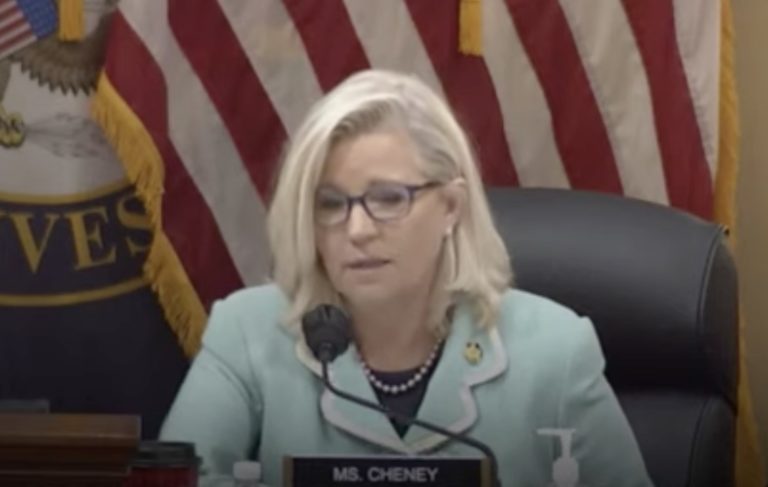
Alaskans can line up to hear former Rep. Liz Cheney on May 1 at the Atwood Concert Hall in Anchorage.
She, who vice-chaired the United States House Select Committee on the January 6 Attack, is being brought from Wyoming to Anchorage by the University of Alaska Anchorage as part of the College of Arts and Sciences Community Lecture Series.
Her 90-minute lecture is titled “Defending Democracy: A Conversation with Liz Cheney.”
The event has resulted in much debate, due in part to Cheney being a particularly polarizing political figure, intensely anti-Trump, and because she is being paid $151,000, as reported by The Alaska Landmine.
Cheney, who was a Republican representative for Wyoming and was a House GOP leader, was ousted in the Republican primary in 2022 after serving in Congress for just four years. She lost by a landslide.
Now, according to her booking agent, she makes between $75,000 and $150,000 for a single speaking engagement.
The university is paying the top end of Cheney’s range, but says the cost of the entire lecture series is recovered by ticket sales and sponsorships. Tickets are going for between $58 and $166.50, and it appears half of the approximately 2,000 seats are still available. If tickets average $75 apiece, the university will need a sell-out crowd to barely break even.
The venue at the Anchorage Performing Arts Center itself is not cheap and may cost the university as much as $10,000 for the evening. Plus, the university is paying for Cheney’s first-class travel and luxury accommodations. All that could push the cost of her visit up to $165,000. There are sponsorships, but those haven’t been made public yet.
Cheney, the daughter of former Vice President Dick Cheney, chaired the House Republican Conference, the third-highest position in the House Republican leadership, from 2019 to 2021, and served as the Vice Chair of the Select Committee to Investigate the January 6th Attack on the United States Capitol.
Cheney publicly blamed Trump for inciting what she called an insurrection on Jan. 6, 2021, and said that he “summoned this mob, assembled the mob, and lit the flame of this attack.”
Her father Dick Cheney called Trump the greatest threat to American democracy in 2020. Again in 2024, he said, “In our nation’s 248-year history, there has never been an individual who is a greater threat to our republic than Donald Trump.” Both Dick Cheney and his daughter Liz Cheney endorsed Kamala Harris for president, and Liz campaigned with Harris.
Her harsh criticism of Trump puts her at odds with much of her party, which largely sought to avoid directly confronting the former president. She is more in line with Rep. Lisa Murkowski than with most Alaska Republicans or conservatives.
Cheney is expected to speak about the need to not be aligned with a party. Indeed, she is not aligned with Republicans and in November 2021, the Wyoming Republican Party voted to no longer recognize her as a member of the GOP. It was a symbolic move by the state party, similar to the censure Alaska Republicans voted overwhelming for in censuring Murkowski on March 13, 2021, and does not affect Cheney’s official voter registration status.
During the second impeachment of Trump, which charged him with “incitement of insurrection,” Cheney was one of only 10 House Republicans who voted in favor of impeachment on Jan. 13, 2021. So did Murkowski, when the Senate voted on whether to convict Trump after the House impeachment process.
Cheney’s vote broke her away from most of the party; 197 House Republicans, including then-Congressman Don Young, voted against the article of impeachment. Congressman Young said publicly that Jan. 6 was not an insurrection.
Cheney served previously at the State Department as the Principal Deputy Assistant Secretary of State for Near Eastern Affairs, and worked in USAID.
In 2022, Cheney and Ukrainian President Volodymyr Zelensky received the John F. Kennedy Presidential Library’s prestigious Profile in Courage Award, with a commendation for her “consistent and courageous voice in defense of democracy.”
Her memoir, Oath and Honor, is her side of the story concerning her stance against Trump, in which she presents herself as a defender of democracy, something Democrats tend to believe about her, while Republicans say is a case of someone who appears too egocentric to be self-aware.
Her appearance is a risk for the university, both financially and in reputation management. But it fits with the liberal track the university is on.
The dean of the UAA College of Arts and Sciences is Jennifer McNulty, a registered Democrat. She books Democrats and leftists in general for the speaker series.
Speakers from the fall segment of the lecture series included NPR host Melissa Block and Seth Kantner, an author who lives in Kotzebue and who is a registered Democrat.
Another speaker was Patrick Flynn Sullivan, an ecologist and researcher with the university who signed the recall petition in 2019 to try to remove Gov. Mike Dunleavy, right after he became governor.
A speaker in the series from earlier this year was Mr. Whitekeys, an Alaska political and musical performer whose real name is Douglas Haggar. On stage he generally lampoons Republicans. He also signed the recall petition in 2019 to remove Gov. Dunleavy.
Gov. Dunleavy has the veto pen for the entire university system, and in 2025, there may be a need to trim the sails of a university that believes Liz Cheney brings any value at all to the Alaska intellectual ecosystem.
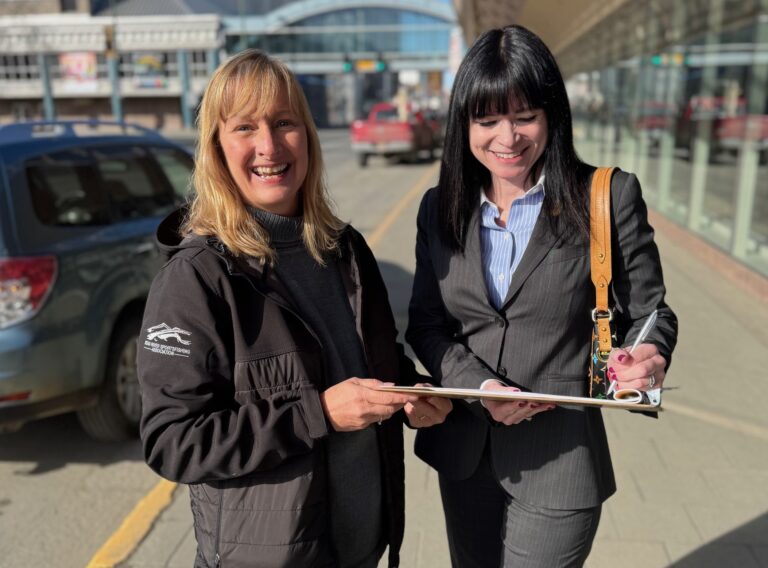
The second effort to repeal ranked-choice voting began its next big phase on Saturday, with the signature-gathering effort launched at the Governor’s Prayer Breakfast in Anchorage. Petition books have been distributed across the state by the group REPEAL NOW, which is headed up by Bernadette Wilson, Bethany Marcum, and Judy Eledge.
The first effort to repeal ranked-choice voting was vastly outspent by opponents with Outside dark money, yet came within a few hundred signatures from repealing the novel voting method put in place — again, with dark money supporters — in 2020.
REPEAL NOW’s campaign focuses on educating voters about the complexities inherent the RCV system, which is confusing and ends up with many more spoiled and uncounted ballots than regular voting. This time, the REPEAL NOW group is doing a straight repeal of the 2020 law that voters passed through initiative.
The signature-gathering process is formidable. To succeed, REPEAL NOW must collect signatures from at least 10% of the number of voters who participated in the last general election, distributed across three-fourths of Alaska’s House districts. This equates to approximately 35,000 valid signatures statewide.
The next big event where signatures will be gathered will be the Mat-Su Outdoorsman Show, Arpril 11-13 in Wasilla. But other signature books will be circulating in communities from Ketchikan to Utqiagvik.
Once collected, these signatures will be submitted to the Division of Elections for verification. If validated, the repeal measure will appear on the 2026 ballot, allowing Alaskans to vote on whether to retain or discard the RCV system.
The group is now planning to raise funds to educate the public about the choice between the current system of voting in Alaska, which Democrats and Sen. Lisa Murkowski support, and the regular method of voting that American voters have used since voting began in 1788’s with the election of George Washington as the nation’s first president.