Sunday, October 18, 2026
Home Blog Page 1684

Should the PFD be enshrined in Alaska’s Constitution?

HOUSE DEMS SAY YES, GOVERNOR SAYS MAYBE, SENATE GOP SAYS ‘SLOW DOWN’

The Alaska House Democrat-led majority is looking at enshrining the Permanent Fund Dividend into the Alaska Constitution.

But not a full dividend, just some portion of what it might have been under the original formula.

Public testimony will be taken on HJR 23 at 1:30 pm on Monday, March 12, and again on Tuesday. 

[Read details of HJR 23 here.]

Paul Seaton, co-chair of House Finance, is likely to reveal more details of the plan this week. HJR 23 is sponsored by Rep. Chris Tuck, Gabrielle LeDoux, Bryce Edgmon, Paul Seaton, Neal Foster, Scott Kawasaki, Jonathan Kreiss-Tomkins, Harriet Drummond, Ivy Spohnholz, Justin Parish, Geran Tarr and Andy Josephson, all Democrats.

Democrats face an uphill climb, as they’ll have to have two-thirds of the House and Senate approve the proposed constitutional amendment. Then it would go to the voters. 

But the mood of the Republican-led Senate is to not create a constitutionally protected payment until there’s a solid fiscal plan for the state.

The Senate majority has so-far declined to advance a bill by Sen. Bill Wielechowski, an Anchorage Democrat. Wielechowski has asked the Senate to bypass the Senate Judiciary Committee, which is holding his PFD Constitution bill. 

The Permanent Fund is currently in statute, and is not constitutionally guaranteed. The constitutional language dating from 1976 that established the Permanent Fund calls for all realized cash earnings to be deposited in the state’s General Fund.  Later, in the early 1980s, the Alaska Legislature created the dividend program in statute.

Now, for the first time, the Walker Administration is also thinking about the idea of putting the PFD in the Constitution. Lt. Gov. Byron Mallott signaled that the Administration is open to discussing it during an interview on APRN’s Talk of Alaska on March 2:

“The Dividend absolutely needs to be a key aspect of the Alaska economy into the future. And that was the reason that the governor made his veto. It was to protect the dividend going forward and to remove it hopefully from legislative table such that they would then act to protect the dividend. And whether or not it should be placed into the constitution is a valid policy debate — very much so,” Mallott told the host of Talk of Alaska.

The Alaska Republican Party State Convention delegates debated a similar measure over the weekend, but in a close vote ultimately rejected adding it to the party platform.

It may turn out that the most vigorous policy debate centers not on whether the dividend should be constitutionally protected, but rather, at what level?

Should it be set near Gov. Bill Walker’s politically set level of approximately $1,200, or should the formula the legislature adopted in the early 1980s be retained?

The so-called “original formula” would yield dividends for Alaskans above $2,500 initially.

The language of HJR 23 would have 33 percent of the income of the fund available for distribution as dividends to residents, as provided by law. The remaining income would be deposited in the general fund and the distribution of dividends would bypass the legislative appropriation or gubernatorial veto process.

Gov. Walker famously vetoed the dividend in 2016, and the Legislature did not fully fund it in 2017. The amount that would be guaranteed by the Alaska Constitution would be not less than $1,250 each year.

HJR 23 contains a provision to recalculate how money is used from the Permanent Fund Earnings Reserve Account, and adds a “Percent of Market Value” provision that would tap the fund in the same way and at a level similar to that of other large foundations such as large university endowments and sovereign wealth funds.

Parnell: Alaska needs to bring jobs back

In remarks to a banquet hall filled with Alaska Republican delegates and guests, former Gov. Sean Parnell delivered a strong message on Friday night: Alaska needs to bring jobs back. Here’s an excerpt from some of his keynote address:

Before I address Alaska’s economic challenges, let me answer another question. Why am I speaking now, when I’ve been mostly silent for the past three years on state policy issues?

[Parnell then told the story of how he and Sandy were at a meeting with President George W. Bush and heard him describe why he refrained from criticizing his successor for a time, out of respect for the will of the people and respect for the office.]

We both thought George Bush was a class act in the years following his departure from office, and Sandy and I both told each other after hearing him, that when our turn came to leave office, that we were going to follow his example, for the same reasons—out of respect for the voter’s choice and out of a desire to give the new administration a chance to succeed.

Now that they’ve had a chance to succeed, and need a help out … the time has come for me to re-enter the public discussion, as an Alaskan, and as an American, because staying silent is not an option where Alaska is so far off-track.

I say, let’s fix Alaska.

Number one on that fix it list — Let’s bring back our jobs.

In the last three years, about 11,000 jobs have gone away. Driven by our economic losses, job losses, GDP losses, and our shrinking population, Alaska came in dead last in a new ranking of state economic stability by U.S. News & World Report and McKinsey & Company. Both U.S. News and 24/7 Wall Street listed Alaska at 50th–out of 50 states for crime and public safety.

Thousands of jobs were lost first in the oil industry, and it took some time for the job losses to spread, but spread they did. Alaskans and companies began leaving the state.

We’ve said good bye to many stores—both large and small. In the oil patch, Apache’s, gone. Pioneer, gone, Shell, gone. StatOil, gone. In the Mat-Su Valley, we have seen the mom and pop businesses under strain, pulling up stakes and leaving.

In 2014, after leaving office, I had 20 years of commercial law experience in my past, and I still work in that area–representing buyers and sellers of businesses. I see the erosion of Alaska’s economy every day in the stories of my clients. It’s a tough time to be in business in Alaska.

But it does not have to be this way.

Alaska’s economic wounds have been self-inflicted and can be undone.

Let’s start with the oil industry and the governor’s decision not to pay tax credits that were earned.

Let’s say you and your spouse saved some money and you want to earn some interest on it.  You decide that one particular bank offers the best rate of interest on your savings, so you go into the bank, sign a contract, open an account, and deposit your money. A year later, you go back to the bank to collect your money plus interest, but here’s the thing. The bank says you can’t have it. Neither your original deposit nor any interest.

That’s what happened to the small oil explorers.  They sank, in some cases, $150 million or more into their first exploration wells, thinking that they would get the tax credit payments back—because that’s what Alaska law said.  When they didn’t, some went into bankruptcy and some postponed further exploration, killing off thousands of Alaska jobs across the last three years of missed exploration seasons, because they didn’t have the money to go forward.

So, you say, what’s the big deal?

Well, let me ask it this way…in my story, the next time you have some money you want to earn interest on, are you going to park it in the same bank—the one that didn’t pay back your money or the interest you had earned on your initial deposit.

Alaska has, in the last three years, earned a deservedly bad reputation among job creators.  People and companies with money are unwilling to make significant investments in Alaska due to the risk and uncertainty.

Other states work hard to get new business. Our state punishes business—we’ve become more like California in this sense.

The administration’s motto seems to be, “We love jobs, but we hate business.” The truth is, Alaska needs more businesses, large and small, because we need the opportunities and jobs they create.

These herky-jerky policies have eroded the ecosystem creating Alaskan jobs—and Alaskans are worse off today because of it.

Policy matters to jobs.

Stability matters to jobs.

And, credibility matters to jobs.

The good news is that we’ve faced similar challenges in the past, and we have overcome them. We have the resources and the people—many in this room—to bring back the jobs we’ve lost and rebuild our economy. We understand that a healthy economy matters to Alaskans’ future.

So, what are our guiding principles to foster a healthy economy?  How do we bring back Alaskan jobs?

  1. First, we bring Alaskan jobs back by restoring stability. Put the state’s budget on a firmer foundation, get spending under control; and, when you use the earnings reserve, make sure there are side boards and dividends. Measure every state fiscal policy change by whether it replaces uncertainty with stability.  Stability’s byproduct is opportunity for Alaskans.
  2. Second, bring Alaskan jobs back by restoring the state’s credibility. Don’t pay the tax credits in part; pay off the state’s debt in full. Don’t let the state be the debtor that didn’t make good on what it owes. Choose to restore the state’s credibility.
  3. Third, bring our jobs back by telling the world that Alaska is once again open for business—and implement policy to prove it; Because we want a future here for our children and grandchildren, we know who we are fighting for…and we know why. Policies that bring Alaskan jobs back, keep our children meaningfully employed here, and, they keep our families close. More Alaska jobs get created when we have a competitive investment climate, rather than a punitive one. More Alaska jobs get created when we reduce the cost of doing business. [State and local government property taxes have gone up on certain properties by 133% in one case I know of, 160% in another—the notices just came out.] Bring our jobs back by competing well.
  1. Fourth, we bring Alaskan jobs back by fostering entrepreneurialism and welcoming start-ups. We support a friendly environment for job creation among start ups by repairing infrastructure, by incentivizing the build-out of tech solutions, by streamlining government tax and fee collections and by addressing the high cost of health care and health insurance.

The next governor and this legislature need to be laser-focused on growing Alaskan opportunity by bringing back Alaskan jobs. Every policy must be measured by whether it will create Alaskan job opportunity or destroy it. If a proposed policy before legislators even leans in the direction of job destruction, even one scintilla—stop it!

That’s my message: Restore stability; restore our credibility; and, fix Alaska by bringing our jobs back!

So how can you help? What’s your part in all this!

  1. Our greatest need…we need good candidates in the state house and senate races. If you have ever thought that one day you might serve, then I’d ask you to consider that this could be the hour. [I’m willing to talk with you, to counsel you, to tell you what to expect.]
  2. Attend public forums and ask every candidate what they will do to create jobs and keep us safe. Do not cede those two issues. We have the high ground and the right policy answers to get our economy on track and to keep us safe.
  3. Volunteer on campaigns – in our first campaign for the State House, when I was 29 years old, it was my House District 17 Republicans and the Republican women who were vital to our victory – a victory that ultimately led to four years in the State House, four in the State Senate and ultimately to Lt. Governor and Governor.

You, here, have the ability to fix Alaska, and to bring our jobs back.  Together, we will do that!

(Excerpt from a speech delivered by former Alaska Gov. Sean Parnell on March 9, 2018, to delegates and guests at the Alaska Republican Party Convention in Anchorage, Alaska.)

Legislative: No regs in place for catch-and-release tool

2

The pretrial risk assessment evaluation being used by the Department of Corrections to let prisoners walk free while awaiting trial has no regulatory framework to support it.

A memo from Legislative Research Services says that the Walker Administration has not adopted required regulations to govern the new pre-trial assessment tools, and will probably not adopt them until December, 2018, a year after the tools have been in effect.

According to the memo, “regulations would be in place one year following the start of the program to work out issues, make adjustment, and validate the program and tools being used for Pretrial Services.”

The pretrial tools being used by the Department of Corrections have become known as “catch-and-release,” as violent and repeat offenders are being released immediately by judges who say their hands are now tied.

The lenient arm of the law: More ‘catch-and-reoffend’ car thievery

In the case of repeat offenders Shane Muse, 28, and Crystal Tui, 25, who were nabbed in Anchorage earlier this month for yet another car theft, the new bail system qualified them for release, although as of this writing they are both housed in prison — Muse had also been on the lam for a prior forgery case where he skipped his court date. He is housed at the Anchorage jail, while Tui is at Hiland Mountain Correctional Center.

BACKGROUND

In 2016, Alaska enacted SB 91, a comprehensive criminal reform bill, which, among other things, adopted “evidence-based pretrial reforms” and created a pretrial services program (AS 33.07).

A key part of SB 91 is a new pre-trial unit called the Pretrial Enforcement Division in the Department of Corrections. The Division required an additional 40 state workers and supervises defendants placed in the community while waiting for a resolution of the charges against them.

Pretrial officers perform a risk assessment for each defendant who is arrested and booked in jail. Known as the “Alaska 2 Scale” or “”AK-2S,” the new pre-trial system became effective on Jan, 1, 2018.

In the Muse and Tui case, Muse scored a 2 on a scale of 1-10, and Tui scored 0, meaning she is no risk for reoffending.

RISK ASSESSMENT TOOL IS BEING BETA TESTED

But if Legislative Research is correct, then the pre-trial scoring system being used today isn’t based on solid evidence; the risk profile tool is essentially undergoing testing this year on real offenders.

“The DOC has not adopted any regulations for the pretrial program at this time,” wrote Susan Haymes, manager of the Legislative Research Services.

The Correction Department said in the fiscal note on SB 91 that the regulations would be in effect by Dec. 31, 2017.

Gov. Bill Walker is asking for further changes to SB 91, jumping over the regulatory process to fix aspects of the assessment tool that are letting dangerous felons back out on the street.

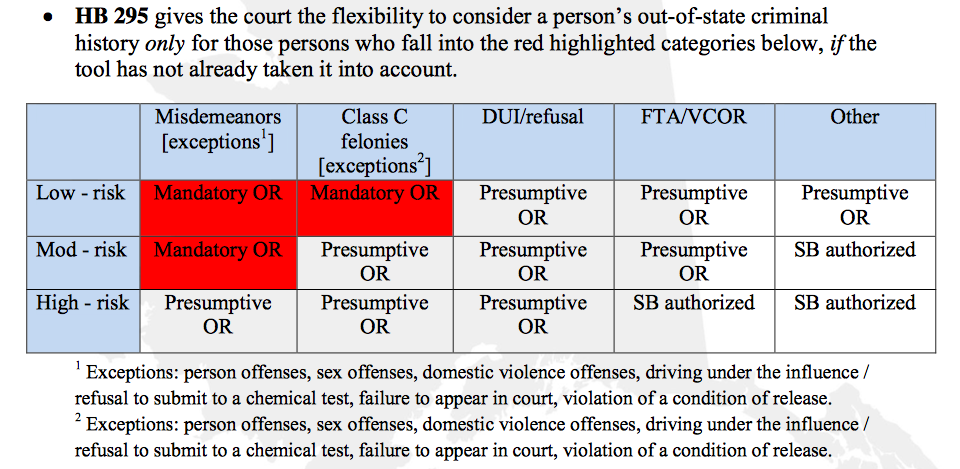
Under SB 91, the AK-2S tool doesn’t take into account a person’s out-of-state criminal history.

HB 295 would give the court flexibility to consider that criminal history for some of those being arrested.

A memo from Attorney General Jahna Lindemuth has asked the House and Senate Judiciary Committees to hasten hearings on HB 295. Neither has held a hearing on the bill.

[Read the full text of HB 295 here]

Criminal round up, release, repeat

In the story linked above, Shannon Perkins is still out on community supervision, and yet another of the suspects has been released, bringing the total to six out of eight who are not in jail.

Senator Sullivan: Alaskans making big impact in DC

Sen. Dan Sullivan drew on a well of good will and optimism before a crowd of 350 at the Alaska Republican Party’s State Convention in Anchorage on Saturday, where he was the keynote speaker along with Congressman Don Young.

Sullivan’s message reflected the mood of the delegates who greeted him warmly at the Anchorage Hilton ballroom: He spoke of optimism, and opportunity, which has been a running theme during his travels across Alaska lately.

A LOT IS GOING RIGHT

Alaska’s senator, now in his fourth year, pointed out that with the Trump Administration in the White House, and with Republicans in control of the House and Senate, there has been a positive shift in the fortunes of the 49th state.

Alaskans have every reason to be optimistic, and have already been beneficiaries of the sea change that took place in 2016, he said.

Where the Obama Administration did everything in its powers to lock up Alaska’s economy, the Trump Administration and the Republican Congress have undone much of the damage, including rolling back an 11th hour executive order that put all fish and wildlife management in the refuges of Alaska under federal control. Using the Congressional Review Act, the Alaska delegation was able to muster the 51 votes needed to rescind that order.

He spoke about how the military readiness is being restored after the Department of Defense lost 25 percent of its budget between 2010 and 2016 under the Obama Administration.

“You saw how we had a dramatic decline in readiness in terms of our military forces. Alaska is destined to play a critical role in the front line of freedom,” he said.

OPENING THE 1002 AREA DUE TO SCRAPPY ALASKANS

Sullivan brought several rounds of applause, mentioning victories such as the progress made o the King Cove Road and opening the 1002 area of the Arctic National Wildlife Refuge (ANWR).

“The national media hated this issue and they did not want us to get it done,” he said. “They said it was all hidden. It wasn’t hidden. There were a lot of votes, 12 total ANWR votes,” Sullivan said.

“There was also this false narrative that this was Big Energy, Big Oil spending all this money to get ANWR open. Big Energy, Big Oil didn’t really lay a finger on it. The big money was the radical extreme interest groups that were spending millions to try to stop us.

“It was grassroots Alaskans, scrappy Alaskans, three members of the congressional delegation, and all of you….That was it! The millions, the media, and even the government of Canada — our friends — actively lobbying members of Congress and the Senate to not open ANWR. So don’t believe the narrative.”

Sullivan also recalled Washington Democrat Sen. Maria Cantwell’s numerous speeches on ANWR that “drip with this attitude that ‘Alaska — you don’t know what’s good for you and for your future and your economy.’ So when I heard that during the battle we had two Democrats in our state hosting a fundraiser for her — in our state — I didn’t think charitable thoughts.”

REXFORD — AN ALASKAN WHO MADE AN UNFORGETTABLE IMPRESSION

Matthew Rexford testifies in front of the Senate Natural Resources Committee, with Gov. Walker looking on from the left, and a former Obama official and former member of the Knowles Administration on the right.

Sullivan recalled the story of Matthew Rexford of Kaktovik, who came to Washington, D.C. to testify on opening ANWR. He spoke in front of Sen. Lisa Murkowski’s Natural Resources Committee.

“He is a strong young Alaska Native man. It was the first time he had been in front of Congress. I’m sure it was very intimidating. But Matthew told the senators in front of him, both Republican and Democrat, that he and his people refused to be ‘conservation refugees.’

“He said, “We do not approve of efforts to turn our homeland in to one giant national park, which literally guarantees us a fate with no economy, no jobs, and no hope.

“Matthew looked those Senators in the eye and told them because of responsible oil and gas development, his village and villages across the area were able to claw their way out of third-world conditions.

“He talked about how they have the right to continue to use their resources, on their lands, to create jobs, for schools, for hospitals, for the things that most Americans have in abundance and take for granted.”

Sullivan also noted how many Alaskans are now in positions of influence in Washington, singling out Joe Balash, who is now Assistant Secretary of Interior.

Just the mention of Balash’s name always gets a round of applause, Sullivan noted, and Saturday’s naming of him was no different, as man people know Balash as the former commissioner of the Department of Natural Resources in the Parnell Administration and then Sen. Sullivan’s first chief of staff.

Balash now reports to Sec. Ryan Zinke at Interior and its well known in political circles that his rise is a particular irritant to Gov. Bill Walker, as Balash is in charge of the Bureau of Land Management, the Bureau of Ocean Energy Management and other areas that impact Alaska.

Sullivan ended his remarks with a quote from President Theodore Roosevelt, about the importance of being involved in the worthy struggle to make the world a better place:

“It is not the critic who counts; not the man [or woman] who points out how the strong man stumbles, or where the doer of deeds could have done them better. The credit belongs to the man who is actually in the arena, whose face is marred by dust and sweat and blood; who strives valiantly; who errs, who comes short again and again, because there is no effort without error and shortcoming; but who does actually strive to do the deeds; who knows great enthusiasms, the great devotions; who spends himself in a worthy cause; who at the best knows in the end the triumph of high achievement, and who at the worst, if he fails, at least fails while daring greatly, so that his place shall never be with those cold and timid souls who neither know victory nor defeat.”

Republican ‘sense of the convention’ voting results for governor

5

Nearly 300 people in the Alaska Republican Party State Convention voted today whether to recommend candidates for governor and lieutenant governor to the 2018 Republican Primary.

The vote was not binding, but came after delegates heard stump speeches and presentations from the candidates. Delegates from across the state had a chance to meet the candidates personally over the course of three days. Then, they were offered the opportunity to vote one at a time whether to recommend candidates; they could recommend all or none, or recommend some and not others.

They needed to achieve 35 percent approval or higher to be considered a “recommended” candidate.

The results were:

GOVERNOR

Mike Dunleavy

76.9 percent YES

23.1 percent NO

Scott Hawkins

76.4 percent YES

23.5 percent NO

Mike Chenault

42 percent YES

57 percent NO

Michael Sheldon

27 percent YES 

72 percent NO


LIEUTENANT GOVERNOR


Kevin Meyer

78 percent YES

21 percent NO

Lynn Gattis

69 percent YES

30 percent NO

Edie Grunwald

59 percent YES

40 percent NO

Stephen Wright

22.5 percent YES

77. 5 percent NO

The illogic of cultural appropriation

3

By WIN GRUENING
SENIOR CONTRIBUTOR

Melting pot: a place where a variety of races and cultures assimilate into a cohesive whole that often results in invigoration or novelty – Merriam-Webster Dictionary

The bulk of my life experience has been centered around two highly regulated and regimented careers – the military and the banking industry.  It goes without saying that neither tolerated much diversity of opinion or creative flair.

For that, we have the arts.

That is, until some in the arts community decided artists had to ask permission to be creative, take risks and be provocative.

I’m, of course, referring to the recent dust-up involving the Wearable Art Show sponsored by the Juneau Arts and Humanities Council (JAHC).  Titled a “Spectacular Celebration of Creativity”, artists were encouraged to “explore, experiment, and showcase.”

Despite this glowing promise, one entry this year caused considerable controversy and was ultimately removed from the show.  The entry, by artist Beth Bolander, “Doragon,” was heavily influenced by Asian artwork and fashion. The piece included a silk kimono-like garment with a dragon-inspired theme and facial makeup reminiscent of a geisha.

When Dani Gross (who has Alaska Native ancestry) modeled Bolander’s creation, it was roundly cheered and won third-place.  Yet, some said it promoted Asian stereotypes.  This sparked a heated debate about cultural appropriation that led to its removal and several apologies by the JAHC Board.

Additionally, JAHC promised to hold meetings about cultural appropriation, implement policies for next year’s Wearable Art Show, and provide “equity” training for staff and board members.

Fordham law professor Susan Scafidi defines cultural appropriation as “taking intellectual property, traditional knowledge, cultural expressions or artifacts from someone else’s culture without permission including…… dance, dress, music, language, folklore, cuisine, traditional medicine, religious symbols, etc.”  (Neither Bolander nor Gross are of Asian descent.)

The issues involved generated a firestorm of criticism of JAHC from all sides – from those believing “Doragon” was not only insensitive but racist – to those believing JAHC’s response was caving to “political correctness” and was an example of reverse racism.

As the apparent arbiter of all things cultural, JAHC should have realized what a slippery slope this can be.

While waiting to learn what the limits of free expression will be in our community, here are a few questions the JAHC Board could consider before diving headlong into this quagmire.

  • Will there be separate committees monitoring every featured art form?  Who will give permission from the appropriate culture, if needed?
  • Will these new policies apply to artwork, jewelry and merchandise sold by the JAHC?  What about food served at events?
  • Will information be requested on the ethnicity of artists?  How will that information be verified?

I don’t dispute there are instances of artistic insensitivity (intentional or not) that mock, marginalize, or exploit other races and cultures. Those are never okay.  But that isn’t the intent of “Doragon” – which celebrated the beauty and artistry of Asian culture.

Most art organizations, in the name of artistic expression, have had no problem defending other “offensive” works of art such as “Immersion (Piss Christ)” that depicts the crucifixion of Christ submerged in a small glass tank of the artist’s urine.  Despite the controversy it generated, it was a National Endowment of the Arts-sponsored award winner.

It’s illogical that any arts organization advocating freedom of expression would yield to the tyranny of the cultural-appropriation crowd.

Creative collaborations, and yes, cultural appropriation, can enrich our lives.  Conversely, guarding cultures to preserve them stifles creativity and prevents the free exchange of ideas, styles, and traditions – which should be the hallmark of any multicultural society.

In a larger context, our culture of freedom is slowly being erased by increasingly militant groups: oversensitive critics offended by anyone coloring outside the lines, speaking their mind or straying across some arbitrary boundary of political correctness.

Juneau, like many communities across our state, is a true melting pot.  Only 50% of children in our schools are Caucasian – with the other half mostly Alaska Native, Asian, Hispanic, or an ethnic mixture.

Why deny anyone the full richness of sharing of cultures by telling them they “can see but not touch”?  For over 200 years, this has never been the inspiration that brought people to America.

Juneau can do better.

Win Gruening was born and raised in Juneau and retired as the senior vice president in charge of business banking for Key Bank in 2012. He is active in civic affairs at the local, state, and national level.

Kito says if per diem cut, he’ll likely not run

8

Editor’s note: This story was written before Rep. Guttenberg was taken to Bartlett Memorial Hospital to be treated for an unknown medical condition earlier today.

LEGISLATIVE PAY: THE JUNEAU EXCEPTION

Rep. Sam Kito, who chairs House Labor and Commerce, continued his habit of inconveniencing citizens (this time naturopaths) who traveled to the Capital City to testify on a bill, and instead continued discussion of a bill that impacts his political future: HB 309, a bill that rejects changes to legislative pay and per diem.

HB 309, sponsored by Fairbanks Rep. David Guttenberg, would reject all of the recommendations of the State Officers Compensation Commission, which cuts the salary of all legislators and decreases per diem of some legislators if session extends past 90 days.

Kito’s committee continued to review his recommendations for changing the bill on Wednesday.

For legislators to reject the salary commission’s recommendations outright is problematic in a year when they are running for office, but Guttenberg must be seen as a safe seat, drawing the short straw to carry the bill that is politically sensitive.

The salary commission recommendations impact Juneau legislators more than those from elsewhere, by dramatically cutting their per diem. Kito has been on record saying if the recommendations stand, he won’t run again because being a legislator is expensive. He added to that sentiment on Wednesday:

“This job has been costing me out of my savings, but not an excessive amount of money. I am single parent, head of household with a daughter in college, and it is not inexpensive. As an engineer, I was able to save up some money for her college,” he said. “With this reduction, I am in a situation now of having to choose whether I run again or whether I take money out of my daughter’s college account to continue this job, and I am not prepared to do that. So if we don’t resolve this issue, I already made the comment and will say here I will not run again. If the choice or the decision of the compensation commission was to pressure legislators to not run, they’ve succeeded, at least if [their recommendation] goes forward.”

Two Juneauites have filed for the District 33 seat: Democrat Sara Hannan and Undeclared candidate Chris Dimond.


Slip of the tongue? Walker admits he’s a Democrat?

SO CONFUSING

Gov. Bill Walker often uses his no-party status to distance himself from the Alaska Democratic Party, while in his actions he has increasingly aligned with Democrats, pushing for bigger government, more social programs, and higher taxes. He also ran and won with the full support of the Alaska Democratic Party, a feat he hopes to repeat in 2018.

But, at a recent event at University of Washington’s Evans School of Public Policy and Governance, even Walker got confused about his own political identity, first calling himself a Democrat, then catching himself and correcting, renaming himself an Independent.

He told the group of students he had cut spending by $1.7 billion in response to dropping oil revenues. But he needs revenues: “A few of my predecessors assumed that oil was a renewable resource and the price would always go up,” he continued. “I introduced nine new pieces of revenue. I wasn’t trying to put a target on anyone. A little bit of income tax, a little bit of fuel tax…not a single one of them passed.”

Here’s the clip with Walker’s confusion about his political identity:


Transgender files complaint against shelter for abused women

VULNERABLE, ABUSED WOMEN MUST NOW SLEEP NEXT TO BIOLOGICAL MEN?

[Editor’s note: The transgender individual in this story is referred to as a male for purposes of clarity, because he is a biological male who presents as a female, and because no legal record of his female identity or name change could be discovered through research.]

“They” said it wouldn’t happen under AO 96, which in 2015 liberalized Anchorage non-discrimination laws to include sexual orientation and gender identity.

They, meaning the ACLU and advocates for gender-neutral bathrooms, promised that no transgendered individual would ever abuse the law — they simply want a place to pee.

ENTER TIMOTHY ‘SAMANTHA’ COYLE

Along came Timothy Paul Coyle, also known as Samantha Amanda Coyle. He had other plans, plans that the ACLU lawyers had perhaps foreseen but dismissed.

Coyle was banging on the door of a shelter for abused women, and he was demanding entry.

In late January, Coyle was homeless, as he so often is. He was also inebriated and got into a fight at the Brother Francis Shelter, according those familiar with the incident. In some of his legal records, he lists Brother Francis Shelter as his home; readers can safely assume the staff is familiar with him.

The Brother Francis Shelter takes both homeless men and women, but because of the circumstances of his inebriation and fight, the staff sent him over to the Hope Center, which runs a shelter for abused and battered women who are homeless.

It’s likely that Brother Francis staff figured Coyle’s assumed female identity would be enough to get him in the door, and they were just trying to move him along.

The Hope Center is run by Christians, with over 30 church partners. It also runs a soup kitchen, a culinary school to train people for jobs, and offers showers and bathrooms for both men and women.

But at night, the sleeping mats are rolled out where the food was served hours earlier, and desperate women, some who are escaping human trafficking, find safe shelter in one big room, crammed next to each other on the floor.

The women sleep beneath a large wooden cross, while the staff does their laundry for them overnight. In the morning, they have breakfast before leaving the shelter, and the staff turns its attention to providing lunches, showers, and bathrooms for all homeless people in need.

The line for lunchtime soup starts up all over again, day after day, with hundreds of people served in a clean, relatively safe setting.

A TRIP TO THE EMERGENCY ROOM

The Christians running the Hope Center took one look at Coyle on the night of Jan. 28 and determined he needed medical attention; they gave him cab fare to get to the emergency room for treatment of his injuries, and they directed him to then go to the AWAIC shelter, which houses both abused men and women.

Coyle came back to the Hope Center the next day, Jan. 29, and tried to gain entry, but was also turned away, this time because he had shown up at the wrong time of day. The “women’s shelter” portion of the Hope mission doesn’t start until after 5 pm, and Coyle showed up in the early afternoon.

He had now been turned away twice.

A COMPLAINT IS FILED

Four days later, Coyle filed a complaint with the Anchorage Equal Rights Commission, saying that he had been discriminated against at a place that provides “public accommodation.” He alleges he was refused entry because he is transgendered. Transgendered means he is in a protected class of individual, his complaint says. He cannot be refused service.

The matter is now before the Anchorage Equal Rights Commission, which has set a hearing for March 15. Will the commission rule that the Hope Center must accommodate those who appear to be biological men?

The Hope Center hopes not. It will argue that it is not a “public accommodation,” as it does not cater to the general public. Its showers and bathrooms and soup kitchen serve the homeless, but its women’s shelter is there to keep vulnerable abused women safe from the dangerous nights in Anchorage.

The Hope Center will also argue that it has a First Amendment right as a faith-based mission to operated its charitable services for women and exclude biological males so that women can sleep in a place that feels safe.

In fact, if the Hope Center had to admit men, it would not have the physical means to segregate them from the women.

WHO IS TIMOTHY PAUL COYLE?

His court records show that Coyle is a man with an extensive criminal record, including violent crimes. There are no court records found in extensive research by Must Read Alaska that pertain to his assumed female identity.

Coyle, 52, appears to have lived in Anchorage, Colorado and Idaho. He has a long list of prior arrests and convictions that include charges for armed robbery with a deadly weapon (dismissed by prosecution), and other theft charges, including shoplifting, resisting arrest, and violation of probation.

As late as January, 2017, his last interaction with the Alaska criminal justice system, the court referred to Coyle as a male, and no records were found for a name change.

But in June of 2017, the media said he was a woman. KTUU quoted Samantha Coyle as a client of Bean’s Cafe, a soup kitchen, where “she” was when a homicide took place outside. A man had been stabbed in what has become one of the most notoriously violent areas of the city, and Samantha Coyle was quoted.

Again in October, Alaska Public Media quoted Samantha Coyle in a story about Anchorage homelessness, referring to her as a woman. “She” told the reporter that there needs to be more affordable housing.

Alaska voter rolls list Timothy Coyle, age 52, whose address is the Brother Francis Shelter.

Coyle’s complaint is clean, legalistic, and notarized. He may have gotten help from Abused Women’s Aid in Crisis (AWAIC) in filing his complaint against Hope Center.

Coyle lists the AWAIC address as his home address on his complaint and he filed his complaint online:

Whether the complaint made to the Anchorage Equal Rights Commission is legitimate remains an unanswered question, since it’s hard to determine if Samantha Coyle is an actual legal person or operating under an assumed name. Samantha Coyle’s complaint is notarized.

If indeed AWAIC is helping transgendered persons file complaints against another women’s shelter over the issue of men seeking entry into a place reserved for the safety of traumatized women, then the AWAIC board of directors may have some new policy decisions to make.

VOTERS WILL DECIDE, COMMISSION WILL HEAR REAL CASE

At the same time the Equal Rights Commission is hearing the Coyle complaint against a women’s shelter, voters in Anchorage are being asked to reverse the Anchorage Assembly’s actions that prevent private businesses like the Hope Center from keeping men out of “intimate places,” when those places have an open architecture that doesn’t preserve privacy.

On the ballot voters will receive in the mail about March 15, they’ll be asked to vote yes or no on Proposition 1:

A yes vote will restrict access to public facilities such as bathrooms, locker rooms and now, it appears, battered women’s shelters on the basis of sex at birth, rather than gender identity. It will allow private establishments such as businesses and religious organizations the right to make their own bathroom rules.

A no vote is against restricting access to facilities such as bathrooms or locker rooms. Members of the public would be free to use bathroom facilities consistent with the gender identification they might feel on a given day.

MUST WOMEN’S SHELTERS NOW BE OPEN TO MEN?

The vote that Anchorage voters cast between March 15 and April 3 will be pivotal to many nonprofits and charities serving battered women.

But what about the Hope Center’s women’s shelter? How will they decide who is a man or woman?

The Hope Center is accustomed to dealing with women who dress more masculinely in order to afford themselves more protection as homeless women.

The staff has to make a judgment about who is actually eligible to stay at the shelter. For instance, they don’t accept those under the influence of alcohol or drugs, and they only accept homeless women. Their focus is on abused women, although for a few years they have had an agreement with the Brother Francis Shelter to accept overflow when the Brother Francis shelter is full. The Hope Center will take women from Brother Francis, if there’s room.

The women who come to the Hope Center for the night are usually suffering from some of the most horrible traumas imaginable. Their experiences with men have left them with what is a form of post-traumatic stress disorder, in many cases.

That’s not something that proponents of gender-neutral intimate spaces have thought through:

  • Former School Superintendent Carol Comeau wrote, “It is not true that the current law allows men to simply dress up as women to enter women’s restrooms. It is not true that the current law makes it more permissible for someone to harass anyone in public facilities.” But Comeau is not the one staffing the door of the women’s shelter. She’s speaking from on high as a retired educator. The people staffing the doors of shelters are now presented with men dressing up as women, and then filing complaints.
  • Former lawmaker Arliss Sturgulewski wrote: “Proposition 1 is one of the most divisive, harmful initiatives I’ve seen on the ballot in our beloved city…Let’s be clear: Proposition 1 targets transgender individuals who want to safely and privately use public facilities, just like the rest of us.  Most transgender individuals have been harassed using public restrooms, and many have been physically assaulted. The current non-discrimination law provides them with the freedom to choose the facilities in which they are comfortable and safe.  That freedom should belong to the individual, not put up for a citywide vote.” (It’s unlikely she wrote that voters should not have a right to weigh in on important public policy, but she signed off on the op-ed and it was printed in the Anchorage Daily News).

But Jim Minnery of the Alaska Family Council wrote back in 2015:  “While not fully repealing the misguided law, our intent is to bring balance and create equal protections for people of faith who want to live and work in the public marketplace without fear of governmental intrusion and legal intimidation.”

Minnery was prescient. It only took 30 months from the passage of AO 96 for a women’s shelter run by Christians in downtown Anchorage to come under attack for turning away biological males.

COMMISSION TO HEAR RESPONSE FROM HOPE CENTER

The Anchorage Equal Rights Commission is governed by nine commissioners appointed by the mayor and confirmed by the Anchorage Assembly. The AERC also has six paid staff, including an executive director and staff attorney, three investigators, an intake and outreach coordinator, and a docket clerk.

The Commission meets on a regular basis in the Mayor’s Conference Room at City Hall (632 W. Sixth Ave., Suite 830), and the next meeting is March 15, from 6-7 pm, when this matter will be heard.