Sen. Al Franken “pulled me in really close, like awkward close, and as my husband took the picture, he put his hand full-fledged on my rear. It was wrapped tightly around my butt cheek. It wasn’t around my hip or side. It was definitely on my butt.”
– Minnesotan Lindsay Menz, telling CNN she met Sen. Franken at the Minnesota State Fair, and he had been a senator for two years when he grabbed her buttocks during a standard constituent photo shoot. That would make him a “breast guy” and a “butt guy” at this point. Will his supporters stand by him?
PART 1: AN ALASKA STATE SENATOR SMUGGLES HER ADOPTED DAUGHTER OUT OF RUSSIA
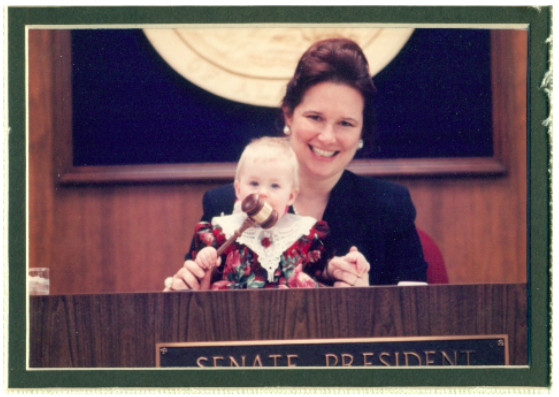
Editor’s note: In November of 1994, Sen. Drue Pearce had just been re-elected to represent Anchorage, and had been chosen as president of the Alaska Senate. Caucus meetings were beginning. Yet she had one big mission to fulfill before session started in January: She had a daughter waiting for her in Yakutsk, Russia. For the first time, she tells the story of the harrowing journey bringing her daughter home to Alaska.
By DRUE PEARCE FORMER ALASKA SENATE PRESIDENT
I flew to Moscow on business. Our jet touched down and taxied to the gate at Sheremetyevo International Airport. The aging steel and glass structure loomed ahead, filled with émigrés, guest workers, and cigarette smoke. Sheremetyevo: A world of uncertainty for families who are being separated, never knowing if they will see each other again.
Historic look at the Sheremetyevo International Airport. – Wikipedia
Sheremetyevo Airport is also a cultural icon whose “transit zone” is famously known as the area where American documents-leaker Edward Snowden lived for several weeks – not in Russia, and not in any other country.
For many Russians, Sheremetyevo is a watershed moment of their lives. Weary from travel and focused on my work ahead, I was not thinking about Sheremetyevo as my own watershed.
It surprised me, then, this heart pounding so fiercely in my chest.
* * *
A BABY FROM SAKHA REPUBLIC
Nineteen years earlier, my husband Michael and I were here on a very different mission. We were leaving Russia — and we were smuggling our new daughter out with us.
Like many couples, we chose to adopt because we were unable to have children. Soon after our decision, I met with a friend, Valerie, who had made several trips with her Rotary Club to Yakutsk, the largest town in the Sakha Republic of Russia. On her first trip she visited the local orphanage, which led her to the adoption of her daughter.
Val said she was returning to Yakutsk soon, and if we were interested in adopting, she would speak to her friends at the Ministry of Education.
Michael and I had, in fact, decided to adopt a daughter. We knew that only babies with certain medical problems could be adopted in Russia. A few days later, I called Val and confirmed our decision and told her we knew the rules.
The voicemail arrived in early June. Valerie had visited the orphanage, where she saw an infant girl available for adoption. The child had been born April 22, the same week that Valerie and I had begun our conversation.
Val’s message let us know to be looking for a photograph she sent by FedEx. We needed to let her know by that weekend if we were interested in proceeding.
MICHAEL AGREES ON THE SPOT
At the time, I knew nothing of this, as I was in a remote part of Venezuela, out of contact with the world. Later, Michael told me that when the FedEx van arrived, he tore open the envelope to find a photo of an adorable blonde-haired baby girl.
But what was he to do? He had once bought a car without consulting me, but to agree to adopt a baby?
Tate Hanna, awaiting adoption in Russia in 1994. The photo was all Michael Williams needed to make the decision, even though his wife, Drue Pearce, was unreachable in Venezuela at the time.
After taking a second look at the photograph, he made up his mind and placed two calls: The first was to the Caracas hotel, to which I would return, and the second was to Valerie.
The message he left for me at the hotel in Caracas was simply, “Call me ASAP.”
I returned to the hotel a few days later and read the cryptic words, fearing my terminally ill mother had taken a turn for the worse. My call home reassured me that Mom was still with us. And then there was a pause and a deep breath, before Michael told me he had committed us to a baby. I couldn’t speak.
Finally, the words came out: “Thank you. I love you.”
Without delay, we started the paperwork. There were visits from social workers, questionnaires to answer, and forms to complete, many of them in Russian. Because we live in Alaska, and trade with Russia was rapidly opening up, finding a translator was the easiest part of the saga that followed.
The first big challenge occurred when we received word from the Sakha Ministry of Education: An outbreak of hepatitis at the orphanage would delay our visit. We were concerned about our baby’s health, of course, yet there was nothing we could do.
By this time she was no longer “the baby” but Tate Hanna, and although we had never set eyes on her, in our hearts she was already our daughter. A few days later we received word that young Tate was healthy, that she had been removed from the orphanage, and was in the care of a retired nurse. However, we would not be allowed to travel until the hepatitis outbreak was over.
Summer came and went, and it was fall before we were allowed to visit. At the time, I was up for reelection as a state senator; we were relieved the Education Ministry made it possible for us to travel to Russia after the November election.
In late November, wearing our heaviest Arctic gear, we began the 10-hour flight from Anchorage to New York and then another 10 hours to Moscow. The U.S. State Department had not allowed us to fly more directly from Alaska to Siberia, so by the time we arrived in Moscow, we were exhausted.
The first stop was the U.S. Embassy. The large hall of the consular section was filled with worried adults and crying children. When our turn came to speak with the official, her first question was, “Where is your agent? When we told her we had no agent, she said we could not adopt without one.
We were stunned.
As most of the paper work from the Russian side had been completed and we had been in almost daily contact with the Sakha Ministry of Education, I asked her why we would need an agent. After much delay and furrowed brows, we found a supervisor who cut through the red tape, and we were on our way to the next leg of our epic journey: an 8-hour flight across Russia in a plane that looked every bit a converted bomber, with an inhospitable crew right out of Soviet central casting. The food was inedible, the smells overwhelming, and arrival at our destination seemed uncertain.
YAKUTSK, WARM AT 60 BELOW
After a tough flight and a rough landing, a surprise awaited us in Yakutsk. In spite of the -60 F Siberian weather, a young lady with a car and driver greeted us at the airport. Irina would be our interpreter during our stay in Yakutsk, and we would come to depend on her.
We were in for an even greater surprise when we checked into the Hotel Ontario. Michael had visited Archangel in the late 1960s, and had prepared me to expect stark accommodations. “Bring your own toilet paper,” he had warned. Yet, this was a delightful place, and modern.
We badly needed sleep, having traveled almost completely around the world. We had heard that families going through adoption would often have to share tiny apartments with Russian families, and struggle to find food. Our accommodations were nothing like the stories.
Irina then announced to us that we were to attend a special dinner that evening. By now, we were totally confused. I took Irina aside and asked with whom we would be dining. She told me that it would be the minister of Education and her staff. My next question was why?
Irina laughed. The minister had recently visited the U.S. and had spent a day in Anchorage – the same day it was announced I had been chosen to be the next Senate President. That explained why we were being treated as visiting dignitaries.
Russians only need such an excuse to break out the vodka.
Last year, Sen. Dan Sullivan was a featured participant at the Halifax Security Forum in Nova Scotia, and was on one of the panels.
But this year, he’s a no show. So are a lot of other senators. The forum is bereft of U.S. participation — from Congress, at least. There are plenty of ministers from other nations, from Afghanistan to Kosovo, and reporters and editors in abundance.
Inquiring minds wanted to know why U.S. senators, in an era of heightened tensions, are sitting this one out, when up to 90 nations are participating.
This is what we found out:
Last year at the opening of the forum, the Canadians showed this video, filled with dozens of the lower moments in American history. Our assassinations. Our dropping bombs on Japan. Our civil rights struggles. And, the film gently mocked President Donald Trump.
It wasn’t only in poor taste, it was openly hostile to the United States, Canada’s only neighbor. And a reliable ally.
In addition to the video in question, Canada has openly opposed opening of the Arctic National Wildlife Refuge 1002 area for oil and gas exploration. Senior officials have gone on the record against the Alaska delegation’s efforts.
That, one Washington insider told us, is equivalent to the U.S. weighing in on whether Quebec should secede from Canada. Or, closer to home, whether Canada should develop its Pt. McKenzie oil and gas reserves. It’s just in poor form, especially since Alaska has one of the strongest relationships with Canada of any of the states.
The Halifax International Security Forum says its mission is to strengthen cooperation between democracies and says it is the “leading gathering of democratic leaders committed to global security and prosperity. Setting the security agenda each November for the coming calendar year, the Forum convenes relevant and key leaders in an unscripted, intimate atmosphere over three days in Halifax, Nova Scotia.”
Limited to 300 participants, the Forum bills itself as “widely acknowledged by the international community as an essential annual meeting place.”
But this year, they’ll find themselves with very few participants of influence from the U.S. And Sen. Sullivan won’t be among them. The forum is Nov. 17-19.
A pair of small companies working in Cook Inlet are trying to overcome funding shortfalls stemming from the State of Alaska not yet making good on promised tax credit refunds.
Furie Operating Alaska and BlueCrest Energy, both Texas-based independents, had to interrupt their 2017 work plans because expected tax credit repayments from the state did not come through.
BlueCrest CEO Benjamin Johnson said in a prior interview with the Journal that the state owes his company roughly $90 million in tax credits for drilling and development work done at its Cosmopolitan oil project before legislation passed to kill the tax credit program July 1. The state has paid BlueCrest $27 million for its refundable tax credits since the company purchased the “Cosmo” project in 2012, according to Johnson.
BlueCrest is the sole owner and operator of the Cosmo oil project on the edge of the Inlet near Anchor Point on the Kenai Peninsula.
He said in August the company hoped it would have to pause its drilling program only for a month or two after a well was finished in September, if private financing could be secured.
Oil industry backers have roundly criticized Gov. Bill Walker for vetoing $630 million worth of appropriations in 2015 and 2016 to pay the industry tax credits. Walker has been steadfast in his assertion that the state cannot afford to make the large credit payments while still in the midst of $2.5 billion-plus annual budget deficits.
On the other hand, the governor has also insisted he would like to see the state pay down on the obligation as soon as the Legislature passes fiscal reforms to balance the state budget. Walker’s original fiscal plan proposed in early 2016 included $1 billion to pay off the credits entirely.
Details recently released by the Alaska Gasline Development Agency show that China would get 75 percent of the gas from the Alaska LNG gasline, and Asian markets would get the other 25 percent.
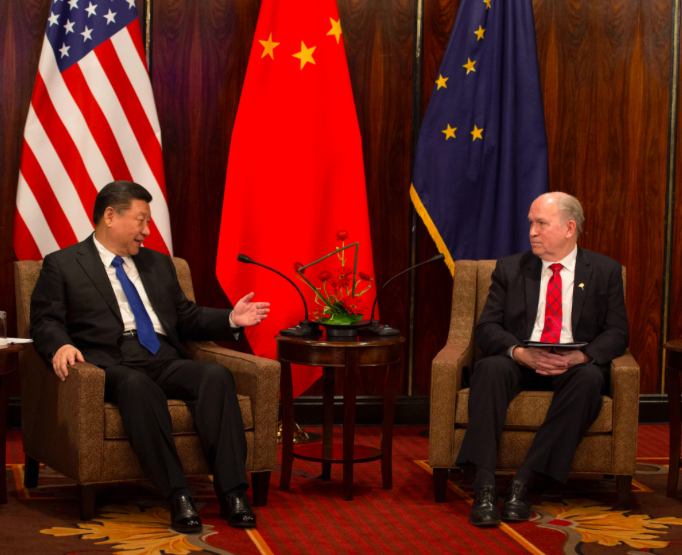
The project, originally targeted for startup in 2025, has been hurried ahead by two years since Gov. Bill Walker and AGDC President Keith Meyer visited China earlier this month and signed a “joint development agreement.”
In a Nov. 16 letter, AGDC has urged the Federal Energy Regulatory Commission to fast track the environmental review of the Alaska LNG gas line project, including issuing a schedule for the environmental impact statement process by Dec. 15.
AGDC submitted its application to FERC in April and has been answering myriad questions the federal agency has posed ever since.
Alaska LNG project is an integrated gas infrastructure system with three major components, including a gas treatment plant at Prudhoe Bay, an 800-mile pipeline from the North Slope to Nikiski, and a liquefaction terminal.
Meyer has asked FERC to finish the environmental impact statement by the Dec. 31, 2018, so the state can start exporting LNG by 2023.
Funding for AGDC is dependent upon appropriation by the Alaska Legislature. The agency has enough funding to stay open until the end of this fiscal year, June 30, but its future is uncertain after that. Funding, during a time of state fiscal crunch, may not be supported by the Alaska Legislature.
Originally, AGDC was one fifth owner of the project, but bought out TransCanada’s share and became one fourth owner, with BP, ConocoPhillips, and ExxonMobil. But the three oil companies said the project was not ripe for development due to current market conditions, and Gov. Bill Walker showed them the door in 2016. It’s now a state-owned project, with Gov. Bill Walker courting China as both the investor and customer.
Prices for natural gas are low, and getting FERC approvals are likely to be lengthy and expensive. Even after the final EIS is issued, environmental groups are already staging themselves to hold the project up in court, and could stall it for years.
Earlier, the governor said that 2025 was the target date for gas exports. But Walker has sought a $40 billion loan guarantee from the Trump Administration for the project, as part of Trump’s infrastructure program.
Details of the governor’s joint development agreement with the Chinese show that China is not obligated to any agreement or to expend any funds on the project.
Some 75 percent of the project debt financing from the Chinese would be in exchange for 75 percent of the gasline’s capacity for the life of the loan, with the remaining 25 percent reserved for AGDC to sell to other Asian markets.
With 100 percent of capacity awarded, the governor’s current plan shows no gas available for Alaska to bring down the cost of energy and provide energy for other development projects, such as the Donlin mine. In the original configuration of the gasline project, there were five offtake points for Alaska communities.
“Her [Ann Coulter’s] books, like her TV appearances, consist of nonstop rabid frothing. Her first, High Crimes and Misdemeanors: The Case Against Bill Clinton, put her on the radar as an up-and-coming liar.”
– Sen. Al Franken, in his book Lies and the Lying Liars Who Tell Them: A Fair and Balanced Look at the Right.
Franken is a member of the Senate Energy Committee who has spoken out against the opening of the Arctic National Wildlife Refuge 1002 area for oil exploration, until every drop of oil from existing leases in Alaska have already been pumped. His amendment to require that condition failed in the committee’s markup process on Wednesday.
There’s no fake news like British tabloid fake news.
The Daily Mirror of London reports that Alaska is being urged to prepare for a North Korean nuclear attack – amid fears that a warhead “could reach residents in 20 minutes.”
“The country will NOT attempt evacuations if maniac despot Kim Jong-un fires a nuclear missile, emergency planners have warned,” the newspaper reports.
The Division of Homeland Security and Emergency Management says, “Not so fast.”
Emergency management professionals say that Alaska is not drafting any nuclear-specific plans, and that the State, as in the rest of the nation, has moved to an all-hazards planning operation to be prepared for manmade, natural, or technological disasters.
“Our message is we encourage everybody to be prepared for anything. Have a disaster plan with your family. Have a disaster supply kit,” said Bryan Fisher, chief of operations.
As for those Prussian blue pills mentioned on the web: An early version of the Mirror story referred to anti-radiation pills, but DHSEM phoned the news desk and had them correct the story.
“Anti-radiation medicine is pretty specific. It only works to prevent absorption of a specific type of radioactive iodine to the thyroid. It’s not going to help against radiation from a nuclear weapon,” Fisher said. He said the department was disappointed in how the story was spun.
The DOT Aviation Advisory Board met on Wednesday. Between the agenda items discussed, such as the proposed Birchwood Airport divestment, rural airports, the governor’s proposed aviation fuel tax and the governor’s proposed airplane tax that targets private pilots, board members expressed concerns about what Gov. Bill Walker’s plans are now that he has released Airport Manager John Parrott. No replacement has been named.
Whomever the governor appoints may only have a one-year job, and then the next governor will have the ability to appoint his or her own person. Critics say the governor has injected politics back into the aviation sector and it is a destabilizing move at a time when the Alaska economy is on its heels.
The first political hiring was at the Fairbanks International Airport. The long-time manager left, and political appointee Jeff Roach was hired Nov. 6, 2015 at the request of former Walker Chief of Staff Jim Whitaker.
Now with Parrott suddenly gone, DOT Deputy Commissioner John Binder is acting airport manager.
One in 10 jobs in Anchorage is related to the Ted Stevens International Airport. It is one of the busiest cargo airports in the world. Parrott had been manager of the airport since 2008, and had been with the airport since the 1990s.
The aviation industry is nervous in Alaska. The governor has just rolled out his airplane tax and registration, and Birchwood Airport pilots are nervous about state talks of divesting the airport.
And word is the person Gov. Walker had lined up to replace Parrott has withdrawn his name.
The job pays less than half of the industry standard, according to those in the field, because it is a State of Alaska job. Finding a qualified person to run the airport is a challenge because of the uncompetitive pay and because the job may only last one year.
Gov. Bill Walker and his gasline team touted an agreement signed Nov. 8 with three Chinese mega-corporations as the largest step the state has ever taken towards finally putting together a North Slope natural gas project.
After a few days to digest the situation, legislators’ reaction has been more subdued.
Senate Resources Committee Chair Sen. Cathy Giessel, R-Anchorage, said she first sought out LNG industry experts to determine exactly what the arrangement, characterized as a joint development agreement by Walker and Alaska Gasline Development Corp. President Keith Meyer, substantively is.
Walker stressed the joint development agreement between the state, AGDC and the integrated Chinese oil and gas giant Sinopec, the Bank of China and the $813 billion sovereign wealth fund China Investment Corp., includes all the pieces needed to make the $40 billion Alaska LNG Project a reality: a gas seller, buyer, and project financiers and investors.
Meyer said in a briefing following the signing that the substance of the joint development agreement goes beyond what would be found in a letter of intent from a prospective gas buyer or project investor.
AGDC Board of Directors Chair Dave Cruz emphasized during an October project update to legislators that the state-owned corporation was seeking to have a letter of intent by the end of the year. Meyer has repeatedly said letters of intent are paramount for gas sellers because while they fall short of being a full-fledged take-or-pay contract, Asian gas customers do not back out of them.
The joint development agreement keeps AGDC on schedule to make a final investment decision on the project at the end of 2018, Meyer said further Nov. 8.
On the other hand, Giessel described it as “another in a line of (memorandums of understanding)” with potential Asian LNG customers or investor companies.