Thursday, July 23, 2026
Home Blog Page 1535

Murkowski teams up with Kamala Harris on workplace harassment bill

CREATES LAWS GOVERNING WORKPLACE HARASSMENT

On International Women’s Day, U.S. Senators Lisa Murkowski (R-AK) and Kamala Harris (D-CA) announced they have reintroduced legislation to address the ongoing issue of workplace harassment and reduce barriers that prevent victims from speaking out and seeking justice.

The Ending the Monopoly of Power Over Workplace Harassment through Education and Reporting (EMPOWER) Act arms individuals with the resources they need to address workplace harassment, according to Murkowski’s office.

Sen. Kamala Harris is running for president, as one of 20 Democrat Party candidates who have announced so far. Murkowski is Alaska’s senior senator.

The bill prohibits non-disclosure and non-disparagement clauses that some employers require as a condition of employment.

“Everyone deserves dignity and safety in a workplace that is free from harassment. And in the unfortunate event that harassment does occur, we must do what we can to create an environment of transparency where victims feel empowered to speak up without the fear of retaliation,” said Senator Murkowski. “This legislation gives victims a voice and works to end harassment in the workplace. The shift in culture we need may not happen overnight, but this is a step in the right direction.”

The bill prohibits non-disparagement and nondisclosure clauses that cover workplace harassment as a condition of employment, promotion, compensation, benefits, or change in employment status or contractual relationship;

  • Establishes a confidential tip-line to receive reports about harassment to allow the Equal Employment Opportunity Commission to target employers that continue to allow systemic harassment in the workplace. This would supplement the EEOC’s current formal complaint process. The information would be shared with state-based Fair Employment Practice Agencies, who could also bring civil enforcement actions against employers;
  • Requires that public companies disclose the number of settlements, judgments, and aggregate settlement amounts in connection with workplace harassment (as a material disclosure) in their annual SEC filings; and disclose the existence of repeat settlements with respect to a particular individual;
  • Prohibits companies from tax deductions for expenses and attorneys’ fees in connection with litigation related to workplace harassment; prohibits tax deductions for amounts paid pursuant to judgments related to workplace harassment; protects plaintiffs’ awards and settlements received in connection with workplace harassment as nontaxable income; and ensures that plaintiffs who receive frontpay or backpay as a result of harassment and discrimination are not taxed unjustly; and
  • Requires development and dissemination of workplace training programs to educate at all levels about what constitutes prohibited workplace harassment and how to prevent this behavior; educates employees about their rights with respect to workplace harassment, including how to report it; trains bystanders on how to intervene and report; and develops a public service advertisement campaign to provide further education on this issue.

[Read Part 1 of the bill]

[Read Part 2 of the bill]

Spring forward, but it could be for the last time

16

Daylight Saving Time begins on Sunday morning. The best practice on that is to set your clocks forward one hour before you go to bed on Saturday. We’ll be on Daylight Savings Time until Nov. 3.

This year legislation in Washington state and Alaska could make it more interesting when time comes for the “fall back” process in November.

Washington state senators have proposed a bill to make Daylight Saving Time permanent in that state, so it would be on just one time all year long. Senate Bill 5139 says that if not authorized by Congress, the state will seek approval from the U.S. Department of Transportation to change Washington to year-round mountain standard time.

That would put Alaska two hours off of Seattle time for most of the year. In winter, when it’s noon in Alaska, it would be 2 pm in Seattle. But during Daylight Saving Time, from March until November, Alaska would be one hour off of Seattle and the rest of Washington State.

A bill presented by Rep. George Rauscher would fix the seasonal confusion by putting Alaska permanently on Alaska Standard Time. In that scenario, Alaska would be two hours off of Washington’s proposed Mountain Time all year.

Rauscher’s House Bill 43 would have the State petition the U.S. Department of Transportation to initiate proceedings under the Uniform Time Act of 1966, which would include public hearings on changing the time zone boundaries, putting Alaska permanently on Alaska Standard Time.

The bill was referred to House State Affairs Committee on Feb. 22.

Nov. 30 earthquake upgraded to 7.1

2

The Alaska Earthquake Center revised the Nov. 30, 2018 Southcentral Alaska earthquake from magnitude 7.0 to 7.1.

In the three months since the earthquake, data was reviewed by numerous agency and academic groups.

“These evaluations are in fairly good agreement and all converge near 7.1,” said Michael West, director of the Alaska Earthquake Center.

There are many ways to calculate the magnitude of an earthquake, he explained. The modern standard for large earthquakes relies on the concept of “seismic moment” — a measure that accounts for the size of a rupture, how far it moves, and the friction.

[Watch this 5-minute explainer video from the IRIS Consortium]

Seismic moment can be estimated by different combinations of seismic waves and analysis techniques, which lead to slight variations in the magnitude estimate.

There are now more estimates of the magnitude available than right after the earthquake, and most of these tilt toward 7.1, due to the convention of rounding the number — and because anything less than a tenth of a unit of magnitude is not meaningful.

At larger magnitudes, such as over 8, the addition of a tenth of a magnitude has more impact.

The 1964 earthquake was for many years considered to be magnitude 8.4-8.5. It wasn’t until the seismic moment technique (described above) was developed that it was revised to 9.2, although that is still debated among those who study these topics.

Chancellor pushes ‘student-led’ tax rally?

The chancellor for the University of Alaska Fairbanks took to Twitter with a 30-second video to encourage students, faculty and university supporters to rally in opposition to budget cuts. In other words, this was a pro-tax rally disguised as an anti-budget-cut rally. About 200 people attended. None of them said where they think the money should come from.

White’s salary is over $300,000 a year, plus a benefit package.

When a school administrator is publicizing a student-led rally against budget cuts, is it really truly student-led at that point? Someone from the 1960s was just wondering.

Sen. Lora Reinbold, ghost buster, makes national news

GHOST HUNTER GETS HUNTED BY SENATOR

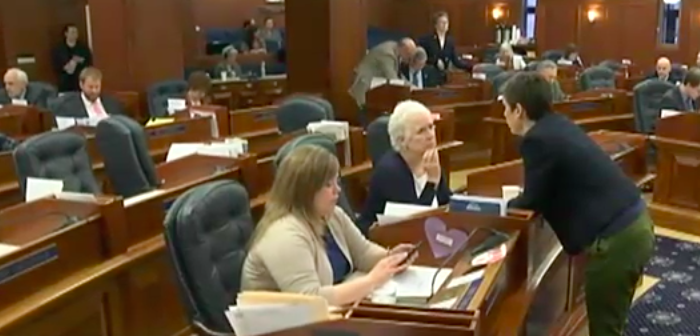
Eagle River Republican Sen. Lora Reinbold has made national news for challenging one of Gov. Michael Dunleavy’s appointees, focusing on his ghost-hunting hobby.

John Francis’ ghost hunting activities came across Reinbold’s radar, and she asked him about it in Senate Judiciary Committee on Wednesday as he was being interviewed for his nomination to the Violent Crimes Compensation Board.

Was he serious about the paranormal or was it a hobby?

“If it’s just for fun and all make believe, tell me that. If you’re serious and there’s investigative process and you believe this is real, I want to know that,” Reinbold said. “I really don’t want you to glaze over this because I think this is a real serious concern.”

Reinbold said tonight that victims of violent crime are emotionally fragile and she’s simply concerned about someone being on the compensation board who could take advantage of them, or influence them about their loved ones being ghosts.

Francis’s Alaska Ghost Hunting website says the team “never asks to be paid for an investigation. Every member of the AKGH team is passionate about what they do.”

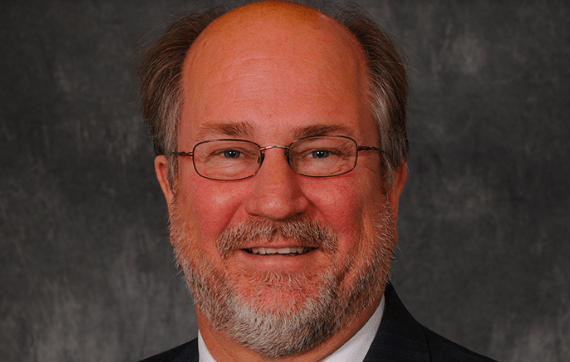
John Francis

But the business also presents itself as a group of serious-minded paranormal investigators that specialize in haunted locations, rather than UFOs, aliens, or mythical creatures. Francis has appeared on television shows on the topic, but said that his group hasn’t been very active recently.

Reinbold said she thought Francis had been less than candid in his answers and she does not plan to vote for him.

[Francis’ resume can be read here]

Francis is an active member on social media sites such as Stolen in Alaska, and Mat-Valley Crime Discussion, for which he is an administrator. He is dedicated to the repeal of SB 91, the liberal crime bill that many believe led to an uptick in crime across the state and his Facebook pages dedicated to crime-stopping have thousands of followers.

The Associated Press story about the interview of Francis has made it as far as the New York Times.

The hearing can be watched here, starting at 1.26 and ending about 1:39.

Wild: Mat-Su School Board meeting disintegrates into shouting

OLE AND DONNA AT EACH OTHER’S THROATS

The March 6 regular meeting of the Matanuska-Susitna School Board devolved into a shouting match after the school board president and a board member got into a disagreement about whether a board member can be forced to serve on a board committee. They also disagreed about whether the complaint by the school board president about another member should be made in public or in executive session.

The meeting started out ordinarily, with Board President Donna Dearman asking board member Ole Larson to read the goals of the school district aloud. Which he did. The board then stood for the Pledge of Allegiance.

The clerk was then asked to read the rules for public comment, which included a stipulation that complaints about individual employees should be avoided in the public setting, and that disruptive persistence by an individual or group “shall be grounds for the chair to terminate the privilege of addressing the meeting. The board may remove disruptive individuals, and have the room cleared if necessary.”

About 45 minutes into the meeting, after going over a report by the superintendent on implications of state budget cuts, the disruptions began.

Board President Dearman needed to get something off her chest. She referenced a conversation she had had with board member Ole Larson prior to the November board meeting, in which Larson had asked to be excused from board committee work and said she had excused him.

“That conversation never took place,” Dearman said to the room. “There was no ask and there was no granting of excusing from committee work.

“I want the board to know that on Nov. 7, when we chose board committees, had I granted such an allowance to any board member, I would have stated at the beginning of that selection process that a board member had asked to be excused,” she explained. It is board policy that members serve on committees, and she said she would have been transparent about it if she had excused him.

Larson sat listening, as she described her version of events, including details about a heated conversation the two had had prior to the November meeting.

At this point in the meeting, Larson leaned into his microphone and interrupted her with “Point of order,” and the two of them began talking over each other loudly.

“Mr. Larson! Mr. Larson! Mr. Larson! Mr. Larson!” Dearman pounded the gavel three times as she yelled. “I have the microphone! Mr. Larson you impugned me in open session and I am clarifying the record in open session.” He continued to argue.

At this point Dearman had reached over to cut Larson’s microphone, and it’s not clear what he was saying, but it appeared to be about moving the dispute into an executive session.

The two were talking simultaneously and the meeting was overheating. Dearman finally called for an at-ease.

When they returned, the arguing and yelling continued, and the clerk tried to explain Roberts Rules of Order as they pertained to someone calling for a “point of order.” There is no debate or vote on a point of order, she said “we are to hear the point of order and the chair has the determination to accept and reject.”

Dearman decided to decline to hear his point of order, and said she would finish her statement.

But Larson persisted and even though his microphone was no longer working, he spoke for a minute about wanting to take the matter into executive session and he objected to her calling him a liar.

Dearman responded that since he opened it up in open session, she was “going to finish it in open session.”

“This could have been resolved in executive session. To bring it up in public is bad, bad form,” Larson said before being subjected to the remainder of her remarks.

(The drama continued and can be watched on the district’s livestream, starting at about the 42.45 minute mark. It’s good, clean family entertainment.)


Ryan McKee is new head of AFP-Alaska

1

Americans for Prosperity has promoted Ryan McKee to state director for Alaska. McKee was grassroots director of the organization since its inception in Alaska in 2014. Jeremy Price, the former state director, has taken a post with the Dunleavy Administration.

In his new role, McKee will be responsible for leading the state’s grassroots network, as well as promoting policies across the state that lift government burdens and improve the lives of those in the Last Frontier.

McKee was born in El Salvador and at the age of 18 months joined his adoptive family in Fairbanks. His family’s business and political roots in Alaska go back to the 1940’s with various family members serving Alaska in local and state government since the early 1990’s.

Raised in Wasilla, Ryan graduated from Colony High School, where he competed in wrestling, rodeo, and soccer. He graduated from the University of Alaska Anchorage in 2011 with a bachelor’s degree in Political Science. McKee joined the staff of Rep. Bill Stoltze, Co-Chair of the House Finance Committee in the Alaska State Legislature. In 2014 he helped start the State chapter of Americans for Prosperity. He lives in Wasilla.

The organization has been involved in several initiatives, most recently working to move the local voting date in the Mat-Su Borough to align with November General Elections, in order to increase voter turnout.

Tlingit code talkers chalk up another honor

3

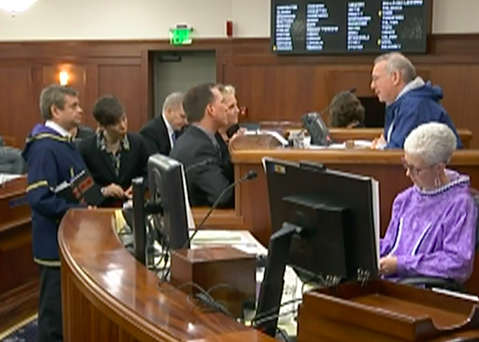
The Alaska State Legislature on Wednesday honored Alaska’s Tlingit code talkers for their exemplary military service and the crucial role they played in helping to end World War II.

Although the Tlingit code talkers have been recognized by Congress, this is the first official State recognition for their secret service in defeating Imperial Japanese Army and bringing the war to a close.

The citation passed by the House and Senate posthumously honored Tlingit code talkers Robert Jeff David, Sr., Richard Bean, Sr., George Lewis, Jr., and brothers Harvey Jacobs and Mark Jacobs, Jr.

Several family members of the late code talkers watched from the House and Senate galleries.

“Their story is a testament to the ingenuity, nobility and bravery of Alaska Native people and highlights the importance of preserving the Tlingit language,” said Senate Majority Leader Mia Costello.

The term “code talker” is usually associated with the better known Navajos, but Comanches, Hopis, Meskwakis, and Tlingits — far away in Territorial Alaska — also were recruited into the program. Code talking for military uses goes back at least as far as World War I with Cherokee and Choctaw peoples.

The Tlingit families never knew about their men’s specialized service to the country, according to former House Rep. Bill Thomas, who initiated the effort for the citation. At the time, of course, Alaska was not only a territory of the United States, but was also a war zone when the Japanese invaded Attu and Kiska Islands in the Aleutians.

“I knew Jeff (David) all my life and he took it right to the grave,” said Thomas, who is a Tlingit elder and U.S. Army veteran (Vietnam, 1968). Thomas said though David often spoke proudly of his accomplishments as a hall-of-fame basketball player and fishing highliner, his amazing achievements as a code talker were never shared. “George Lewis too, he was a storyteller. He would sit there and tell you stories, but he never told one about that.”

Thomas said he was told by families of the code talkers that they theorized the men were told their families would be killed by the enemy combatants, if the secret ever got out.

Lewis spent 52 years working for the Salvation Army, and was carver, boat builder, and silversmith, and David was one of the first directors of the Sealaska Corporation, was a commercial fisherman and a Hall of Fame basketball player for the Gold Medal Tournament, said Thomas.

“They took their orders seriously, to never talk about it,” said Southeast Alaska Native Veterans Commander Ozzie Sheakley, who attended the House and Senate sessions.

“He took it to his grave,” said Krissy Bean, granddaughter of Tlingit code talker Richard Bean of Hoonah. “My Grandma Bean (Richard’s wife) did not even know he was a code talker.”

“I remember asking (Tlingit Code Talker Jeff David) what he did when he was in the service and he would just smile and say ‘Oh, it was the best time of my life. I played basketball, I played in a band,’ ” said his stepdaughter Jodi Mitchell after the event. “He never talked about what he actually did.”

Other family members at the legislative event honoring the code talkers included Verna Adams, daughter of George Lewis, and John David, son of Jeff David.

GOLD MEDAL HONOR

The code talker program was eventually declassified by the government, and the Code Talkers Recognition Act of 2008 honored all Native American code talker who served during WWI or WWII. President George W. Bush authorized the making of a Congressional Gold Medal of individual design for each tribe and a silver medal duplicate for each code talker.

In November 2013, Congress awarded the silver medals posthumously to the Tlingit code talkers, and Southeast Alaska Native Veterans Commander Ozzie Sheakley received the Congressional Gold Medal, the nation’s highest civilian honor, on behalf of the Tlingit tribe.

On the reverse side of the coin is an homage to the Killer Whale Clan. The medal’s design was created by noted U.S. Mint coin designer Susan G. Gamble, and it was the last coin she ever designed for the Mint, before she passed unexpectedly in 2015. Sheakley had a hand in advising the design.

To order your own commemorative coin honoring the code talkers, follow this link the U.S. Mint.


Anchorage climate plan filled with code words

THE ANCHORAGE DAILY PLANET

The city apparently does not have enough on its plate. Now, it turns out, Anchorage has a new draft Climate Action Plan.

Mayor Ethan Berkowitz announced Anchorage has joined with something called the Global Covenant of Mayors for Climate and Energy – a European group – to reduce greenhouse emissions in Anchorage by “80 percent from 2008 levels by 2050, with an interim goal of 40 percent by 2030.”

More important, we suppose, it “places equity and inclusion at the heart of our social, environmental, and economic policies and practices.” How in the world can you have a Climate Action Plan without equity and inclusion?

The city teamed up with the University of Alaska and myriad other entities and individuals to come up with the plan and, until March 31, is taking public comments.

The draft document is a “guiding document that provides a framework for policies that reduce emissions and a pathway to achieve long-term outcomes that reflect the values of Anchorage as an equitable and resilient community.”

Read the rest of this commentary at:

http://www.anchoragedailyplanet.com/150355/climate-action-plan/