Tuesday, October 13, 2026
Home Blog Page 1516

Victim was 18; shooter still at large

5

Anchorage police say the dead man in a shooting on Sunday was 18, not a juvenile, as earlier reported. It also appears that the other person taken to the hospital was not the shooter, because detectives are still on the hunt.

Police say that their initial investigation has found that an altercation between a group of young people started in the sports fields near Sullivan Arena, and ended in the wooded area near the Chester Creek Trail along 20th and C Street. The suspect fled on foot after shooting the two victims multiple times.

The deceased teen’s identity has not been released, but detectives are aggressively working at identifying and locating the suspect. The shooting took place at about 6:20 pm on Sunday.

[Read the original story here]

Senate Rules: Explaining the $1,600 dividend proposal

THE OPENING BID FOR THE PFD IS $1,600, BUT LIKELY TO BE AMENDED

Senate Bill 1002, Permanent Fund dividend payout legislation, was the subject of thoughtful discussion in Senate Rules Committee today, before being sent to the Senate Floor for consideration on Tuesday’s calendar.

Sen. Bert Stedman of Sitka drew the short straw to explain how that number was reached, where the funds would come from, and the rationale behind it.

Last year’s dividend was $1,600, he explained. Lawmakers just didn’t want to go lower than last year. “There is no magic to the $1,600,” he said, other than the sense that the previous amount under discussion — $1,200 — was too low.

Gov. Michael Dunleavy has said that the statutory formula for the dividend would mean $3,000 dividends this year, but some senators and House members are saying that, considering the State’s fiscal situation, that is unwise.

Stedman pointed out that the vast majority of the committee was born in Alaska, and some before Statehood, and they grew up during a time before oil,  when “times were tough, but they survived just fine.”

Then oil started flowing: “We lived in a very fruitful time period,” he said, and the oil revenues made a lot of improvements to Alaska to bring it up to on par with the rest of the United States.

“We set aside $60-65 billion. If we now devour our current revenue and start eating our seed capital, we’re hurting our descendants,” Stedman explained.

SB 1002 proposes three funding sources for paying the $1.07 billion payout for the dividend, and none of those sources are eating into the Earnings Reserve Account: $770 million would come from the General Fund, $172 million would come from the Statutory Budget Reserve, draining that account, and $128 million would come from the Higher Education Fund, although the amount would change depending on how many Alaskans end up qualifying for this year’s dividend.

The way Stedman explains it: All funds are General Funds, which comes from taxes on resources, mainly oil extraction. Lawmakers can’t separate out one dollar from another, and only pay dividends from exact dollars that come from oil wealth. The funds are comingled.

Stedman, who is co-chair of Finance, wants to stay out of the Earnings Reserve Account of the Permanent Fund, because dipping into that fund would, for one thing, send a signal to Permanent Fund managers that the Legislature is coming after the account, and then managers would have to invest with that in mind; they’d hoard more cash and change their investment targets and asset allocation modeling to adjust to a potential raid on the fund, or “cash call,” as Stedman put it.

Legislators passed SB 26 last year, which makes a “structured draw,” or a set draw on the earnings of the Permanent Fund of 5.25 percent this year and 5 percent in subsequent years. That is in statute, Stedman explained. He also acknowledged there is a another Alaska Statute that addresses how Permanent Fund dividends are to be calculated, and that statute would set this year’s check at $3,000. “Its common for people to talk about one statute and ignore the other,” Stedman said, acknowledging that there are two statutes in conflict with each other.

General fund operating budget is $4.4 billion this year, not counting the dividend. The dividend at $1,600 represents one quarter of all other obligations, Stedman said.

The discussion will continue on the Senate Floor tomorrow when the bill is brought back. All members of the Rules Committee signed to move it to the floor, with Sen. Mia Costello the only one recommending changes.

If the $1,600 dividend passed both bodies, it’s likely the governor will veto it, along with other spending, and ask the Legislature to come back into session to try again.

“This bill kills the Permanent Fund Dividend as we know it. The PFD is your share of Alaska’s mineral wealth, and there should be no change to the dividend without a vote of the people,” said Gov. Dunleavy. “That’s what I promised on the campaign and that’s the promise I intend to keep. I cannot and will not support this legislation.”

“SB 1002 severs the dividend from the Earnings Reserve Account and market activities, and further dismisses the statutory formula of the dividend that has been in place for nearly 40 years. As proposed, the legislation ignores longstanding laws and overwhelming public support for a full PFD. Alaskans have been diligent in providing testimony and urging the legislature to stop using the Permanent Fund as a political piggy bank to support a larger government,” his office said in a press release.


“Let me be clear, this is a non-starter. If passed, I will veto SB 1002. I encourage an amendment that would restore a full PFD to the people.  Follow the law— that’s what Alaskans have demanded and deserve,” said Governor Dunleavy.

MRAK Almanac: The Turnagain bore ‘spring tide’ edition

By KOBE RIZK

The MRAK Almanac is your place for political, cultural, and civic events, events where you’ll meet political leaders or, if you are interested in getting to know your state, these are great places to meet conservative- and moderate-leaning Alaskans.

6/3: A great day for viewing the famed bore tide in Turnagain Arm. The bore tide tables online are in disagreement — either the wave is set to arrive at Beluga Point at around 3:30 pm, followed by its arrival at Bird Point half an hour later, or it arrives at Beluga Point at around 5 pm, and Bird Point at 5:30ish. Timing is even more approximate than we thought, so arrive early. Weather: High of 64 degrees with a good chance of bore tide surfers. Note: Spring tides like this one come right around the new moon, with the highest variation between low and high tides.

Can’t make it? Live vicariously here:

6/3: Juneau Assembly will begin at 7 pm in the assembly chambers. Ordinances and budget appropriations set to be considered by the Assembly at this meeting appear at this link.

6/3: The Alaska LNG Project Advisory Committee holds a meeting in Nikiski at 6 pm. The public is invited to attend this meeting, and the committee will hold a period of public testimony. More info here.

6/3: Down Memory Lane: Educational conversation with former UAF Museum Director and Professor Aldona Jonaitis. Event is free and begins at 7 pm in the Murie Auditorium.

6/3: Anchorage Chamber of Commerce has its 26th Annual Military Appreciation Luncheon. This is a registration-only event, more details here.

6/3: The Federal Subsistence Board holds a public hearing regarding a proposal to close federal lands in Unit 13 to the hunting of moose and caribou, with the exception of qualified subsistence users. Testimony may be given in person or over the phone. Visit this link for details.

6/3: The North Pole City Council will hold a regular meeting at the council chambers. Agenda includes approval of the 2019-2020 City of North Pole Healthcare Plan as well as a new advertising contract. Agenda packet here.

6/3-6/10: The North Pacific Fishery Management Council will meet in Sitka. The Council oversees the 900,000 square miles composing Alaska’s Exclusive Economic Zone, primarily managing the harvesting of groundfish such as cod, pollock, and halibut.  More info here.

6/4: The Valdez City Council will gavel in for a regular meeting at 7 pm, following their 6 pm work session. Click here for the full agenda.

6/4: The Sitka Summer Music Festival will begin, set to run the entire month of June. Visit this link for more details.

6/4: 100th Anniversary of Women’s Right to Vote Celebration hosted by Anchorage Republican Women. Will take place at the Delaney Park Strip Veterans Memorial. Visit this link for more info.

6/4: The Alaska Army National Guard will hold a community recruiting event in Anchorage from 11 am – 4 pm. Free BBQ and outdoor sports games will take place, and all are invited to attend. Facebook event here.

6/4: Regular meeting of the Anchorage Assembly. The assembly will be considering several ordinance changes, including property sales by competitive bid and alterations to city trash disposal policies. Gavels in at 5 pm in the assembly chambers, read the full agenda here.

6/4: Lunch on the Lawn at the Anchorage Museum. Tuesday will be the first happening of this weekly summer event featuring outdoor family activities and live music. Free admission, food truck lunches available for purchase.

6/4: Mat-Su Borough Assembly regular meeting at 6 pm in the assembly chambers (located in Palmer). View the detailed agenda packet here.

6/4: The Kenai Peninsula Borough Assembly will hold a regular meeting at 6 pm in the Betty J. Glick Assembly Chambers. The assembly will hold public testimony on the FY2020 budget, as well as a proposal to levy a 12 percent tax on temporary lodging in the borough. Visit this link for more info.

6/4-6/6: The U.S. Missile Defense Agency will hold public hearings regarding their proposal to significantly expand restricted airspace surrounding Clear Air Force Station (located approximately halfway between Nenana and Healy). Visit this link for meeting locations and information.

6/7: Deadline to submit photos to Senator Dan Sullivan’s Frontier in Focus photo contest. Send photos of your best Alaskan summer scenery to Senator Sullivan at [email protected].

ALASKA HISTORY ARCHIVE:

June 3, 1997: Alaska politician John Butrovich dies in Fairbanks at 87 years old. Butrovich was born in an Interior Alaska mining camp in 1910, and served in the Alaska Territorial Senate as a Republican for fifteen years. In 1958, he ran for Alaska Governor, but lost to Democrat Bill Egan. He later served for another 15 years in the Alaska State Senate.

June 3-4, 1942: Battle of Dutch Harbor takes place, killing 43 Americans and injuring 50. The battle began with an aerial attack from the Japanese Navy on the Naval Operating Base and U.S. Army Fort Mears in Dutch Harbor, though the cloudy conditions on this day prevented many of the Japanese bombers from ever reaching their target. This event signified the start of the Campaign for the Aleutians of World War II.

June 4, 1989: Tuesday is the 30th Anniversary of the Tiananmen Square Protests in China. These protests garnered worldwide attention when the communist-controlled Chinese military intentionally used lethal force to kill hundreds of protestors blocking the military’s path through the Chinese capital of Beijing. Some one million Chinese citizens participated in the protests, calling for expanded democracy and basic protections such as freedom of speech and of the press.

Another urban trail shooting, this time deadly

17TH HOMICIDE OF THE YEAR IN ANCHORAGE

Around 6:25 p.m., Anchorage Police dispatch received a report of shots fired in the Chester Creek Trail area near the Sullivan Arena. A short time later, police received a report from someone saying they had been shot in the woods.

Police searched the area and found two teenage boys in the woods far off of the trail system, both shot multiple times. One of the boys was dead, the other was transported to a nearby hospital with life threatening injuries.

Detectives with the Homicide Unit and Officers with the Crime Scene Team were on the way; trail access at 20th Avenue and C Street is closed due to the investigation, and police ask the public to stay away.

The community crime map shows this to be the 17th homicide in Anchorage since Jan. 1.

KISS — 45 years ago today in Anchorage

On June 2, 1974, KISS played its first Alaska concert with Savoy Brown at the Sundowner Drive-In Theatre in Anchorage. It would be the band’s only tour of Alaska until they returned in 2000. (Photographer unknown.)

KISS made note of the anniversary on its Facebook page today.

Did you attend the concert? Leave your memories in the comment section below.


Alaska life hack: Bringing home firewood — and spruce beetles

0

DON’T IMPORT THESE BUGS INTO YOUR LIVE STANDS OF SPRUCE

If it’s summer in Alaska, it must be time to cut firewood for winter.

But with the invasion of the spruce bark beetle throughout Southcentral, are you bringing the pest to your own yard where it will kill your trees and those of your neighbors?

Probably, if you’re cutting infested spruce. Your best bet is to debark the wood before you bring it home. But who has time for that?

With spruce beetle already showing up in neighborhoods like Spenard and Turnagain in Anchorage, it may be a losing battle, but then again, knowing about the life cycle of the beetles may save that tree in your yard.

Spruce beetles infest Sitka, white, and Lutz spruce trees, and are rarely are seen in black spruce or Scots pine. They live in the layer between the bark and the wood, where they lay eggs, and the adults are only 1/4 inch long. Because they aren’t in the wood, the wood itself remains usable for construction for some time, according to the Alaska State Forester.

One female beetle may lay between 10 and 150 eggs in “galleries” and a large downed spruce tree may have 100 beetles per square food of bark.

NOW IS THE HIGH SEASON WHEN THEY ARE ON THE MOVE

The beetles emerge from infested trees and fly to new host trees from mid-May until mid-July, when temperatures are above 60 degrees. They do not attack birch, hemlock, aspen, cottonwood, or other trees.

Southcentral Alaska has up to a million acres of impacted spruce trees.

Spruce beetles prefer to attack recently wind-thrown, diseased, or weakened trees, and these are trees often used as firewood. Here’s what you need to know:

During the first winter after infestation, larvae and adult beetles may be present under the bark. During the second winter, adult beetles may be under the bark around the base of the tree and may emerge the following spring. Two years after the attack, beetles will have left the tree. So you’re looking at a two-year life cycle.

Adult beetles may jump to your nearby spruce trees if you bring home beetles in your firewood.

If you have to store firewood from last year or the year before, don’t store it next to the house or near a living spruce tree. And don’t apply pesticides to your firewood.

Here’s what the State Forester page says to do when harvesting firewood:

FRESH LOG WITH GREEN NEEDLES WHEN CUT
(Bark peels away from wood smoothly; wood not split.)

  • Store only enough firewood for a single winter’s use.
  • Split into stove-size pieces to dry out; stack loosely or separate to allow maximum air circulation.
  • Dry wood discourages new spruce beetle attacks.
  • De-bark log to eliminate potential beetle habitat.

FRESH LOG WITH GREEN NEEDLES WHEN CUT, BUT VISIBLE BEETLE ATTACKS ON BARK SURFACE
(Reddish-brown boring dust and pitch globules; bark may peel smoothly; wood not split.)

  • Store only enough firewood for a single winter’s use.
  • Split into stove-size pieces to dry out; stack loosely or separate to allow maximum air circulation.
  • This will dry out the larvae and their food source.
  • De-bark log to eliminate larvae and habitat.

DRY LOG; RUST COLORED OR NO NEEDLES PRESENT WHEN CUT
(Some evidence of old beetle attacks or woodpecker activity; bark may adhere tightly or pull off in pieces.)

  • Split and use prior to next spring to kill adult beetles that will emerge at that time.
  • Fire-scorch the outer portion of the bark, killing beetles beneath, but keep the bulk of the wood
  • intact (messy, but intact) for future use.
  • Consider preventive measures on surrounding live spruce trees.

DRY, OLD LOG OR SPLIT WOOD
(Barks pulls off loosely.)

  • Spruce beetles will not attack well-seasoned wood and are normally gone from trees that have been dead for more than one year ( though beetles and other insects may enter the wood). Old wood, free of spruce beetles, is not a potential spruce beetle infestation source.

Check the USDA Region 10 website for information on good forest management practices for mitigating spruce beetle.

Be sure to get a permit for cutting firewood on State land. The Department of Forestry has an  Online Firewood Permit System for state land in Fairbanks, Tok, Glennallen, Haines, Mat-Su, and Kenai.

Do you have Alaska life hack tips? Share them with [email protected].

Barr comes to learn about violence in the village

BUT WERE TABOO TOPICS DISCUSSED — OR AVOIDED?

U.S. Attorney General William Barr came to Alaska from Washington, D.C. to learn about violence against Natives.

He participated in a roundtable discussion with Sen. Dan Sullivan at the Alaska Native Tribal Health Consortium in Anchorage. He travelled to Bethel and Galena. He listened. He observed Native dancers in a community center in Napaskiak.

He is the first U.S. Attorney General to ever visit rural Alaska, the first to visit a women’s shelter in Bethel or travel by boat to a remote village.

He and Sen. Lisa Murkowski listened to the locals talk about the need for more law enforcement in rural Alaska. The need for more resources, more money.

So many questions remain unanswered in the media coverage of the trip. Did the Alaska Native leaders come clean with the full nature of the problem? These are matters that many Alaskans will not speak of openly, for fear of being called racist.

Did they tell Attorney General Barr about this manhunt?

Right now, in an Alaska Native village that must go unnamed, troopers are looking for an extremely dangerous man. The man is Native and he is on the loose. The Troopers asked the village council to help them locate the man. The council refused to help. They are protecting him and hiding him from Troopers. The man is a known vicious sexual offender and Troopers have now stepped up the manhunt, first devoting three, and now five officers searching for this man, in a matter that could be and should be already handled. Across village Alaska, Native leaders often do not cooperate with law enforcement, and just as often are known to protect criminals.

Did they tell Attorney General Barr about this recent case?

In a village that must go unnamed, a Village Public Safety Officer arrested a tribal elder recently. It was a rightful arrest. But the village council didn’t agree with the arrest, so they wrote a letter to the hiring authority (tribal agency that must go unnamed) saying they don’t want that VPSO to serve their community, and the VPSO was removed from that position. The tribal entity hired a different person as a VPSO, sending a message that the new VPSO can only make arrests the community leaders agree with.

It’s not an isolated problem. VPSOs know that their jobs are very political, and that they can lose their position in a heartbeat if they arrest a powerful person.

NATIVE VILLAGE VIOLENCE — STUDIED TO DEATH

Study after study show that Alaska Native women are assaulted in staggering numbers.

A Department of Justice study reveals that 84 percent of Alaskan Native women have experienced violence, 56 percent have experienced sexual violence. Roughly 50 percent of the women said they had experienced physical violence. Over 60 percent had experienced psychological aggression. 49 percent had been stalked.

It’s not just the women. 27 percent of Alaska Native men have experienced sexual violence, 43 percent have experienced physical violence by an intimate partner, and 73 percent have experienced psychological aggression by an intimate partner.

The 2016 study, by UAA’s Dr. Andre Rosay, says that 92.6 percent of the Native women and 74.3 percent of the Native men had talked to someone about what the perpetrators did to them. In other words, most victims are not remaining silent. And yet, the problem continues unabated and perpetrators are not held accountable.

Then there’s this: Fifty-four percent of Alaska’s sexual assault victims are Alaska Native, even though Alaska Native people comprise not quite 15 percent of the population.

THE PERPS

Who are the perpetrators of this violence? That’s harder to define, but in rural Alaska villages, where Natives are predominant, it’s a stretch to say that perpetrators are a race other than the residents who live there.

Yet, we are told by the report that 96 percent of victims say perpetrators were from another race. Something doesn’t add up.

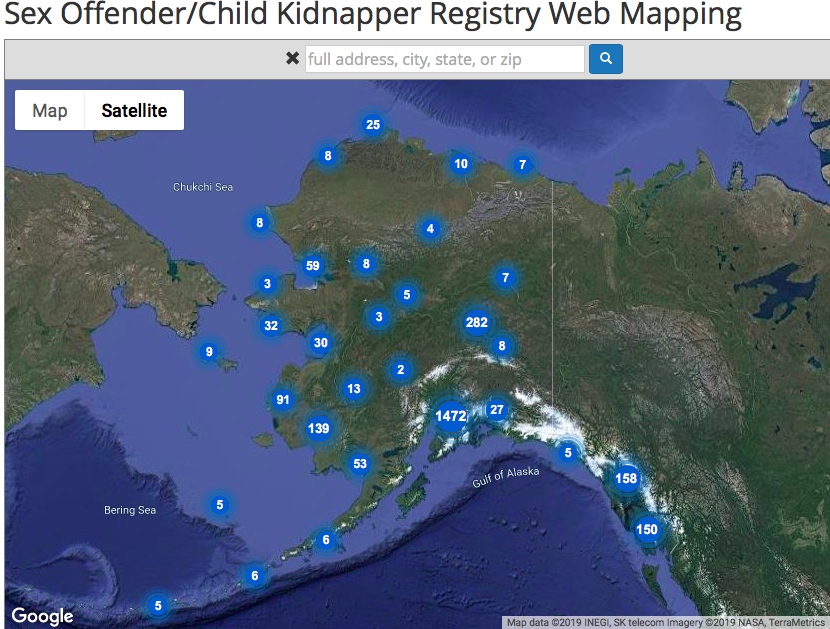
An important data point: A review of Alaska’s Sexual Offender Database shows that Alaska Native men dominate the sex offender and kidnapper registry.

CHOOSE RESPECT, LOCK ‘EM UP

Some say the solution rests with the tribes.

With 229 federally recognized tribes in Alaska — far more “tribes” than there are incorporated communities — beefing up law enforcement, allowing villages to enforce tribal laws and allot justice to non-tribal members — these are some of the solutions offered that have all kinds of problems attached to them. The largest Native community, after all, is in Anchorage, and it’s multi-tribal.

Did Attorney General Barr get the full picture while he was in Alaska? Did tribes and village leaders come clean about the problem of Native-on-Native violence, the protection of perpetrators by village leaders, or the fact that some communities are — to be blunt — not much more than rape camps?

Likely, Barr heard for the need for more money, better jails, more shelters for victims, and social services. He likely did not hear about the need for personal, family, and community responsibility for communities that want, more than anything, sovereignty. They want money to run affairs their way.

If rural Alaska wants to end the epidemic of violence, it will mean locking up or removing more of their men. This is complicated business, because these offenders can be sent to prison, can be removed from households and communities where they’ve harmed people, but at great cost, because communities without men are going to be very different communities. Boys growing up with fathers who are in prison have very different challenges.

Barr vowed to provide greater security to rural Alaska. What that means is locking up perpetrators. And what that means is arresting and prosecuting them. Are village leaders ready for that?

Do you know of a story from rural Alaska where village leaders did not allow law enforcement to arrest a perpetrator? Add it in the comment section below.

Police roundup four in drug-related killing

4

Police arrested four people Friday and Saturday that investigators say were involved in a shooting death on Oklahoma Street in Anchorage on March 31.

Wutner Buom Lul, 23, pictured above from his Facebook profile; Alaaaldin Alfons Bom, 20; Deavonnie Harford-Lee, 21, and Izaiha Moronta, 21, are facing manslaughter, robbery 1, burglary 1, assault 1, and assault 2.

Police located Lul on Friday evening in the 300 block of North Lane Street in the Mountain View neighborhood, where they arrested him. They rounded up the others on Saturday afternoon and evening. Moronta was taken into custody near Old Seward Highway and 76th Avenue; Born was found at a 400 block North Lane Street address, and Harford-Lee was in the 900 block of Richardson Vista Road at the North Pointe Apartments.

The homicide that occurred on March 31 was believed to be drug related. Police were called to the 300 block of Oklahoma Street in Muldoon to investigate shots fired. They found three people injured outside an apartment building, with one of them — Tion Price, 19, pronounced dead at the scene.

The others were taken to a nearby hospital for gunshot injuries. The victims knew the assailants, police said at the time.

What we know about the suspects:

Wutner Buom Lul attended Bartlett High School and the Alaska Military Youth Academy, and started getting into trouble with drugs by 2015, according to court records.

Alaaaldin Bom was on the lam after being arrested for armed robbery. He failed to appear in court earlier this month on that 2017 felony charge; he was out on bail while awaiting resolution of his case.

Izaiha Moronta was charged in 2017 with theft of a firearm but it was pleaded down in court to concealed firearm while under the age of 21.

Deavonnie Harford-Lee has an unremarkable court record with only minor items, such as driving without proof of insurance.


Book Review: ‘Alaska Raw’ by Bob Lacher

SO SATISFYING, THIS BOOK WILL PROMPT YOU TO GET OFF THE SOFA

It’s not often I tuck a book into my satchel before heading to the airport. I tend to work when bouncing between Anchorage and Juneau. When the jet hits 30,000 feet, my computer is out and I’m at the office.

But this extreme outdoors memoir — Alaska Raw — had me hooked from the first page, as the author, Bob Lacher, takes off like lightning in the first chapter to describe a wild and wooly caribou hunt with his father, who was then in his 70s. After reading that chapter, I took the book with me on my recent trip to Juneau and Skagway. I’ve no regrets, except a faint sense that perhaps I’m not living wildly enough. This book will make you want to get outdoors and feel the edges of this unforgiving land of Alaska.

As the writer tells it, on this particular hunt the roles between father and son were finally reversed. Once upon a time, Lacher had trailed in his father’s exact footsteps, trying to not snap a twig or crunch some dry leaves during a hunt.

Now, decades later, his father was behind him, doing the same thing, walking in his exact footsteps. Many of us can relate, even if we’ve not high-stepped through a mushy tundra in the Aleutians that “looked like a field of four foot beach balls crammed together with a thin green blanket draped loosely over them.” The roles do reverse with our parents, if we’re lucky to keep them that long.

The story of stalking caribou on Unimak Island after flying the beaches of the Aleutians “beach combing” for walrus tusks with an older dad is a can’t-stop-reading way to enter the epic life of an Alaska big game hunter.

“This guy can write,” I thought, as I allowed my commitment to the book emerge, feeling the howling wind push against the tent as the pinned-down hunting party braced their backs against the inside wall in a “brand of tent made to hold up to just about any weather that anyone would want to camp in.”

It was on Page 19 that I came to the line that let me know I’d stick around to the end of this book:

“In some ways, and for reasons unknown, this is the stress some of us live for.”

Yes, that is so, for some of us.

Lacher is describing the anxiety of not knowing if his plane, a Super Cub, tied down outside the tent, would survive the force of that wind, and how he kept unzipping the tent to check on the status of things that he’d not be able to change regardless in that crazy wind storm. And yet, he was unable to avert his attention from the peril.

It also is an apt description of every adventure that follows in this approachable set of stories, where many an escapade started at about the fourth beer around the camp stove. “That is when we get down to the base elements regarding which Cro-Magnon itch really needs scratching.”

Alaska Raw is about flying the wild country and surviving. Snow machining the back country in search of prey. Stalking wild animals in the Brooks Range. It’s about hunting big game: The bull caribous, monster grizzlies, 100-pound wolves, wolverines and Dahl sheep.

I’m not a hunter, and never have been. I went hunting hare with my dad while a teenager in Juneau, but it was not my thing and we never even saw one on that expedition. My father and brothers brought home ducks and geese from the Mendenhall wetlands, but none of us sought the blacktail deer or big game. When I shoot, it’s a hand gun at the range. Hunting is not part of my background, and yet, the stories here are wildly entertaining even to a non hunter.

Although the center plates of the book have photo after photo of Lacher and his dead trophies, it’s not a turn-off if you’ve already read with curiosity about what it actually takes to bring down some of these animals. Skill, grit, confidence, dedication, and a sturdy constitution, to begin with. You begin to understand why the pictures matter.

And then you come to the final chapter: The Wrong Side of the Edge (2010), where Lacher writes for the first time about the fatal avalanche that took the life of two of his friends, and how he watched it happen and could do nothing to stop it.

“I could now see a massive wall of hurtling snow slabs, tumbling through clouds of explosively charged white mist eating up the distance. My mind struggled to measure it in fractions of seconds and know that it was going to bury me alive. Instinctively, I jerked the snowmobile hard left, downslope, putting all my weight and muscle into the lean and rolling up into a banking, full power turn in the deep powder snow.”

Lacher tells second by second what it was like to be in the path of the avalanche with Curtis Spencer, Eric Spitzer, Jim Bowles, and Al Gage. Neither Bowles nor Gage made it out alive. Spencer was miraculously spit out of the enormous slab that barreled down a Kenai Peninsula mountain in 2010.

It was the “stress that some of us live for” moment that left a permanent scar on the author, and caused him to rethink his life and take things in a different direction. The lifelong Alaskan left the corporate world that very year, after working for most of his adult life in the oil and gas industry in Alaska.

Lacher could have done more with that final chapter, described more fully the personalities of his companions and how they came to be in that fateful position. He scratches the surface of what must be a painful story to tell, but you almost need to know the full story from news accounts to understand the context of the tragedy.

“We all ask ourselves from time to time, what acts of ours should, in the end, accumulate to some satisfactory finish that memorializes the high water mark of our time here…Maybe the mark is no mark at all but only the satisfaction of rejecting a life lived looking through a keyhole constructed by the myths and memes of our time, a keyhole that divines order out of disorder in the minds of those who cannot live without it. Maybe it’s not about any high mark but all the white space in between, savoring the moments we live that are scrubbed of all pretense and insincerity. Among such moments are our experiences in the wilderness,” Lacher writes in his “Final Word” closing chapter. Indeed.

That is the kind of book it is: It’s wild, expansive, descriptive, funny, poignant, and at times profane, and it’s worth every minute you spend with it. Reading it will make you yearn to find that “edge” in your life and hopefully live through it.

Alaska Raw is available at Todd Communications, www.alaskabooksandcalendars.com.  And at Amazon.