Wednesday, December 24, 2025
Home Blog Page 1490

Why I’m no fan of power sharing agreement

7

By GEORGE RAUSCHER
REPRESENTATIVE, DISTRICT 9

For the past two weeks, I was asked to be a substitute member on a bipartisan committee that was created to explore the concept of power sharing. Late this week, I decided to withdraw.

Let me first say that I have great respect for the other House members who have worked long hours on this project to try to find a way forward. We all worked in good faith and did everything we could to move forward with this concept, but after many hours now spent, I can confidently say that I do not believe all the hurdles can be addressed. Since there is a Republican majority in both houses, the concept of power sharing, while noble on its face, seems to be a way to elevate the power of one caucus and diminish the power of the other caucus to a level playing field.

STALEMATE HAS LED TO DEEP DISCUSSIONS

As you know, there has been a stalemate in the State House over which caucus will have control. While Alaskans voted overwhelmingly for a Republican majority, three of our Republican representatives left our caucus.

Because of this reality, the Republicans have been unable to organize a needed majority of 21 and have entered into many discussions and negotiations to resolve the deadlock. Searching all possibilities, the thought of a unified effort was being considered.

The start of this process was to launch a bipartisan exploratory committee to hammer out a “power sharing agreement” proposal, under which leadership roles could be split between the caucuses. I stayed a part of that committee, curious as to where this was all headed.

One of the biggest obstacles to a sharing agreement, however, was that we would have to find a way to satisfy the requirements of Alaska’s Constitution, the Alaska statutes and the Uniform Rules.

This is much easier said than done.

It may be easy to look at other states that have had limited success in the concept of power sharing and think that success might be easily transferred, but each one of those states has its own constitution, statutes and internal rules that are all substantially different from Alaska’s.

Let’s take the Uniform Rules, for example — the rulebook that exists to govern the internal rules of both the House and the Senate.

In order to change the Uniform Rules to even allow for shared leadership in the House, the Republican-led Senate would have to agree to allow the House to change or suspend the Uniform Rules, which could seriously damage the integrity of the built-in safeguards that those rules provide. Because Senate bills would have to be sent over to the House side and to be put through the power sharing process, I do not believe the Senate would put their bills at a disadvantage within the confines of a power sharing agreement.

But even if we were to ignore this foundational issue, the remainder of the proposed power sharing agreement still has significant flaws. One of the cornerstones of this proposed agreement is that important decisions, such as who gets the third seat on a joint committee hearing a budget bill, could be determined by a coin toss. This is an illustration of broader issues.

A major tenet of the proposal states that, for a bill to be scheduled for a hearing in committee, both co-chairs of a committee (one Democrat and one Republican) must both agree to allow a bill to be heard or the bill would not be considered. This could stifle all bills from moving forward.

A concept called “silver bullets” was added to allow Senate and House bills to be heard in committees, regardless of any potential co-chair disagreement. But because the proposal also calls for even numbers of members from each caucus on each committee, bills would still be more likely to tie and stall out in committee than to get a majority of votes and move forward to the next stage.

The concept of “gold bullets” was added to allow important bills to be pulled out of the second committee of referral or the Finance Committee and go straight to the floor. But this doesn’t work either, because bills go to House Finance to be vetted for their expected cost to the state. We cannot afford to skip this process.

The plan also calls for leadership to be somewhat multiplied. It calls for a speaker and a speaker pro tempore, two Rules chairs and two whips, and in the House Finance Committee, two co-chairs of the capital budget and two for the operating budget, plus two vice chairs. At this point, utilizing committee aides becomes tricky, office space becomes a logistical challenge and it would be tough for staffing to come in under budget also.

It took Oregon six weeks to organize after agreeing to a power sharing agreement. I believe there is just too much to mitigate in the time frame we need to accomplish this structure.

There’s nothing wrong with wanting to make sure every Alaskan is represented in government, but we’re at a point with this proposal where we’d essentially have to create a double government to govern those doing the governing.

I even wonder if this would lead to calls for two administrations (one for each side of the aisle). Co-governors and co-lieutenant governors, doubling the bureaucracy we already have in Alaska so we can grant power to both sides simultaneously?

On Nov. 6, Alaskans elected 23 Republicans, 16 Democrats, and one independent into the State House. While they could have done exactly the opposite, the people of Alaska chose a Republican governor and a Republican majority of seats in both the Senate and House. The people spoke clearly, and we would be wise to listen to them.

At this juncture, two dozen days into session without organization, I propose we continue using the model that our framers laid out: a majority-led representative government.

Rep. George Rauscher, R-Sutton, represents House District 9 in the Alaska House of Representatives. 

Police are searching for John Vang, suspected arsonist

2

Thanks to an alert and responsive public, detectives identified one of the suspects in the investigation of Yakitori Sushi arson, which was set on Feb. 4 at the restaurant’s Tudor Road address.

An arrest warrant has been issued for John Vang (36-years-old).

Vang is the second suspect seen fleeing the business in the surveillance video released by police.

[Video: Arsonists caught on camera]

Vang is believed to have burn injuries to his lower body, but is not the suspect who caught his glove on fire. That suspect still has not been identified.

“The public’s response to helping the Anchorage Police Department and the Anchorage Fire Department has been very helpful. Those involved in these crimes should know that the public is actively assisting us with tips and evidence.  The ability for detectives to identify John Vang is a great example of spotting something or someone suspicious (in person or smartphone/surveillance video) and calling the police,” police said in a statement.

If you have any information about the suspects and/or this investigation, including video (smartphone/and or surveillance) and the suspect’s whereabouts, please call Dispatch at 311 or Crime Stoppers at 907-561-STOP to remain anonymous.

Knopp refuses to show up to vote for Speaker

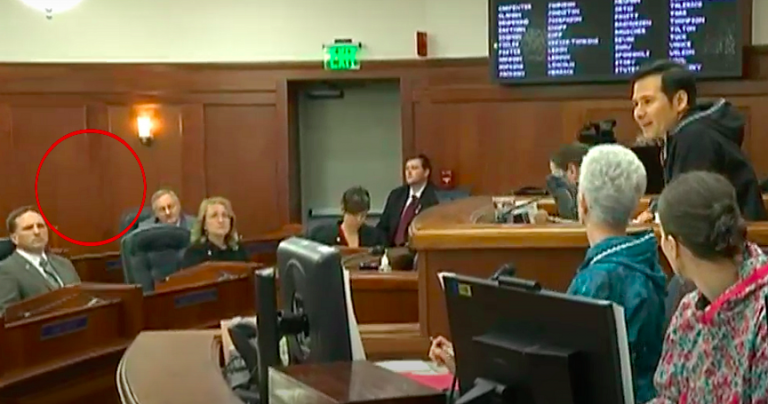
An unexcused and unexplained absence by Rep. Gary Knopp of Kenai has left the Alaska House of Representatives in disarray and without a Speaker for the 25th day.

Rep. Gary Knopp

During this morning’s session, Republicans had 20 votes in favor of Rep. Dave Talerico, and Democrats had 17 votes opposed. Two Democrats had excused absences — Zack Fields and Tiffany Zulkosky. Two Republicans — Rep. Gabrielle LeDoux and Rep. Louise Stutes, vote with the Democrats on everything.

Knopp was the 21st vote that would have ended the stalemate

But although Knopp attended the Ocean Beauty legislative reception on Thursday night, although he caucused with the Democrats early Friday, and attended the first half of the House session, he did not show up after a recess, during which he and Democrats huddled.

Speaker Pro Tem Neal Foster gaveled in at 10 am and the usual introductions were made by the members.

Knopp was in the House Chambers for this earlier portion of session, but when it came time to vote after a short recess, he simply didn’t return.

All legislators knew that there would be a vote for Speaker during Friday’s session. Democrats appeared relaxed, knowing that Republican Knopp was not going to show up for work.

People in the Capitol said Knopp claimed to be sick, but there was no public explanation and he had not asked for an excused absence.

This is Day 25 for the session, and the House is still without a Speaker, which means no business can be accomplished. Twice before, Knopp has voted against Rep. Talerico, of Healy, for Speaker.

Thursday’s floor session had been cancelled when no progress was made on the 21 votes needed to elect a Speaker. At this point, it appears that trust between Democrats and Republicans is at a low point.

[Read: House reaches new normal: Suspending the rules]

Crisis averted? How API became broken

11

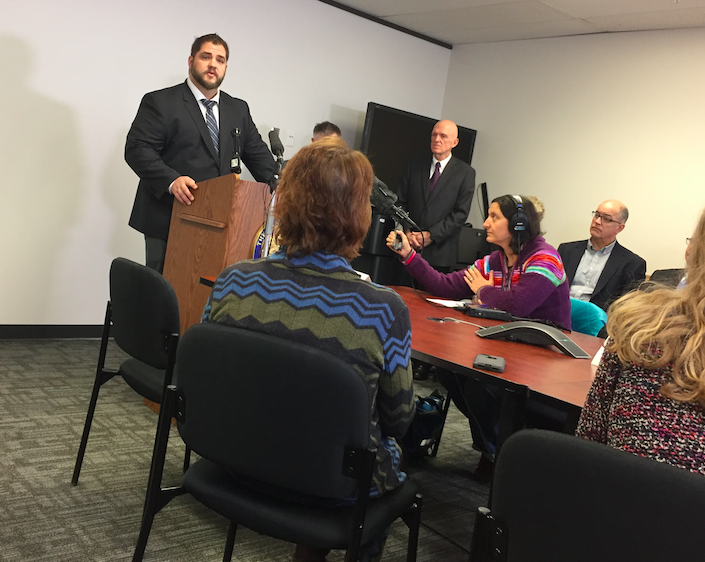
Commissioner Adam Crum speaks to the media on Friday.

(6-minute read) PSYCHIATRIC HOSPITAL WAS ON THE BRINK OF A NERVOUS BREAKDOWN

The state’s psychiatric hospital was broken and close to being decertified by federal agencies.

That emergency prompted the Department of Health and Social Services Commissioner Adam Crum to act with speed, take over control of API, and then contract with a private company to manage the hospital, in the hopes of salvaging what has become known as one of the worst psychiatric hospitals in the country. He made the announcement today at a press conference in the Atwood Building in downtown Anchorage.

Wellpath Recovery Solutions is a company that specializes in running state institutions like API. Crum and other health stakeholders hope the company can help retain the institution’s certification.

Four years of neglect by the Walker Administration, including a commissioner of the Department of Health and Social Services who disappeared to her hometown of Bethel for months at a time, left the institution in shambles. It was worse than unsafe. It was dangerous.

The announcement of a professional management team is some of the only positive news to come out of API in the past few years. In fact, good news almost never comes out of psychiatric institutions anywhere in the country. Sometimes the best news is that they have retained their accreditation. They are the places where the most violent, most mentally ill, and most despairing citizens are housed, medicated, cleaned up and, sometimes, restrained.

In recent years, patients have become increasingly violent, abusing and attacking staff and other patients. Alaska’s mentally ill population has exploded, and because of the configuration of the institution, only 45 of the 80 beds can be filled.

Today’s announcement had the support of the Alaska Mental Health Trust, the Alaska Behavioral Health Association, North Star Behavioral Health, Alaska Regional Hospital, Fairbanks Memorial Hospital and brought positive comments from legislators such as Sen. David Wilson, Senate President Cathy Giessel, Rep. Ivy Spohholz, and Rep. Matt Claman, all who expressed optimism.

Sens. Bill Wielechowski and Tom Begich took another approach, and slammed the move toward professional outside management of API; Wielechowski made a hair-on-fire Senate floor speech and Begich took to social media to criticize.

12-MONTHS OF RAPID DECLINE

Over the past year, work conditions at API had deteriorated. The institution was starting to get surprise visits from inspectors. It was taking in increasingly violent patients. Cameras were watching employees, documenting their every move, and handling a patient by using the “wrong” protocol was a point of stress for staff and management. The stress on API nurses and aides had become unbearable.

Last fall, a report by Anchorage attorney Bill Evans showed that the hospital was unsafe for the employees, as disputes raged over whether staff could use restraints on violent patients. Staff shortages were chronic and the staff were fearful for their lives and their jobs.

[Read Bill Evans’ independent report here]

In September, then-DHSS Commissioner Valerie Davidson came back from Bethel and promised things would change.

“No employee should feel unsafe when they go to work, and clearly the report indicates we do have an unsafe work environment,” Davidson said. Heads started to roll, from the top down.

API Chief Executive Ron Hale was soon replaced by Duane Mayes, who was director of DHSS’s Division of Senior and Disabilities.

Also let go were a deputy health commissioner and the director of the State Division of Behavioral Health.

But things didn’t get better. They got worse.
Davidson had been “phoning it in” from Bethel for much of her tenure as commissioner, an absentee overseer of her department at best.
By October, the Walker Administration was done, unable to be re-elected. Lt. Gov. Byron Mallott was shown the door for his misdeeds, and Walker elevated Davidson to lieutenant governor. She gave speeches on behalf of his campaign. But his race for re-election was spiraling out of control, and there was no effective leadership at DHSS, which by now was itself falling apart.
The Walker-Mallott-Davidson Administration had through neglect brought the institution from being a serious concern to being a full-blown crisis.

[Read: API staff fearful to even call a code]

Gov. Michael Dunleavy and newly appointed Commissioner Adam Crum were left to pick up the pieces.

The new governor quickly accepted the resignations of the hospital’s chief of psychiatry and another psychiatrist. Dr. Anthony Blanford and Dr. John Bellville quickly enlisted the ACLU and are now suing to get their jobs back.

In December, federal officials were at API for an inspection. That report and the one that followed weeks later were devastating.

Duane Mayes, who was named the new CEO under Walker, left in December, taking another job within the state. He was never cut out to run a psychiatric institution.

[Read: The qualification, certification, and oversight reports here.]

Last Monday, yet another inspection was scheduled.

NURSE PLEADS FOR HELP

One nurse, who asked to remain anonymous, sent the following letter to Must Read Alaska, last week, and copied it to  the State Ombudsman and members of the Board of Nursing:

“We are in crisis here at API. Tonight we walked into yet another slew of policies, paperwork, hourly reports and notifications, and documentation all without training or guidance. These requirements are removing our focus from our patients and our concentration on our med pass and patient safety. We need immediate intervention and representation here from each of you. We need you to speak with people on the floor and away from administration ASAP please. We are effectively no longer nurses but investigators and reporters, and in fear of discipline and retaliation.

“Administration failed to follow up on an actual sexual assault between patients and instead of them being accountable they are putting it on staff to hourly report things as small as psychotic statements made by patients, this is consuming our time and energy, focus, and ambition as nurses, and endangering patients. I will forward the policies.

“You will not have nurses to staff API if this madness continues. There is so much more to tell but tonight is breaking the camel’s back.  People are contacting the press. Administration is not taking into account what it is like to work on the floor, not involving floor staff in decisions, and isolating all but one unit from input. There are instances of bullying, retaliation, unprofessional, and unethical behavior by the interim Director of Nursing.  Statements have been prepared and more are being prepared. Morale and safety are at an all time low  Fear of reprisal requires I remain anonymous, but there are many more voices you need to hear.”

Several other messages followed, describing the deteriorating situation.

Today may have been the day that API turned the corner.

Will private management improve the safety of patients and staff at API?

From information being sent to Must Read Alaska from inside the walls of the facility, things can only get better in an institution that has hit rock bottom.

Breaking: Commissioner takes over Alaska Psychiatric Institute

9

INVOKES HIS AUTHORITY UNDER STATE LAW

Alaska Department of Health and Social Services Commissioner Adam Crum has invoked his authority under state law to immediately assume management of Alaska Psychiatric Institute.

In a news release this morning, the commissioner said the decision was made in response to the “considerable problems that continue to put patients and staff in jeopardy at API and in light of recent and ongoing investigations from the Centers for Medicare and Medicaid Services (CMS) and other state and federal regulatory agencies.”

Commissioner Crum has contracted with Wellpath Recovery Solutions, a nationally recognized health care company with a proven record of success, to provide administrative leadership of the facility with continued oversight from the state.

“During the course of recent investigations at API, we determined immediate steps were needed to protect patients and staff and ensure complete compliance with federal regulations, which also allows the facility to continue to receive federal funds,” said Crum.

He recognized that serious efforts have been made towards addressing the deficiencies identified by federal and state authorities, but progress is not being made quickly enough.

“While additional security measures have recently been implemented at API to better ensure patient and staff safety, contracting with Wellpath was deemed necessary to further address safety and patient rights issues and bring the facility rapidly into complete compliance with federal and state standards,” he said.

Alaska state law (AS 47.32.140) allows for the commissioner to assume either temporary or permanent management of a licensed health care entity when there is reasonable cause to believe there is a danger to the health, safety or welfare of individuals receiving care from that entity.

Wellpath will provide administrative oversight with the intent of correcting problems of patient and staff safety and patient rights, bringing the hospital into rapid compliance with its regulatory bodies, improving the therapeutic environment, and preparing the hospital to return to its full capacity by June 30, 2019.

During the initial phase of the contract, Wellpath will bring in a team of experts to fill key leadership positions at API to support the successful completion of their mission. All API staff will remain in their positions as State of Alaska employees. Gavin Carmichael will continue as API’s acting chief executive officer. If Wellpath is successful in the first phase, the company will assume full responsibility of API after July 1, 2019.

“I recognize this decision may take Alaskans by surprise, but it was not made lightly. Changes have been needed at API for a very long time,” said Commissioner Crum. “This decision will help us solve these long-standing problems at API, and then allow us to more effectively broaden our focus to address the entire continuum of behavioral health care across Alaska.”

Wellpath, which merged with Correct Care Solutions and Correctional Medical Group Companies, has had success bringing facilities similar to API back into compliance with CMS and Joint Commission standards. In Massachusetts, Wellpath substantially improved conditions at the Bridgewater State Hospital after assuming operations in 2017. All hospitals managed by Wellpath are fully accredited by the Joint Commission.

A press conference will take place this morning with Crum, representatives from the Alaska Mental Health Trust, the Alaska Behavioral Health Association, North Star Behavioral Health, Alaska Regional Hospital and Fairbanks Memorial Hospital.

“By taking this step with the support of the health care community, the State of Alaska and our health care partners can begin to seriously address API’s longstanding problems and Alaska’s behavioral health crisis,” Crum said.

This is a developing story. Check back for more details.

Out? French accused of slacking off and browbeating

(2-minute read) BEING REMOVED FROM OIL AND GAS COMMISSION FOR CAUSE

A letter written by Gov. Michael Dunleavy to AOGCC Commissioner Hollis French shows that French has been identified as  being ripe for dismissal from the governing body “for cause.”

That cause is chronic absenteeism and a bad attitude.

The letter gives French a right to defend himself in a publicly heard session, represented by counsel. That counsel has been identified as attorney Kevin Fitzgerald, a reputable defense attorney who represented Mechele Linehan in the notorious murder of Kent Leppink in Hope in 1996.

The charges against French include:

Chronic absenteeism. He is absent from the office without submitting a leave slip and without consulting his fellow commissioners. In his two years as a commissioner, he has received a yearly salary of $145,000 and has only been at work 3.5 to 4 hours per day, despite the 37.5-hour work week that is the agency’s official policy.

Browbeating fellow commissioners. French is accused of not being able to set aside his disagreements with his fellow AOGCC commissioners and has disrupted the commission. While dissent and disagreement are appreciated, Dunleavy wrote, his fellow commissioners are being browbeaten to the extent that they are being undermined.

Publicly undermining the work of AOGCC. French has been publicly promoting views contrary to the commission’s stated position, putting his personal views above those of the agency and damaging the agency’s credibility.

Security breaches. French is accused of disclosing confidential information to the press regarding a test well.

Failure to perform. French has, according to Dunleavy, expressed disinterest in his job and is using his work time to pursue non-work-related interests.

French was to respond to the charges by Jan. 18, and the personnel hearing was to take place on Feb. 6, and end no later than Friday, Feb. 8.

Tim Petumenos is the hearing officer for the case. He was once hired as independent counsel to the Alaska Personnel Board in the dismissal case known as Troopergate,  the July 2008 dismissal of the Alaskan Public Safety Commissioner Walt Monegan by Gov. Sarah Palin.

Must Read Alaska earlier this week attempted to locate the hearing, but was unsuccessful.

Public broadcasting station KTOO had one of the first known copies of the letter, which is now in circulation in political circles. The station got the letter as part of a routine public records request of the governor’s correspondence.

[Read: Where in the world is Hollis French?]


Where in the world is Hollis French?

3

POLITICAL FIGURE HAS BEEN A NO-SHOW

Hollis French, the chairman of the Alaska Oil and Gas Conservation Commission, is missing in action — from the role, at least. Both the Jan. 2 and the Feb. 6 meeting of the commission were cancelled.

Gov. Bill Walker appointed French to the Commission in 2016 and made him the chairman. It was a political appointment, because French had originally run for lieutenant governor along with Byron Mallott. Under pressure from Democrats, he dropped out so that Mallott could be Walker’s running mate under a “unity” ticket that was endorsed fully by the Alaska Democratic Party.

French acquiesced to the party’s wishes, and applied for a judgeship. But he had not practiced law in a courtroom for five years, so that went nowhere. Then Walker found a spot for him as the public commission member on the AOGCC.

But the past two meetings of the commission have been cancelled without explanation.

And when AOGCC was to make a presentation to the Alaska Senate Finance Committee on Jan. 24, the duty fell to the  other two commissioners, Cathy Foerster and Dan Seamount. French was nowhere to be found at the Juneau hearing.

This week a call to the commissions offices by Must Read Alaska discovered that all three of the commissioners, who run the day-to-day operations at the commission, were busy in a private meeting all week, the location of which was not disclosed by the phone answerer.

The word in Juneau is that he has been dismissed by the governor, “for cause.” Cause is the only way the governor can remove French from the commission.

The AOGCC is the state’s regulatory agency established under the Alaska Oil and Gas Conservation Act. It oversees oil and gas drilling, development and production, reservoir depletion, and metering operations on all lands subject to the state’s police powers.

Its mission is to protect the public interest in exploration and development of Alaska’s valuable oil, gas, and geothermal resources through the application of conservation practices designed to ensure greater ultimate recovery and the protection of health, safety, fresh ground waters and the rights of all owners to recover their share of the resource.

The quasi-judicial agency’s commissioners earn $140,000 per year.

French is a former state senator who served from 2003 to 2015, representing downtown Anchorage. He ran for governor unsuccessfully in 2009, losing in the primary to Ethan Berkowitz.

[Read: Hollis French gets confirmed, but with drama.]

Document circulates: Knopp was a Democrat for decades … until he ran for office

(2-minute read) HE’S THE 21ST VOTE NEEDED FOR A REPUBLICAN CAUCUS IN THE HOUSE

Rep. Gary Knopp, the self-appointed negotiator between the Alaska House as Republicans and Democrats try to determine a power structure, has a leg in both camps.

He was a registered Democrat when he came to Alaska in 1984, and didn’t register to be a Republican until 2010, the same time he got involved in running for office in a strong Republican district.

Documents acquired from the Division of Elections show that he registered on April 20, 1984 as a Democrat, and remained one for 24 years, until March of 2010. This document is making its way across the Kenai Peninsula and appeared in the emails of legislators as early as yesterday:

Knopp began his switch-hitting political career on the Kenai Peninsula Borough, elected first in 2006. He rose to become borough Assembly president, and at that time changed his registration to Republican.

Knopp ran as a Republican for the House of Representatives in 2014 against fellow Republican Kurt Olson, but lost.

When Olson retired, Knopp won the seat in 2016, and again in 2018. He ran unopposed last year because in this strongly Republican district, his conservative voters knew him as a Republican incumbent, and the Democrats didn’t want to waste their money in the General Election — they had other fights to join around the state.

The record shows Knopp didn’t start voting until 2014, but the report from the Elections Division only goes back five years. Other sources show Knopp voted as early as 2010, 26 years after he had moved to Alaska.

Knopp was initially a member of the Republican majority when it formed the day after the November General Election, with Dave Talerico as Speaker.

But the caucus dropped to 20, splitting evenly with the Democrats, when Knopp surprised his Republican colleagues by divorcing himself from the caucus.

Since then, as the 21st vote needed to own the majority, he has instead worked to form a bipartisan working group that would have him in some kind of leadership role under Bryce Edgmon as speaker.

He has alternately worked to create a 50-50 power-sharing agreement between the Democrats at one end of the hall, and Republicans at the other end. As of this writing, no majority has been formed, even though there are 23 elected Republicans.

REPUBLICAN REGISTRATION: PARTY OF CONVENIENCE?

Another political switch hitter is Rep. Gabrielle LeDoux, the representative for Muldoon and JBER who has been elected as a Republican but organized with the Democrats in 2016 in order to help them enact an income tax.

But 19 years ago, LeDoux ran for State House as a Democrat in Kodiak in 2000, losing in the general election to Republican Gary Stevens. She changed her party registration in 2004, ran again, and then moved to District 15, where the turnout is low and her odds of winning were better.

Louise Stutes of Kodiak is the third Republican who caucuses with the Democrats.

On Tuesday evening, the House was still split, 20-20, and Knopp has now voted twice against Republican Dave Talerico as Speaker. LeDoux and Stutes did the same.

[Read: Eastman pulls a surprise, but Knopp votes against Talerico as Speaker]

Tom Boutin named new head of AIDEA

1

The Alaska Industrial Development and Export Authority agency has a new chief executive director: Tom Boutin of Juneau.

Boutin spent more than 17 years in state government, but also had a career spanning 30 years in the private sector, much of it in timber and aviation. He was deputy commissioner of the Department of Revenue, and was the State Forester for Alaska from 1993 through 1997.

Tom Boutin

In the 1980s, he was the manager of Alaska’s public debt, issuing securities and working to preserve Alaska’s bond rating.

For 14 years, Boutin represented a manufacturer of firefighting aircraft throughout the United States and was a lobbyist in Juneau, representing several companies. He was the chief financial officer and president of a timber firm in Southeast Alaska.

Boutin has an MBA in finance from the University of Oregon, and a forestry resources undergraduate degree from the University of New Hampshire.

AIDEA was created by Alaska Legislature in 1967 to provide affordable financing for Alaskan businesses to expand the economy of the state and provide jobs for Alaska. Since its formation, it has paid over $392 million in dividends to the State’s General Fund from the millions of dollars in loans, and revenue bonds it has issued to advance industrial infrastructure and enterprise.

Boutin served on the AIDEA board for 13 years. He also once worked as a tree faller for Gildersleeve Logging and for Owens Drilling at Whale Pass, on Prince of Wales Island, where Gov. Michael Dunleavy first worked in Alaska.

Boutin was appointed by the Board of Directors to the position during a meeting this afternoon.

He replaces John Springsteen, who will be the Chief Operating Officer at AIDEA assigned to the Department of Commerce to bring AIDEA’s financing expertise to Gov. Dunleavy’s newly created economic development team.